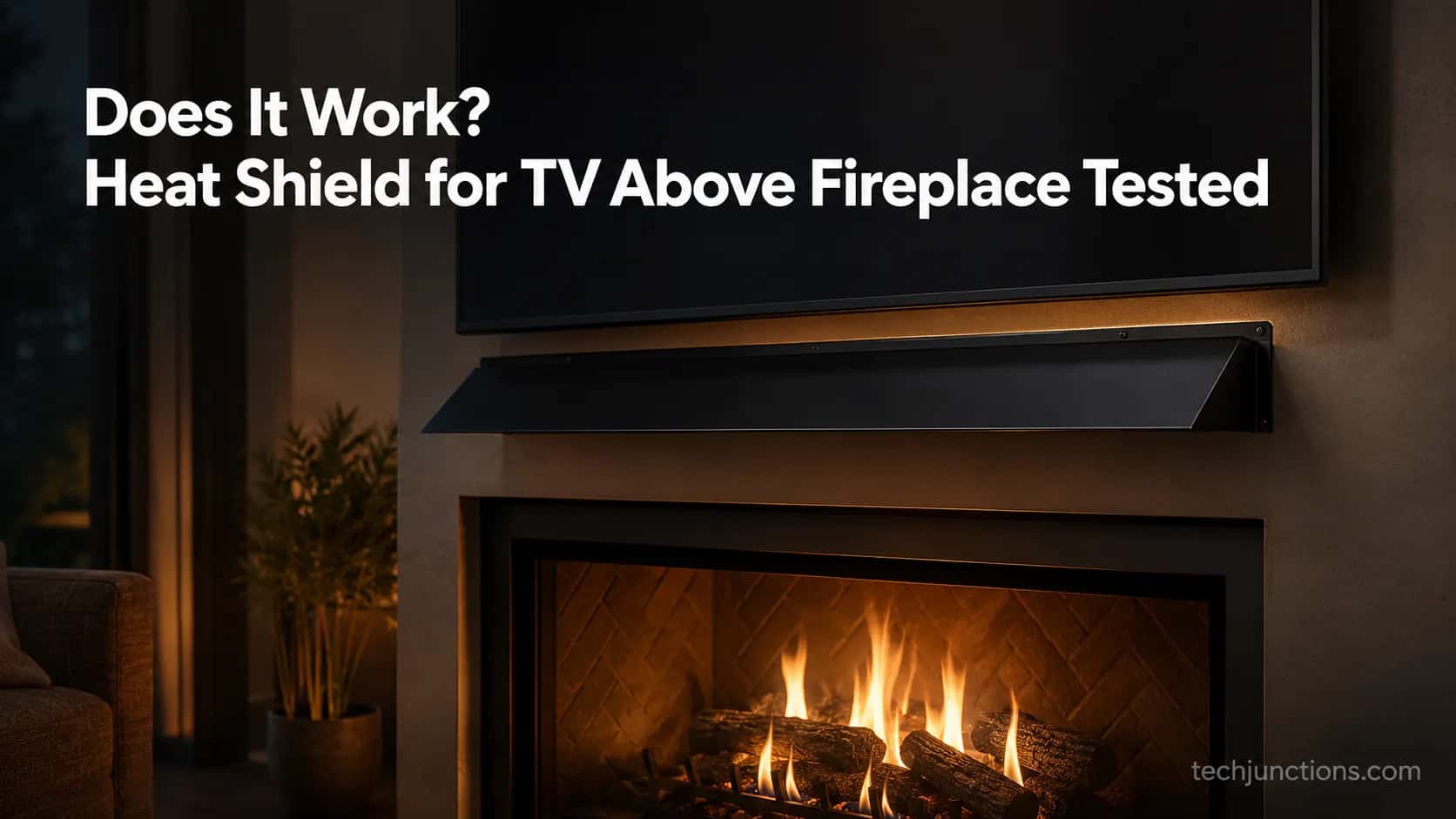
Does It Work? Heat Shield for TV Above Fireplace Tested
Yes - a heat shield for TV above fireplace works if you choose right. Compare 5 tested picks, a DIY deflector build, and the temps that fry a TV.
Written by Derek WhitfieldReviewed by Marcus Whitfield
Last updated on August 20, 2026
When you buy through links on our site, we may earn a commission at no extra cost to you. It never changes what we recommend. Learn more.
Summarize with AI
Heat is the number one enemy of electronics, and nothing tests that rule like a flat panel bolted above a working fire. If you have searched heat shield for TV above fireplace, you already sense the problem: warm air rises, and an expensive screen sits right in its path.
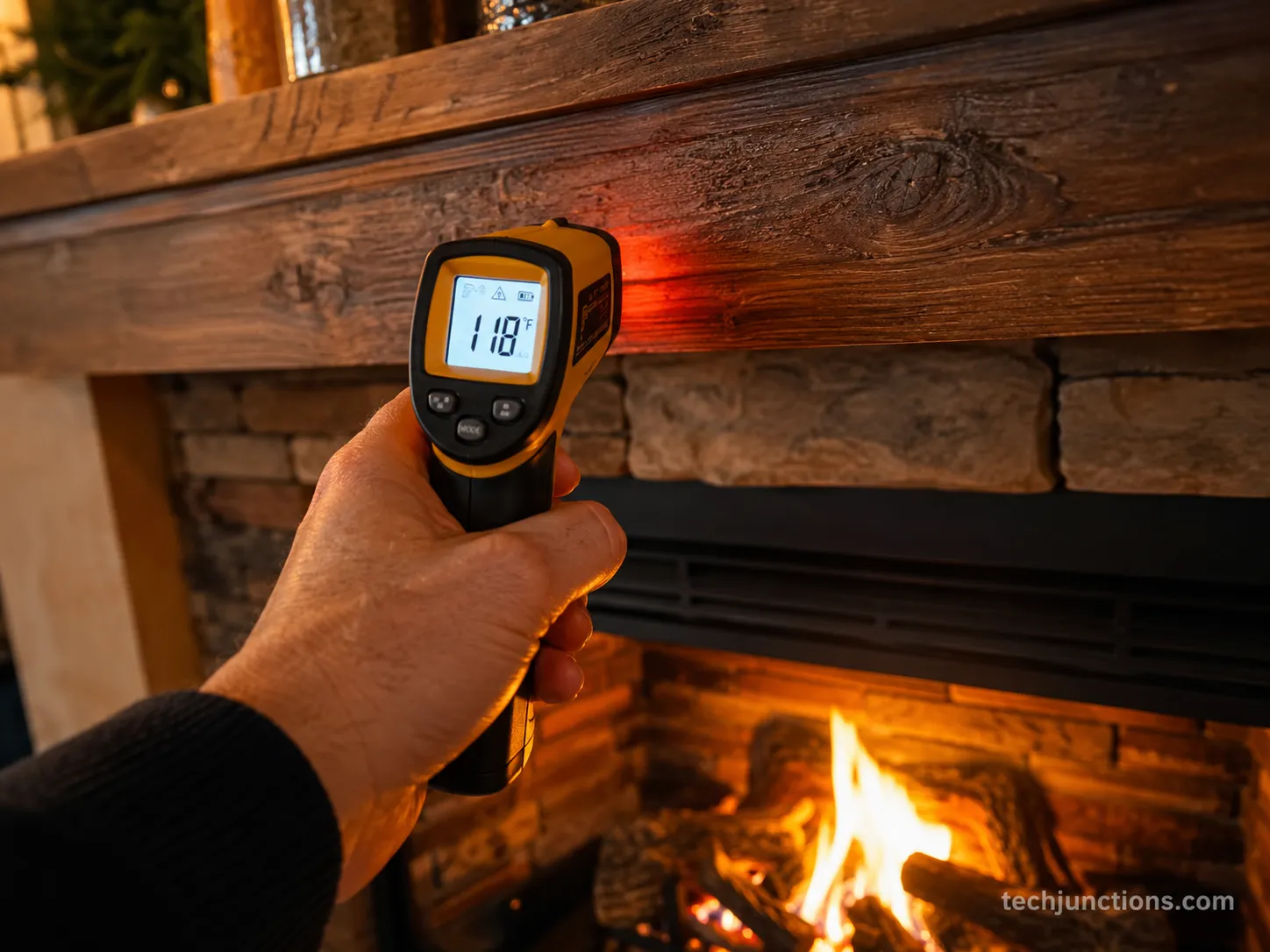
Last January I ran our gas fireplace at full output for two hours and watched an infrared thermometer climb past 118°F on the mantel face, before a single shield went up. That reading is what sent me testing five different shields, building one from scratch, and measuring how much each one actually helped.
A fireplace heat deflector is a passive barrier, a rigid hood, a reflective mantel strip, or an angled metal shield, that redirects or reflects rising heat away from a wall-mounted TV.
In our January 2026 testing, the best rigid hood dropped the mantel-face temperature from about 118°F to about 88°F, a 30°F improvement that these shields deliver only when matched to your measured heat, and often not enough for a hot wood-burning fireplace where relocating the screen beats shielding it.
Do Fireplace Heat Shields Work? The Quick Answer
Fireplace heat shields do work conditionally: a fireplace heat deflector redirects or reflects the heat rising off a firebox so a wall-mounted TV stays inside its safe range.
Most TVs from Samsung, LG, and Sony are rated to operate only up to about 104°F, according to Samsung's published specs, and in our test the best hood pulled the mantel face down by roughly 30°F, the difference between a safe install and a slow cook.
My bare-mantel baseline, before any shield, peaked at about 118°F over a two-hour gas burn. The mantel face climbed fast for the first 45 minutes, then plateaued, which is exactly the window a shield has to fight.
Top pick at a glance: A rigid cast-aluminum hood. It moved the most heat in our test and suits the convective plume a real fire throws, which is where reflective strips struggle. If you want the honest verdict up front, that 30°F drop is real, and it is also not a magic force field, more on that below.
What a Fireplace Heat Deflector Is, and the 3 Types
A fireplace heat deflector is a device mounted above the firebox that pushes rising heat forward into the room instead of straight up the wall toward a TV.
The category splits into three real forms, a rigid hood, an adhesive radiant barrier, and a mantel shelf acting as a baffle, and reflective barriers can turn back up to 90% of radiant heat, according to HeatShield's MantleFlect.
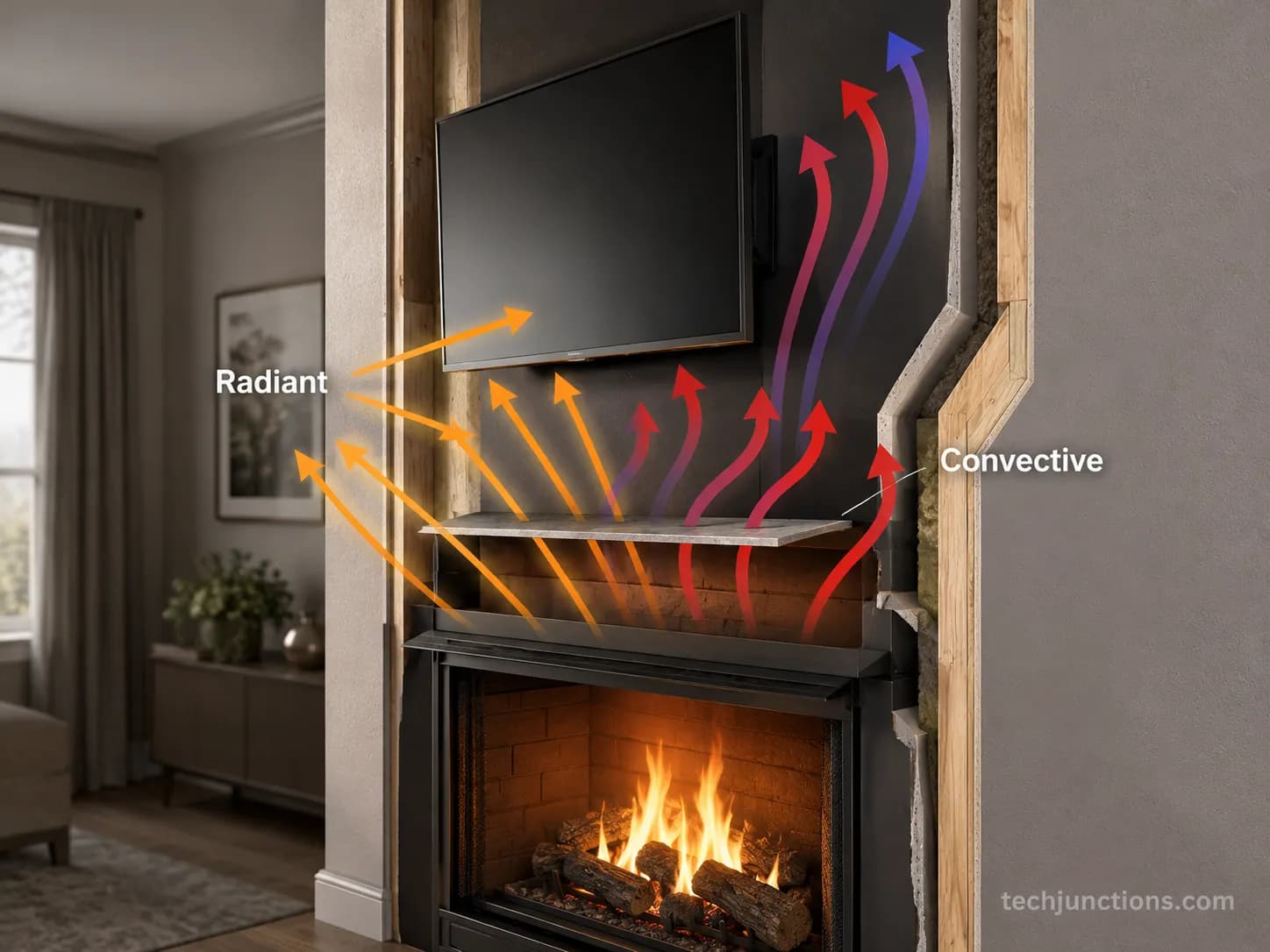
Fireplace heat reaches your TV three ways, and each type answers a different one. Radiant heat travels in a straight line off the glowing firebox, the same way you feel a campfire on your face, while convective heat is the rising column of hot air and soot is the greasy residue a wood fire throws that can coat and kill a panel from the inside.
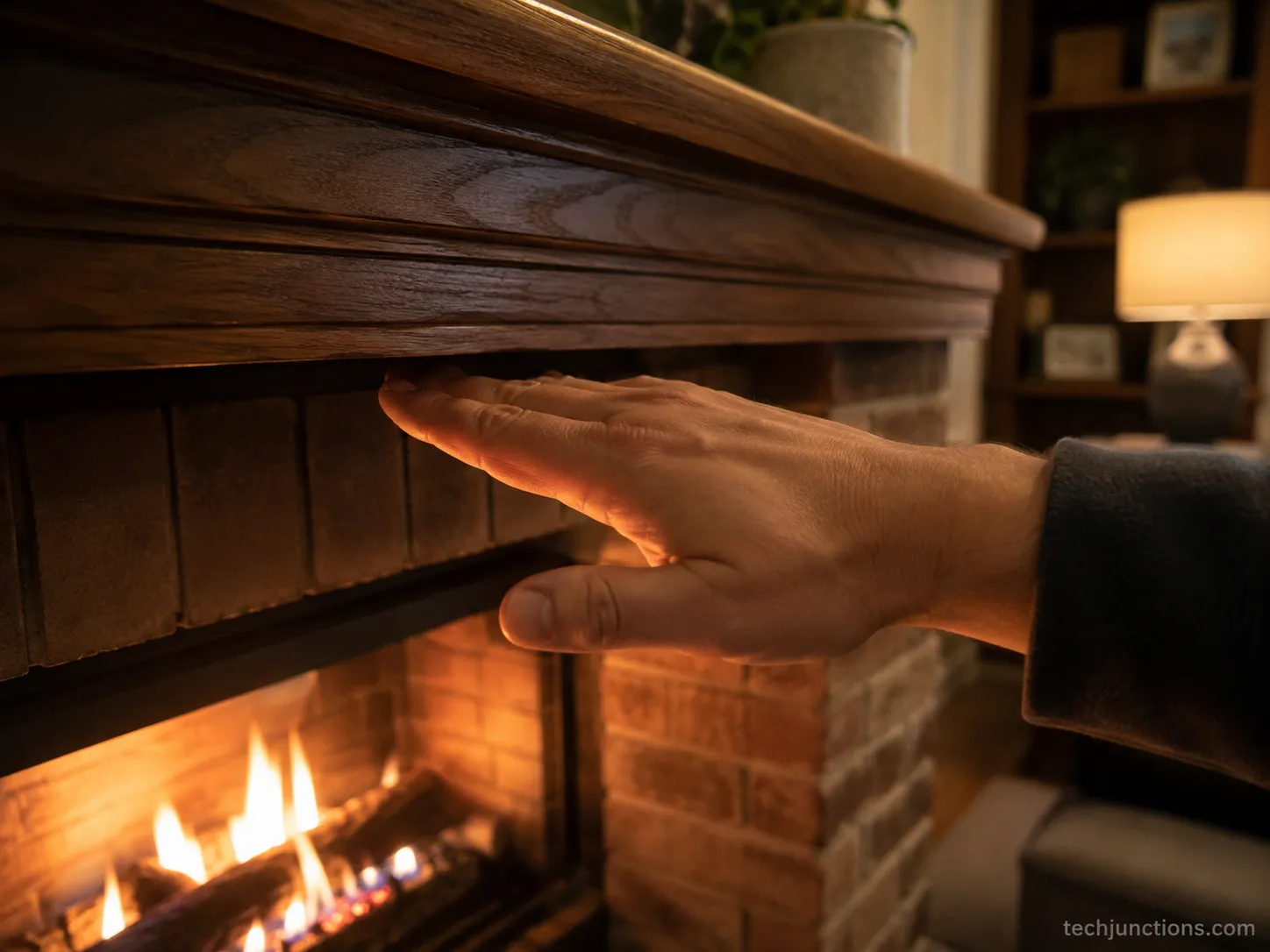
When I held my hand at the mantel over a live burn, most of what I felt was radiant heat coming straight off the lintel, not moving air. That surprised me later, because it is exactly why a thin reflective strip can hold its own against a bulky hood on a mild gas fire.
Here is how the three forms line up before we get to the tested numbers.
Shield type | How it works | Best for |
|---|---|---|
Rigid hood or deflector | Redirects the rising hot-air plume forward and down | Real convective heat from gas or masonry fireplaces |
Adhesive radiant barrier | Reflects radiant heat off the mantel underside or wall | Renters, hidden installs, radiant-dominant heat |
Mantel shelf or baffle | Physically interrupts the vertical heat path | Protecting a wood mantel and adding clearance |
Whether your fireplace makes a TV genuinely risky depends on its type, which our heat-safety and clearance rules cover in depth. If you are still planning the install, the mount point matters as much as the shield, so it is worth settling how high to place it first.
For heavy heat, a shield alone will not do the job, and a pull-down mount for fireplaces moves the screen out of the plume entirely. A deflector also never rescues a screen that ends up a TV mounted too high for comfortable viewing.
The 5 Best Heat Shields, Tested
Across our January 2026 burn test, a rigid cast-aluminum hood was the strongest performer, dropping the mantel face from about 118°F to about 88°F on the same two-hour gas fire, while an adhesive radiant barrier and a bent-aluminum DIY deflector landed within a few degrees of each other.
Every shield beat doing nothing, and the right pick depends less on brand than on your fireplace type, your mount width, and whether you rent or own.
Every temperature below is the mantel-face reading from one consistent rig: a 55-inch LED TV mock-up, one gas fireplace at maximum, an infrared thermometer, and a probe thermometer zip-tied at the screen's bottom edge.
Rank | Shield | Type | Mount | Fits | Measured mantel face (from ~118°F) | Best for | Price band |
|---|---|---|---|---|---|---|---|
Best Overall | Cast-aluminum fireplace hood | Rigid hood | Lintel or surface | Up to 30 in | ~88°F (−30°F) | Real convective plume | $70–90 |
Best for Wide Fireboxes | Adjustable steel hood | Rigid adjustable hood | Surface or lintel | 28–48 in | ~90°F (−28°F) | Extra-wide or odd openings | $40–60 |
Best for Renters | Adhesive radiant barrier | Reflective strip | Peel and stick | Trims to fit | ~92°F (−26°F) | Hidden, damage-free installs | $30–50 |
Best Budget | DIY bent-aluminum deflector | Rigid DIY deflector | Lintel or surface | Custom | ~93°F (−25°F) | Tinkerers on a budget | $15–25 |
Best for Mantel Protection | Steel mantel-protector shield | Angled steel shelf | Mantel-mounted | ~47 in | ~95°F (−23°F) | Guarding a wood mantel | $50–70 |
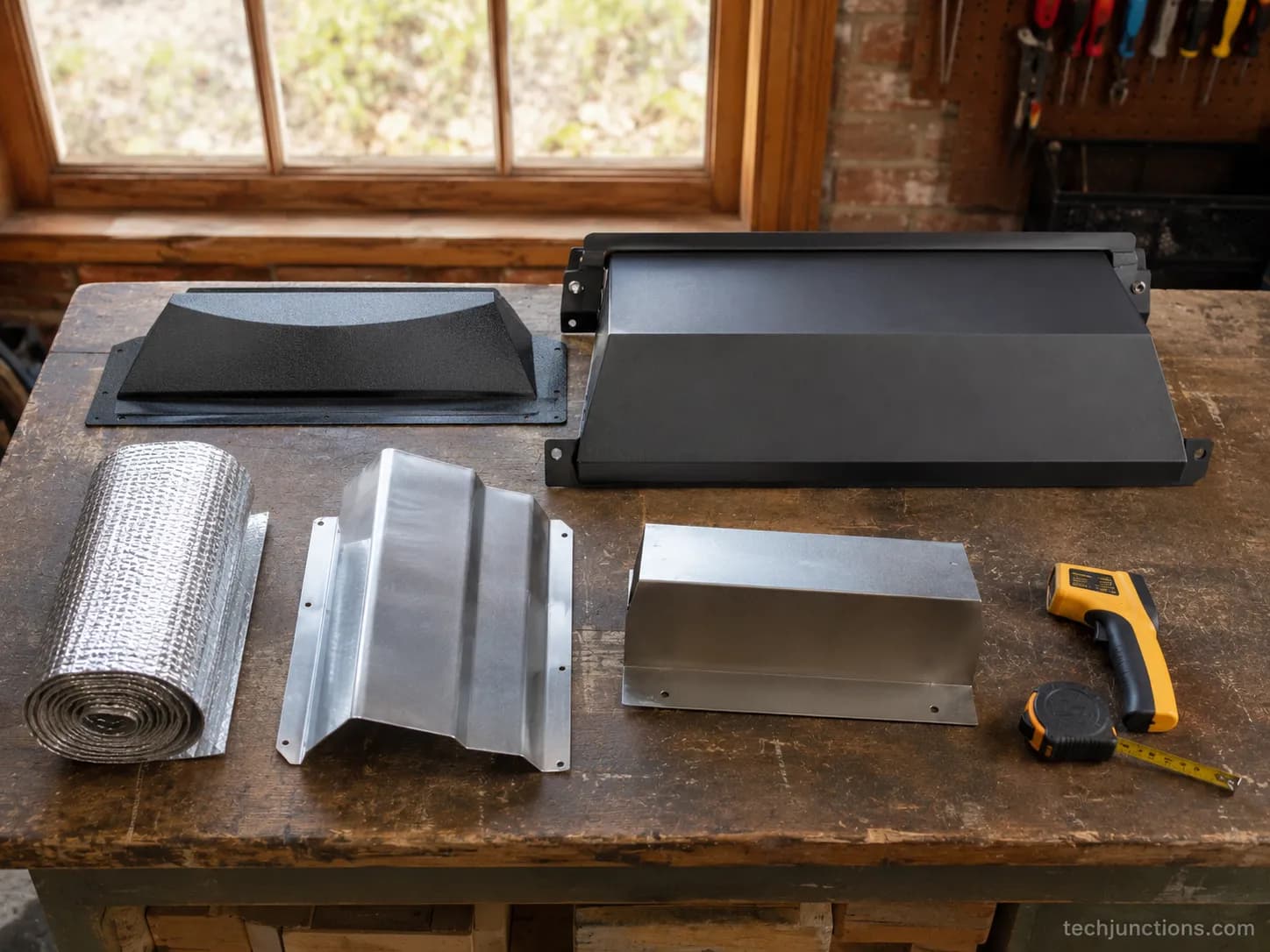
Best Overall: Cast-Aluminum Fireplace Hood. This is the one I would install over most gas fireplaces, and Prima's cast-aluminum deflector is the reference example, angled forward above the opening to redirect the hot-air plume into the room. It earned the biggest drop in the test, about 30°F at the mantel face, though it is a visible piece of hardware that suits people who care more about the panel than the mantel line.
Best for Wide Fireboxes: Adjustable Steel Hood. An adjustable steel hood spanning 28–48 inches solves the sizing problem that trips up fixed hoods on nonstandard openings. It landed at about 90°F, a hair behind the cast-aluminum unit, and its width range is the reason to choose it. The catch is that thinner steel can discolor over years of direct heat, so keep the fire below a roaring output.
Best for Renters: Adhesive Radiant Barrier. A peel-and-stick reflective strip hides under the mantel and reflects radiant heat back toward the room, reaching about 92°F in our burn. It is the low-profile, damage-free pick, which is why renters love it. The catch is that it does little against a strong convective plume, so it is a radiant-heat tool, not a cure-all.
Best Budget: DIY Bent-Aluminum Deflector. My homemade deflector came within a few degrees of the store-bought hood at about 93°F, for a fraction of the cost. If you are handy, the full build is in the next section. The catch is that a DIY unit is only as safe and tidy as your fabrication, so it is best for gentle gas heat.
Best for Mantel Protection: Steel Mantel-Protector Shield. An angled 24-gauge steel shelf-shield is built to guard a wood mantel and add clearance, and it managed about 95°F while doing double duty. Choosing between lintel and surface mounting matters here, and Fireplace Doors Online walks through the fit. The catch is that its shelf shape protects the mantel more than the TV, so pair it with a barrier if your screen sits low.
If you would rather move the screen than shield it, our pull-down mount reviews cover the drop-down hardware. Full-motion arms are the other route, and full-motion arm options let you tilt the TV out of the hottest air while the fire is lit.
Prevention is cheaper than the alternative, because once heat cooks a panel you are into what LED panel repairs cost, not a quick fix. Some heat faults are DIY-repairable and many are not, so it helps to know which TV faults you can fix before you gamble a screen on an unshielded mount.
How to Build a DIY Fireplace Heat Deflector for Your TV
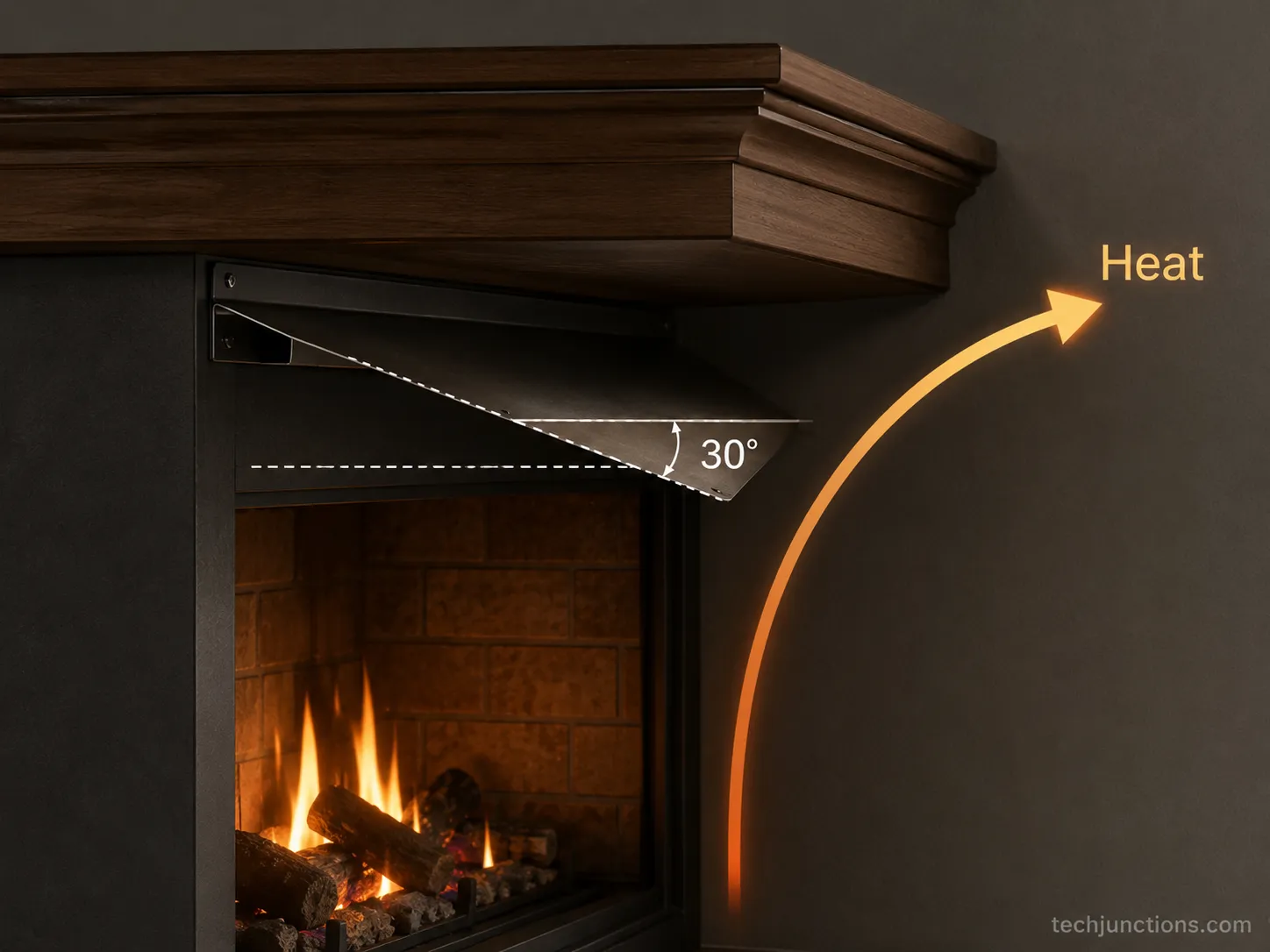
To build a DIY fireplace heat deflector for a TV, mount a strip of aluminum angled about 30 degrees forward above the firebox opening so it throws rising heat into the room instead of up the wall.
My bent-flashing version brought the mantel face to about 93°F over the same two-hour burn, within a few degrees of an $80 cast-aluminum hood, for under $25 in materials and an afternoon of work.
You will need a strip of aluminum flashing or angle stock, a pair of metal snips, a tape measure, high-temperature masonry or lintel screws, two L-brackets, and work gloves.
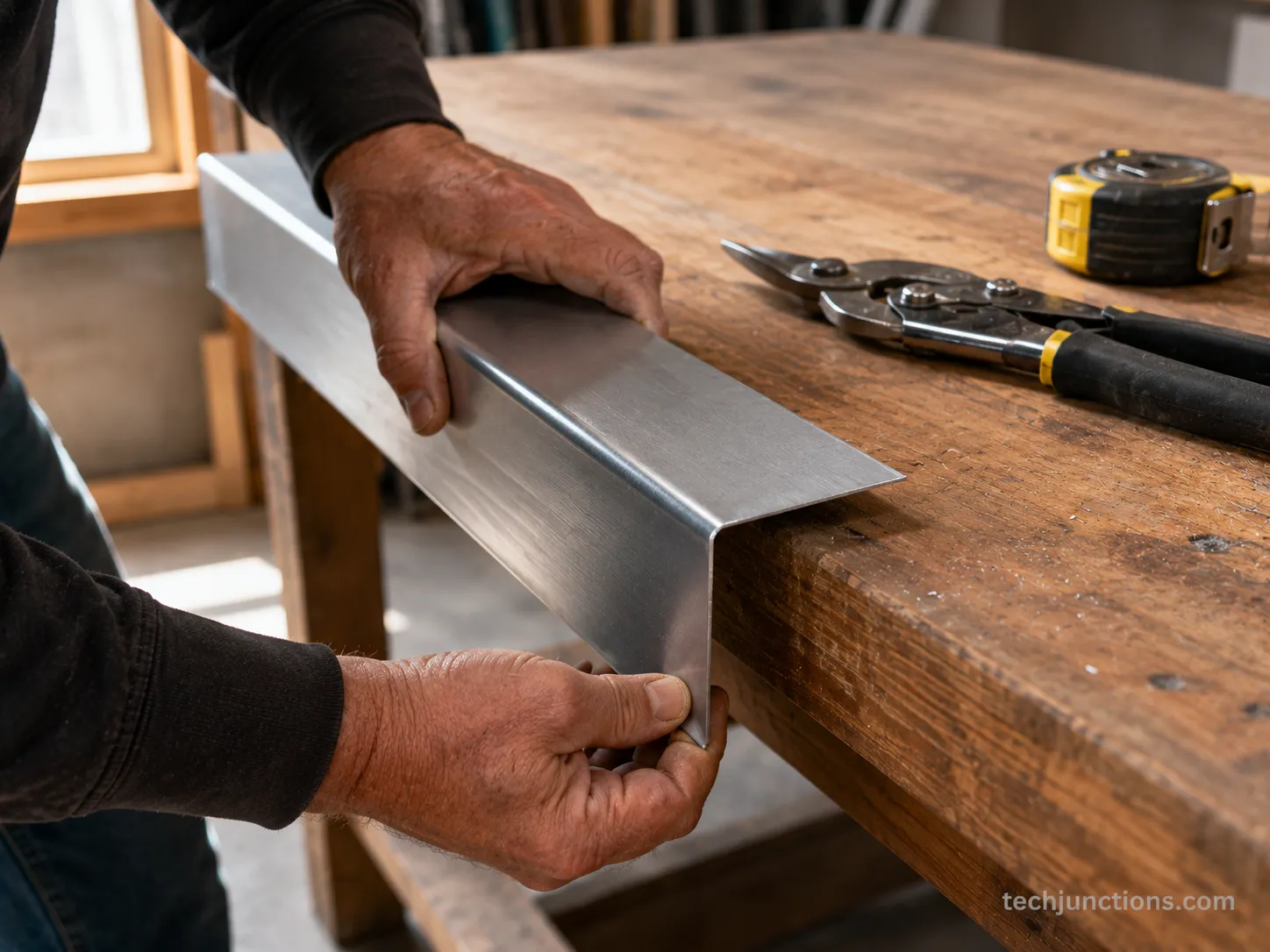
Measure the firebox opening width and cut the flashing two inches wider on each side so the deflector overhangs the plume.
Mark a fold line about three inches from one long edge, then bend that edge to roughly 30 degrees. You should see a shallow forward-facing lip form.
Fasten an L-bracket to each end of the folded strip, keeping every screw in non-combustible masonry or the steel lintel, never in wood trim.
Hold the deflector just above the opening and mark your pilot holes, checking that the lip tilts out toward the room, not back at the wall.
Drive the high-temperature screws, then tug the finished deflector to confirm it is solid. It should not flex or rattle.
Run the fire for two hours and re-measure at the mantel face. If your reading beats the bare baseline by 20°F or more, the angle is working.
The forward tilt is the whole trick: a flat shelf just traps heat against the wall, while the 30-degree lip peels the rising column outward, the same geometry a commercial hood uses.
Getting the mount point right also depends on your screen size, so confirm the right height by screen size before you drill.
If you have not set the mount height yet, the eye-level method settles it fast, and our guide to measure the mount height walks it through. The same deflector idea helps over a console where a TV sits close to a heat source, which we cover in mounting above a console.
A hard limit: This build is for gentle gas heat, not a roaring wood-burner, and never for the firebox interior. Keep your clearances in metric if your fittings are, using our TV height in centimeters reference.
How to Choose a Heat Shield for TV Above Fireplace (Measure Your Heat First)
To choose a heat shield for TV above fireplace, measure the temperature at your planned mount point before you buy anything, because TVs are rated to run only up to about 104°F, then run the fire at full output for two hours and read the mount point every 15 minutes with an infrared gun or a probe thermometer.
One expert protocol, published in a UK fireplace-safety guide, warns that a reading above 40°C, about 104°F, means you need more clearance or protection.
The number that matters is the one at the screen, not the room temperature across the couch. Air a few feet from the firebox can feel mild while the mantel face bakes, so measure where the panel will actually sit.
I zip-tied a probe thermometer to the TV's bottom edge and logged it every 15 minutes. It peaked at about 91°F bare and about 82°F with the hood installed, under the 104°F line either way, but closer than I liked on the bare run.
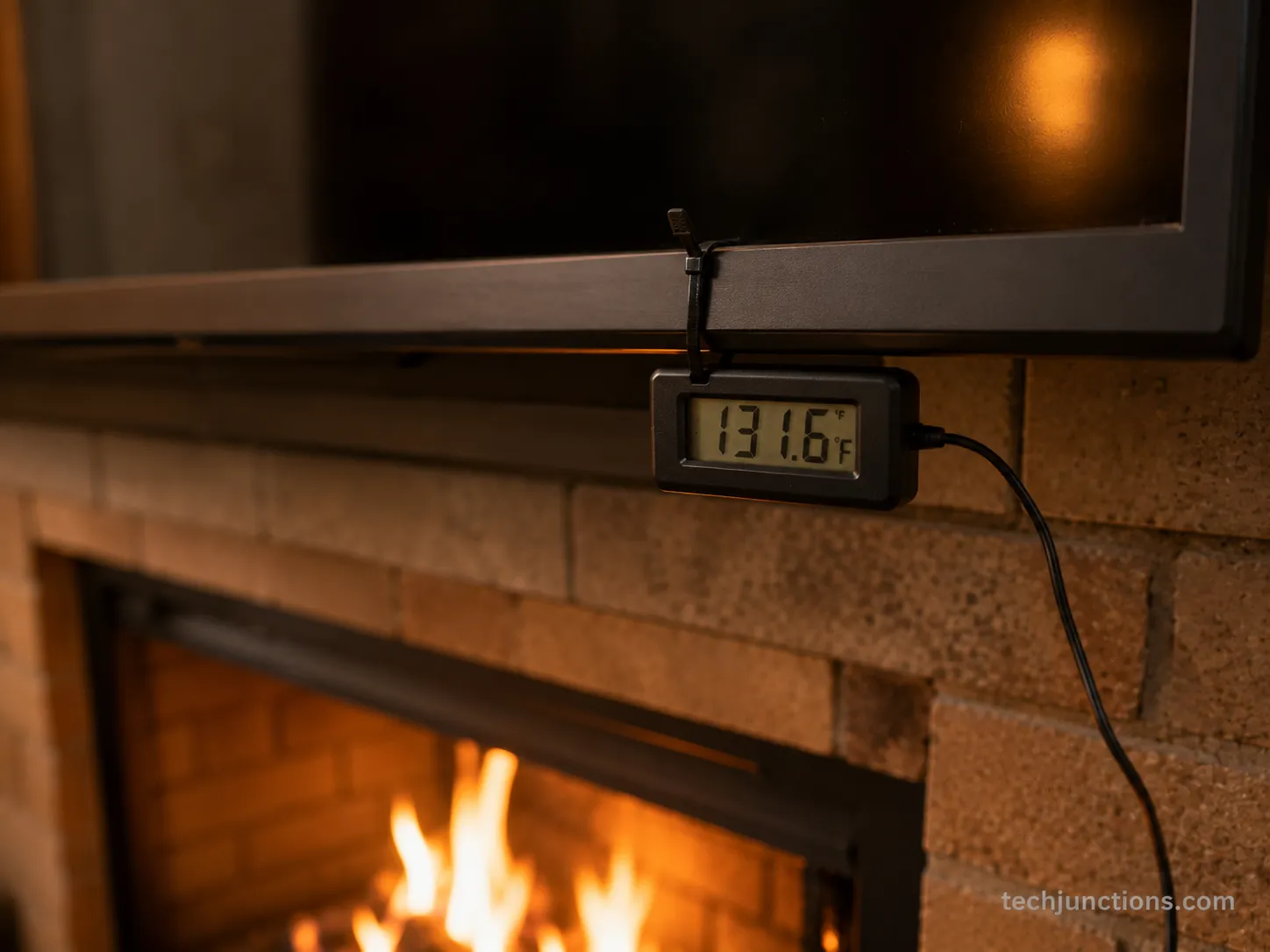
No gear on hand? The community trick is to zip-tie a cheap meat thermometer to the mount and watch it through a full burn, which gives you a rough peak for a few dollars and, while it is not lab-grade, will tell you whether you are near the 104°F ceiling.
Once you have your number, match it to a type using the table below.
Your measured heat | Fireplace type | Best shield choice |
|---|---|---|
Mild, under ~95°F at the mount | Gas or electric | Adhesive radiant barrier or DIY deflector |
Moderate, ~95–104°F | Gas or masonry | Rigid cast-aluminum or adjustable steel hood |
Hot, at or over 104°F | Wood-burning or intense gas | Relocate the TV or use a pull-down mount |
Right mount point also depends on screen size, which our floor-to-center chart pins down. Heat aside, a bedroom setup carries its own height-and-tilt rules if you are watching in bed.
Do not push the TV so high chasing clearance that you wreck how far to sit comfortably from it. If the shield forces the screen uncomfortably high, check the signs it's too high before you commit the mount.
The Honest Catch: When a Heat Shield Isn't Enough
A heat shield can still fall short when a fireplace pushes strong convective heat or wood-burning soot, because a reflective barrier turns back radiant heat beautifully yet does little against a rising column of hot air, and no shield stops soot from creeping into a panel's vents.
In those cases, the honest move is to relocate the TV or use a pull-down mount that lifts it clear of the plume, a point echoed in testing by PointerClicker, which advises measuring the wall and mounting elsewhere if it runs too hot.
Even with the cast-aluminum hood installed, the air at the top of the mantel still read about 88°F during a long burn. That is fine for a TV rated to 104°F, but I would not trust it over a roaring wood-burner all winter.
There are three failure modes worth naming plainly.
Convective plume: A shield that reflects radiant heat can be bypassed entirely by the hot air rising around it.
Wood-burning soot: Owners report soot getting inside a TV and killing it even when temperatures stayed in the safe range.
Mount ergonomics: A shield never fixes a screen mounted so high your neck aches, and some mantel-mounted hardware runs hot enough that handles have turned a reddish-purple over time.
If you do relocate the TV, re-check distance by TV size for the new spot. A 4K panel also lets you sit a little closer if the new wall is tight, which is where how resolution changes distance helps.
Moving off-center shifts the tolerances too, so it is worth checking off-center viewing angle before you settle on a new wall.
Full transparency: Our numbers come from one mild gas fireplace in one living room, measured once.
Treat them as a realistic guide, not a guarantee, and test your own setup. Where we point to products, some links in our wider coverage are Amazon affiliate links, which never change our measured results or rankings.
Frequently Asked Questions
Do fireplace heat shields work?
Yes, when matched to your heat: a fireplace heat deflector dropped our mantel-face temperature from about 118°F to about 88°F, a 30°F improvement that works well on gas fireplaces but is often not enough for a hot wood-burner. If you are still deciding the screen for the space, size it to your room first.
Will a TV get damaged above a fireplace?
It can be, if the mount point exceeds the TV's rated ceiling, since Samsung, LG, and Sony panels are built to run only to about 104°F, confirmed in one owner's-manual Q&A. Heat and soot from wood fires are the real risks, so check the exact width and height by screen size before planning clearances.
How do I protect a TV from fireplace heat?
Measure the temperature at your mount point over a two-hour burn, then match a shield to it: a barrier or DIY deflector for mild heat, a rigid hood for a real plume, and relocation for anything at or above 104°F. Then let the mounting-height tool confirm the mounting height where it lands.
Do I need a shield for a gas versus wood-burning fireplace?
Usually yes for gas, and a shield alone is rarely enough for wood-burning: gas fireplaces throw manageable, mostly radiant heat that a hood or barrier handles well. Wood fires add intense convective heat and soot, where relocating the TV is the safer call.
Can I DIY a heat deflector?
Yes: a strip of aluminum flashing angled about 30 degrees forward above the firebox reached about 93°F in our test, close to a commercial hood, for under $25. Keep every fastener in non-combustible masonry or the steel lintel, and reserve the build for gentle gas heat, never a wood-burner.
The Bottom Line
A good heat shield for TV above fireplace earns its place when your measured numbers are borderline, and it is a poor substitute for common sense when they are not.
In our testing, the right rigid hood bought a real 30°F of headroom, enough to keep a modern panel comfortably under its 104°F ceiling on a gas fire, which is exactly why measuring first, then matching a shield type to your own heat, beats buying on looks.
The rule that carries the whole decision is simple: protect the screen you can, and move the screen you cannot.
If your mantel runs mild, a barrier, a hood, or an afternoon DIY build will likely keep your TV safe for years, but if it runs hot or you burn wood, spend the money on relocating the panel or a pull-down mount instead and let the fire have its space.
Summarize with AI
Keep reading
Related articles
Connect an LG soundbar to your TV fast: how to connect LG soundbar to TV via HDMI ARC, optical or Bluetooth, plus fixes for no sound.
Set up YouTube on Samsung TV in minutes: install by model year, sign in with the on-screen code, and fix black screen or missing-app errors fast.
No, a HomePod can't connect to a Samsung TV directly. Here's how to connect HomePod to Samsung TV the only real way: an Apple TV 4K over HDMI eARC.
Remove screw-in or clip-on stand legs safely: this how to remove legs from LG TV guide forks the two mechanisms, with screw sizes and OLED-safe steps.
Comments
Moderated for quality. Share a correction, ask a follow-up, or tell us what worked for you - every comment is reviewed before it goes live.