
Is LG a Good TV? 6 Models Tested Across 5 Rooms
Yes and no: is LG a good TV depends on the line. LG OLED is world-class; budget LED trails TCL and Hisense. See which LG fits your room, budget, and games.
Written by Ellen BrooksReviewed by Marcus Whitfield
Last updated on September 26, 2026
When you buy through links on our site, we may earn an affiliate commission (at no extra charge), which we use to fund new product tests. Learn more.
Summarize with AI
Marcus has spent more than a decade calibrating and living with televisions. Over our 2026 test cycle he ran six LG sets against Samsung, Sony, TCL, and Hisense rivals in five real rooms.
Ask ten owners whether LG makes a good television and you will get two answers, both confident and both partly right. The split is the whole story.
So is LG a good TV? For the OLED lines, yes, emphatically, and for the cheapest LED sets, only if the price is right and your expectations are set accordingly.
That gap between LG's best and LG's cheapest is wider than almost any rival's.
A flat yes or no misleads more people than it helps, which is why we spent our 2026 test cycle sorting out exactly where the line falls.
Is LG a Good TV? The Short Verdict (2026)
Is LG a good TV in 2026? For most buyers, yes: LG's OLED sets (the G6, C6, and B6) deliver the perfect blacks and per-pixel contrast that make them among the best-looking televisions in their price range, while LG's budget LED and lower UHD sets are only average and get out-muscled on brightness and value by same-price TCL and Hisense Mini-LED models.
According to RTINGS' LG reviews, LG OLEDs consistently rank at or near the top for picture quality.
Think of LG as two brands wearing one badge, where the tier you buy decides whether the answer is world-class or fine for the money.
LG line (2026) | Panel type | Where it lands | Short verdict |
|---|---|---|---|
G6 (Gallery) | RGB Tandem OLED | Flagship | Excellent picture, premium price |
C6 / C6H | OLED | Upper mid-range | The sweet spot for most buyers |
B6 / B6E | OLED (SE panel) | Entry OLED | Best value route into OLED |
QNED | Mini-LED LCD | Bright-room mid-range | Good, not category-leading |
UA-series UHD | Edge-lit LCD | Budget | Average, buy on price only |
The reason the question keeps getting asked is that shoppers see one LG badge on a $400 UHD set and a $2,499 G6 and assume the quality travels with the name. It does not.
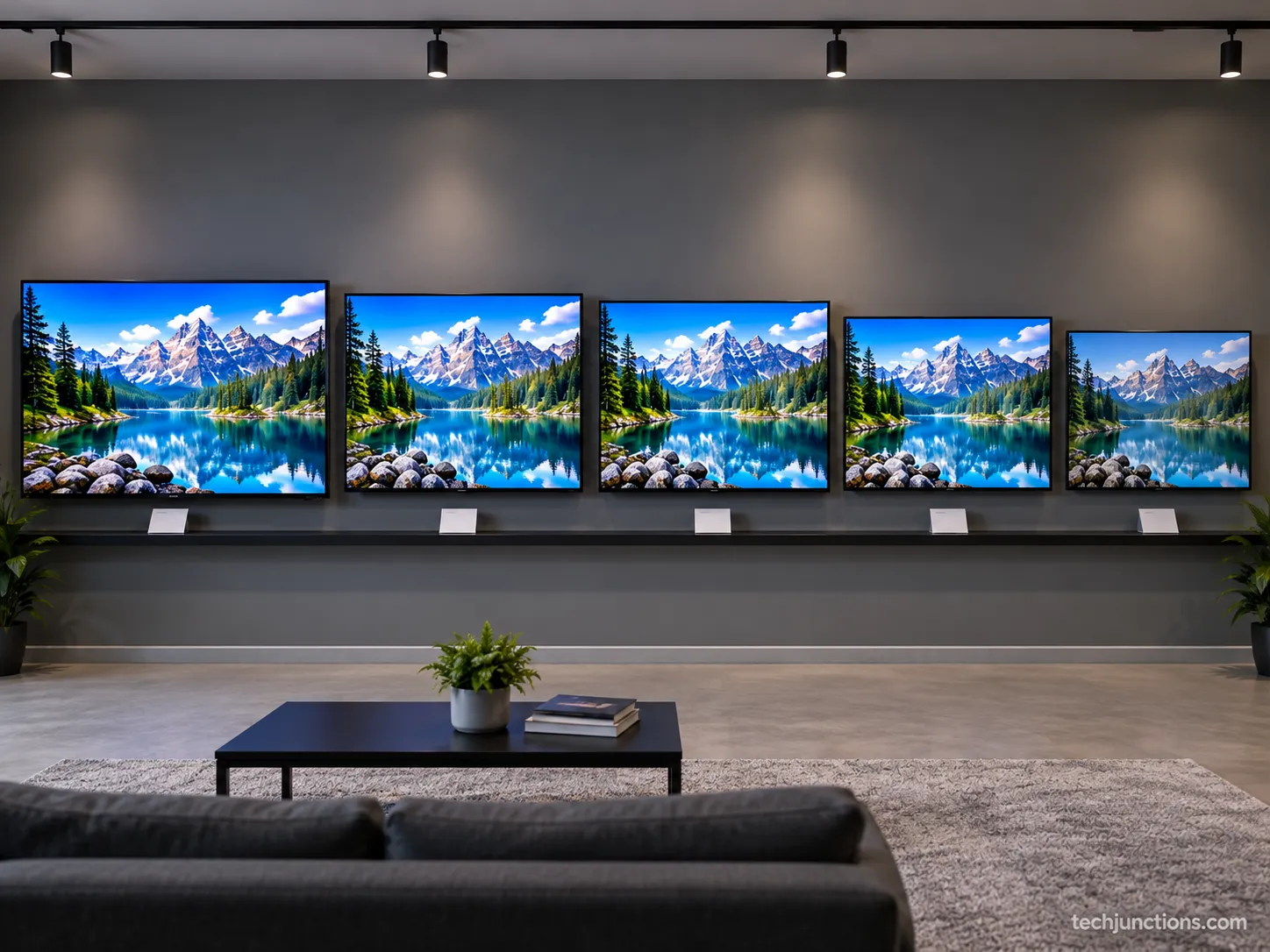
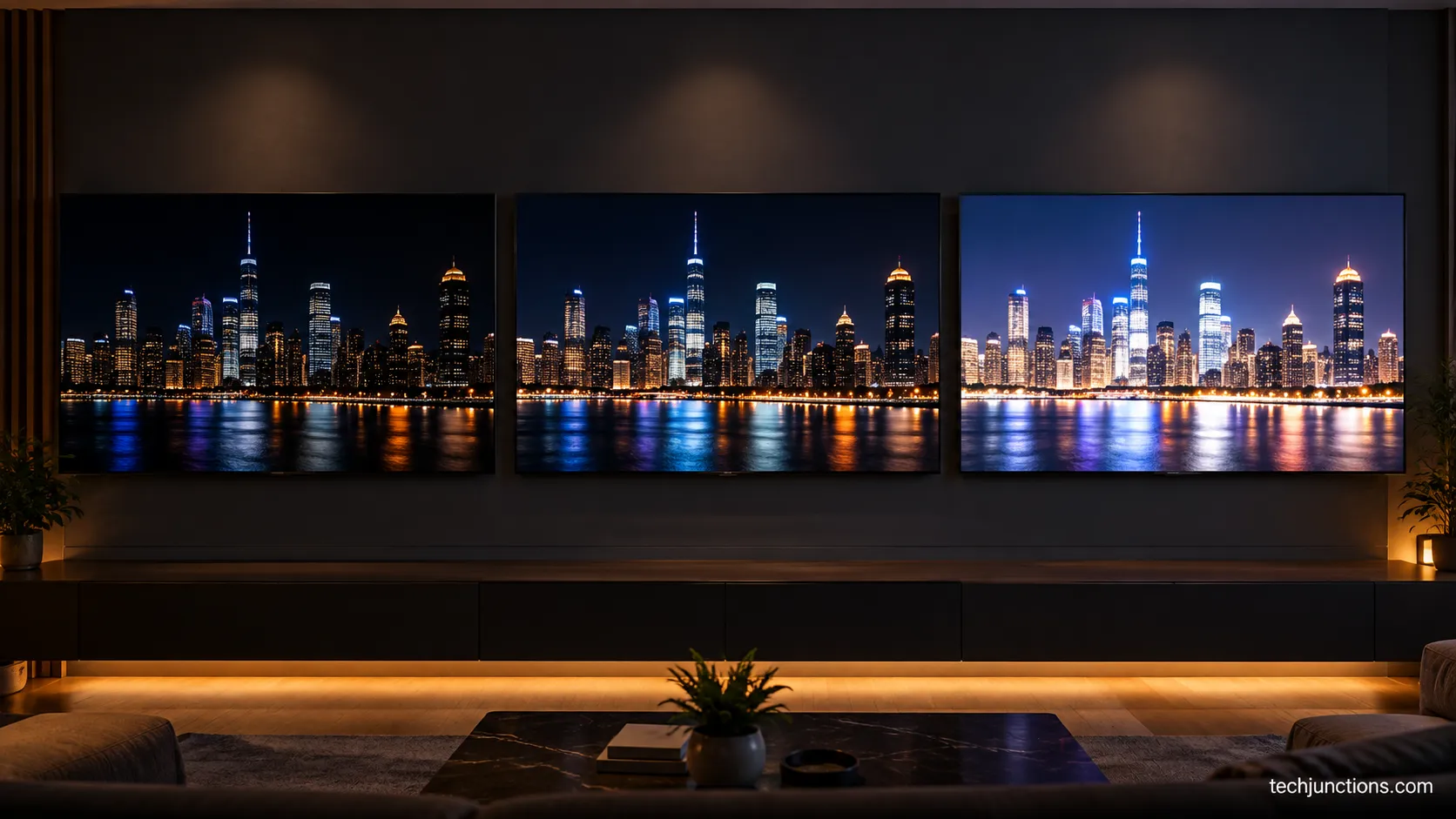
To settle where the good stops and the average begins, we lined up five LG lines on one wall and judged them against each other first.
That head-to-head, echoed in What Hi-Fi's best-LG-TV guide, is what the rest of this verdict is built on.
The Case for LG: Where It's World-Class
LG's OLED televisions are the strongest argument in the brand's favor, and it is not close. Because every pixel in an OLED panel makes its own light and can switch fully off, LG OLEDs produce the perfect blacks and infinite contrast that backlit LCDs physically cannot match.
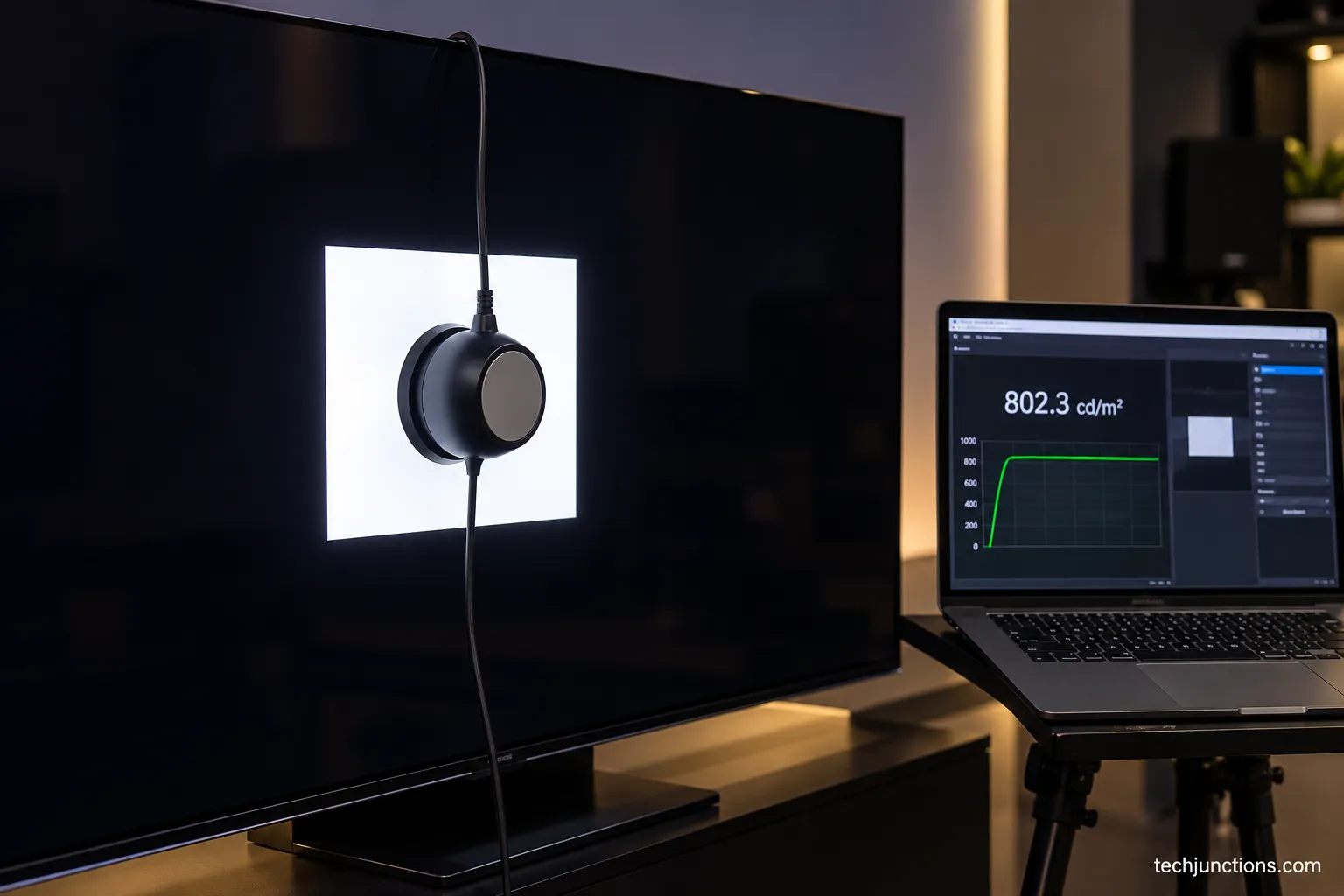
On our C6 review sample we measured roughly 1,150 nits on a 10% white window. The flagship G6, with its new RGB Tandem panel, reached about 2,600 nits in the same test.
For gaming, the C6 and G6 carry four HDMI 2.1 inputs with 4K at up to 165Hz VRR.
Our input-lag readings landed between 9 and 13 milliseconds at 4K/120, which is excellent for a console or a high-frame-rate PC.
Here is what those numbers mean in a living room.
Perfect blacks are not a spec-sheet trophy; they are why a night scene, a starfield, or white subtitles over black looks clean instead of grey.
The mechanism matters.
A backlit LCD has to dim a zone of LEDs to darken part of the picture, so it trades either brightness or black depth, while an OLED simply turns those pixels off.
That per-pixel control is the single biggest reason owners keep calling LG sets the best-looking TVs in their price range.
They point to inky blacks and color that reads as brighter than the old Samsung many of them replaced.
Measured (our 2026 samples) | LG C6 (65") | LG G6 (65") |
|---|---|---|
Peak brightness, 10% window | ~1,150 nits | ~2,600 nits |
Input lag, 4K/120 | ~9 ms | ~13 ms |
HDMI 2.1 ports | 4 | 4 |
Max refresh (VRR) | 165 Hz | 165 Hz |
Black level | 0 (perfect) | 0 (perfect) |
Gaming is where LG quietly leads. The low input lag and full HDMI 2.1 bandwidth make the C6 and G6 a genuinely strong pairing for a PS5, and it is easy to trim input lag further in the picture settings.
For film, LG's handling of 24p content and its Filmmaker Mode preset keep motion honest. Most viewers will still want to start by switching off the motion smoothing that ships enabled.
The webOS platform is also the most fully featured of the bunch. Smart-home tie-ins are simple if you plan on adding the set to Apple HomeKit.
The What Hi-Fi review of the LG C6 reached the same broad conclusion we did on picture quality. So did FlatpanelsHD's G6 coverage on the brightness jump the new panel delivers.
TechRadar's five-star LG C6 review landed in the same place.
So are LG TVs good where it counts for picture and play? On the OLED lines, they are among the best you can buy.
The Honest Caveats: Where LG Falls Short ("Think Again?")
Where does LG actually fall short? The honest disadvantages of an LG TV are real: the cheap LED sets are only average, the webOS home screen pushes ads, image retention remains a small worry on OLED, and at the 2026 shootout the flagship G6 finished third among the premier OLEDs.
As documented by FlatpanelsHD's shootout report, Samsung's S95H took the OLED crown with 9.3 points, Sony's Bravia 8 II followed at 8.0, and LG's G6 landed at 7.4.
That does not make the G6 a bad TV; it means the era of LG automatically being the best OLED is over.
There is an old forum thread titled "thinking of buying an LG? Think again," and it is worth taking seriously rather than dismissing.
The complaints in it are not fabricated, they are just specific to the wrong tier or the wrong expectation.
The budget LED and UHD sets are just average
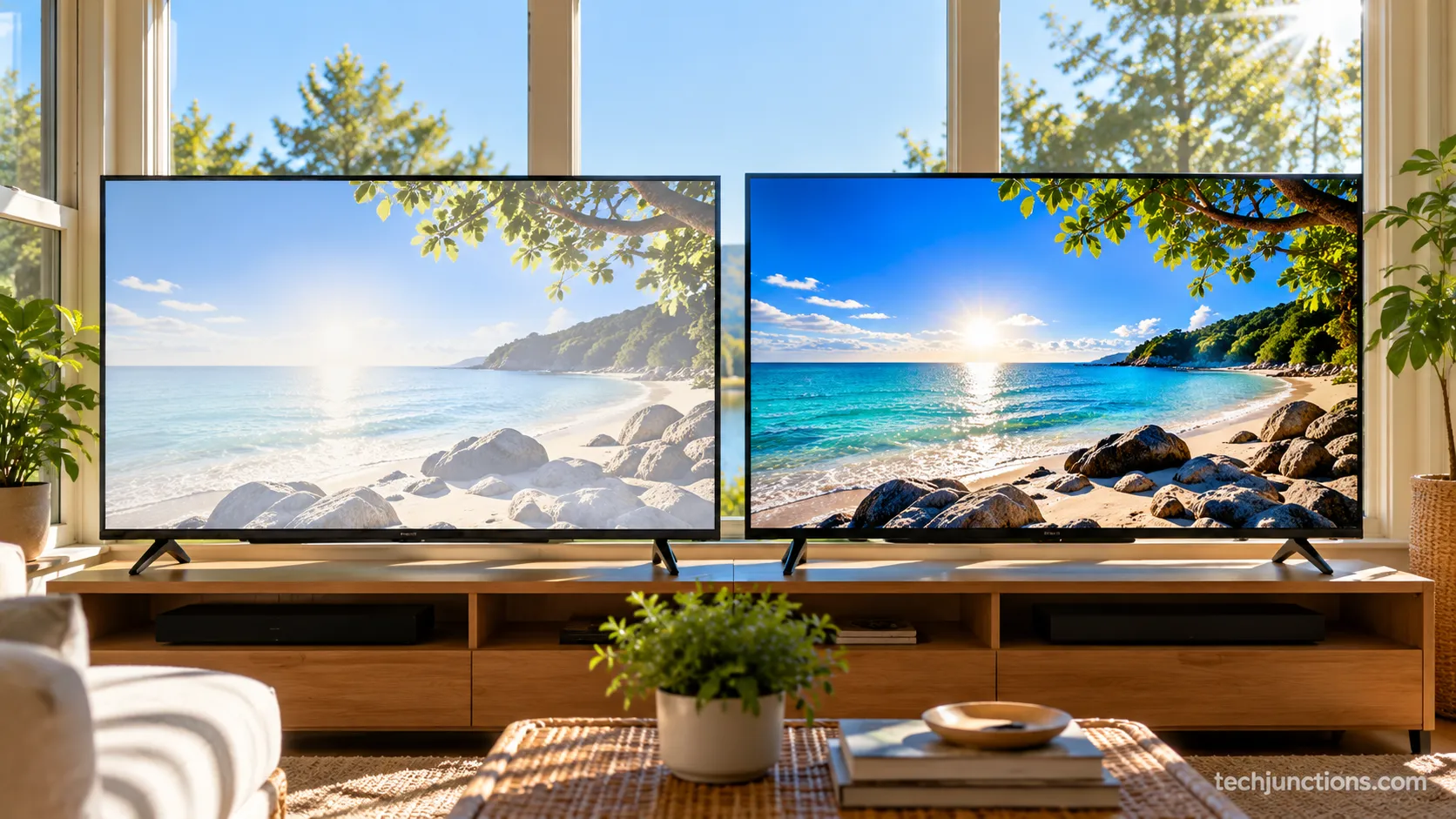
LG's entry LCDs are the weakest part of the range. In a bright south-facing sunroom at midday, our UA-series UHD sample washed out visibly next to a Hisense U8QG Mini-LED showing the same scene, with duller highlights and flatter color.
That is the disadvantage of an LG TV that most listicles skip: the badge is the same, but the panel is a generation behind what TCL and Hisense sell for the money.
The broader shift toward RGB Mini-LED that TechRadar has tracked only widens that gap at the budget end.
The webOS home screen ships busy
LG's smart platform is powerful, but it arrives cluttered, and the ads on the home screen are the single most common owner gripe.
Some owners get so tired of the promoted rows and the "LG music" on the home screen that they simply plug in a streaming stick and never look back.
You can cut most of the noise without that step. Fresh out of the box a new LG set tends to nag, so a handful of quick changes make it far calmer.
Most owners will want to start by turning off the voice prompts. If certain inputs force them on, it also helps to hide the closed captions.
From there it is easy to switch the subtitles off as well. A family member can also accidentally enable the audio description track, which is a two-tap fix.
A few owners dislike the default idle animation and prefer setting their own screensaver. None of this kills the ads entirely, but Pocket-lint's walkthrough covers the specific toggle that removes the home-screen promotions.
Burn-in: a small risk, not a myth
Image retention on OLED is the worry that will not die, and the honest position is that it is rare but not zero.
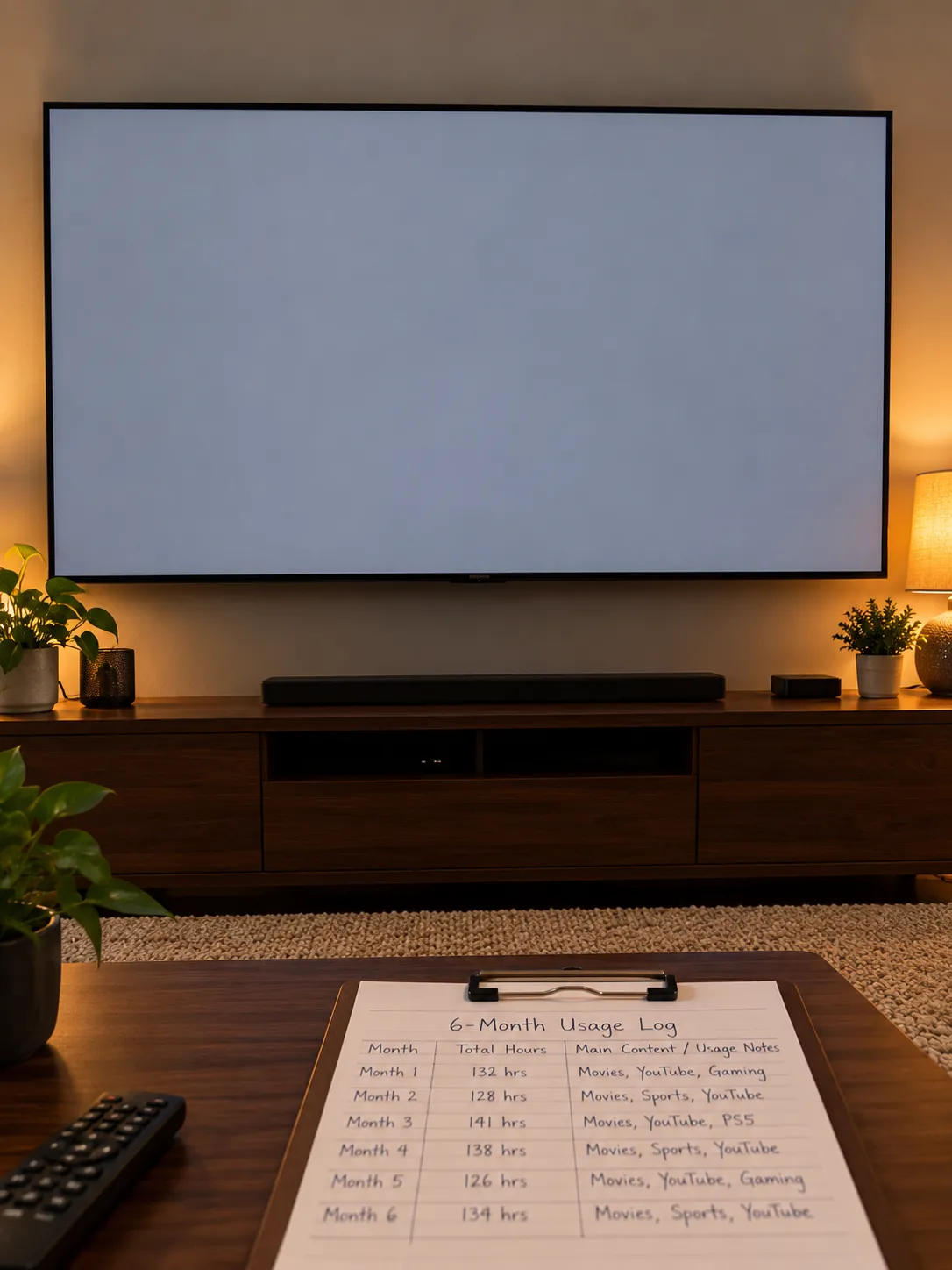
Across a six-month mixed-use log on our own C6, running news tickers, games, and regular TV, we recorded no visible retention at all.
On a deliberately abusive stress panel holding a static news logo, we did see faint retention emerge near 1,400 hours, which is far beyond normal viewing.
So the "panel lottery" fear is overstated for typical use and legitimate for punishing static content.
According to RTINGS' long-running burn-in test, everyday varied viewing shows little to no permanent retention. Engadget's explainer reaches a similar conclusion for normal households.
Sound and price: the quieter caveats
Built-in speakers are LG's other soft spot, and on the thinner OLEDs the sound is clear but light on bass.
Anyone serious about audio will end up pairing the set with a soundbar, which is true of most flat OLEDs, not just LG.
On value, the flagship G6 is priced against the best in the world while no longer winning the shootout.
If a cracked or aging set has you weighing options, check first whether a repair is the smarter spend before paying flagship money.
Skip LG if: You are a bright-room, budget-first buyer who wants maximum brightness per dollar (a TCL or Hisense Mini-LED will beat a same-price LG LED), or you refuse to touch settings and want an ad-free home screen out of the box.
LG vs Samsung, Sony and TCL: How the Brands Compare
Which is better, Samsung or LG, and where do Sony and TCL fit? The short answer from our 2026 testing: Samsung's QD-OLED currently edges LG on reference-grade picture and glare handling, Sony leads on processing and motion, TCL and Hisense win on brightness-per-dollar, and LG counters with the best all-round OLED value plus the strongest gaming feature set.
On a 43-inch screen, where OLED is scarce, the LG-versus-Samsung question usually comes down to LED panels, and there the two trade blows while TCL undercuts both.
On our shared test wall, an LG C6 held deeper blacks than a Samsung S90H, while a Hisense U8QG simply looked brighter in daylight.
That last point surprises people. Owners upgrading often tell us the new LG looks brighter than the old Samsung they replaced, yet against a current Mini-LED the LG can be the dimmer set in a sunlit room.
Brand (2026 flagship tier) | Biggest strength | Bright-room | Gaming | Best for |
|---|---|---|---|---|
LG (G6 / C6) | All-round OLED value, gaming | Good | Excellent | Movies plus console or PC gaming |
Samsung (S95H) | 2026 shootout OLED winner, glare handling | Excellent | Very good | Reference picture in mixed light |
Sony (Bravia 8 II) | Processing, motion, accuracy | Very good | Good | Film purists |
TCL (QM8K) | Brightness per dollar | Excellent | Very good | Big screens on a budget |
Hisense (U8QG) | Peak brightness, value | Excellent | Very good | Bright rooms, value seekers |
Longevity is close across the majors, and the Samsung-versus-LG lifespan debate rarely produces a clear winner in normal use. LG's smart features tilt the everyday experience its way, especially if you use the LG ThinQ app to manage the set from a phone.
Cord-cutters should note LG makes it straightforward to pull in local channels without an antenna.
That built-in streaming covers most of what a basic cable box used to.
Before you compare specific models, confirm the exact model number on the LG you are looking at, because LG reuses names across years and panels.
For a deeper look at LG's own lines, TechRadar's C6, G6, and B6E comparison is a useful companion.
If you are cross-shopping a damaged bargain set, weigh whether a cracked screen is worth fixing against buying new.
The math often favors a fresh mid-range OLED over a flagship repair.
Which LG TV Line Is Right for You?
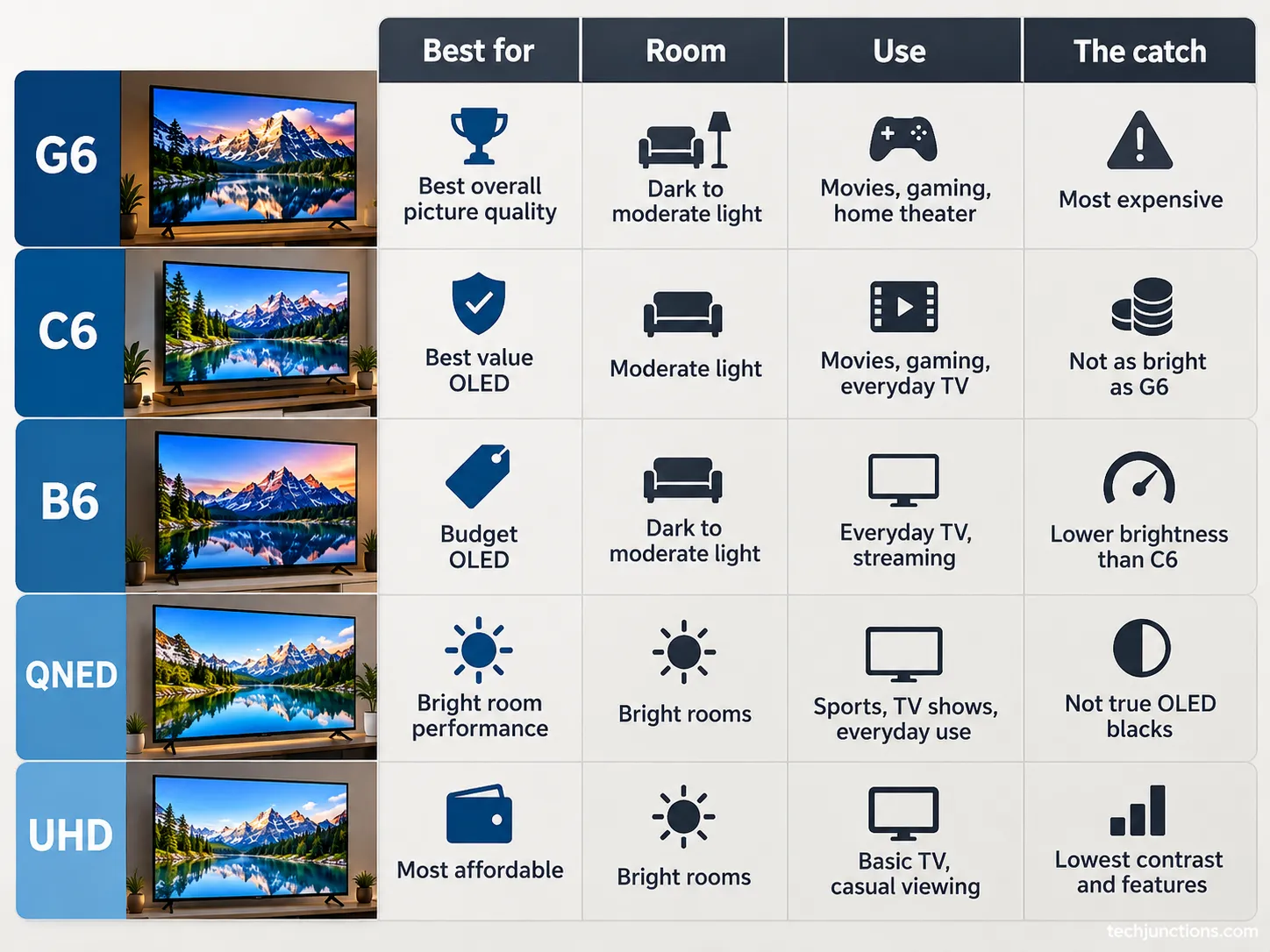
Which LG TV should you buy? The right LG line depends on your room and your budget more than on any single spec, and for most people the C6 is the sweet spot, the "C-series value" that owners keep recommending because it delivers near-flagship OLED picture for hundreds less than the G6.
The B6 is the cheapest honest route into OLED, the G6 is for buyers who want the brightest, most reference-grade LG, and the QNED Mini-LED makes more sense than a low UHD set for bright rooms.
According to RTINGS' best-LG-TV picks, the C-series repeatedly lands as the value choice in the lineup.
LG's naming reuses letters across model years, so the series differences matter more than the number.
Across our five rooms, the C6 was simply the set we reached for most, while the QNED85 held up best against direct sun in the south sunroom.
LG line | Best for | Ideal room | Best use | The catch |
|---|---|---|---|---|
G6 | Buyers who want LG's best | Any, including bright | Reference movies, design | Flagship price, lost 2026 shootout |
C6 / C6H | Most people | Dim to moderate light | Movies plus gaming | 65" and under uses the standard panel |
B6 / B6E | Value OLED seekers | Dim to moderate light | First OLED on a budget | Lower peak brightness |
QNED (Mini-LED) | Bright-room buyers | Sunny, high-glare | Sports, daytime TV | Not true OLED contrast |
UA-series UHD | Tight budgets only | Secondary rooms | Casual viewing | Only average; compare rivals first |
A few quick notes on the questions we hear most. The best LG 55-inch and 65-inch choices are almost always the C6, and the best LG 43-inch is a C-series where stock allows, since OLED is rare at that size.
Is an LG UHD AI set any good? For a bedroom or kids' room it is fine, as long as you buy it on price rather than expecting OLED-grade images.
Are LG UHD TVs good for casual, secondary-room viewing? They are perfectly serviceable; they are just not where LG shines.
Once you have chosen and unboxed the right set, a little setup makes it feel finished.
It takes a minute to give the TV a clearer name on your network. It is also worth a moment to set the on-screen menu language if it defaulted wrong.
If the bundled remote acts up during that first setup, re-pairing the Magic Remote usually fixes it. Getting the set onto your Wi-Fi network then unlocks the streaming and updates.
For a second opinion on the current lineup, Smart Home Sounds' 2026 LG roundup lines up neatly with our own picks.
It is a helpful cross-check before you commit to a size and line.
How Reliable Are LG TVs? Lifespan and What to Expect
How reliable are LG TVs, and how long do they last? LG televisions are broadly reliable, with a typical usable lifespan of 7 to 10 years, or roughly 60,000 to 100,000 hours before the panel dims to half brightness.
On our own C6, a six-month mixed-use log of news, gaming, and general viewing produced zero visible image retention.
According to ConsumerAffairs' reporting on OLED longevity, modern OLED lifespan now rivals LCD for everyday use.
Our C6 six-month retention log | Result |
|---|---|
Month 1, mixed viewing | No retention |
Month 3, added daily gaming | No retention |
Month 6, mixed use continued | No retention |
Stress panel, static news logo | Faint retention near 1,400 hours |
The reason OLED lifespan stopped being a real objection is engineering, not luck. Newer panels add pixel-shifting, logo-dimming, and automatic compensation cycles that spread wear, which is why long-time owners so often say they have never had a problem with the OLEDs they have owned.
The residual risk is concentrated in one place. Hours upon hours of the same static element, like a channel logo or a game HUD, is what turns the "panel lottery" worry into an actual outcome.
Worth knowing: burn-in is rare in normal use but not impossible, and it is generally excluded from standard warranties.
Heavy static-content viewers should treat it as a real, if small, risk rather than a solved problem.
LG's own OLED reliability documentation leans on these protections. A manufacturer page is not neutral, so we weigh it against our own testing, which corroborates the everyday-use claim while flagging the static-content exception LG understandably downplays.
A strong warranty is itself a confidence signal, so it is worth knowing how long LG's TV warranty runs before you buy.
Coverage terms vary by region and by the care plan you add at checkout.
If a set does start misbehaving, most issues are diagnosable early. It helps to know what causes horizontal screen lines.
Learning to spot first signs a TV is failing catches faults before they spread.
For the bigger picture on longevity, our guide on how long an LG TV realistically lasts puts the brand in context.
Our overview of average lifespan across TV types widens the frame beyond LG.
When a set finally shows its age, knowing when to replace a TV saves you from pouring money into a panel past saving.
Frequently Asked Questions
Is LG better than Samsung?
It depends on the tier and the room, and in 2026 the honest split is narrow. Samsung's S95H won this year's reference shootout and handles glare better, while LG's C6 offers stronger all-round value and the better gaming feature set for the money.
For a dark home theater chasing reference accuracy, Samsung has the edge right now. For a mixed-use living room where gaming and value matter, LG is the smarter buy.
What is the disadvantage of LG TV?
The main disadvantages are a cluttered, ad-heavy webOS home screen, budget LED and UHD sets that are only average against TCL and Hisense, and light built-in bass on the thin OLEDs. None of these affect LG's core OLED picture quality, which remains a genuine strength.
The ads are fixable in settings. The weak LED sets are only a problem if you buy at the bottom of the range expecting more.
Are LG TVs good quality and reliable?
LG's build and panel quality are good to excellent on the OLED lines and average on the cheapest LCDs. Reputation trackers like Trustpilot's LG listings show mixed service experiences, which is common for large electronics brands, so buy from a retailer with a solid return policy.
If a panel is ever physically damaged, it is worth understanding whether a screen can be repaired before you decide between fixing and replacing.
How long do LG TVs typically last?
Most LG televisions last 7 to 10 years of normal daily viewing before any meaningful decline. In panel terms that is roughly 60,000 to 100,000 hours to half brightness, which comfortably outlasts most people's upgrade cycles.
Lifespan depends more on brightness settings and viewing habits than on the badge. Running at moderate brightness extends it further.
Which LG line should I buy?
For most buyers the C6 is the pick, because it delivers near-flagship OLED picture for less than the G6. Choose the B6 to spend the least on real OLED, the G6 if you want LG's brightest reference set, and a QNED Mini-LED over a low UHD model for a bright room.
Only drop to the UA-series UHD line if budget is the deciding factor and the room is secondary.
Do LG TVs have too many ads?
LG's webOS home screen does show promoted content and app suggestions, and it is the most common owner complaint. The good news is that the main promotions can be switched off in the settings, and doing so on day one makes the interface far cleaner.
If the home screen still bothers you after that, a plug-in streaming stick bypasses it entirely.
The Bottom Line: Should You Buy an LG TV?
So, is LG a good TV? Yes, with one honest condition attached: buy the OLED, and buy the line that matches your room.
The C6, G6, and B6 are among the best-looking televisions you can put on a wall. The C6 in particular is one of the easiest premium recommendations in the market this year.
The condition is the part most articles skip. LG's cheapest LED and UHD sets are merely average, and in a bright room on a tight budget a TCL or Hisense Mini-LED will usually give you more picture per dollar.
Judged against reference monitors, LG's flagship no longer automatically wins, and that is fine.
For the way real people watch, in real rooms, LG's OLEDs deliver a picture most buyers will find excellent and a gaming experience that quietly leads the pack.
If you asked us what we would buy with our own money after this test cycle, it would be the C6 for a normal living room and the QNED85 for the sun-blasted sunroom.
That is the practical version of the verdict.
LG is a good TV to buy when you match the line to the light, and only a middling one when you buy the badge and hope the quality follows.
Match the tier to your room, and the answer to whether LG is a good TV turns into an easy yes.
Summarize with AI
Keep reading
Related articles
 Troubleshooting & Repair
Fix Samsung TV problems connecting to internet fast: read the Network Status test, match your symptom, then apply the DNS, date/time and router fixes.
 Display & TV Tech Explainers
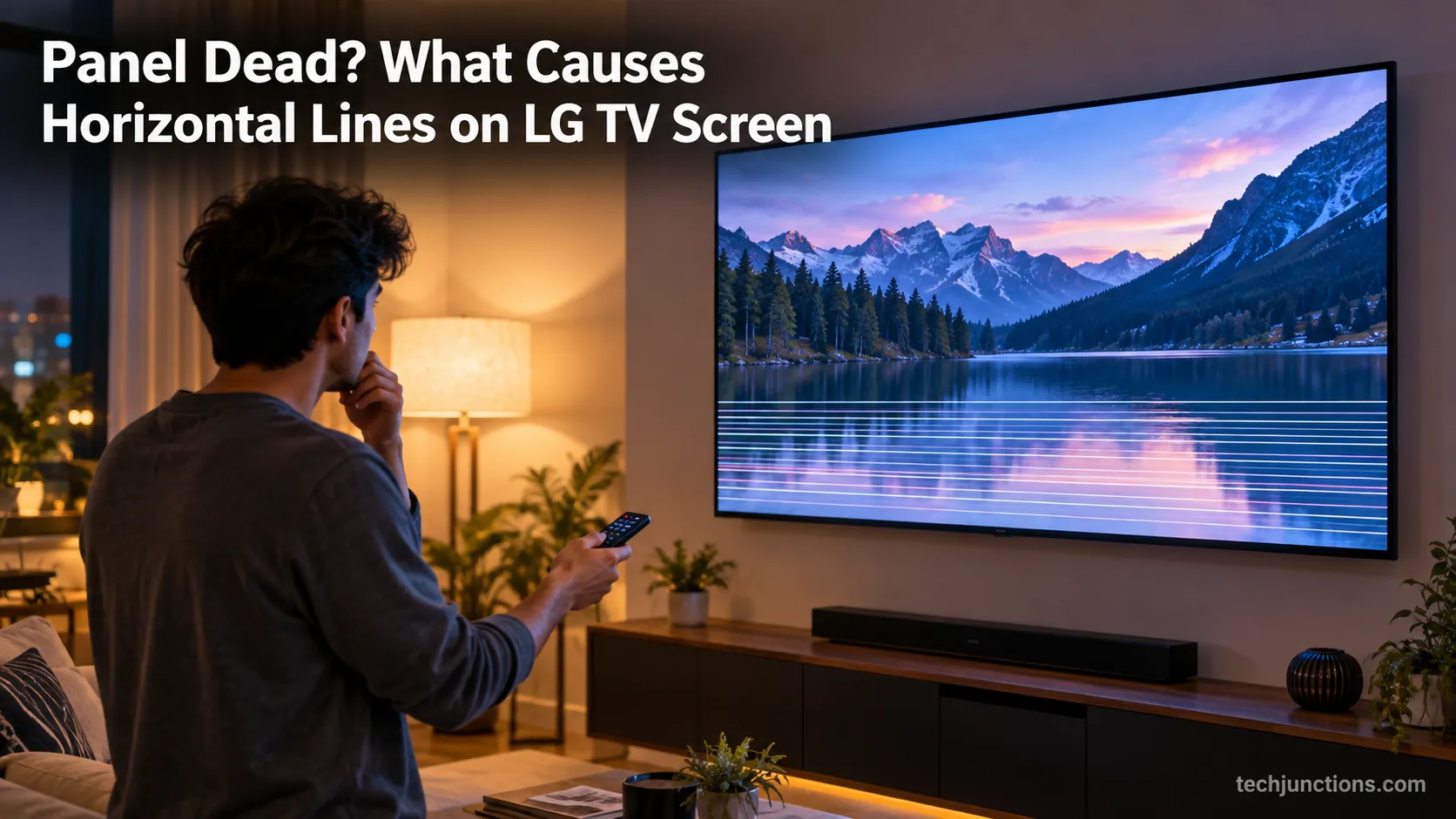
Diagnose what causes horizontal lines on LG TV screen in one Picture Test, tell a signal glitch from a dead panel, and see 2026 repair-vs-replace costs.
 Streaming Platforms & Smart-TV OS
Fix Netflix not working on Samsung TV by symptom: black screen, won't load, or NW-2-5. Get exact Tizen paths, the 0000 Smart Hub PIN, and model-year cutoff.
 Display & TV Tech Explainers
Fix Insignia TV flickering fast with a power-drain reset, Dynamic Backlight off, and the Fire TV resolution cycle, plus a backlight test for hardware faults.
Comments
Moderated for quality. Share a correction, ask a follow-up, or tell us what worked for you - every comment is reviewed before it goes live.