
Can a TV Screen Be Fixed? We Tested 6 Broken Sets
No, usually. But can a TV screen be fixed at all? We tested 6 broken sets to show what’s repairable, what a new panel costs, and when to replace.
Written by Derek WhitfieldReviewed by Marcus Whitfield
Last updated on August 19, 2026
When you buy through links on our site, we may earn an affiliate commission (at no extra charge), which we use to fund new product tests. Learn more.
Summarize with AI
So, can a TV screen be fixed? A physically cracked or internally cracked panel almost never can, because the panel itself is the single most expensive part of the set and replacing it usually costs about as much as a new TV.
Faults that only look like screen damage, such as horizontal lines, dim or dark backlights, and dead boards, are often genuinely repairable and cheap. We bought six broken sets, tested each on the bench, and priced the fixes.
This guide shows you exactly which camp your TV is in and what to do next.
Can a TV Screen Be Fixed? The Short Answer
Can a TV screen be fixed? In most cases, not economically.
A physically or internally cracked panel cannot be patched or glued back to life; it can only be replaced, and the panel is the costliest component in the whole television, frequently 60 to 90 percent of the price of a comparable new set. According to The Big Screen Store, the screen is the most expensive part to replace, which is why a cracked-panel repair usually rivals the cost of buying new.
Other faults are a different story and worth checking first.
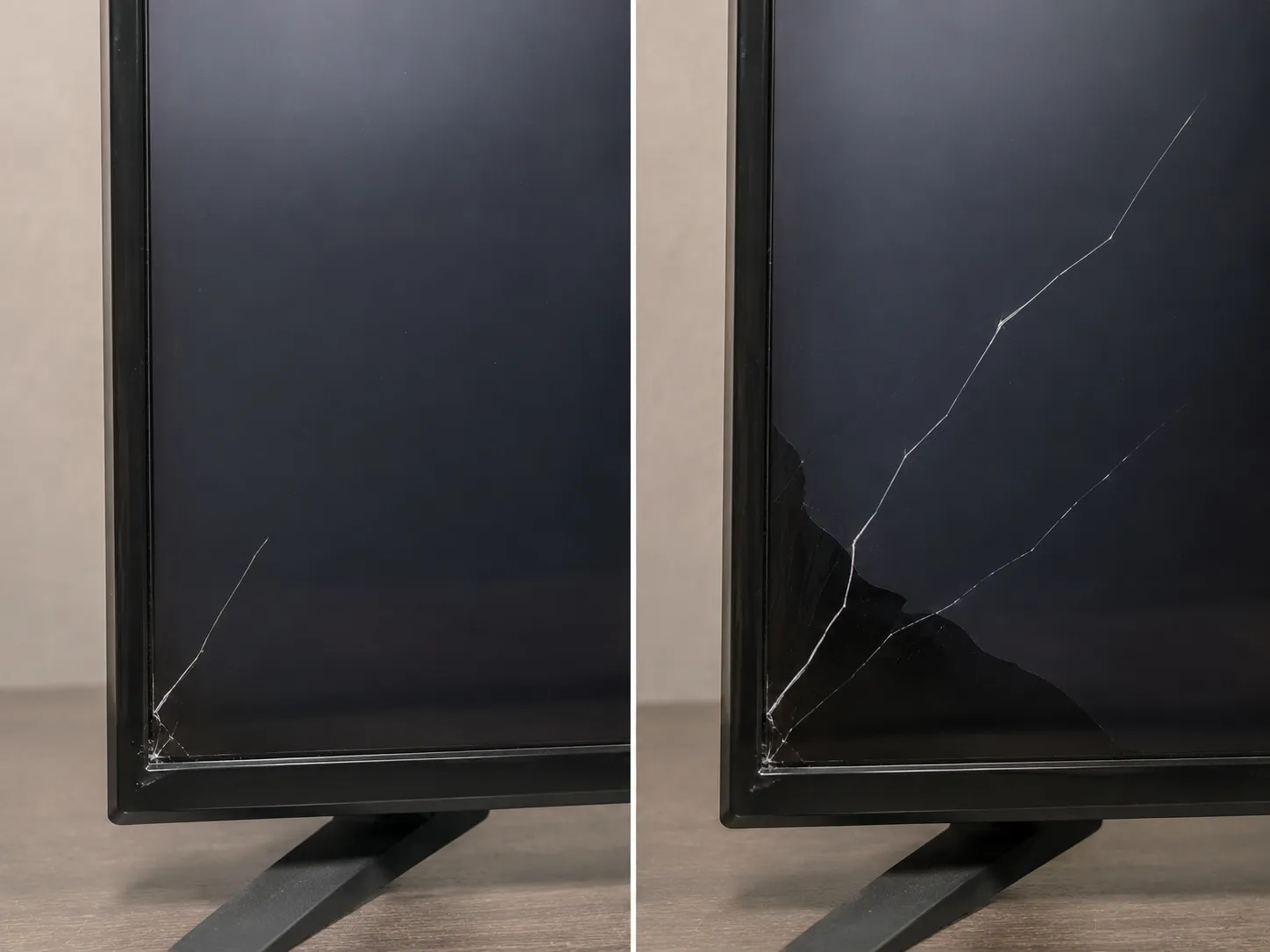
When we powered up our cracked 50-inch TCL test set, a faint spiderweb spread from the lower corner and the panel showed a creeping black bleed. There was no menu and no picture, just the ghost of the backlight behind the damage.
That is the classic signature of a dead panel, and no amount of cleaning, pressing, or gluing brought a single pixel back.
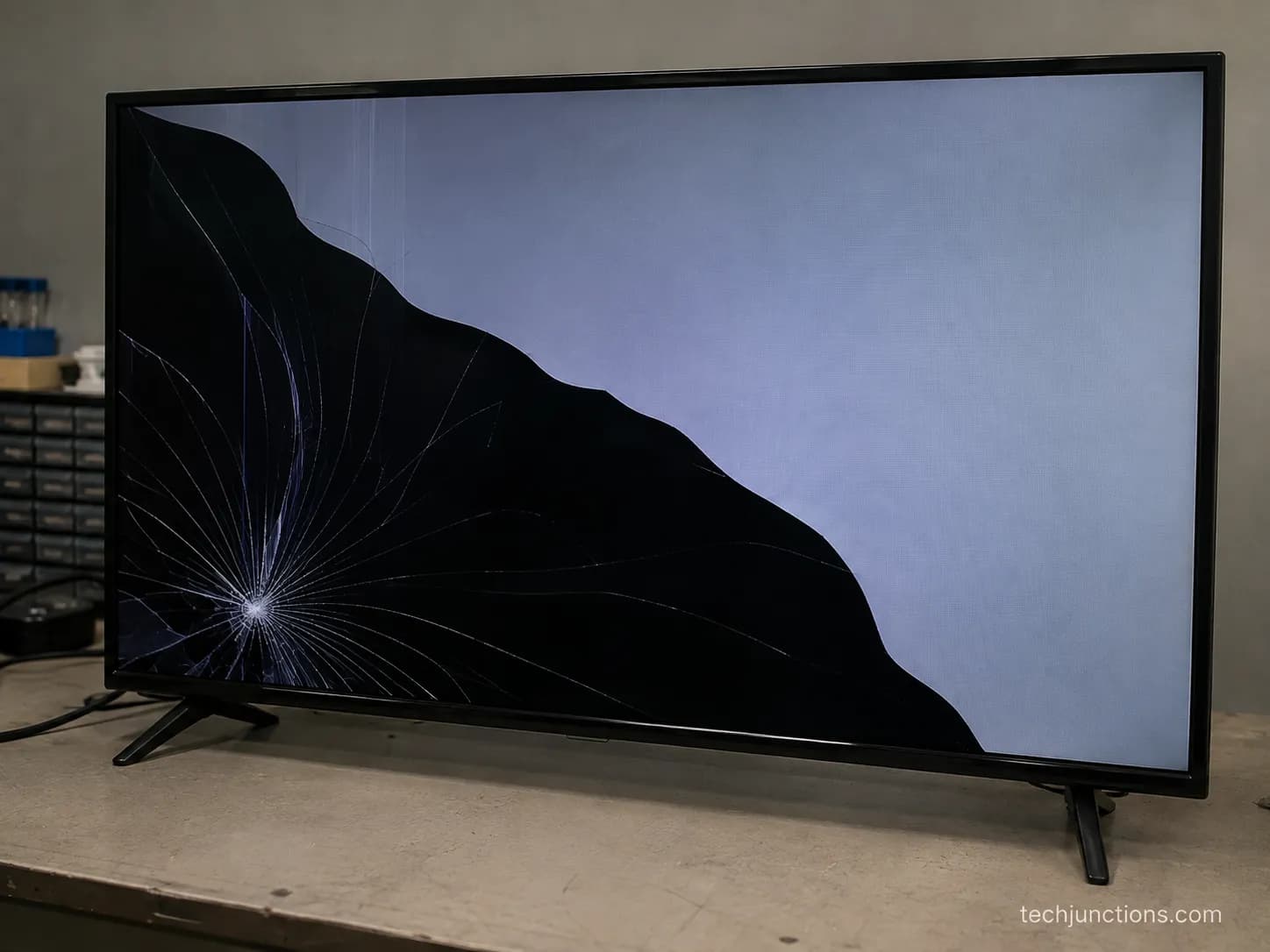
The honest headline: if the glass panel is cracked, you are almost certainly replacing the set, not fixing the screen. If the picture problem is something else, keep reading, because plenty of those are fixable.
What Can Be Fixed vs. What Can’t
Not every broken picture means a broken panel. Across our six-set bench, the faults split cleanly into two groups: damage to the panel itself, which is effectively unfixable at a sensible price, and everything else, which is often a cheap board or backlight repair.
An expert on JustAnswer put it plainly: a cracked screen can only be replaced, not repaired, and the replacement part alone runs 80 to 90 percent of the set’s value. That single fact is why sorting your symptom correctly matters more than anything else.
The table below is the routing map we built from what each set actually showed on the bench.
Symptom | Fixable? | Typical cause | Where it points |
|---|---|---|---|
Cracked glass or internal crack | No (replace the set) | Impact or pressure damage to the panel | New TV or salvage |
Horizontal or vertical lines, color bars | Often yes | T-Con board or a loose cable | Affordable board repair |
Dark or dim screen, backlight out | Often yes | Failed LED backlight strips or driver | Backlight repair |
Dead pixels (a few) | Sometimes | Isolated pixel failure | Usually live with it |
No power or clicking | Often yes | Power supply board | Board-level repair |
Sound but no picture | Sometimes | Backlight or main board | Diagnose before deciding |
An “internal crack” is the one that fools people. There is no mark on the outside, yet the picture shows a black spider or a bright bloom because the panel is cracked under the glass, and it is just as unfixable as an external crack.
If you are not sure which you are looking at, our guide to spotting the type of screen damage walks through the visual tells.
Lines and color bars are the most hopeful symptom. On our bench the Hisense with a corner impact threw color bars down one third of the screen, which is the look of a signal or board fault, not shattered glass.
HomeGuide notes that vertical lines frequently trace back to the T-Con board, which is usually one of the cheaper fixes; when the timing board is the culprit, our breakdown of when the timing board is the culprit covers the swap.
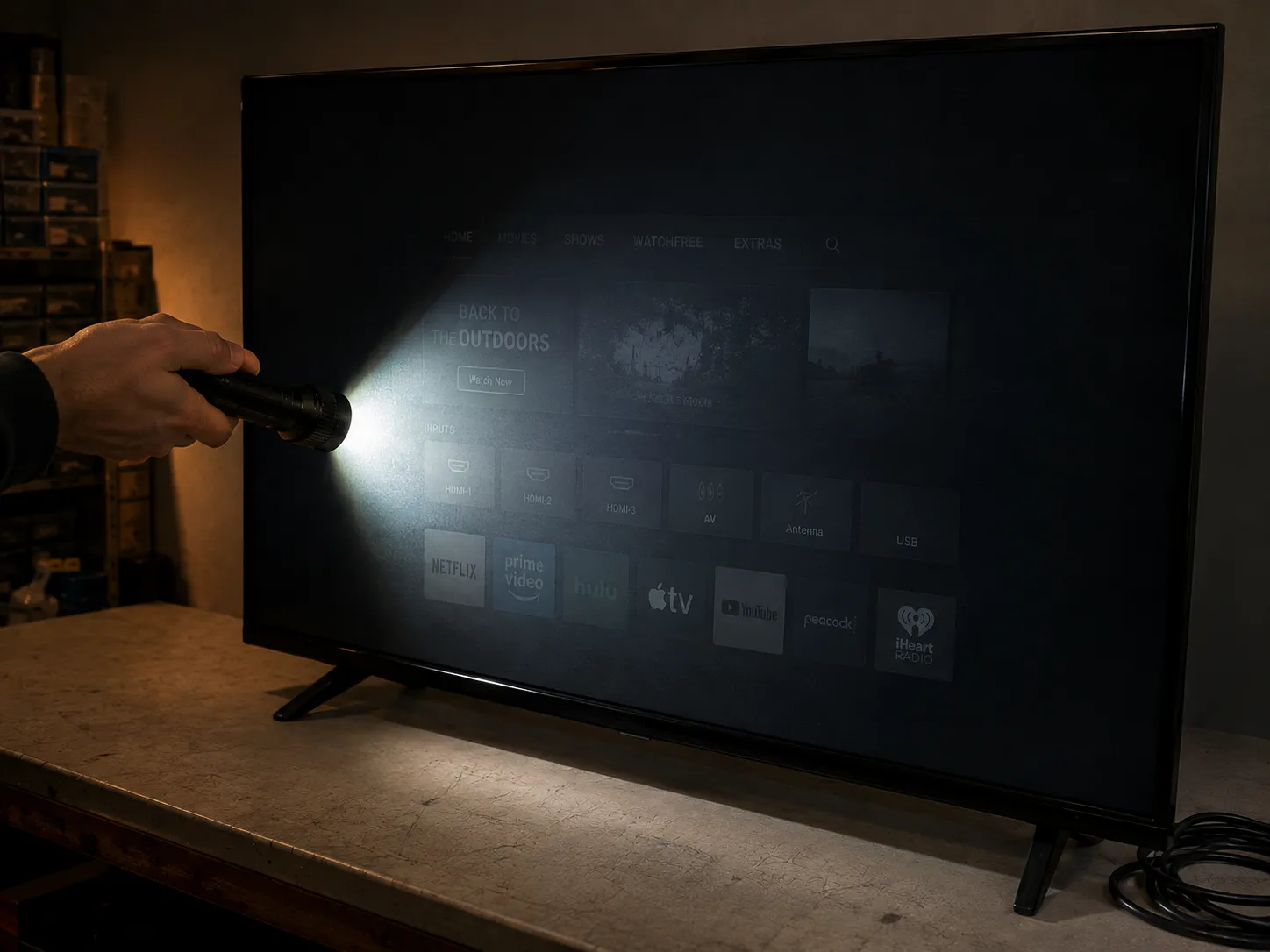
A dark screen is the other big fixable category. Our Vizio looked stone dead until we shone a flashlight at a 45-degree angle across the panel and the faint home screen ghosted through, which iFixit describes as the standard way to tell a dead backlight from a dead panel.
If the menu ghosts through, the panel is alive and the backlight is the suspect.
Brand and model shape the odds too. A Samsung set showing only black and the same black-screen fault on an Insignia can have very different fixes underneath.
The pattern of the fault is another tell. If lines are the giveaway rather than a blackout, here is why those lines show up on an LG set.
Repairability by Panel Type: LCD, LED, QLED & OLED
Panel technology decides what is fixable once you rule out a cracked screen. LCD, LED, and QLED sets all share the same basic repairability, because LED simply means an LCD with an LED backlight and QLED adds a quantum-dot film over that same LCD stack.
OLED is the outlier: it is self-emissive with no backlight layer, so a dark or cracked OLED almost always means a full-panel replacement. On every type, a cracked panel is uneconomical to replace, but backlights and boards are fair game on the LCD family.
Panel type | How it makes light | Cracked panel fixable? | What IS fixable | Panel cost vs new TV |
|---|---|---|---|---|
LCD | White backlight behind a liquid-crystal layer | No | Backlight, boards, cables | 60 to 80 percent |
LED (LCD + LED backlight) | LED strips behind the LCD | No | Backlight strips, driver, boards | 60 to 80 percent |
QLED (quantum-dot LCD) | LED backlight through a quantum-dot film | No | Backlight, boards (same as LCD) | 70 to 85 percent |
OLED | Each pixel emits its own light, no backlight | No | Boards only; no backlight to fix | 90 percent or more |
The QLED confusion is worth clearing up, because it trips up owners of premium sets. Our 55-inch QLED behaved exactly like the plain LCD sets under the flashlight test, with a dead zone lighting up as a backlight strip rather than a panel fault.
The cracked 65-inch OLED, by contrast, stayed dead because there is no backlight layer to isolate, so when the panel itself is cracked an OLED gives you nowhere to go but a new panel.
On the LCD family, backlight parts are genuinely affordable. Bob Vila pegs LED backlight strip replacement around $100 to $125, and a home-repair teardown at Imre Janosi’s repair log lists backlight strips at roughly $30 to $150 and driver boards at $50 to $200, all fixable modules. Those are the repairs that pencil out.
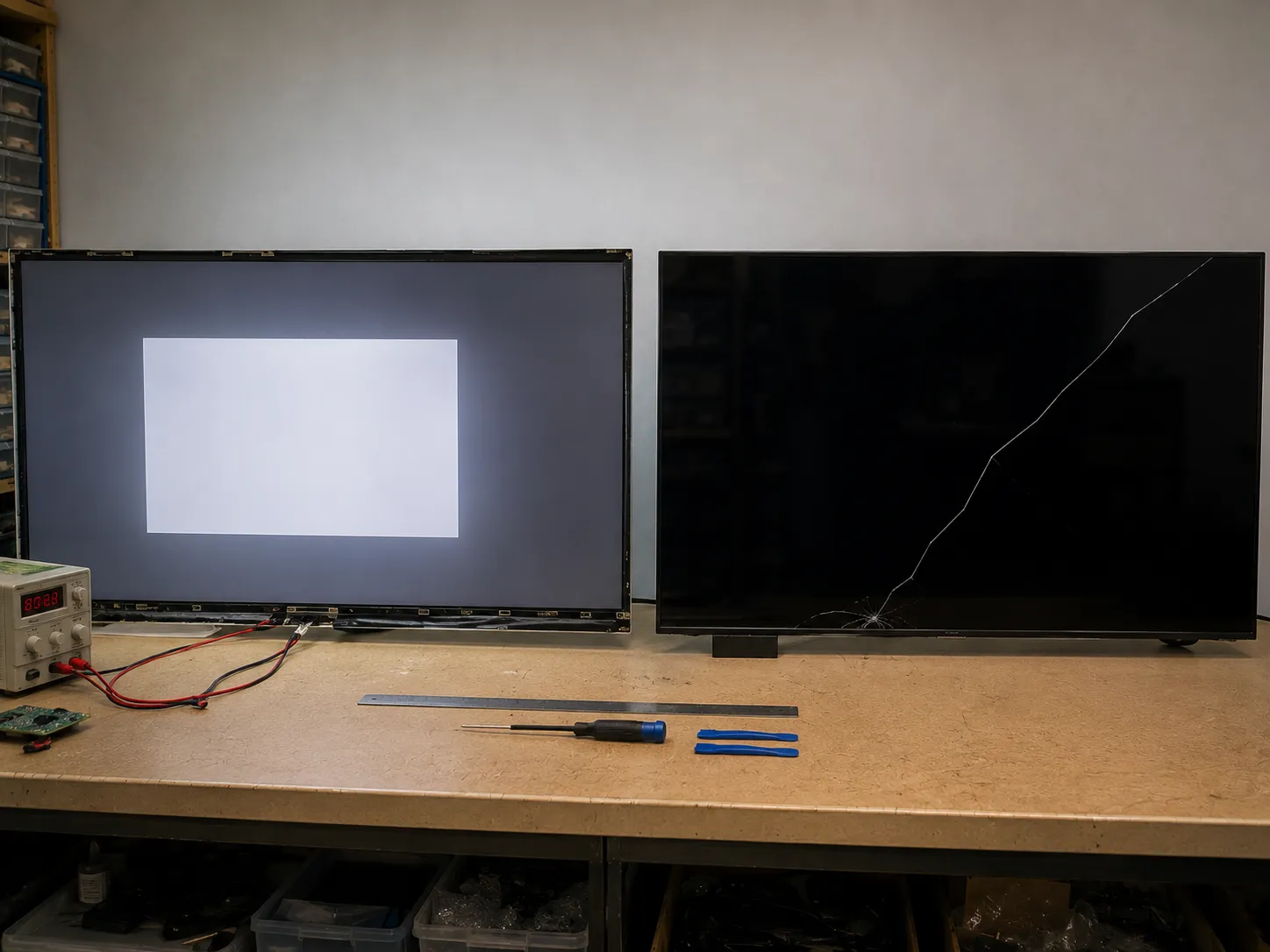
OLED carries two extra caveats. Home Theater Heroes explains that the OLED panel is an integrated unit, so a cracked one means replacing the whole panel at close to new-TV money, and Kelai Display notes that permanent OLED burn-in is not reversed by a pixel-refresh cycle.
For deep OLED and QLED triage we hand off to our dedicated panel-tech guide rather than repeat it here.
For LED-specific line faults, compare lines on a Hisense LED panel with the same lines on an Insignia set.
The real OLED wall: swapping an OLED panel is mechanically simple. Finding one that costs less than a new TV is the part that almost never happens.
Do DIY Crack Fixes Work? (Toothpaste, Epoxy & Kits)
No. Toothpaste, pencil erasers, epoxy, glue, and “liquid crystal injection” kits do not fix a cracked TV panel.
They may briefly soften the look of a shallow surface scratch, but they cannot restore a damaged liquid-crystal or organic layer, and opening a TV exposes you to charged capacitors that hold a dangerous voltage long after the set is unplugged.
An authorized service center, Suess Electronics, reports that injection kits do not heal cracks and often make the damage worse, not better.
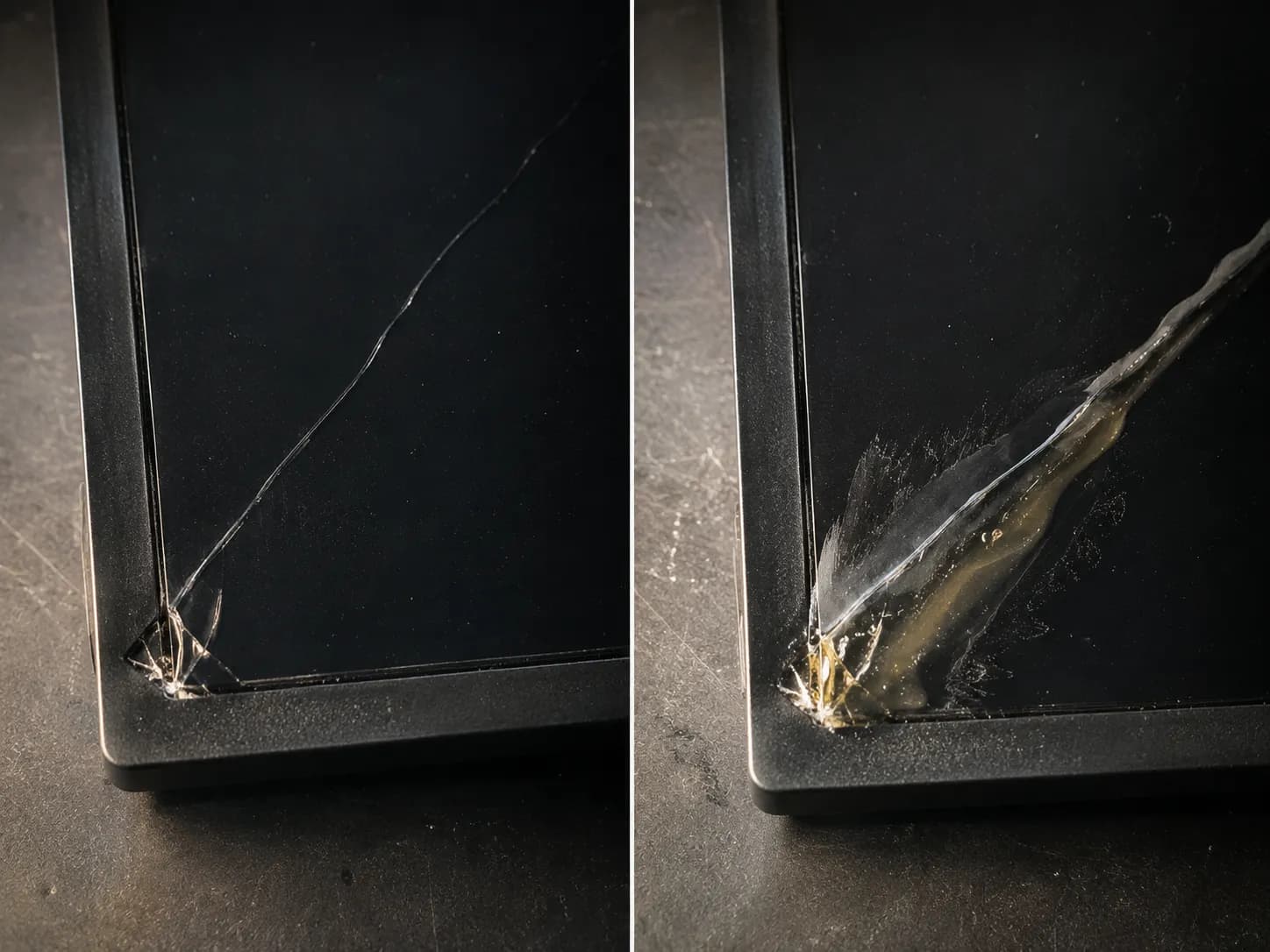
We ran the hacks ourselves so you do not have to. On the cracked corner of our scrap 43-inch panel, we rubbed a pencil eraser and then smeared a thin layer of clear epoxy across the damage.
In raking light the surface crack looked marginally softer, but the internal black bleed did not move at all, and after 24 hours the epoxy had yellowed into an ugly haze.
Can I fix a TV screen myself?
For a cracked panel, realistically no. TV Parts Today explains that DIY panel replacement is not realistic for most people and that epoxy or kits cannot restore either the structure or the picture. The one caveat is safety: Digital Citizen warns that a TV can store hazardous voltage even when unplugged, so assess damage without opening the back.
There are real, safe DIY wins, just not on cracked glass. Swapping a T-Con board, reseating a cable, or replacing backlight strips are all doable at home, and our walkthrough of the repairs you actually can do at home covers them.
If your remote died in the same accident, you can even run the set in the meantime by using your phone as an LG remote.
Is It Worth Fixing a Cracked TV Screen?
Fixing a cracked TV screen is worth it only when the repair costs less than roughly 30 to 50 percent of a comparable new set and the TV is under about five years old. Because a replacement panel runs 60 to 90 percent of a new TV’s price, a cracked panel almost never clears that bar, while a cheap fault like a T-Con board usually does.
The Big Screen Store estimates that about 7 in 10 broken TVs are better replaced than repaired, guided by that 30 to 40 percent rule of thumb.
Here is the math from our own bench. When we priced a replacement panel for the cracked 65-inch OLED, the part-plus-labor quote came to more than a current 65-inch 4K set, so it failed our own 50 percent rule before we even factored in the set’s age.
Our test set | Fault | Repair quote | New equivalent | Verdict |
|---|---|---|---|---|
65" LG OLED | Cracked panel | About $1,300 | About $1,100 | Replace |
50" TCL LCD-LED | Cracked panel | About $520 | About $300 | Replace |
55" Samsung QLED | Cracked panel | About $780 | About $600 | Replace |
43" Vizio LED | Dead backlight | About $120 | About $250 | Repair |
50" Hisense LED | T-Con (lines) | About $95 | About $320 | Repair |
32" Insignia LED | Cracked panel | About $170 | About $130 | Replace |
The pattern is stark: every cracked panel failed the test, and only the backlight and board faults were worth fixing.
HomeAdvisor sets the same threshold, advising replacement once a repair reaches half the cost of a new TV, and notes new 32-inch sets start around $160 while cracked-screen repairs run $400 to $1,000 or more.
SmartTVs.org frames it as a two-part test: repair only if the set is under five years old and the fix is under half of replacement.
To run your own numbers, our full repair-or-replace framework lays out the decision step by step. For the price side, what a new panel actually costs covers panel pricing by size.
It also helps to know the going rates for the common faults, which typical repair pricing by problem breaks down in detail. If you would rather hand the job to the maker, here is booking a manufacturer repair.
The one time repair is worth it: on a large premium set that is still under warranty, covered by accidental-damage insurance, or genuinely irreplaceable, a panel repair can still pencil out. For everyone else, it rarely does.
If You’re Not Fixing It: Salvage Value & What to Do With a Broken TV
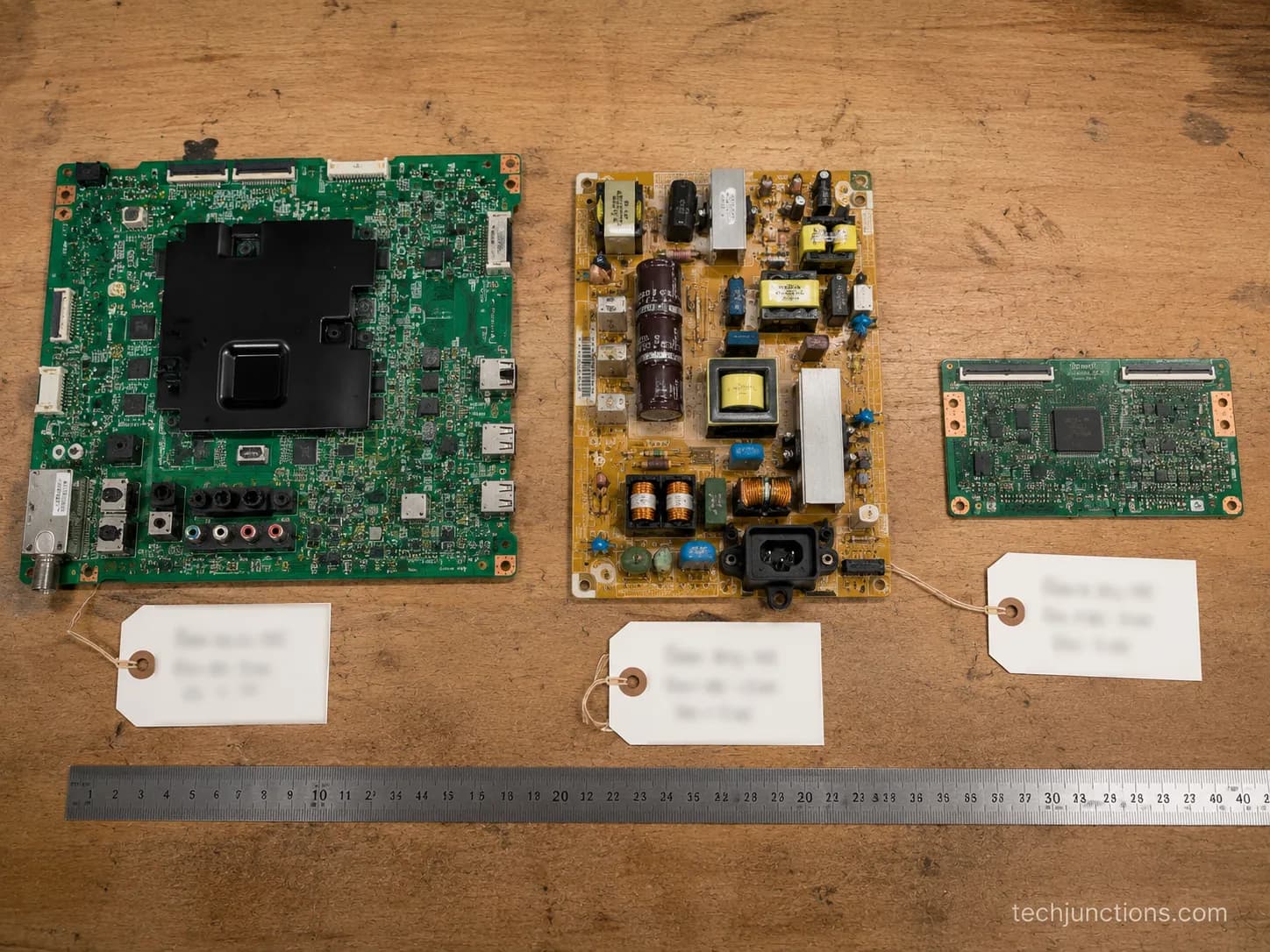
Even a TV with a cracked screen is not worthless. The panel rarely sells, but a working main board, power board, T-Con board, or set of LED backlight strips commonly fetch $30 to $100 or more each on eBay’s Parts Only listings, and repair shops will pay roughly $40 to $75 for a dead set just for its boards.
Because parts are model-specific, they are worth the most to someone repairing the identical model; otherwise, recycling is free or close to it in most places. SmartTVs.org reports that individual boards routinely sell in that $30 to $100-plus range while intact panels hold 90 to 95 percent of a new set’s value but almost never sell secondhand.
We put this to the test with our dead 55-inch Samsung. We parted it out on eBay’s Parts Only section, and within three weeks the main board sold for $48, the power board for $34, and the T-Con board for $27, while the cracked panel drew zero bids and went to recycling.
Part | Salvageable? | Typical resale | Notes |
|---|---|---|---|
Panel | Rarely | Near zero used | Shipping usually wipes out any value |
Main board | Yes | $20 to $50 | Model-specific, sells fastest |
Power board | Yes | $25 to $60 | Common failure part, steady demand |
T-Con board | Yes | $10 to $40 | Cheap but frequently needed |
LED backlight strips | Sometimes | $15 to $40 | Sell as a matched set |
Stand and remote | Yes | $10 to $30 | Easy, quick sales |
Two sources back the low end and the shop channel. A broadcast engineer on Quora explains that boards are locked to specific models by firmware and panel pairing, so buyers are almost always fixing the same set.
Live eBay Parts Only listings show T-Con boards around $9 to $41 and main boards around $20 to $50, and hobbyists on the Scrap Metal Forum note that shops buy dead sets for $40 to $75 mainly to harvest those boards.
Don’t bother shipping the panel. A cracked panel almost never sells, and the shipping cost on a large sheet of glass wipes out any value even when it does. Pull the boards, recycle the rest.
Recycling the carcass is easy and usually cheap. Per Best Buy’s recycling program, in-store TV drop-off is free in most states, though a few charge a small fee, and note that Best Buy will not accept a cracked-screen set at the desk, so a damaged TV routes to haul-away or a municipal e-waste program.
Our guide to where to recycle an old set lists the free options, and knowing the early warning signs of a failing TV helps you plan the next one before it dies.
Once the new set arrives, the small stuff is quick. You can get comfortable controlling an LG set from a laptop or start loading apps onto a new Samsung set the same evening.
Frequently Asked Questions
How much does it cost to fix a TV screen?
A true cracked-panel repair runs roughly $400 to $1,000 or more, which is why replacement usually wins. Cheaper faults are far kinder: HomeAdvisor notes backlight and board repairs often land in the low hundreds, and a T-Con swap can be under $100 in parts.
Can I fix a TV screen myself?
For a cracked panel, no; the panel cannot be repaired, only replaced, and that is rarely economical. For a backlight, T-Con, or power board, yes, many people manage it safely, but never open the back without discharging the risk first, because the set holds dangerous voltage even unplugged.
Is it safe to watch a TV with a cracked screen?
It is risky, not recommended. A crack tends to spread, the glass can shed sharp fragments, and a compromised panel can stress the electronics behind it.
On our bench, one hairline crack visibly lengthened over two weeks of normal use.
Does TV warranty cover a cracked screen?
Usually not. Standard manufacturer warranties cover defects, not accidental physical damage, so a cracked screen is typically excluded, as The Big Screen Store confirms.
If your fault is an electronic one rather than a crack, how warranty repair actually works explains what may still be covered.
Can an internal crack be fixed?
No. An internal crack means the panel is cracked beneath the outer glass, and like any panel crack it can only be replaced, not repaired, even though the outside looks flawless.
Treat it exactly like a visible crack when you run the repair-or-replace math.
So, can a TV screen be fixed? If the panel is cracked, plan on replacing the set and recovering value from the parts; if the trouble is lines, a dark backlight, or a dead board, a fix is often cheap and worth doing.
If your replacement ever hangs on the setup screen, that is a quick software fix, not a broken panel.
Diagnose the symptom first, price the repair against a new set, and let the 50 percent rule make the call. Answer that one question honestly and you will know whether a TV screen can be fixed or whether your money is better spent on a new set.
Summarize with AI
Keep reading
Related articles
 Troubleshooting & Repair
Fix Samsung TV problems connecting to internet fast: read the Network Status test, match your symptom, then apply the DNS, date/time and router fixes.
 Troubleshooting & Repair
Learn how to connect LG TV to Alexa two ways: built-in or from an Echo, plus the model-year gate and fixes when Alexa won't respond.
 Troubleshooting & Repair
Fix Insignia TV horizontal lines on screen in minutes: a hard reset and one built-in menu test show instantly if it's a cheap cable or a dead panel.
 Troubleshooting & Repair
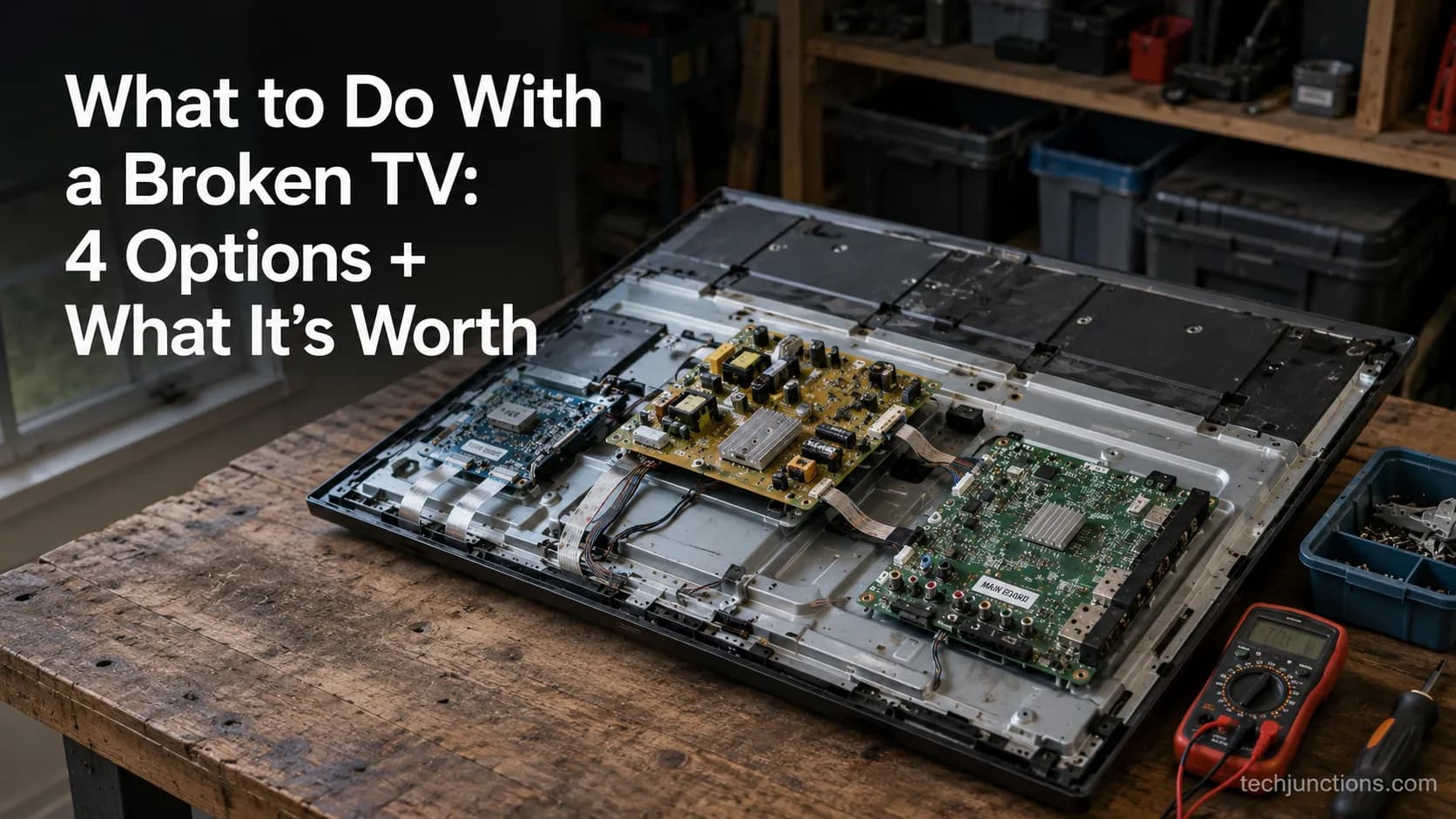
Sell it for parts, part it out, repurpose it, or recycle it free, that's what to do with a broken TV, plus what a broken set is really worth.
Comments
Moderated for quality. Share a correction, ask a follow-up, or tell us what worked for you - every comment is reviewed before it goes live.