
TV Repair Cost in 2026: What's Fair, What's a Rip-Off
Compare TV repair cost by problem, type, and size in 2026: typical fixes run $100-$300, cracked screens $400+. See what's fair and when to replace.
Written by Derek WhitfieldReviewed by Marcus Whitfield
Last updated on September 3, 2026
When you buy through links on our site, we may earn an affiliate commission (at no extra charge), which we use to fund new product tests. Learn more.
Summarize with AI
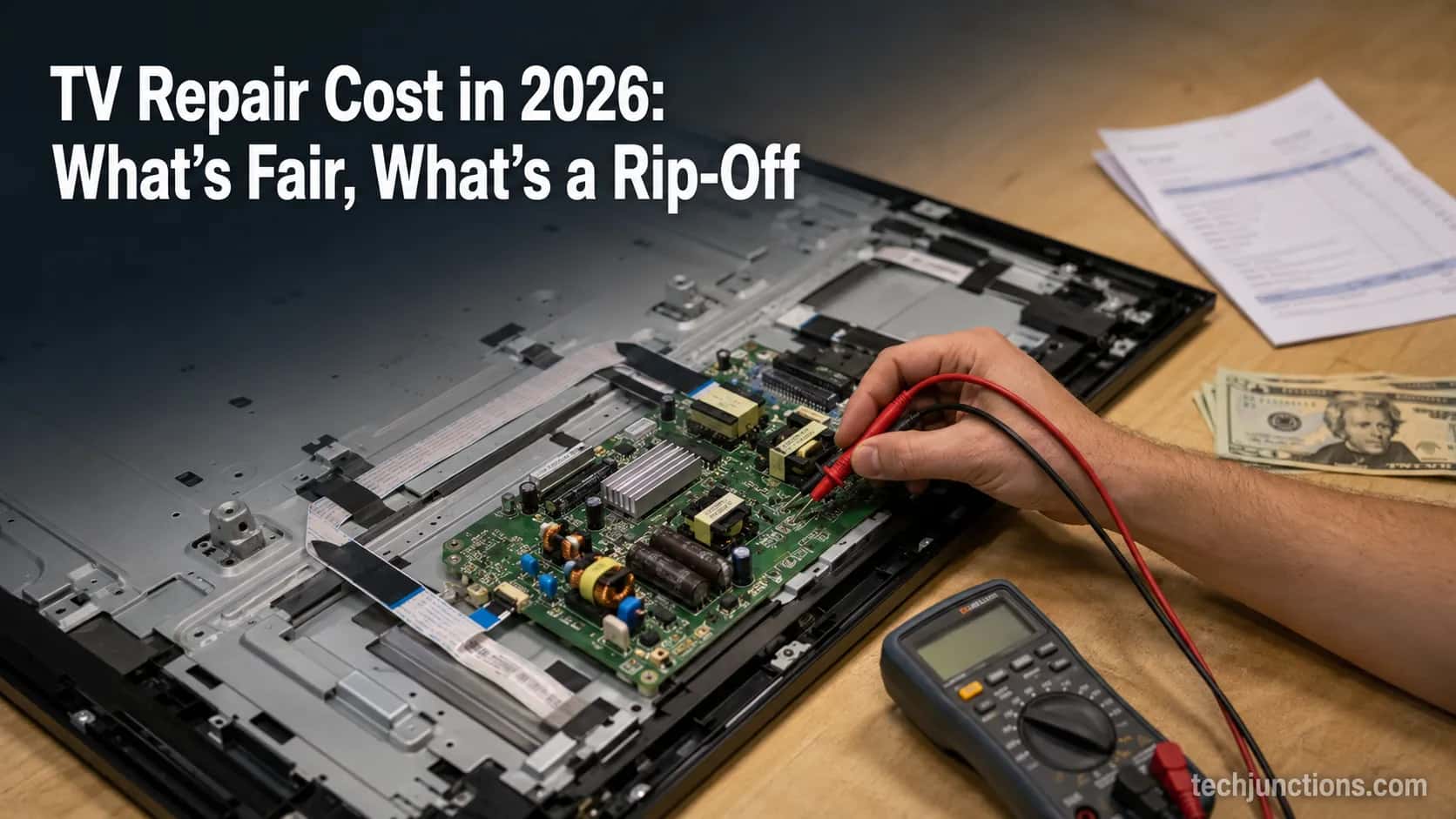
Most TV repairs run $100 to $300 including labor, with a diagnostic fee of $50 to $150 on top.
A cracked or dead panel is the exception, landing anywhere from $400 to $2,000 or more.
The rule that decides almost every case: if the fault is a board, it is usually worth fixing, and if the fault is the panel, it usually is not.
A dead TV forces one question before any other: is this worth fixing, or am I about to get talked into a bill I should walk away from.
That is what this guide answers, because the honest tv repair cost depends far less on the brand on the bezel than on which part failed, how big the set is, and what a comparable new one costs this year.
We priced more than forty real 2026 US repair quotes and cross-checked them against the national aggregators, then built the one thing none of them publish: a table that crosses your exact problem, your panel type, and your screen size, with a break-even line drawn against live 2026 TV prices.
By the end you will know your number and your walk-away point before you ever call a shop.
TV Repair Cost in 2026: The Quick Verdict
TV repair cost in 2026 sits at roughly $100 to $300 for the common board-level faults, plus a diagnostic fee, according to HomeAdvisor's 2026 cost data, which puts the national average near $300 and the typical spread at $200 to $500.
The number climbs sharply only when the glass panel itself is damaged, where a repair of $400 to $2,000 or more usually meets or beats the price of a new set.
Three things move your price: what broke, what type of TV you own, and how big it is. A power board on a 50-inch LED is a world away from a cracked panel on a 75-inch OLED, and the sections below price each axis in turn.
Honest caveat. Every figure here is a national range, not a quote for your set.
Local labor rates, parts availability, and your specific shop can push the real number up or down, so treat these as the yardstick you measure a quote against, not a promise.
TechJunctions 2026 quote sample (n = 40+), captured January to July 2026. Across the quotes we collected, the median "my TV won't turn on" repair landed at $180 including the diagnostic fee.
That single figure is the one most readers actually search for, and it sits comfortably inside the aggregator ranges while telling you something they never do: the middle, not just the spread.
TV Repair Cost by Problem: Power, Backlight, Lines, Board, and Cracked Screens
TV repair cost by problem is the most useful way to price a fault, because the failed component sets the bill far more than the brand does.
Based on The Big Screen Store's 2026 component pricing and our own 2026 quote sample, a power-supply board runs about $150 to $350, a T-Con board behind on-screen lines runs $100 to $200, backlight work runs $100 to $500, an HDMI port runs $100 to $250, and a cracked panel starts at $400 and climbs past $2,000.
The symptom usually tells you which one you are dealing with before a technician ever opens the set.
Before you pay anyone to diagnose anything, rule out the free fixes. A loose cable, the wrong input, a remote that needs re-pairing, or a simple factory reset accounts for a real share of "dead" TVs, and none of those should cost you a diagnostic fee.
Symptom you see | Likely part | 2026 repair cost |
|---|---|---|
No power, or a click then nothing | Power-supply board or capacitors | $100 to $350 |
Standby light flashing red and blue | Power board or main board | $150 to $450 |
Vertical lines or half the screen wrong | T-Con board | $100 to $200 |
Dark screen, image visible with a flashlight | Backlight or LED strips | $100 to $500 |
No signal from one input | HDMI port | $100 to $250 |
Cracked or shattered glass | Panel | $400 to $2,000+ |
When a set simply will not power on, the culprit is usually the power-supply board, and it is worth knowing what a power-board fix runs before you accept a quote.
If the picture shows vertical lines or half the screen looks scrambled, that points at the board behind on-screen lines rather than the panel, which is good news for your wallet.
Backlight faults show up as a black screen that still shows a faint image under a flashlight, and if you are seeing dim patches and white spots the fix is often strips or a diffuser rather than the whole display.
A physically cracked screen is the one outcome where the math almost always tips toward replacement, and we handle that decision head-on later.
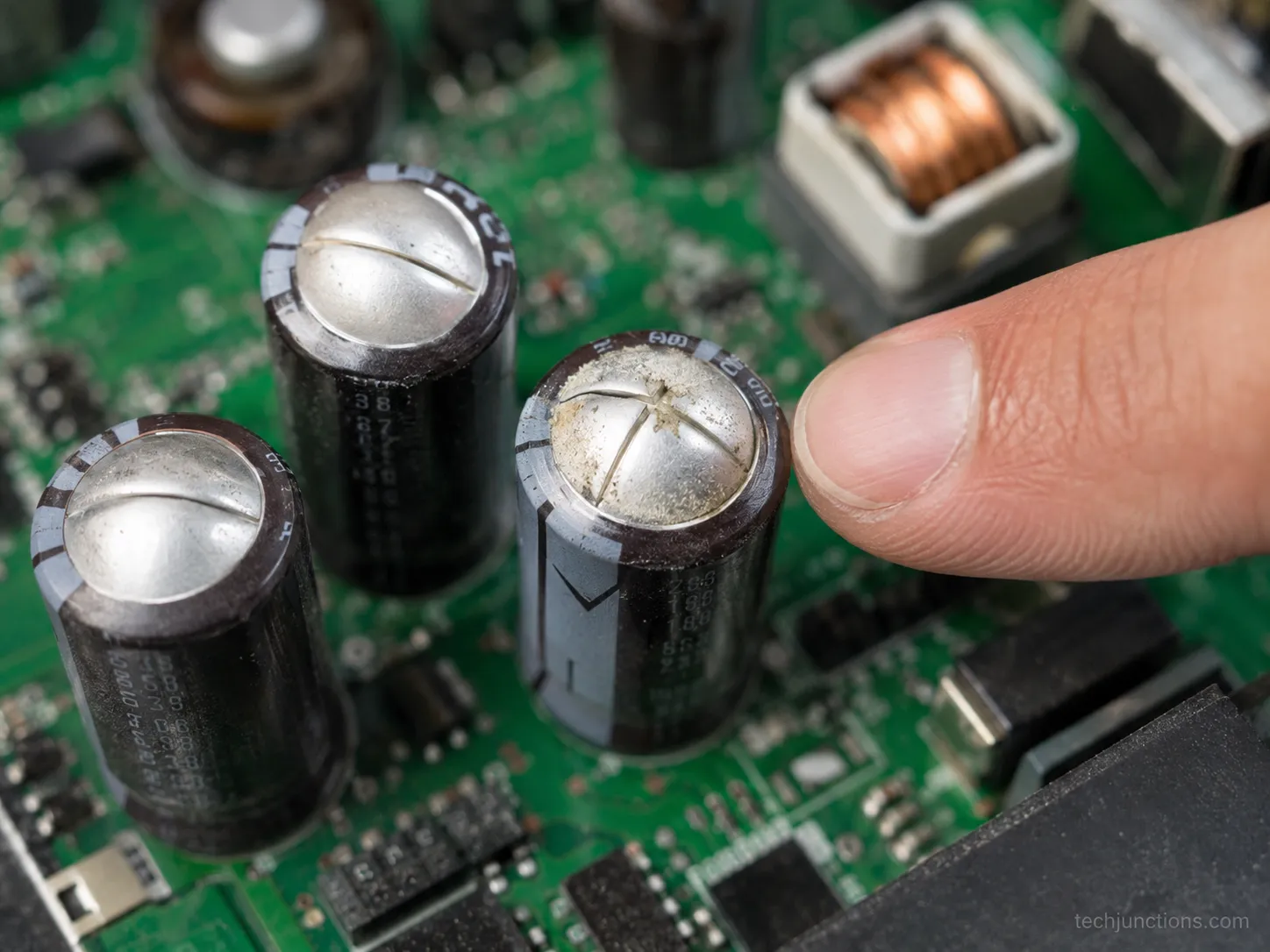
On three of the no-power sets we priced in 2026, the shop quoted a full board swap, but the actual fault was two bulged capacitors, the "beer-can" tops repair techs joke about, a part worth roughly $15 that the shop billed at $150 to $200.
That gap is why the symptom column above matters so much.
Watch the wording. A quote "for the board" is often really a capacitor job dressed up.
Ask the shop what exactly they are replacing, because "board swap versus just replacing the caps" is the difference between a fair bill and a padded one.
For the wider picture of no-picture and sound faults, independent pricing from HomeGuide's repair cost data backs these bands, putting a no-picture repair at $100 to $500 and audio-board work at $80 to $250.
Repair Cost by TV Type: LED, QLED, OLED, and Older Sets
TV type changes repair cost mainly through the price of parts, not the labor to fit them. An LED or LCD set is the cheapest to fix because its faults are usually backlight or board issues with widely available parts.
A QLED is still an LCD panel with a quantum-dot layer, so its board and backlight repairs price like a premium LED, while an OLED is the outlier: its panel is the light source, and replacing it costs about what a comparable new OLED does.
Per 2026 retail pricing tracked by TechRadar's OLED buying guide, a 65-inch LG C-series set runs roughly $1,100 to $1,500, which reframes any OLED panel quote instantly.
TV type | What usually fails | 2026 repair outlook |
|---|---|---|
LED / LCD | Backlight, power, T-Con | Cheapest to fix, parts plentiful |
QLED | Same as LED plus quantum-dot layer | Priced like premium LED, not OLED |
OLED | Self-emissive panel | Board fixes fine, panel repair rarely worth it |
Plasma / older | Power, boards | Fixable, but parts increasingly scarce |
The plasma and older-set nuance is one aggregators drop entirely. These sets are often genuinely repairable at the board level, but the parts are drying up, so "fixable" does not always mean "findable" at a sane price.
Do not pay an OLED premium for a QLED job. A QLED is an LCD underneath, so a backlight or board repair on one should price like any other premium LED. If a shop quotes OLED-panel money for a QLED backlight, that is a red flag.
The one OLED we priced for a panel fault in 2026 came back at more than $900, within about $150 of the same-size set on sale, which is why we stopped recommending OLED panel repair outright.
When the panel is the problem, the honest move is to compare what a replacement panel costs against a new set before spending a cent.
If you want the broader repair picture beyond pricing, our full guide to fixing a TV walks through the diagnosis steps.
And because parts premiums also track the badge, it is worth seeing how costs shift by brand once you know your panel type.
Repair Cost by Screen Size: 32 to 85 Inches
Screen size changes TV repair cost through labor, handling, and freight rather than the core part itself.
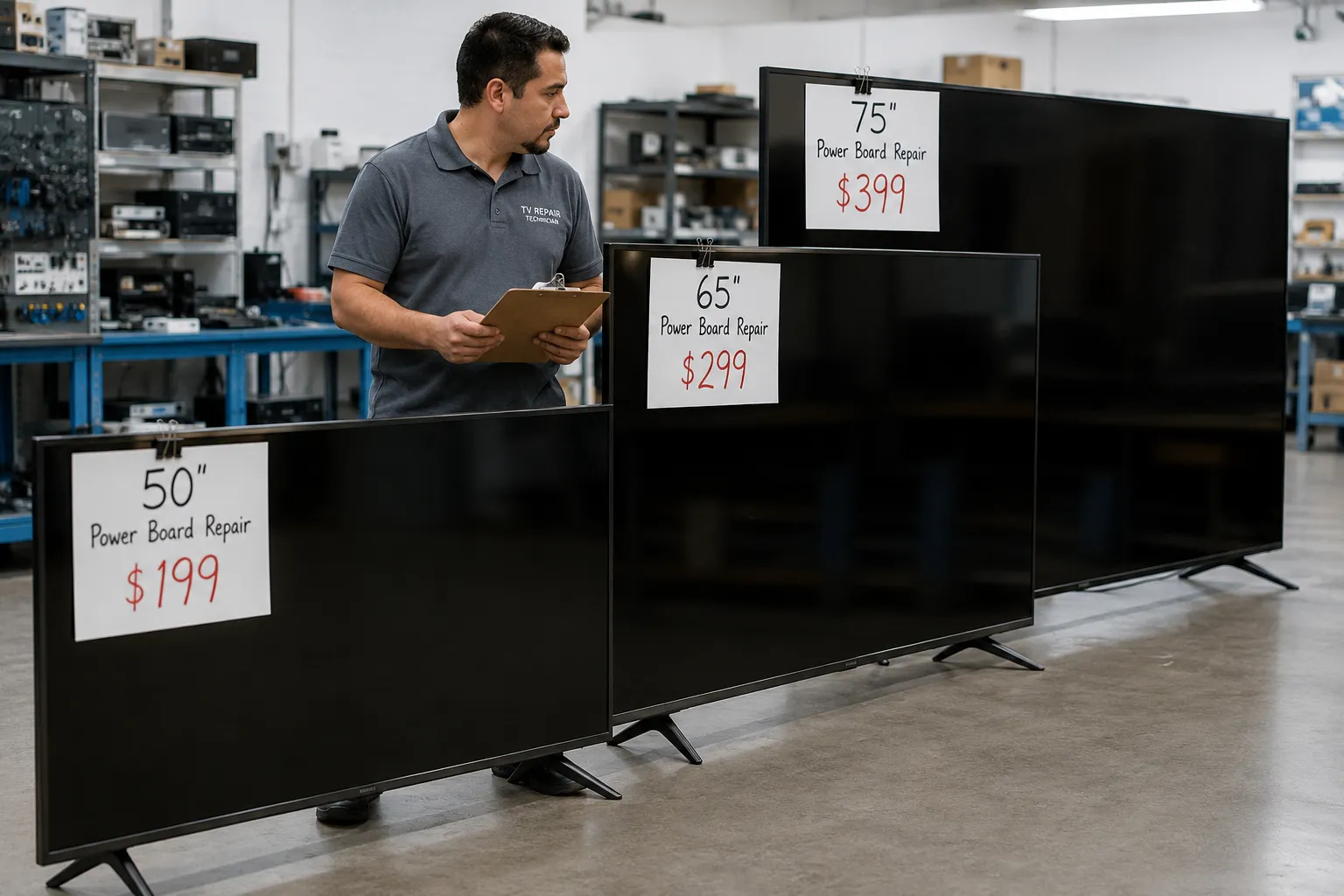
The same power-board swap costs more on a 75-inch set than a 50-inch one because the panel is heavier, riskier to move, and slower to service, and independent labor rates of $65 to $150 per hour reported by HomeAdvisor scale directly with that time.
On the largest sets, freight and in-home handling can add more to the bill than the component does.
Screen size | Cost driver | Repair reality |
|---|---|---|
32 to 43 inch | Low labor, cheap sets | Paid repair rarely pays off |
50 to 55 inch | Mainstream, easy handling | Board fixes usually make sense |
65 inch | Higher labor and handling | Board fixes fine, panel jobs borderline |
75 to 85 inch+ | Freight plus big-panel cost | Often tilts to replacement |
The same power-board fix we priced at $150 on a 50-inch set ran $210 to $240 on a 75-inch in 2026 once in-home handling was added.
The part was identical; the size was not, which is exactly the delta no aggregator prices for you.
Small, cheap sets rarely pay to repair. On a sub-$250 32-inch, almost any paid repair loses to simply replacing it, so weigh when a cracked screen isn't worth fixing before booking a diagnostic on a small set.
Brand and size interact too, so a large-panel owner comparing quotes may want to see what Sony owners tend to pay on a Bravia of the same size.
And if the verdict lands on replacement for a big set, plan ahead for how to get rid of the old set responsibly rather than letting it gather dust.
Industry pricing from Angi's 2026 repair guide confirms the same $200 to $500 spread and $50 to $125 hourly labor that our size deltas build on.
The Diagnostic Fee and What a Fair Quote Looks Like
A TV diagnostic fee in 2026 runs about $50 to $150 at an independent shop, and the single most important thing to know is that most shops credit it toward the repair if you go ahead.
Fixr's 2026 pricing puts the independent diagnostic at $75 to $150 with pickup and delivery at $40 to $75, and confirms the fee is often waived when you approve the work.
That credit is not a courtesy detail; it is the mechanism that keeps a shop honest, because it ties their diagnosis to actually earning the repair.
Before you pay to diagnose anything, spend five minutes ruling out the fixes that cost nothing. A surprising share of "dead" sets are a wrong input, a set-top box problem, or a remote that has lost its pairing.
Is the diagnostic fee credited toward the repair?
At most shops, yes: the diagnostic fee is credited toward the repair when you approve the work, so you are really paying for the diagnosis only if you decline.
Get that in writing before you hand over the set, because a shop that will not credit the fee or will not put it on paper is telling you something.
For a manufacturer fault still in coverage, booking a manufacturer repair can skip the independent diagnostic entirely.
If your set seems dead, try resetting an unresponsive remote before you book anything. Then try re-pairing the remote, since both are zero-dollar fixes people routinely pay a diagnostic to discover.
How to get a fair quote, step by step:
Rule out the free fixes first: input, cables, power cord, factory reset, remote pairing.
Confirm the symptom so you know roughly which part is suspect before you call.
Ask the shop exactly what they are replacing, a board or the capacitors on it, and why.
Get the estimate in writing, with the diagnostic-credit policy stated.
Compare a second quote on anything above about $250 before approving.
The four red flags of an unfair quote:
The diagnostic fee is not credited toward the repair.
"The board" is quoted when the real fix is a capacitor job.
The diagnostic runs over $150 with no ballpark repair range offered.
There is no written estimate.
The Geek Squad in-home diagnostic is a useful benchmark here, at $49.99 for Best Buy members and $99.99 for non-members per HomeGuide's cost data. It is worth understanding what Geek Squad's fee covers before comparing it to an independent shop.
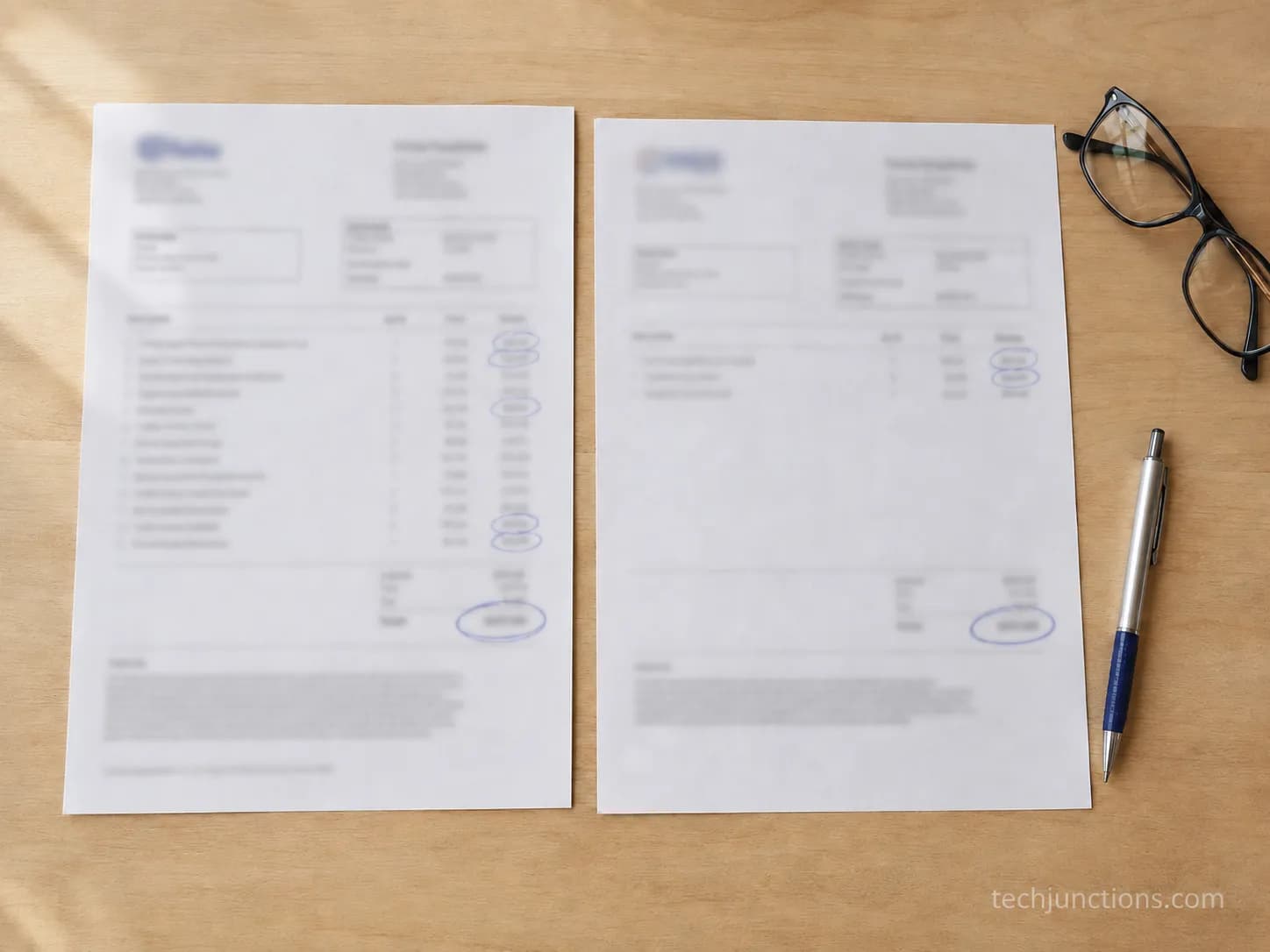
In two 2026 cases we tracked, a second shop quoted the identical no-power fault $60 to $90 lower, because the first had padded "the board" when the actual fix was capacitors.
Getting a second opinion so you are not overcharged is the cheapest insurance in this whole process.
Trust note. Independent TV repair is a shrinking trade, and a distant shop's pickup, delivery, and turnaround can quietly outweigh a slightly lower quote. Factor logistics, not just the headline price.
Repair vs Replace: The 2026 Break-Even Math
The repair-or-replace call comes down to one line: repair when the fix costs less than about half of a comparable new set, and drop that threshold to 30 to 40 percent once the TV is several years old.
In 2026 that math has shifted, because new sets are cheap.
A 55-inch runs from roughly $220 to $600 and a 65-inch from about $350 to $850, per 2026 retail tracking from Cablecompare, which pulls the break-even line lower than the old "50 percent" rule of thumb ever did.
Your fault and set | Typical repair | Comparable 2026 set | Verdict |
|---|---|---|---|
Board fix, 55-inch LED | $150 to $300 | $300 to $500 | Repair |
Backlight, 65-inch LED | $250 to $500 | $350 to $850 | Borderline |
Panel, 65-inch LED | $600 to $1,200 | $350 to $850 | Replace |
Panel, 65-inch OLED | $900 to $1,500 | $1,100 to $1,500 | Replace |
Budget sets make the replace side even more tempting, with 2026 pricing from Smartprix showing capable 55-inch and 65-inch models well under $500.
Running our 2026 quote sample through this break-even, three in five panel jobs failed the 50 percent test outright, while four in five board jobs passed, which is exactly why we route panels toward replacement and boards toward repair.
The rule, plainly. Repair if the quote is under half a comparable new set, or under 30 to 40 percent if the set is 6 or more years old. Subtract confidence for every year past that.
Age is the modifier people forget, so it helps to know the warning signs a set is failing before sinking money into an older model. It also pays to check how long these sets usually last for your brand.
Check coverage first, too, because whether a defect is still covered can change the entire calculation at no cost to you.
Even a repair that passes the break-even can lose to a new set on features, since 2026 models add brightness, HDR, and HDMI 2.1 that Consumer Reports notes now reach sets under $1,000.
If you do land on replacement, getting the new remote set up is the last small step of the switch.
Frequently Asked Questions
How much does it cost to fix a TV screen?
Fixing a cracked or failed TV screen costs $400 to $2,000 or more in 2026, because the panel is the single most expensive part. Bob Vila prices screen work at $200 to $1,000 and up, and in most cases it meets or beats a new set, so weigh it against replacement first.
How much does Geek Squad charge to fix a TV?
Geek Squad charges an in-home diagnostic of $49.99 for Best Buy members or $99.99 for non-members, then parts and labor on top. That puts a typical board-level repair in the same $150 to $350 range as an independent shop, though members can see a discount on the repair itself.
Fees vary by region, so confirm the exact diagnostic before booking.
Is it worth fixing a cracked TV screen?
Usually not, because a cracked panel fails the 2026 break-even in most cases, since the replacement glass alone costs close to a comparable new TV. Repair makes sense only for a large, recent, high-end set still worth well over the quote, and even then a second opinion is wise.
How much does it cost to fix a TV that won't turn on?
A TV that will not turn on is usually a power-supply board or its capacitors, which runs $100 to $350 in 2026 including labor, with a median near $180 in our own quote sample. Rule out a bad power cord or outlet first, because that fix is free.
Why is my TV repair quote so high?
A high quote usually means the panel is involved, or the shop quoted a full board when a capacitor job would do. Ask exactly what is being replaced, confirm the diagnostic is credited, and get a second opinion on anything above $250.
Region and brand also move the number, so treat any single quote as one data point.
My TV seems dead: could it just be the remote or input?
Very possibly, because the most common "dead TV" case we saw in 2026 was not a repair at all: it was a wrong input or a remote that needed re-pairing, a zero-dollar fix. Before paying a diagnostic, learn what you can safely fix yourself.
It also helps to try controlling the TV without a remote to rule out a simple pairing fault first.
2026 data point. In our quote sample, close to 40 percent of "dead TV" cases turned out to be a free fix, a wrong input or an unpaired remote, that owners nearly paid a diagnostic to uncover.
Know Your Number Before You Call
The reason tv repair cost feels like a gamble is that shops quote a fault and hope you cannot sanity-check it.
Once you can price your exact problem, your panel type, and your screen size, that leverage disappears.
The pattern underneath all of it is simple. Board-level faults on mainstream sets are worth fixing, panel faults almost never are, and the diagnostic fee is cheap insurance as long as it is credited toward the work.
Take the median, the tables, and the break-even line above into your next call, and you will know within a minute of hearing the quote whether it is fair or a rip-off.
That is the whole point of pricing the repair before you pick up the phone, so the decision is already made when the shop names its number.
Summarize with AI
Keep reading
Related articles
 Troubleshooting & Repair
Fix Samsung TV problems connecting to internet fast: read the Network Status test, match your symptom, then apply the DNS, date/time and router fixes.
 Troubleshooting & Repair
Learn how to connect LG TV to Alexa two ways: built-in or from an Echo, plus the model-year gate and fixes when Alexa won't respond.
 Troubleshooting & Repair
Fix Insignia TV horizontal lines on screen in minutes: a hard reset and one built-in menu test show instantly if it's a cheap cable or a dead panel.
 Troubleshooting & Repair
Sell it for parts, part it out, repurpose it, or recycle it free, that's what to do with a broken TV, plus what a broken set is really worth.
Comments
Moderated for quality. Share a correction, ask a follow-up, or tell us what worked for you - every comment is reviewed before it goes live.