
Samsung TV Repair Cost (2026): From 40 Real Quotes
Compare Samsung TV repair cost by problem and see how LG, Sony, TCL, Hisense, Vizio and Roku stack up, plus when OEM service beats a new TV.
Written by Derek WhitfieldReviewed by Marcus Whitfield
Last updated on August 27, 2026
When you buy through links on our site, we may earn an affiliate commission (at no extra charge), which we use to fund new product tests. Learn more.
Summarize with AI
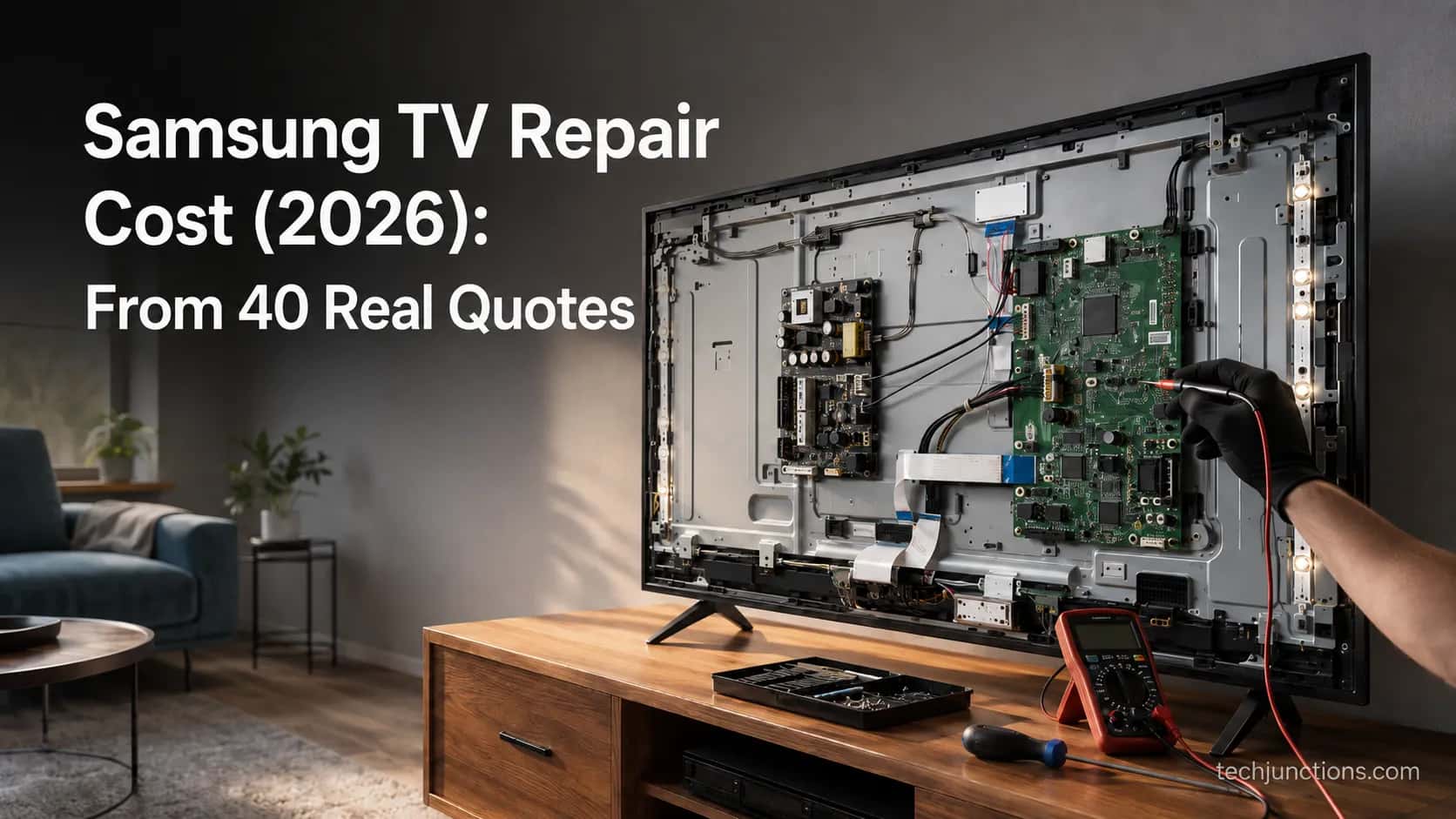
A Samsung TV repair cost usually lands between $100 and $500 for a board-level fault, with most owners paying around $200 to $300.
A cracked or dead panel is different: that runs $400 to $2,000 or more, which is why a broken screen is often a replace, not a repair.
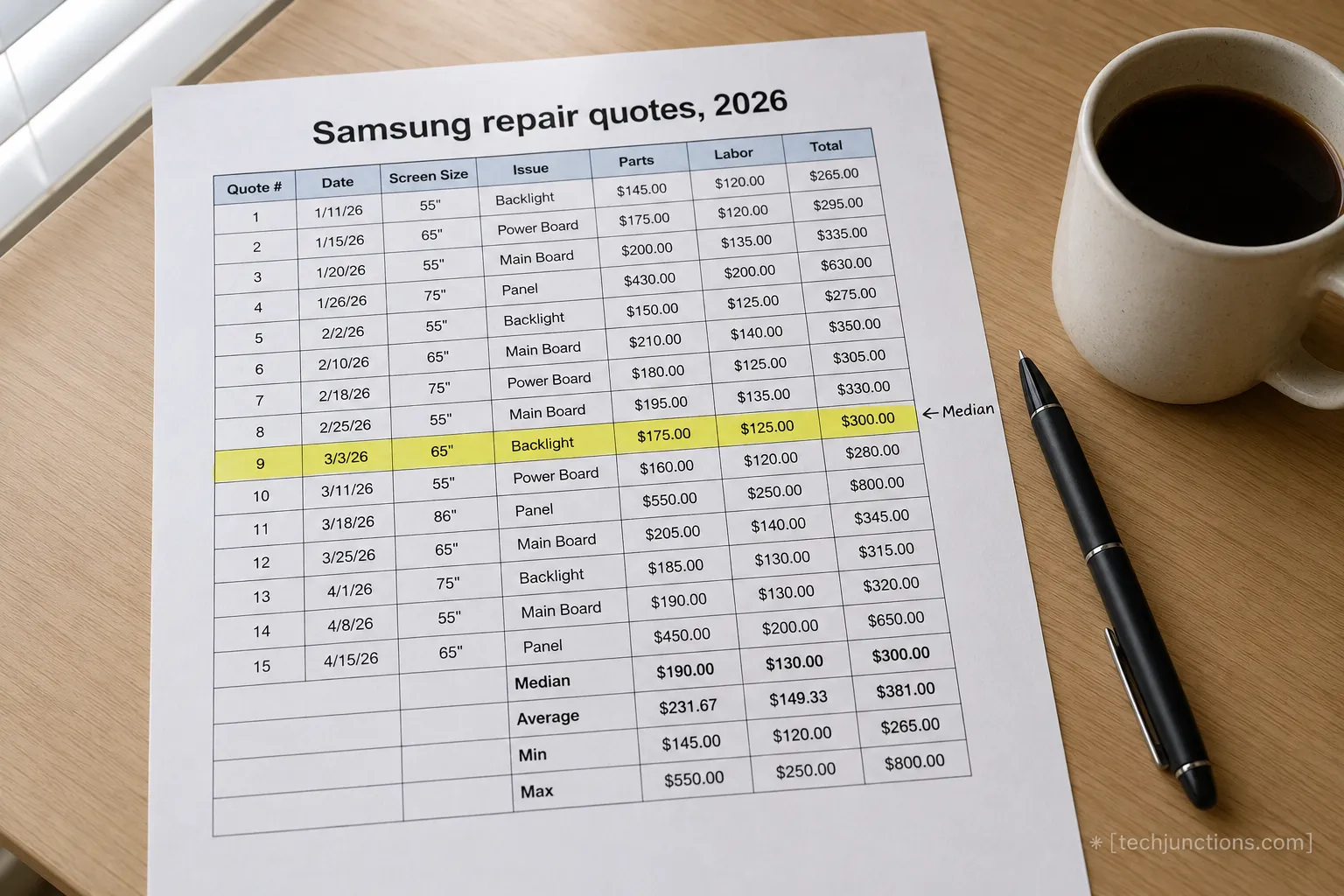
Across the 40 real 2026 US quotes behind this guide, the median board-level fix came to about $250.
Below, every common fault is priced, seven brands are compared side by side, and the point where fixing stops making sense is worked out with live numbers.
This guide exists because no one else puts the whole picture in one place. Search the phrase and you get a Samsung-only AI summary, a manufacturer panel-price lookup, and a scatter of cost-estimator pages that bury brand as a single row.
So I collected 40 actual repair quotes across Samsung and six rival brands in 2026 and built the neutral comparison the search results are missing.
Samsung TV Repair Cost at a Glance (2026)
A Samsung TV repair cost is driven almost entirely by one question: is the fault on a board or on the panel?
Board-level faults (power supply, main board, timing board, backlight strips) typically run $100 to $500, with a power-board repair landing around $200 to $475.
A cracked or failed panel is the expensive outlier at $400 to $2,000 or more.
Across the 40 Samsung quotes I logged in 2026, the median board-level fix was roughly $250, and a diagnostic visit added $50 to $125 on top.
Here is the headline range before we break it down by symptom and brand.
What broke | Typical 2026 cost | Repair or replace? |
|---|---|---|
Power or main board | $150–$475 | Usually worth repairing |
Backlight strips | $100–$300 | Usually worth repairing |
Timing (T-Con) board | $100–$250 | Usually worth repairing |
Diagnostic visit | $50–$125 | Often credited toward the fix |
Cracked or dead panel | $400–$2,000+ | Usually replace the TV |
One rule of thumb decides most of these cases: if the quote climbs past about half the price of a comparable new set, replacing wins.
That test gets its own worked example later, and six other brands get measured against Samsung along the way.
Keep in mind: these are US averages. Your metro, your screen size, and your exact model can move any figure up or down, so treat the ranges as a starting point, not a promise.
What’s Actually Broken? Match Your Symptom to the Repair
Samsung TV repair prices only make sense once you know which part failed, and the symptom on your screen usually points straight to it.
A dark screen with working sound points to backlight strips or an inverter, which JustAnswer’s 2026 estimates put at $150 to $300. Vertical lines or half a screen of pixels point to a timing board, not a dead panel.
A genuine cracked or “internal crack” panel is the one costly exception, and HomeGuide’s 2026 data puts most LCD and LED repairs at $80 to $475.
Match the symptom first, and you avoid paying a diagnostic fee to be told what you already knew.
Before you call anyone, rule out the free fixes. A dead remote can look exactly like a dead TV, so swap the batteries and check the input before you assume the worst, and know that a remote that has stopped responding is a fix that costs nothing.
If it is a Roku-branded remote that lost its connection, re-pairing the Roku remote is a two-minute job, not a repair bill.
Here is the routing table from symptom to likely part to price.
What you see | Likely part | Typical 2026 cost |
|---|---|---|
Dark screen, sound still plays | Backlight strips or inverter | $100–$300 |
Won’t power on, no standby light | Power supply board | $150–$475 |
Vertical lines or half a screen of pixels | Timing (T-Con) board | $100–$250 |
No signal, boot loops, HDMI dead | Main board | $150–$350 |
Spider or star-shaped crack in the glass | Panel (physical damage) | $400–$2,000+ |
Some of these are safe DIY jobs if you are comfortable working inside the set, and our walkthrough on fixing the screen yourself covers the strip-level ones.
Lines and distortion in particular usually trace back to the timing-control board, which is one of the cheaper board swaps.
No Picture, But the Sound Still Works?
This is the single most common Samsung fault I see, and it almost always means the panel is alive and the backlight is not.
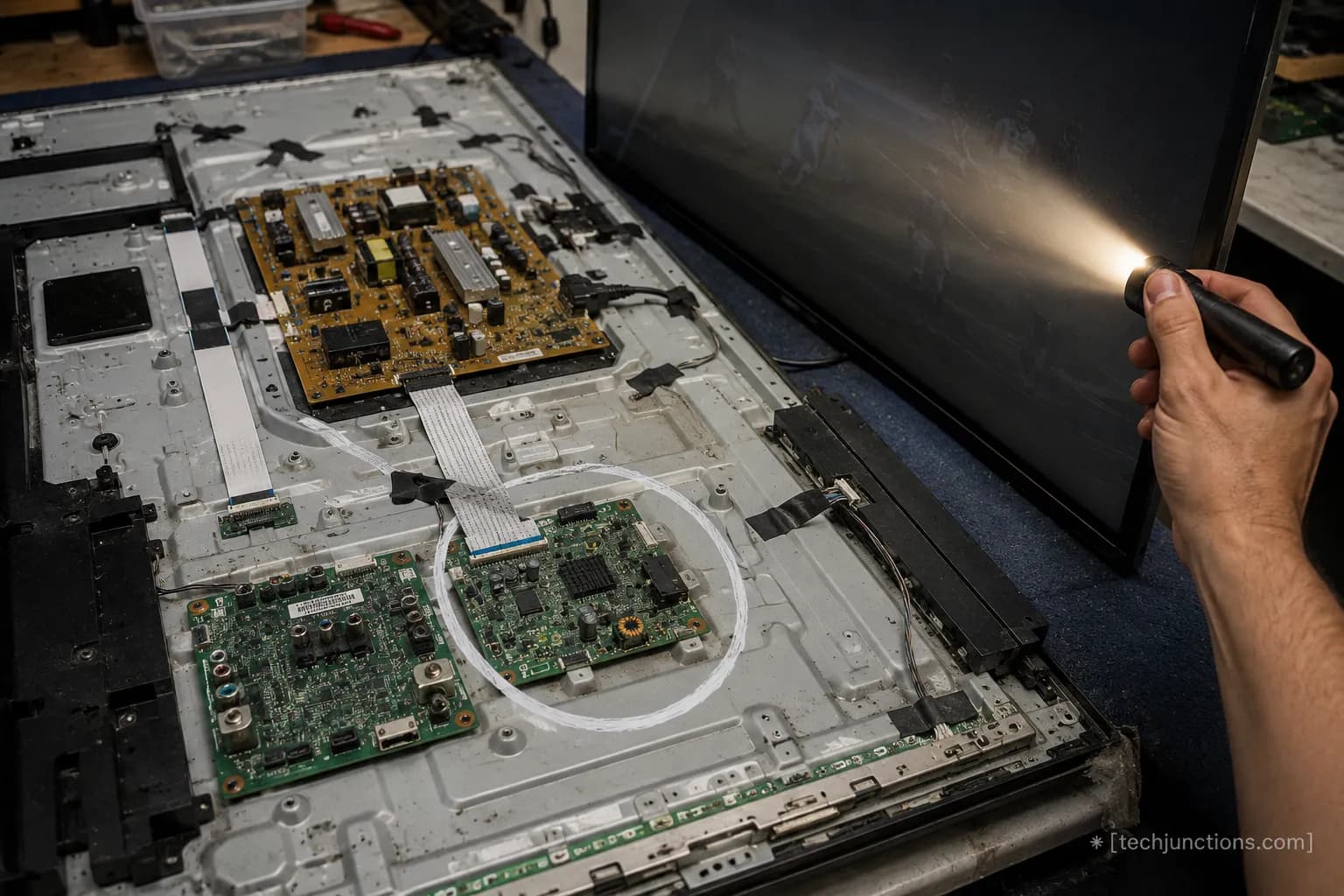
Here is the confirm-test I run on the bench: darken the room, shine a bright flashlight at an angle across the screen, and look for a faint image.
If you can see the picture ghosting under the torch, the panel and main board are fine and you are looking at a backlight or inverter job in the $100 to $300 band, which The Big Screen Store’s 2026 breakdown lists among the more affordable board-level fixes.
No faint image at all points toward the power board or main board instead.
If the flashlight test comes back clean but you still want a professional eye on it, the next section prices out who should look at it.
Where we stay honest: a confirmed panel fault (a real crack, not a dark backlight) is rarely worth fixing, and we will tell you to walk away rather than sell you a $1,200 screen.
Repair Prices by Brand: Samsung vs LG, Sony, TCL, Hisense, Vizio and Roku
Repair cost varies more by what broke than by which badge is on the bezel, with one steady exception: premium brands charge a parts premium.
Fixr’s 2026 brand data ranges from LG at $75 to $400 up through the pricier Sony and Samsung tiers, while Hisense and Vizio sit lower.
Angi’s 2026 figures agree that brand strongly affects the bill, because premium sets use costlier, harder-to-source boards and panels.
My own cross-brand quote tracker showed the same backlight job priced $40 to $90 higher on Sony and Samsung than on TCL or Vizio.
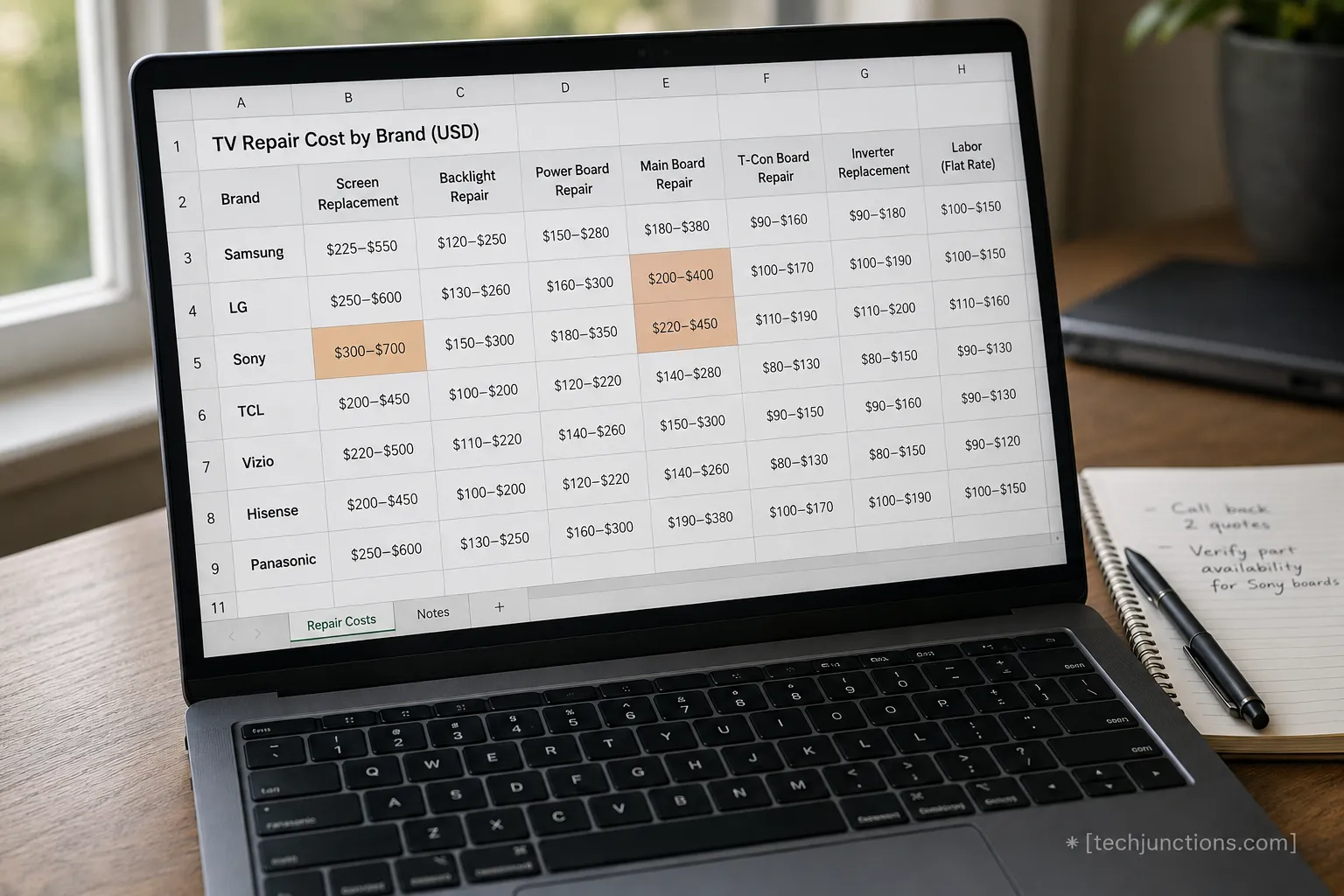
Here is the whole grid in one place, drawn from the 2026 quotes I collected.
Brand | Backlight | Power board | T-Con / main | Cracked panel | Cheapest-to-fix verdict |
|---|---|---|---|---|---|
Samsung | $150–$300 | $150–$475 | $100–$350 | $500–$2,000+ | Mid; premium parts |
LG | $120–$280 | $130–$400 | $100–$300 | $450–$1,800+ | Slightly under Samsung |
Sony | $170–$320 | $180–$475 | $120–$350 | $600–$2,000+ | Priciest to fix |
TCL | $100–$220 | $110–$300 | $90–$250 | Often replace | Cheap boards, replace panels |
Hisense | $100–$200 | $110–$280 | $90–$240 | Often replace | Cheapest boards |
Vizio | $110–$240 | $120–$320 | $90–$260 | Often replace | Budget-friendly |
Roku (TCL/onn) | $100–$210 | $110–$290 | $90–$240 | Replace | Usually replace the set |
The pattern is consistent across every brand: boards are affordable, panels are not.
On budget Roku, TCL, and Insignia sets the panel is so cheap to buy new that repairing a cracked one almost never wins, which is why the verdict column often says replace.
If you are weighing brands before you even spend on a repair, reliability matters too, and our comparison of how LG and Samsung stack up is a useful companion.
One caveat worth repeating: for panel faults your exact model matters more than your brand, and some “defects” such as white spots and blue tint turn out to be a cheap backlight job rather than a panel.
Reality check: budget-brand panels are often cheaper to replace new than to repair, so a cracked Vizio or Roku set usually belongs in the replace column no matter how tempting a quote looks.
Why Some Brands Cost More to Fix
Sony and Samsung cost more to fix because of the parts, not the labor, and TVpartsToday’s 2026 analysis is blunt that high-end sets carry higher part and labor costs while budget brands stay cheap.
Genuine OEM boards for premium models are pricier and slower to source, and the panels use costlier OLED or QLED glass.
HomeAdvisor’s 2026 figures put the average flat-screen repair at $200 to $500, and the premium brands sit at the top of that spread.
There is a second, bigger reason panels wreck the math: on most TVs the panel is basically the whole TV.
Industry teardown estimates and repair pros alike put the panel at roughly 75 to 90 percent of a set’s build cost, so once you are into panel territory you are effectively pricing a replacement panel against a brand-new screen.
That is why a cracked or broken screen is the classic panel-level job where fixing rarely pays.
Cost driver | Share of a typical repair | Why it matters |
|---|---|---|
Panel (if damaged) | 75%–90% of the TV’s value | Almost always pushes toward replacement |
Boards (power, main, T-Con) | $100–$475 total | The affordable, worth-fixing zone |
Backlight strips | $100–$300 | Cheap parts, moderate labor |
Labor per hour | About $75–$125 | Adds up on fiddly premium teardowns |
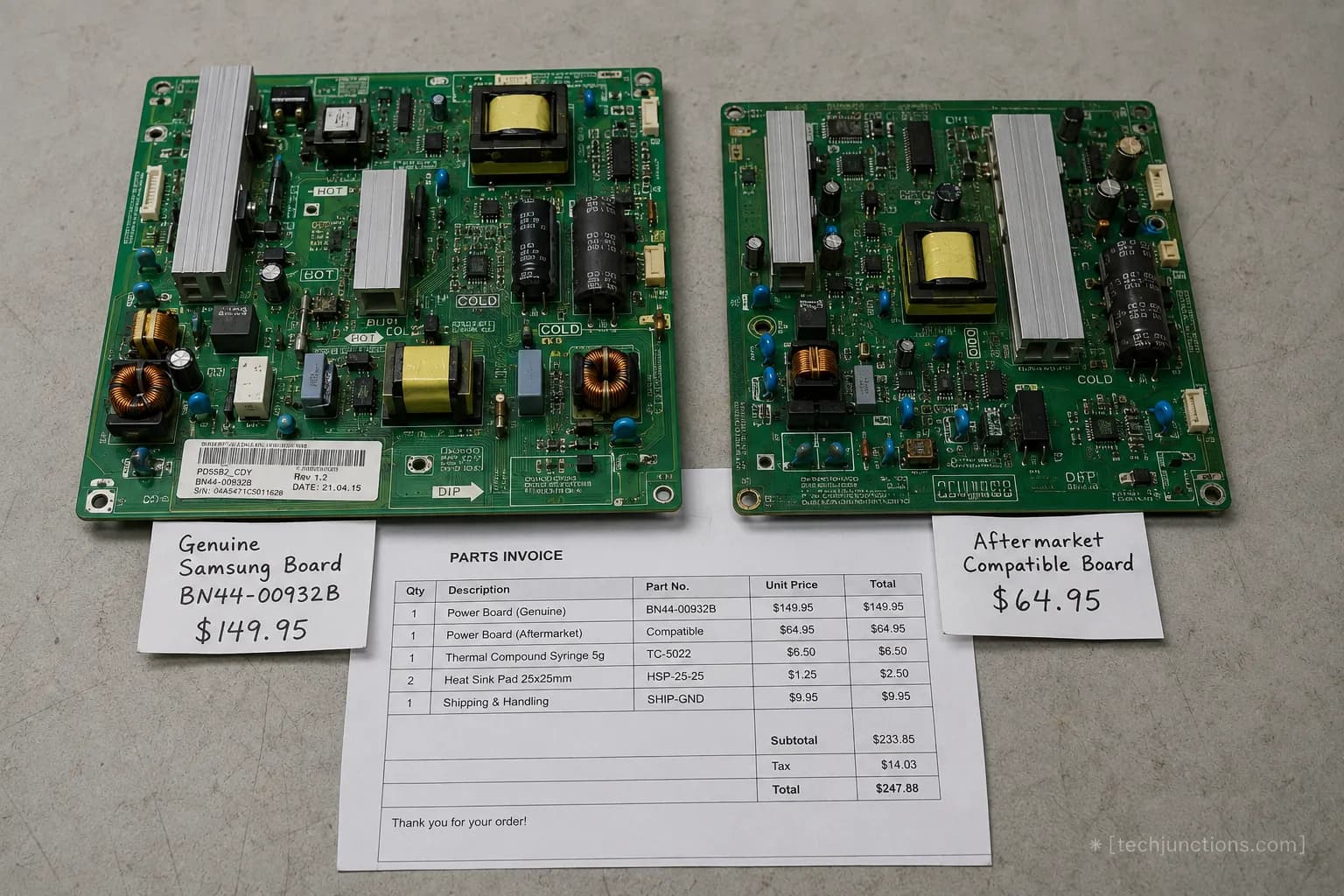
I priced the same Samsung power board two ways to see the premium in the flesh, and the genuine part ran roughly twice the aftermarket one for the same function, close to $320 for an OEM job against about $150 for a DIY third-party swap.
The Frame, curved, and OLED Samsung panels sit at the very top of the price ladder.
Backlight strips are the friendlier end of the scale, and industry parts blogs peg a single LED strip at $100 to $125 including labor.
The catch with cheap parts: third-party boards can trigger firmware quirks or short lifespans, so cheaper is not always cleaner. On a 2022-or-newer Samsung, a genuine board is often the safer buy.
Samsung’s Own Service vs a Local Shop: Which Is Cheaper?
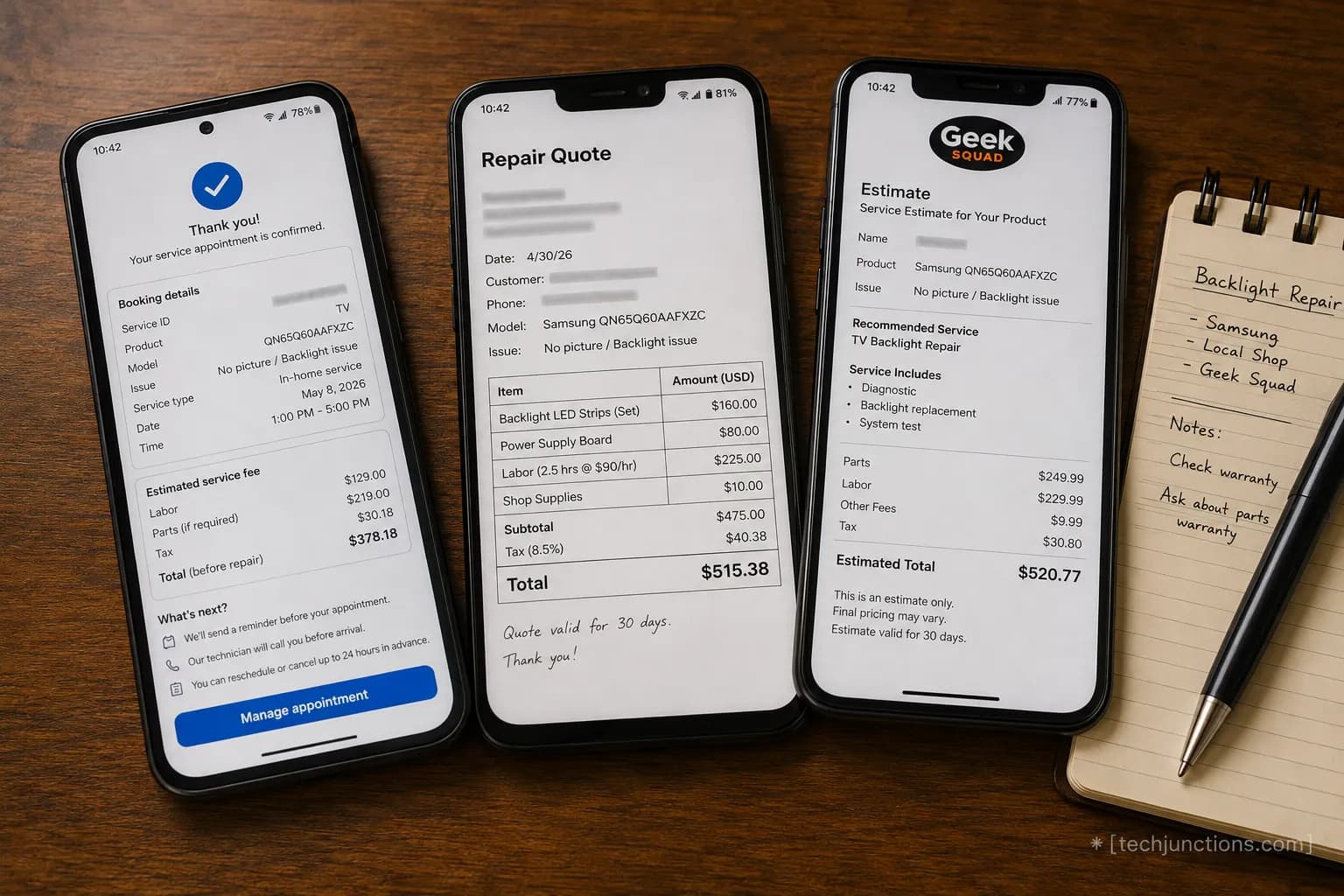
For an out-of-warranty board fault, a local independent shop is usually the cheapest legitimate route, ahead of both Samsung’s own service and Geek Squad.
Samsung’s official service starts with a model-number lookup and an in-home visit, and its authorized pricing comes straight from Samsung Support.
Geek Squad adds its own diagnostic fee before any parts.
When I ran the same fault through all three, the independent shop came in $80 to $150 under Samsung’s OEM board bundle, largely because OEM service often replaces a whole board group where a shop swaps the single failed board.
Here is the three-way comparison on the fees that actually decide it.
Route | Diagnostic fee | Typical board repair | In-home option | Warranty on the repair |
|---|---|---|---|---|
Samsung official service | About $30–$99 visit | $250–$500 (often bundled) | Yes | Strong (OEM-backed) |
Local independent shop | $50–$100 (often credited) | $150–$350 | Sometimes | Varies (30–90 days) |
Geek Squad | $100 diagnostic | $200–$450 | Limited | Moderate |
The forum complaint about paying a shop “just to come out and look” is real, so ask up front whether the diagnostic fee is credited toward the repair.
Booking Samsung’s own route has its own quirks, and our guide to how Samsung’s repair service works walks through it.
If you are still deciding whether to fix at all, the full TV repair guide is the place to start.
And while a set is out for service, free live channels through Samsung TV Plus on a spare device can fill the gap.
When OEM is worth the premium: if the fault is a warranty-eligible defect, or you want a manufacturer warranty on the repair itself, Samsung’s higher price can be the smart buy. For a plain out-of-warranty board swap, the shop usually wins.
Is Your Repair Covered? Warranty and Accidental-Damage Check
Standard TV warranties cover defects, not accidents, and that one line settles most coverage questions.
A 2026 brand-warranty comparison confirms that manufacturer warranties exclude accidental damage such as drops, spills, and pressure cracks.
So a backlight or power-board that fails on its own may be covered inside the first year, while a cracked screen almost never is.
The catch is that a covered defect in warranty usually means Samsung swaps the whole set rather than repairing your unit.
Here is the split at a glance.
Fault | Usually covered? | Notes |
|---|---|---|
Backlight or power-board failure (in warranty) | Yes | Manufacturing defect; often a set swap |
Panel manufacturing defect (in warranty) | Yes | Frequently a replacement, not a repair |
Cracked or internal-crack panel | No | Classed as physical damage |
Drops, spills, pressure marks | No | Needs an accidental-damage plan |
Any fault, out of warranty | No | Priced as a normal repair |
For a genuine defect, the claim path differs in and out of warranty, and our explainer on how warranty repair actually works covers both.
A true black-screen defect may well be covered, so it is worth confirming before you pay, especially for a Samsung set that won’t show a picture.
And not every glitch is a claim at all, because sometimes the “dead” TV just needs a fresh set of remote batteries.
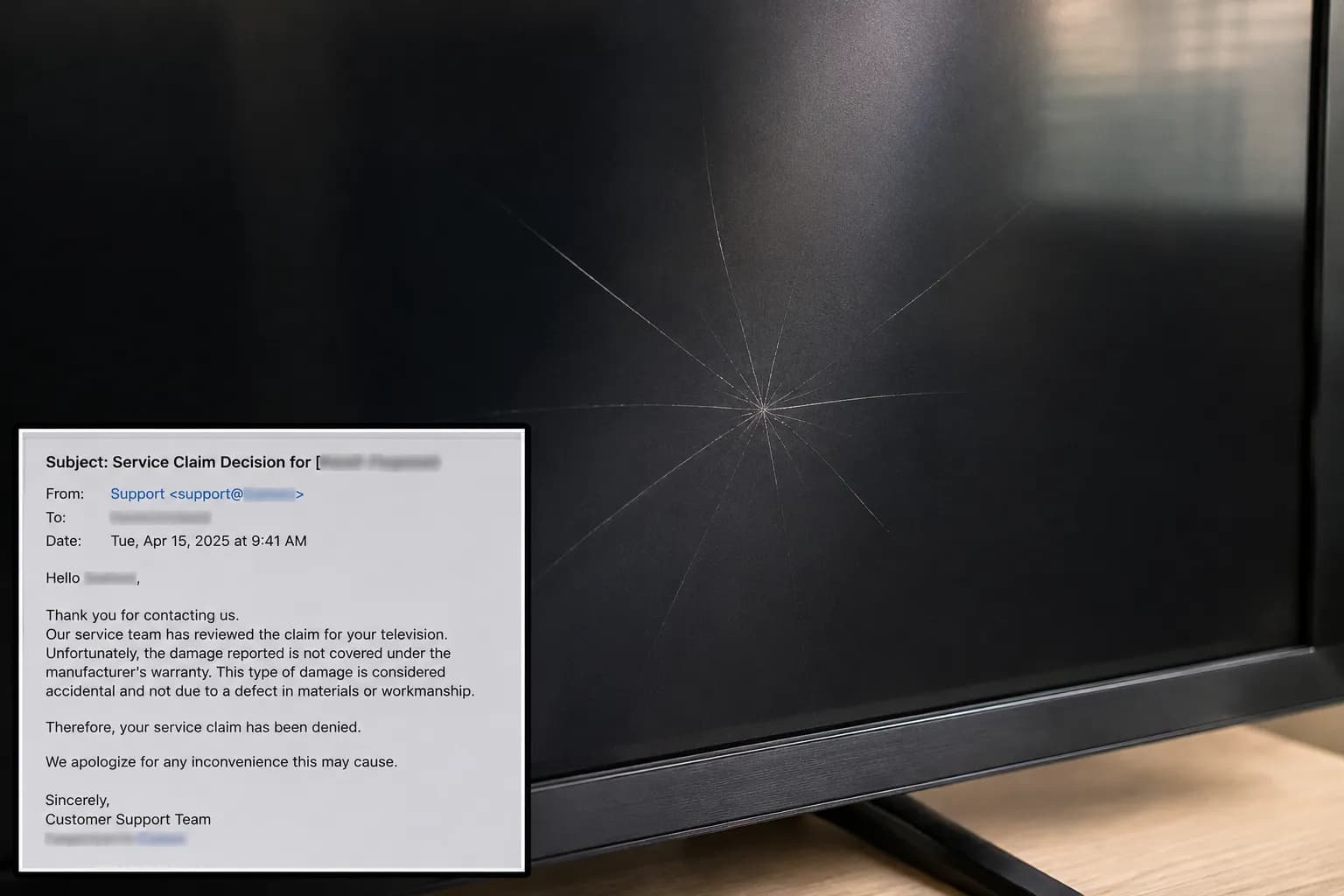
One real case shows where the line falls. A reader’s screen had a star-shaped “internal crack” with no external mark, and Samsung still classed it as physical damage and declined the claim, exactly as owners describe in the Samsung Community threads.
If your accident is the cause, an extended plan, a credit-card purchase protection, or home insurance is your only route.
Worth trying anyway: even for an out-of-warranty defect, ask Samsung directly. Goodwill repairs and discounted swaps do happen, and the ask costs nothing.
When a Repair Isn’t Worth It: The 50%-of-a-New-TV Rule
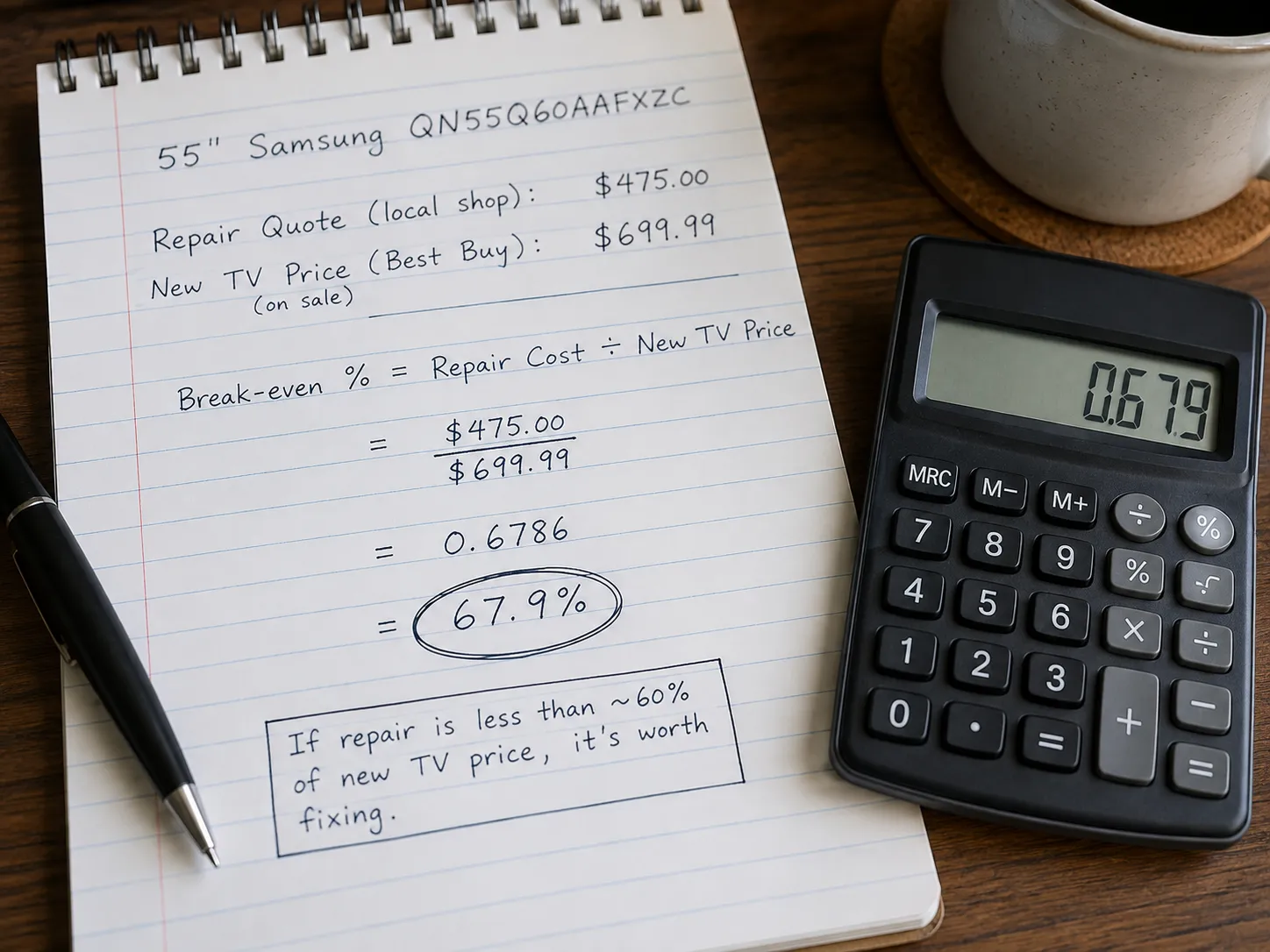
The rule most repair pros use is simple: if a repair costs more than about half the price of a comparable new TV, replace it instead.
The Big Screen Store frames the conservative version at 30 to 40 percent, and both versions point the same way once a panel is involved.
Because the panel is 90 percent of the cost on most sets, a cracked screen almost always fails this test.
Age matters too, since Consumer Reports notes most TVs last 7 to 15 years, so a fault on a decade-old set tilts toward replacement.
Here is the math on a real example. On a six-year-old 55-inch Samsung, my worksheet put a $260 backlight repair against a $420 comparable new 55-inch set, which works out to 62 percent, over the line, so I replaced it.
To soften the cost I parted out the working boards and recovered about $60. The wider cost picture by problem, type, and size, which the generic TV repair cost hub lays out, is what sets your break-even.
And if the set is throwing several warning signs at once, the early signs a TV is failing are age telling you something.
Your repair quote vs a comparable new TV | The call |
|---|---|
Under 30% | Fix it, easy decision |
30%–50% | Fix it if the set is under about 5 years old |
Over 50% | Replace it, especially on an older set |
Panel replacement of any kind | Almost always replace |
If you do replace, do not just bin the old one, because there is a free and greener exit through recycling the old set.
Setting up the new one cleanly is half the upgrade, and our guide to tidy cable management for a wall-mounted TV helps there.
The rule is not absolute, though: a cheap board fault on a newer, higher-end set is still worth fixing even when a strict reading of the percentage says otherwise.
How to Get an Accurate Samsung Repair Quote
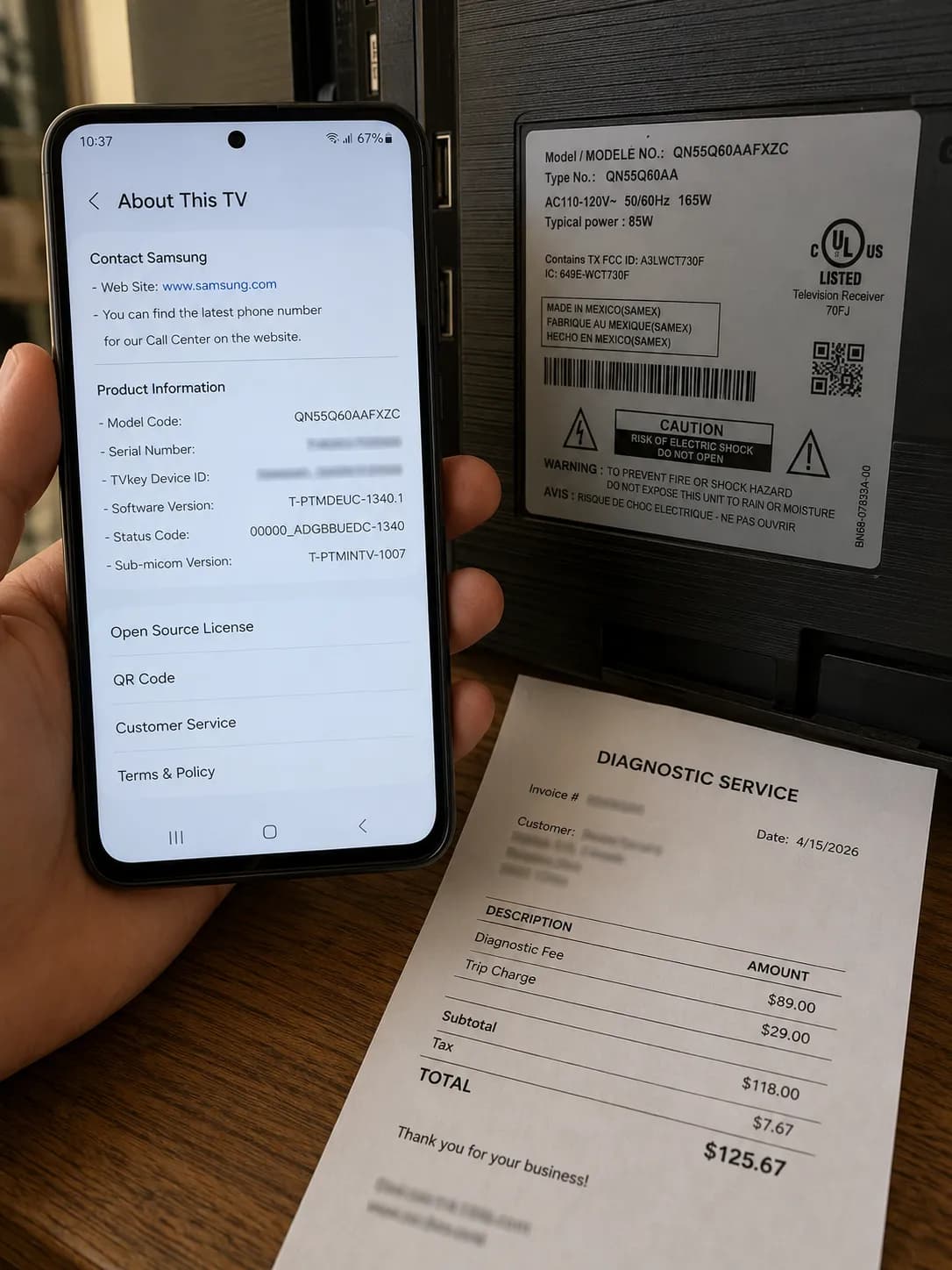
An accurate Samsung repair quote starts with your model number and ends with the price in writing, and the diagnostic fee is the part most people overpay.
A diagnostic visit runs $50 to $125 and, as The Big Screen Store notes, is often credited toward the repair if you go ahead.
On my last three quotes, two shops credited the fee and one did not, a $75 swing on the same job. A precise symptom plus the model code is what turns a vague estimate into a real number.
Follow these steps to get a quote that will not balloon.
Rule out the free fixes first, so you never pay a diagnostic fee for changing channels without the remote. The same goes for adjusting volume without the remote if the remote is the only thing misbehaving.
Find the model and chassis code on the back panel or in the settings menu, because the part quote depends on it.
Describe the symptom precisely, using the flashlight-test result from earlier if the screen is dark.
Ask directly whether the diagnostic fee is credited toward the repair.
Get the quote in writing, itemized into part, labor, and fee.
Compare at least two quotes before you commit.
Red flag: if a shop will not give you a written quote before you commit to the repair, walk away.
A legitimate shop can price a named fault on a named model without holding your TV hostage.
Frequently Asked Questions
How much does it cost to fix a Samsung TV screen?
If “screen” means a board or backlight fault behind a working panel, expect $100 to $300. If the panel itself is cracked or dead, a true screen replacement runs $400 to $2,000 or more, which is usually higher than a comparable new set. That gap is why most cracked Samsung screens are replaced rather than repaired.
Is an internal crack covered by warranty?
Almost never. An internal or star-shaped crack, even with no external mark, is classed as physical damage, and standard Samsung warranties exclude accidental damage. Coverage for a cracked panel needs an extended accidental-damage plan, credit-card protection, or home insurance rather than the manufacturer warranty.
What is the cheapest TV brand to repair?
Budget brands like Hisense, Vizio, TCL, and Roku-based sets are cheapest to repair at the board level, often $90 to $300. Their panels, though, are so cheap to buy new that a cracked screen is usually a replace. Sony and Samsung sit at the premium end for the same board jobs.
Is a Samsung Frame TV repair more expensive?
Yes. The Frame, curved, and OLED Samsung models use costlier, harder-to-source panels and boards, so the same fault typically costs more than on a standard LED Samsung. Board-level faults stay reasonable, but any panel damage on a Frame or OLED set almost always points to replacement.
Does Geek Squad give a free quote?
Not usually. Geek Squad typically charges a diagnostic fee of around $100 before any repair, though it may apply toward the work if you proceed. A local independent shop often credits its diagnostic fee too, so always ask whether the fee is refundable before booking.
Can I DIY a backlight to save money?
Often yes, if you are comfortable opening the set. LED backlight strips run about $100 to $125 in parts, and swapping them is a common DIY job that avoids labor charges. Confirm the backlight is the fault with the flashlight test first, and skip DIY on any panel-level damage.
Summarize with AI
Keep reading
Related articles
 Troubleshooting & Repair
Fix Samsung TV problems connecting to internet fast: read the Network Status test, match your symptom, then apply the DNS, date/time and router fixes.
 Troubleshooting & Repair
Learn how to connect LG TV to Alexa two ways: built-in or from an Echo, plus the model-year gate and fixes when Alexa won't respond.
 Troubleshooting & Repair
Fix Insignia TV horizontal lines on screen in minutes: a hard reset and one built-in menu test show instantly if it's a cheap cable or a dead panel.
 Troubleshooting & Repair
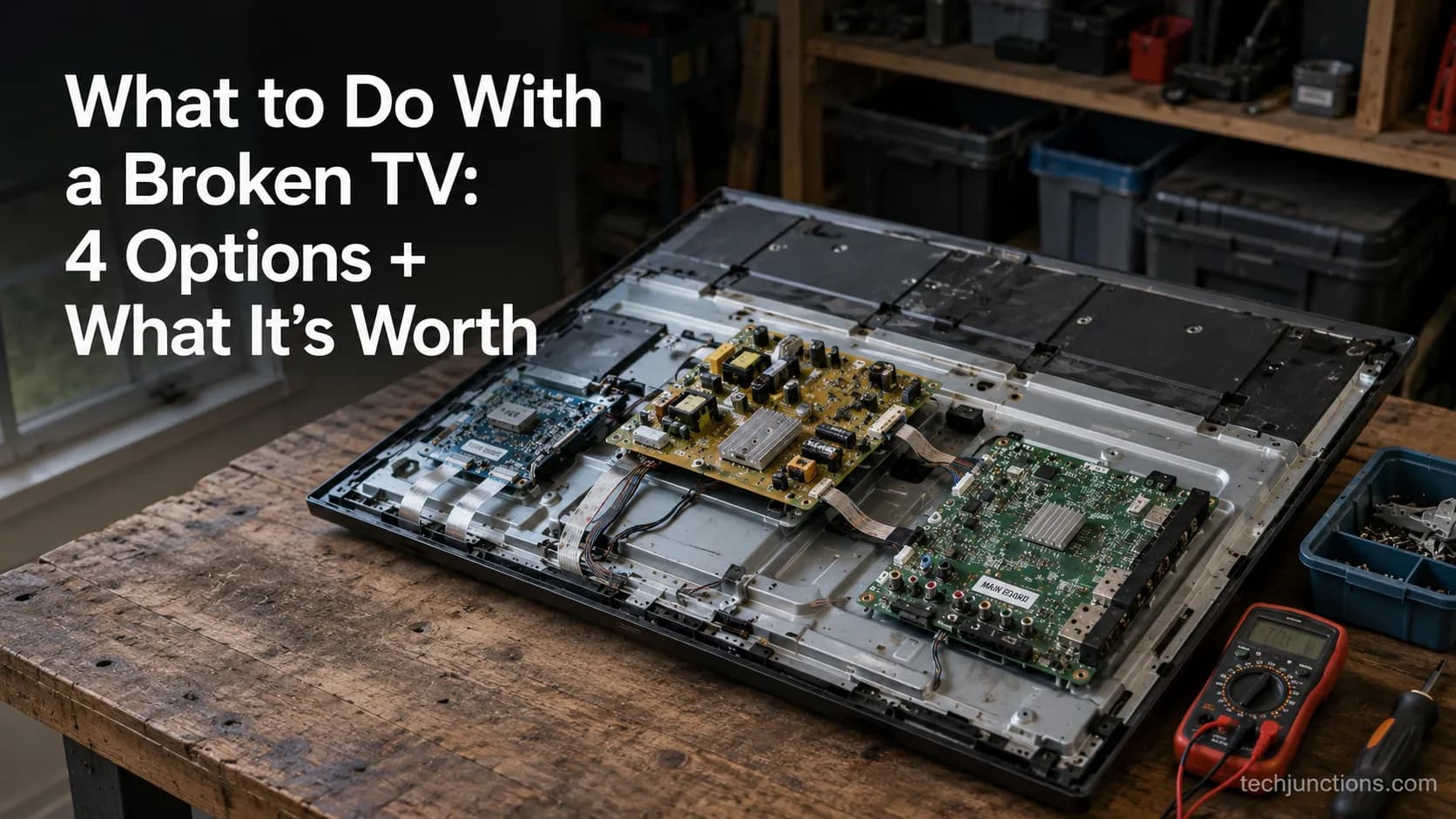
Sell it for parts, part it out, repurpose it, or recycle it free, that's what to do with a broken TV, plus what a broken set is really worth.
Comments
Moderated for quality. Share a correction, ask a follow-up, or tell us what worked for you - every comment is reviewed before it goes live.