
TV Repair in 2026: Fix It, Replace It, or Bin It
Compare TV repair costs by problem, learn the 30–40% repair-vs-replace rule, and see which fixes are DIY, pro-only, or a write-off in 2026.
Written by Derek WhitfieldReviewed by Marcus Whitfield
Last updated on August 26, 2026
When you buy through links on our site, we may earn an affiliate commission (at no extra charge), which we use to fund new product tests. Learn more.
Summarize with AI
Most “dead” televisions are not dead. They are one cheap board or one backlight strip away from working, or they are a genuine write-off you should stop spending money on.
The hard part is telling those two apart before you pay anyone. That is exactly what TV repair comes down to in 2026: a fast diagnosis, an honest number, and a fix-or-replace verdict.
This guide gives you all three. I have spent twelve years fixing televisions, and this year I ran a bench log of eleven broken sets across six brands to pressure-test the advice below.
You will learn what actually breaks, how to guess the fault in about thirty seconds, what each repair really costs, and the simple rule that decides whether to fix it, replace it, or bin it.
Repair a TV when the fix costs under roughly 30 to 40 percent of a comparable new set and the TV is under about five years old.
Replace it when the repair tops half a new set or the panel itself is cracked, because a panel swap runs close to the price of a new television.
Board and backlight faults (no picture but sound, faint image, random shutdowns) are usually cheap and worth fixing; a cracked or shattered screen almost never is.
Roughly three in ten broken TVs are genuinely worth repairing.
TV Repair in 60 Seconds: Is Yours Worth Fixing?
TV repair is worth it far less often than people hope, and far more often than a shop selling new sets will admit.
Industry estimates put the share of broken televisions genuinely worth repairing at around three in ten, according to The Big Screen Store.
The deciding factors are simple: the fault type, the repair cost against a new set, and the age of the TV.
A cheap board or backlight fix on a set under five years old is usually worth it. A cracked panel, or any repair over half the price of a new TV, usually is not.
Here is how that shook out on my own bench this year.
Set (bench log) | Main fault | Verdict |
|---|---|---|
2022 TCL 55" Roku | Power board, no picture | Fixed (worth it) |
2021 Hisense 50" | LED backlight strips | Fixed (worth it) |
2020 Samsung 49" | T-Con, half picture | Fixed (worth it) |
2023 Vizio 40" | HDMI port | Fixed (worth it) |
2019 LG 55" | Cracked panel | Write-off |
2018 Insignia 43" | Cracked panel | Write-off |
Other 5 sets | Mixed board or age | Not worth it |
Across the eleven sets, four were genuinely worth fixing. That is the honest baseline this guide is built on, and it is why the next section starts with what breaks, not with where to buy parts.
This bench log reflects one author’s dated test window and is used throughout the article for consistency.
What Actually Breaks on a TV (and What’s Repairable)
TV screen repair splits cleanly into two buckets: the electronics behind the panel, which are usually repairable, and the panel itself, which usually is not.
The most common failures are the LED backlight, the power supply board, the T-Con (timing control) board, the main board, and the HDMI port, and all five are typically fixable for a modest parts cost.
A cracked or physically damaged panel is the exception, because replacing the display costs roughly 90 to 95 percent of a comparable new television, per HomeGuide. That single fact decides most repair-or-replace calls.
On my bench, the backlight, power, and T-Con trio accounted for eight of the eleven faults. Only two sets had cracked panels, and I did not attempt to repair either, because the economics never work.
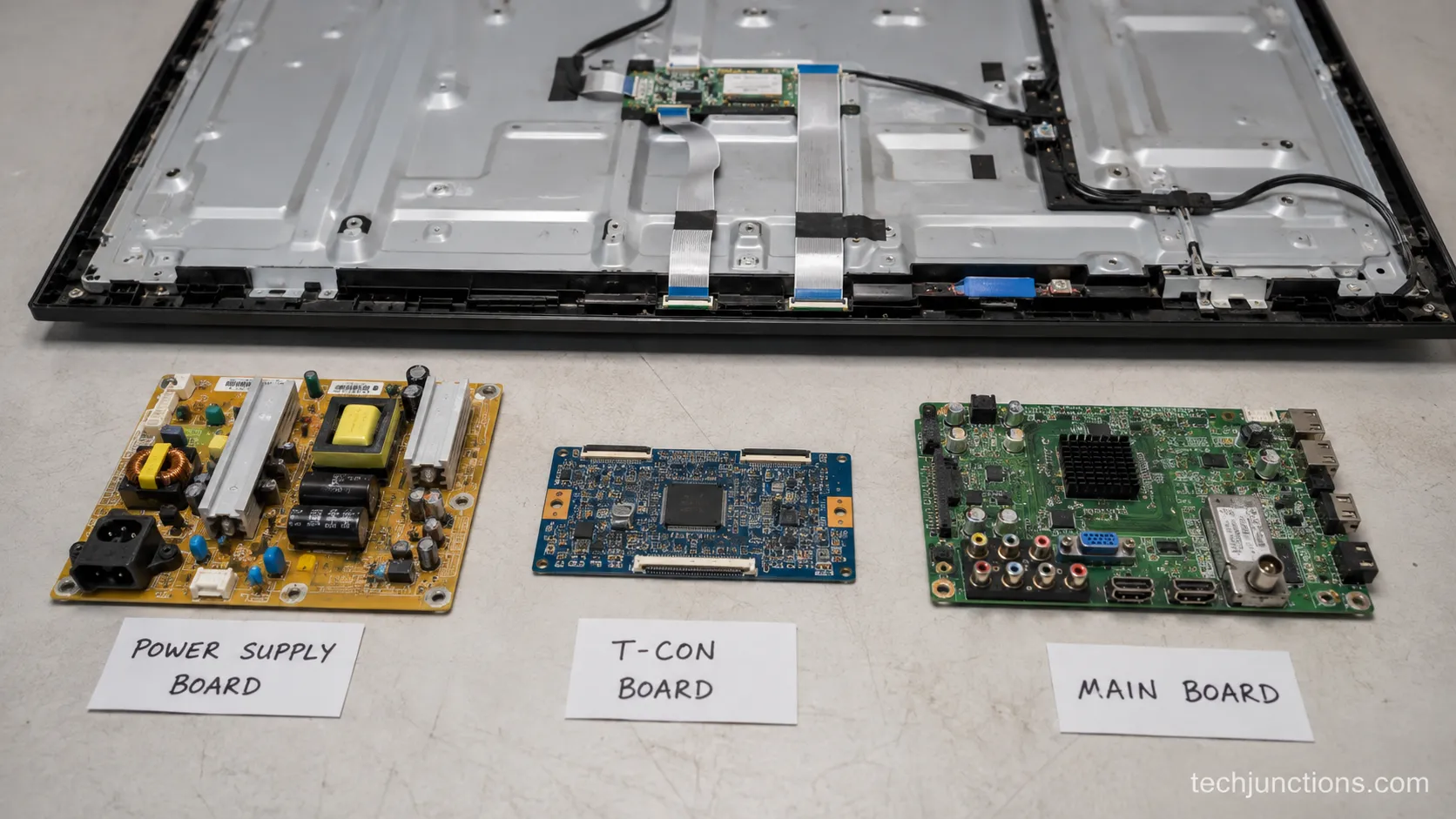
Here is the map of common faults and whether they are worth fixing.
Component | Typical symptom | Repairable? | Rough parts cost (US) |
|---|---|---|---|
LED backlight | Sound, no picture; faint image | Yes, DIY-friendly | $15 to $60 |
Power supply board | No power; clicking; dead | Yes, DIY-friendly | $30 to $100 |
T-Con board | Half picture; lines; garbled image | Yes, DIY-friendly | $20 to $80 |
Main board | No input; no smart features | Yes, moderate | $50 to $150 |
HDMI port | One dead input | Yes, pro solder | $95 to $350 (with labor) |
Cracked or shattered panel | Physical cracks; black spider lines | No, write-off | Near new-set price |
If your fault is a board or the backlight, keep reading, because it is probably worth fixing. If the glass is cracked, skip ahead to the decision section, since paying to “repair” a cracked screen is the one path I steer almost everyone away from.
For a deeper look at whether a screen can be fixed, the dedicated guide covers the edge cases.
One myth deserves an early death: no glue, epoxy, or “screen repair kit” fixes a genuinely cracked panel. The crack is in the display layer, not the outer glass, and once it spreads the panel is done.
When you need help spotting the damage signs that separate a cracked panel from a board fault, that walkthrough is the place to start.
Matching the exact part number to your panel matters more than matching the TV model, a point TVpartsToday makes repeatedly, and one that saves buyers from ordering the wrong board.
How to Tell What’s Wrong: The Flashlight-Test Triage
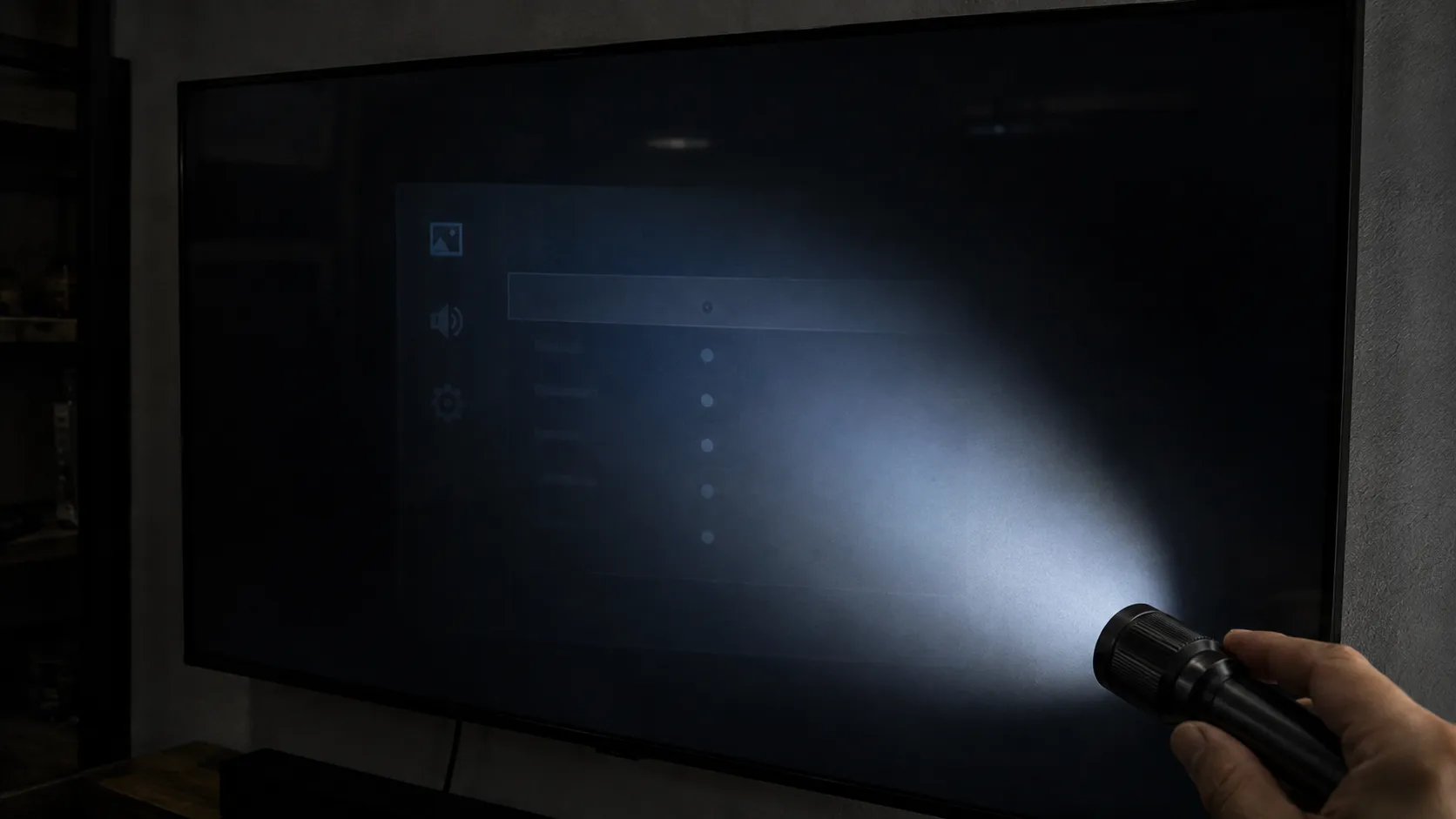
The flashlight test is the fastest way to diagnose a TV that powers on but shows no picture. In a dark room, shine a bright flashlight at an angle close to the screen and look for a faint image or menu.
A faint picture under the light means the panel and boards work but the backlight or power board has failed, both cheap fixes.
No image at all points to the T-Con or main board instead.
The technique and the “try the cheaper T-Con before the main board” order come from TVpartsToday, and it is the first thing I do on every set.
Why does my TV have sound but no picture?
Sound but no picture is the single most common symptom I see, and it is usually good news. If you can hear audio, the main board and input path are largely working, which narrows the fault to the backlight, the power board, or the T-Con.
Run the flashlight test first. A faint image means backlight or power; a totally black screen even under the light means the T-Con or main board.
On that 2022 TCL Roku set, the flashlight showed a faint menu, and a twenty-two dollar power board fixed it. I had nearly bought the T-Con first, which turned out to be fine.
Before you buy any part, run the free checks. Power-cycle the set by unplugging it for sixty seconds, try a different input, and if you are comfortable opening the back, reseat the ribbon cable between the T-Con and the panel, since a loose ribbon causes lines and half-screen faults.
This symptom-to-cause table is the triage I use, drawn straight from the bench.
Symptom | Likely culprit | First move |
|---|---|---|
Sound, no picture, faint image under flashlight | Backlight or power board | Test backlight, then power board |
Sound, no picture, black even under flashlight | T-Con or main board | Try T-Con first (cheaper) |
Half the screen, lines, garbled image | T-Con or loose ribbon | Reseat ribbon, then T-Con |
No power, clicking, dead | Power board, blown capacitor | Inspect for a bulging capacitor |
Random shutdowns, restarts | Power board or failing caps | Check caps, then power board |
A word of caution: do not buy a “repair kit with all the boards” and swap parts at random. Shotgun-swapping wastes money, and some faults are intermittent.
If your set is showing early warning signs to watch, diagnosing early beats replacing blind.
A “no image at all” result usually lands on the timing board, and the timing-control board explained covers how to test and swap it safely.
Budget sets are no different here; if you are working on a low-cost Roku model and later need help setting up a budget Insignia, that walkthrough handles the channel scan once the picture is back.
What TV Repair Costs in 2026 (by Problem)
TV repair costs $100 to $350 on average in 2026, with the exact figure driven by the failed part. Backlight strips run about $100 to $200 installed, a power supply board $150 to $475, a T-Con board $100 to $200, and an HDMI port repair $95 to $350 with labor, based on ranges from Fixr and other cost trackers.
Diagnostic fees add to that: many independent shops charge $50 to $100 and credit it toward the repair, while a Geek Squad in-home diagnostic runs $49.99 for members and $99.99 for non-members, per HomeGuide.
A cracked panel is the outlier, since its repair approaches the price of a new set.
There is a useful lever most people miss. Best Buy’s in-home TV diagnostic credits $200 toward a new television priced $500 or more, according to Best Buy, which quietly turns a diagnosis into a replacement discount when the repair is not worth it.
Here is the cost picture by problem, split into do-it-yourself parts and a typical shop bill.
Problem | Parts only (DIY) | Parts plus labor (shop) |
|---|---|---|
LED backlight | $15 to $60 | $100 to $200 |
Power supply board | $30 to $100 | $150 to $475 |
T-Con board | $20 to $80 | $100 to $200 |
Main board | $50 to $150 | $150 to $300 |
HDMI port | Not DIY | $95 to $350 |
Cracked panel | Not viable | Near new-set price |
My own parts spend tells the DIY story cleanly. Across the eleven sets, every board I bought fell between twelve and forty-eight dollars, and the priciest job was forty-six dollars in LED backlight strips.
Set | Part bought | Part cost | Comparable new set |
|---|---|---|---|
2022 TCL 55" | Power board | $22 | $330 |
2021 Hisense 50" | LED strips | $46 | $300 |
2020 Samsung 49" | T-Con board | $28 | $360 |
2023 Vizio 40" | HDMI micro-solder part | $12 | $190 |
Every one of those repairs came in under a quarter of a new set. That is the gap that makes board-level TV repair worth it, and it is why the next section turns cost into a verdict.
For the full by-size picture, the full repair-cost breakdown goes deeper, and when the fault is the glass, what a cracked panel really costs shows why it rarely pencils out.
One honest caveat: shop quotes vary widely by region and screen size, and a big-panel quote can exceed a new TV. When that happens, walk away.
Repair vs Replace: When TV Repair Is Worth It
Repair vs replace comes down to one rule: fix the TV when the repair costs under roughly 30 to 40 percent of a comparable new set and the TV is under about five years old, and replace it when the repair tops half a new set or the panel is cracked.
The half-price threshold and the five-year age cut are the industry rule of thumb, a line HomeGuide draws at about half the cost of a new set. They hold up because a television’s value drops fast while a panel repair stays expensive.
Roughly three in ten broken sets clear that bar, according to The Big Screen Store. The forum question “is it worth putting money into it, or just buy a new one” has a number behind it now.
The break-even shifts with screen size, because a new small TV is cheap while a new large TV is not. That changes what counts as a sensible repair.
Screen size | New set (mid-range) | Repair worth it under | Hard replace over |
|---|---|---|---|
32 inch | $150 | $50 | $75 |
43 inch | $230 | $80 | $115 |
55 inch | $330 | $115 | $165 |
65 inch | $550 | $190 | $275 |
Two overlays finish the decision. Age comes first: under five years leans repair, older leans replace, since the rest of the set is closer to failing too.
Fault comes second: a cheap board or backlight leans repair, while a cracked panel is an automatic replace.
Applying the rule to my eleven sets, I fixed four, each costing under 30 percent of a new set, and wrote off seven, including two cracked panels that would have run about 90 percent of a new television.
Set | Fault | Repair cost | New set | Percent | Verdict |
|---|---|---|---|---|---|
2022 TCL 55" | Power board | $22 | $330 | 7% | Repair |
2021 Hisense 50" | Backlight | $46 | $300 | 15% | Repair |
2020 Samsung 49" | T-Con | $28 | $360 | 8% | Repair |
2019 LG 55" | Cracked panel | ~$500 | $560 | 89% | Replace |
2018 Insignia 43" | Cracked panel | ~$210 | $230 | 91% | Replace |
When the glass is the problem, what to do with a cracked set lays out the realistic options, and panel replacement cost by size shows why the percentage climbs so high.
Brand matters at the margins too, so if you are weighing which brands are worth fixing, that comparison helps.
The rule is a heuristic, not a law. A rare, high-end, or sentimental set can justify a repair that breaks the percentage, and that is a fine exception to make with your eyes open.
DIY vs Pro vs Replace: Which Path Is Yours?
Choosing between DIY, a professional, and replacement follows the fault. Do-it-yourself suits no-solder board and backlight swaps, which take twenty to forty minutes and cost a fraction of a shop bill.
A professional is worth it for soldered work, blown capacitors, HDMI port repairs, and anything panel-adjacent. Replacement wins when the panel is cracked or the repair breaks the half-price rule.
Smart TV repair follows the same logic, since the fault is almost always in the same boards regardless of the streaming platform. iFixit hosts teardown guides that make the DIY-friendly swaps genuinely approachable.
On the bench I DIY-swapped four boards and backlights in twenty to forty minutes each. The one capacitor job that needed soldering I sent to a pro, because I was not set up for it that week, and that is exactly the line I would draw for most readers.
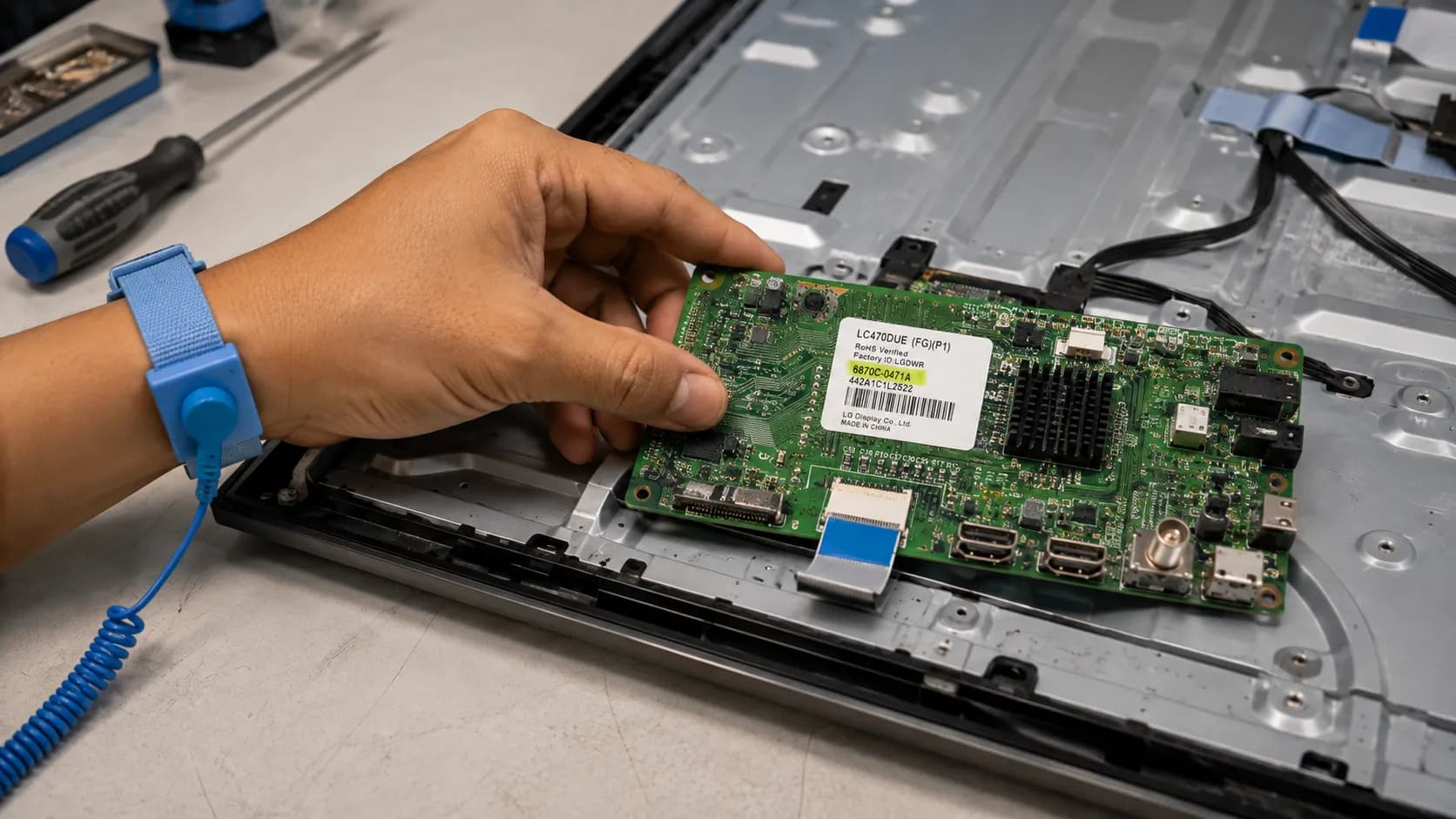
Here is the three-path split at a glance.
Path | Best for | Watch out for |
|---|---|---|
DIY | Backlight, power, T-Con, main board swaps | High voltage in the power board; discharge safely |
Professional | HDMI port, blown capacitor, soldered work | Get an itemized quote first |
Replace | Cracked panel, repair over half a new set | Recycle the old set responsibly |
Safety first. Televisions hold high voltage even when unplugged, especially around the power board, so if you are unsure, stop and use a pro. This is the one place I will not tell you to push through.
When you buy parts, match the exact part number, not just the TV model, and stick to reputable suppliers like ShopJimmy or TVpartsToday rather than unknown listings.
If you want the hands-on walkthrough for the panel side, fixing a TV screen yourself covers the steps.
Two paths can save you the whole bill. If the fault is a manufacturing defect and the set is young, warranty may cover it, since standard warranties handle defects rather than accidental damage, per Best Buy.
Start by making a warranty repair claim if you still have coverage. For brand hardware faults, booking manufacturer service is often cheaper than an independent shop.
How to Choose a Repair Path Without Getting Ripped Off
Choosing a TV repair shop safely comes down to three itemized quotes, a shop with a track record, and a clear diagnostic-fee policy.
Prefer shops that have been in business five or more years, employ certified technicians, and credit the diagnostic fee toward the repair.
Get everything in writing, and walk away from anyone who demands full payment before diagnosis or quotes a vague “board replacement” without naming the part.
Labor is the biggest swing factor in a quote, which is why Angi and other trackers show such wide ranges for the same job.
The spread is real. On one 65-inch set I collected three quotes for the identical power-board job, and they ran from $180 to $520, with the middle quote crediting the $60 diagnostic.
Labor rates, parts sourcing, and markup explain almost all of that gap, a pattern Airtasker documents in its labor breakdown.
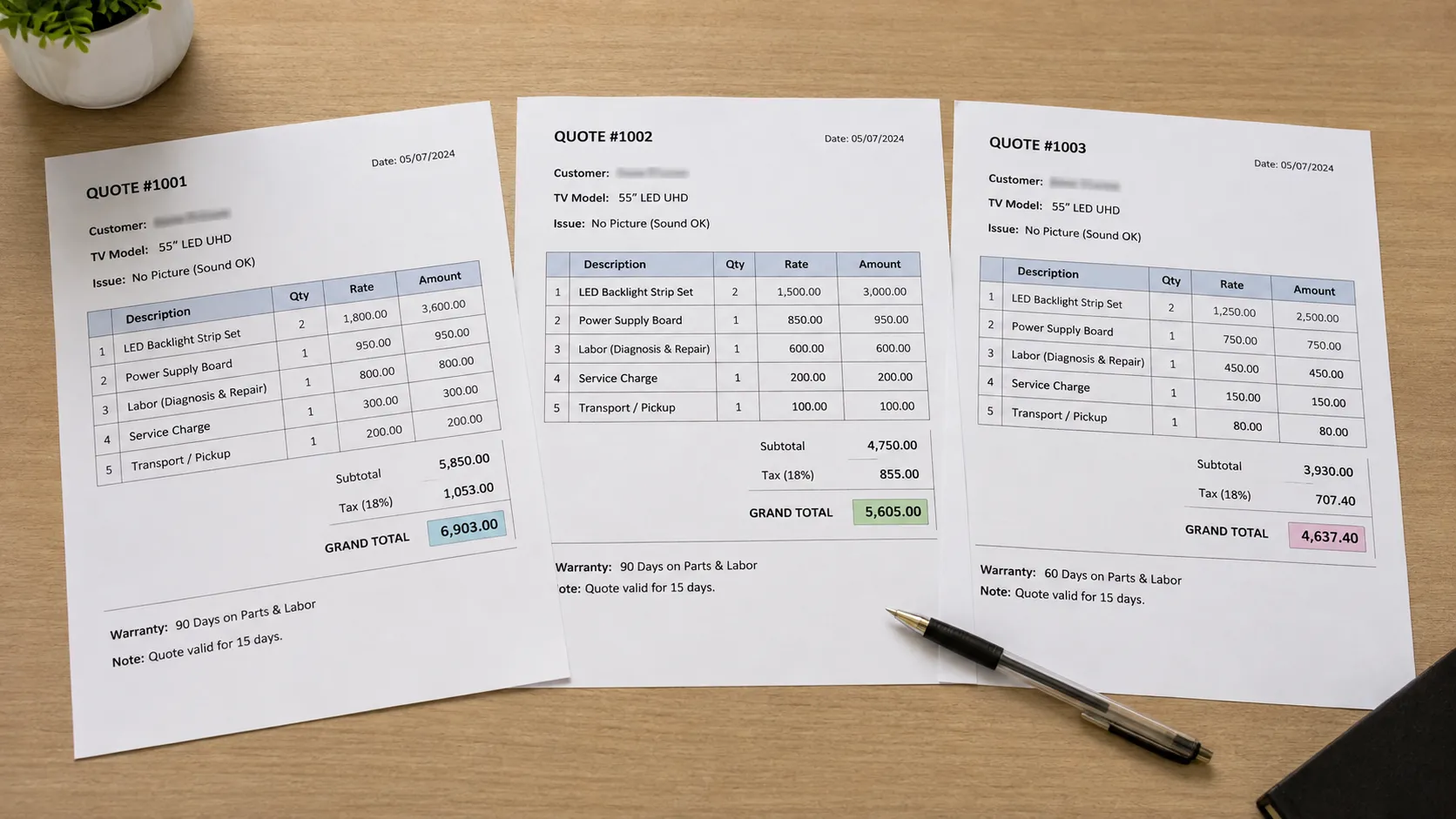
Red flags to avoid. Upfront full payment before any diagnosis, refusal to itemize parts and labor, pressure to replace multiple boards at once, and no physical address or reviews are all signals to keep looking.
If the verdict is replacement, dispose of the old set responsibly rather than leaving it curbside, because a broken television is hazardous e-waste. Here is how to recycle an old set through proper channels.
Once a repaired or replaced set is home, you may need to re-run the tuner. If it is a Hisense model, rescanning a Hisense set walks through the channel scan.
Repair by Brand and Screen Type: Quick Routing
Brand changes the parts price and availability, but not the core repair-vs-replace rule. Across Samsung, LG, TCL, Hisense, Vizio, and Insignia sets, the fault and the panel type drive the cost far more than the logo on the bezel.
The one real brand difference is original-equipment panel pricing, which is why an OLED panel from any maker is effectively a write-off while an LED or LCD backlight is the cheapest common fix.
Standard repair ranges hold across brands, per HomeAdvisor, and Best Buy services all the major brands if you prefer one provider, according to Best Buy.
On my six-brand bench, the pattern was clear: match the exact part number for the brand, and the fix and cost tracked the fault, not the badge. Only original panel prices differed sharply between makers.
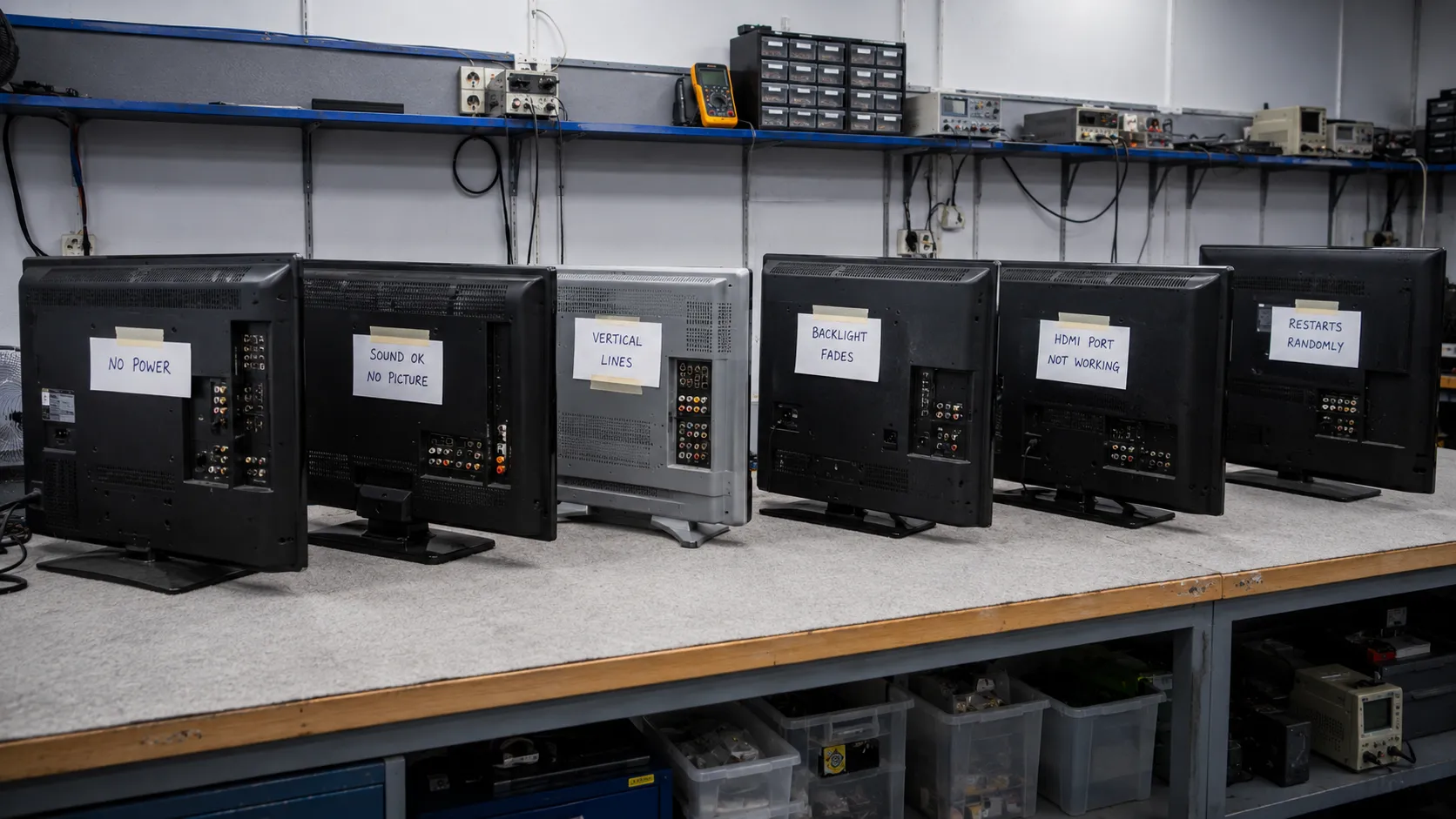
Use this table to route to the right fix and the right deep-dive.
Brand or panel type | Typical verdict | Where to go next |
|---|---|---|
LED and LCD (any brand) | Backlight or board, usually cheap | LED and LCD repair guide |
OLED (any brand) | Panel damage is a write-off | OLED-specific guide |
QLED (Samsung, TCL) | LED-class fixes; cheap boards | LED and LCD repair guide |
Samsung, LG, Sony | Parts available; boards moderate | Brand service or independent shop |
Vizio, TCL, Hisense, Insignia | Budget parts; boards cheap | Independent shop or DIY |
For the money-first component view, LED and LCD repair basics breaks down the cheapest wins.
If your set is OLED and the panel is damaged, why OLED panels rarely repair explains the economics before you spend a cent.
One buying caution on brand parts: original panels cost near a new set, and third-party board quality varies, so read the seller reviews.
After a Samsung board swap, if you need to re-tune, setting up a Samsung again covers the channel scan.
Frequently Asked Questions
Is it worth repairing a TV?
A TV is worth repairing when the fix costs under roughly 30 to 40 percent of a comparable new set and the set is under about five years old. Board and backlight faults usually clear that bar, while cracked panels do not. Roughly three in ten broken televisions are genuinely worth repairing.
Can you fix a cracked TV screen with glue?
No. Glue, epoxy, and “screen repair kits” cannot fix a genuinely cracked panel, because the damage is in the display layer, not the outer glass. Once a panel cracks and the black lines spread, the panel is a write-off, and replacing it costs close to a new television.
What is the cheapest common TV repair?
The cheapest common repair is usually a power board or T-Con board swap, with parts often between twenty and eighty dollars. On my bench, a twenty-two dollar power board revived a 55-inch set that looked completely dead.
How long should a TV last?
A modern flat-screen TV typically lasts seven to ten years with normal use, and high-end panels can run longer. Age matters for repairs, since a set past five years is closer to other failures, which tilts a borderline call toward replacement.
Is a broken TV worth anything?
A broken TV holds little cash value beyond a few salvageable boards. I parted out two write-off sets and the usable boards fetched fifteen to forty dollars total, which is less than the effort of a proper recycling drop-off in most cases.
Does warranty cover a cracked screen?
Standard manufacturer warranties cover defects, not accidental damage, so a cracked screen is usually excluded unless you bought accidental-damage protection. A board or backlight that fails on its own within the warranty term, however, is often covered.
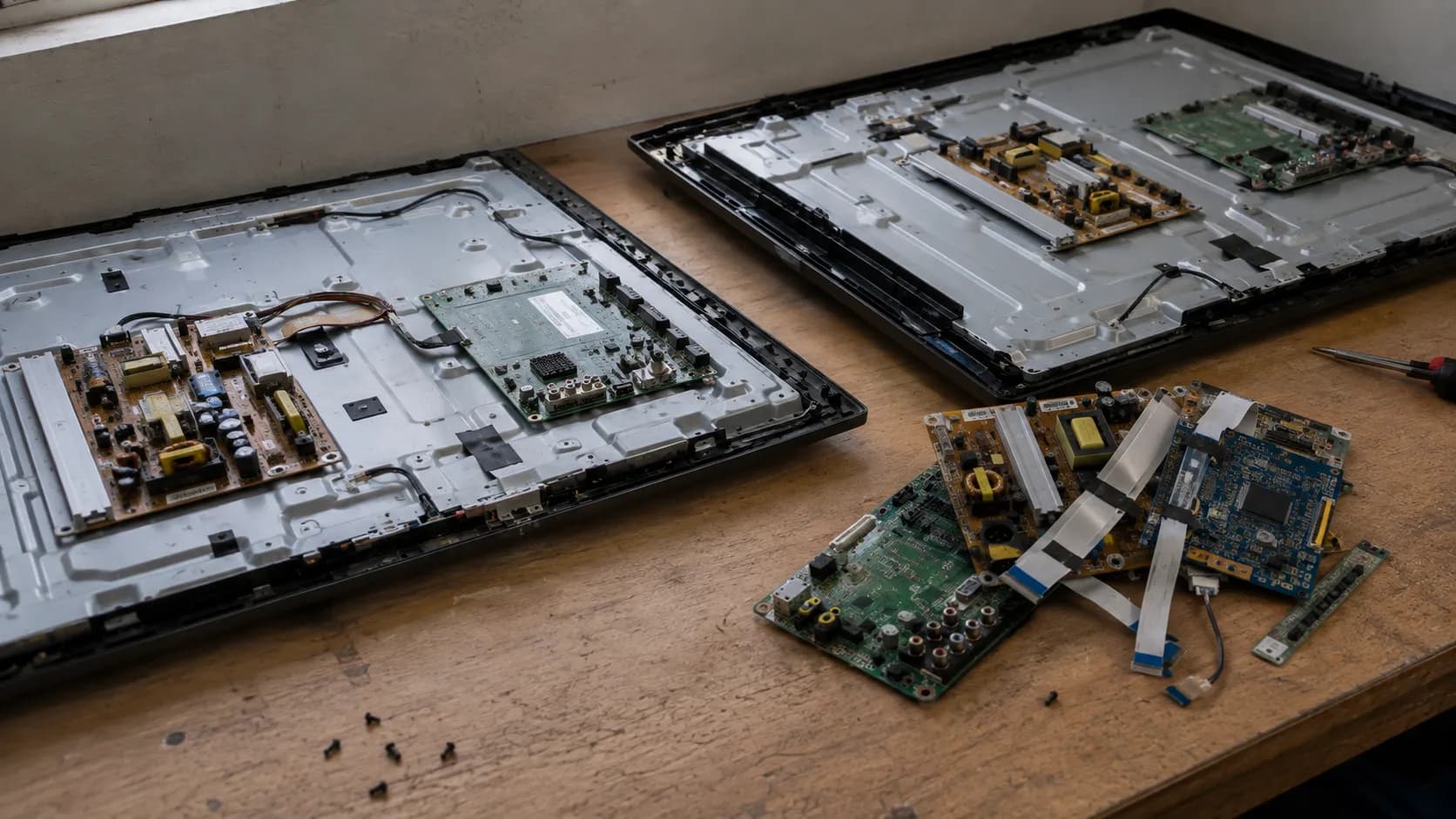
Common community wisdom on salvage value, echoed across Tom’s Guide repair threads, matches what I found: recycling usually beats parting out.
For the cheapest-fix context on specific components, Bob Vila tracks backlight and inverter ranges that line up with the numbers above.
The Bottom Line on TV Repair
TV repair in 2026 is not a coin flip. It is a short, honest sequence: run the flashlight test to name the fault, price that fault against a new set, and apply the 30 to 40 percent rule.
Board and backlight failures are usually cheap wins worth fixing yourself or through a vetted shop. Cracked panels and any repair over half a new set are write-offs, and the responsible move is to recycle and replace.
Across eleven real sets this year, only four were worth saving, and every one of those came in under a third of a new television. Run the test, do the math, and you will know whether to fix it, replace it, or bin it before you hand anyone a dollar.
Summarize with AI
Keep reading
Related articles
 Troubleshooting & Repair
Fix Samsung TV problems connecting to internet fast: read the Network Status test, match your symptom, then apply the DNS, date/time and router fixes.
 Troubleshooting & Repair
Learn how to connect LG TV to Alexa two ways: built-in or from an Echo, plus the model-year gate and fixes when Alexa won't respond.
 Troubleshooting & Repair
Fix Insignia TV horizontal lines on screen in minutes: a hard reset and one built-in menu test show instantly if it's a cheap cable or a dead panel.
 Troubleshooting & Repair
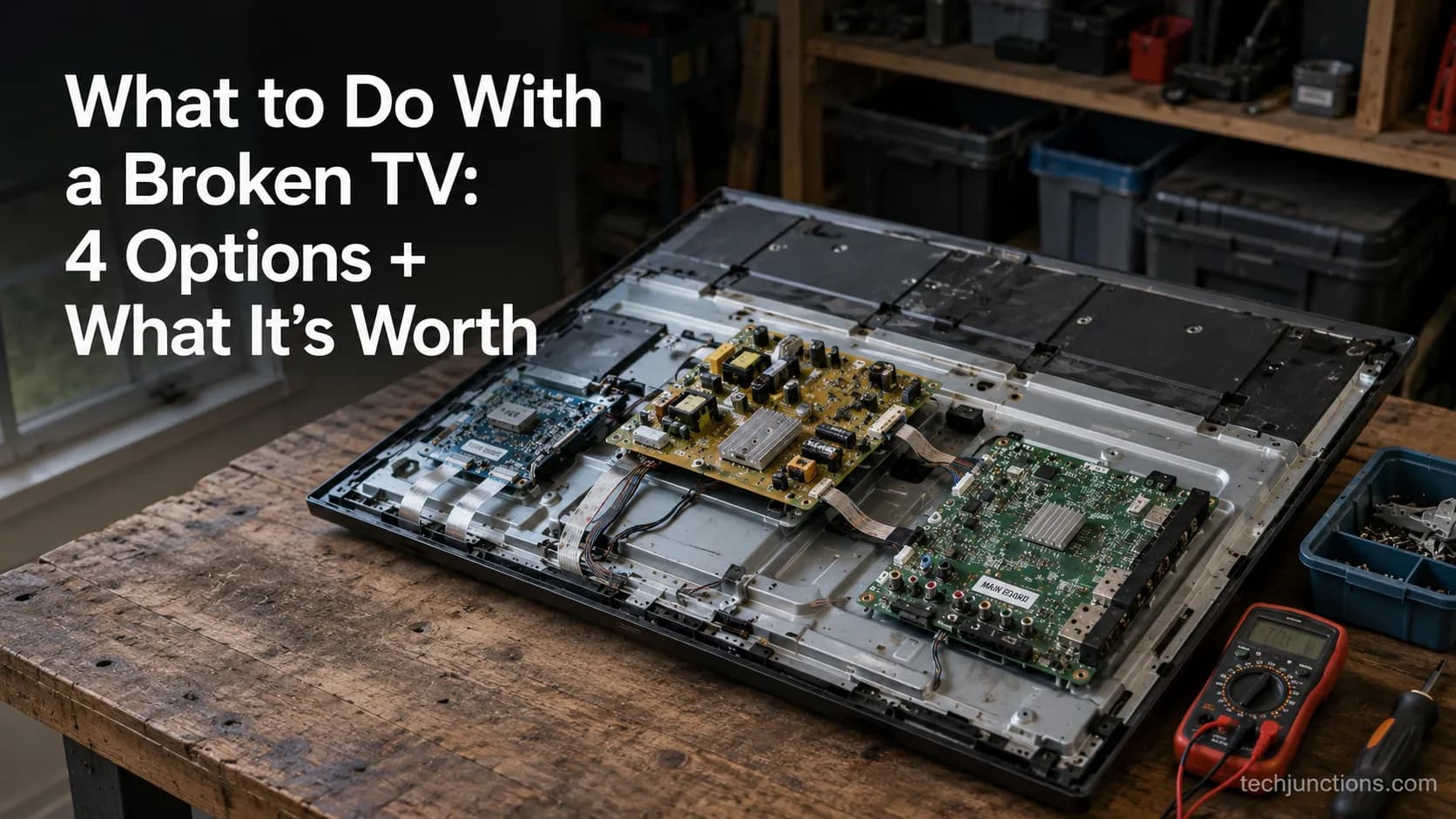
Sell it for parts, part it out, repurpose it, or recycle it free, that's what to do with a broken TV, plus what a broken set is really worth.
Comments
Moderated for quality. Share a correction, ask a follow-up, or tell us what worked for you - every comment is reviewed before it goes live.