
Most Vizio TV Repair Isn't Worth It (Here's When It Is)
See when Vizio TV repair is worth it: the faults worth fixing ($20-60 boards), what a pro really costs, plus cross-brand math for 8 TV brands.
Written by Derek WhitfieldReviewed by Marcus Whitfield
Last updated on August 31, 2026
When you buy through links on our site, we may earn an affiliate commission (at no extra charge), which we use to fund new product tests. Learn more.
Summarize with AI
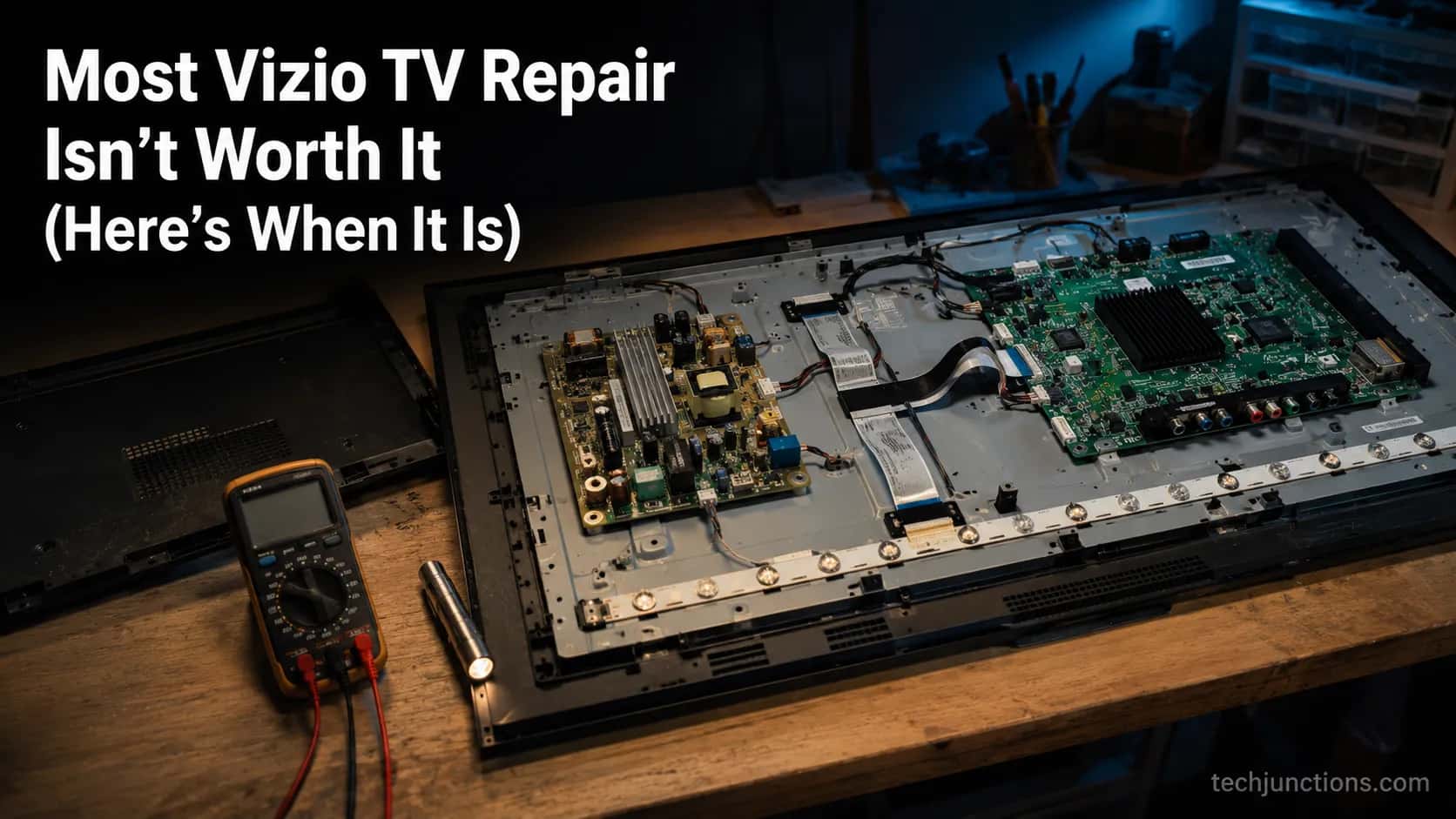
Your Vizio went dark, and the first thing you searched was probably some version of "vizio tv repair."
Before you call a shop or order a single part, the honest answer is this: paying a pro to fix a budget Vizio usually loses to just replacing it, but a cheap do-it-yourself board or backlight swap often wins big.
That gap between a $250 shop invoice and a $34 part is the whole story. This guide shows you which side of it your TV lands on, and then does the same math for every major brand.
The 30-Second Verdict: Is Any TV Worth Repairing?
Whether any modern TV is worth repairing comes down to two things: which component failed, and whether you do the work or pay a pro.
A do-it-yourself board or backlight fix runs $20 to $60 in parts and pays for itself immediately, while a shop repair adds $60 to $125 per hour of labor, which is why a quote above roughly half the price of a comparable new set means you should replace instead.
Physical panel damage is the one fault that almost always means replace.
Fix it yourself if the fault is a power board, T-Con board, or backlight (parts are cheap).
Think hard before paying a pro on any set you could replace for $250 to $350. Replace it if the glass panel itself is cracked or dead.
Two rules of thumb decide the borderline cases.
The widely used version says skip any repair costing more than half the price of a new set, and a more conservative variant draws the line at 30 to 40 percent.
The reason the rule holds is simple: labor is a fixed cost, and new-TV prices keep falling. A repair quote that looked reasonable three years ago now competes with a $280 replacement, according to HomeGuide's repair cost data.
A note on who does the work. "Worth it" flips entirely depending on the person holding the screwdriver.
The same backlight fix that is a clear win as a $30 do-it-yourself job becomes a coin-flip once a shop attaches labor to it.
What's Actually Broken? The Flashlight Test and Symptom Map
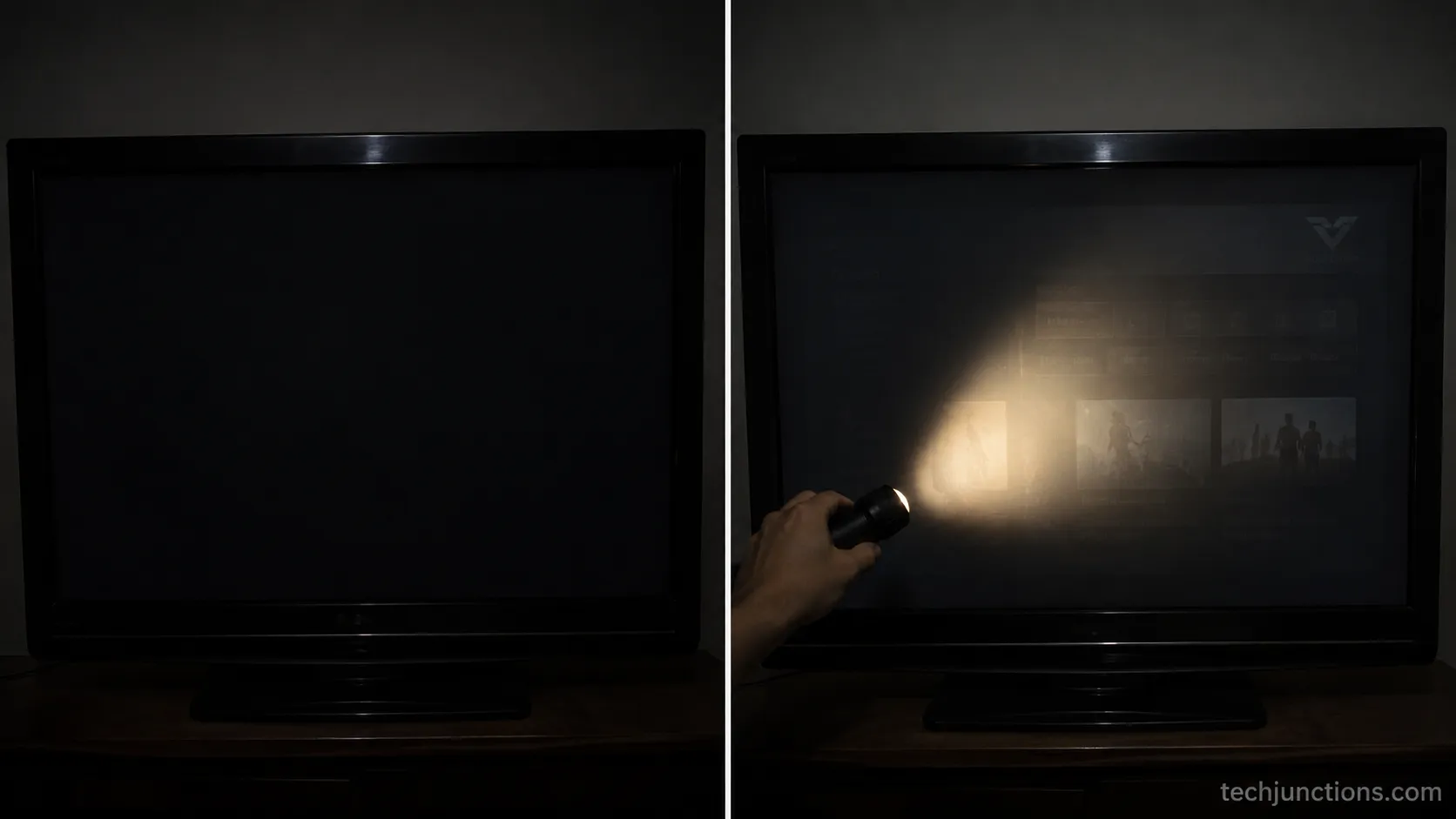
To find what broke on a Vizio TV, run the flashlight test first: with the set powered on, shine a flashlight at an angle against a dark screen.
A faint image means the backlight or its power supply failed, while a fully dark screen with no image at all points deeper, to the power supply board, the T-Con board, or the main board.
Sound with no picture usually means the T-Con or backlight, not the glass panel, which saves you from ordering the single most expensive part by mistake.
Owners describe these faults in a handful of recurring ways, and each phrase maps to a component. That mapping is what turns a scary "dead TV" into a specific, orderable part.
Vizio Black Screen of Death: Sound but No Picture?
The classic "black screen of death" (a lit power light, working sound, but no picture) is the most reported Vizio complaint, and it is rarely the panel.
Owners on repair forums describe the picture that "went out like a snap" or "faded to black" while audio kept playing, and the flashlight test almost always reveals a faint image hiding underneath.
When you can see that faint image, the backlight or its power feed has failed, a split that TV Parts Today's Vizio guide uses to isolate the fault.
When you cannot see anything at all, the fault sits on the power supply board or the board that drives the panel, and you can often tell it's a bad board by the symptom pattern alone.
Use this symptom map to isolate the component before you spend anything.
What you see or hear | Most likely component | Do-it-yourself difficulty |
|---|---|---|
Black screen, sound works, faint image under a flashlight | Backlight (LED strips) or backlight power | Moderate |
Black screen, sound works, no image even with a flashlight | Power supply board or T-Con board | Easy to moderate |
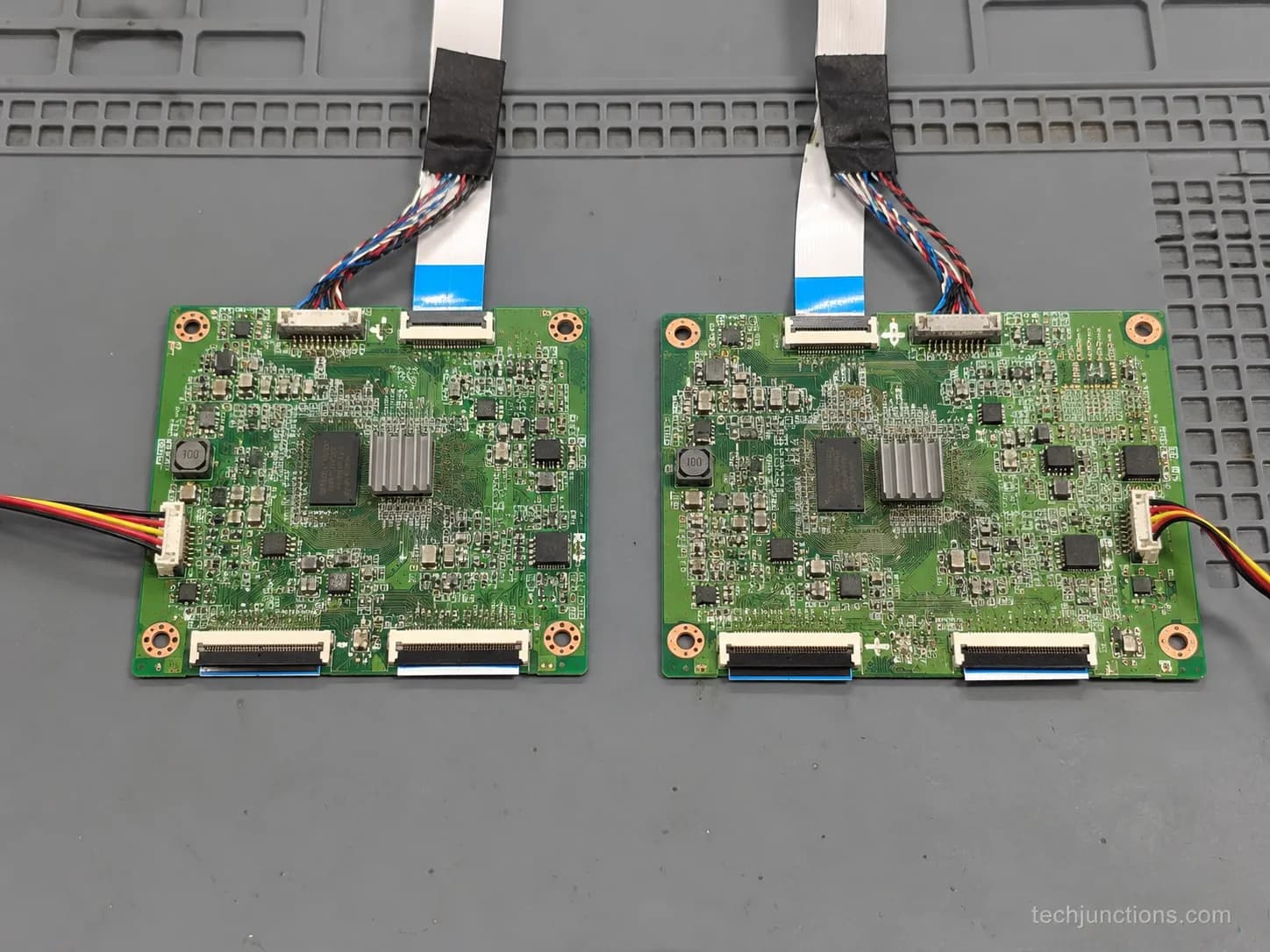
Lines on screen, half the screen dark, or a horizontal band | T-Con board or its LVDS cable | Easy |
Will not turn on, blinking light, logo lights then fades | Power supply board (often bad capacitors) | Easy |
Standby light on but no boot, LED comes on then cuts out | Power board protection or main board | Moderate to hard |
Cracked or physically damaged glass | Panel (usually not repairable) | Replace |
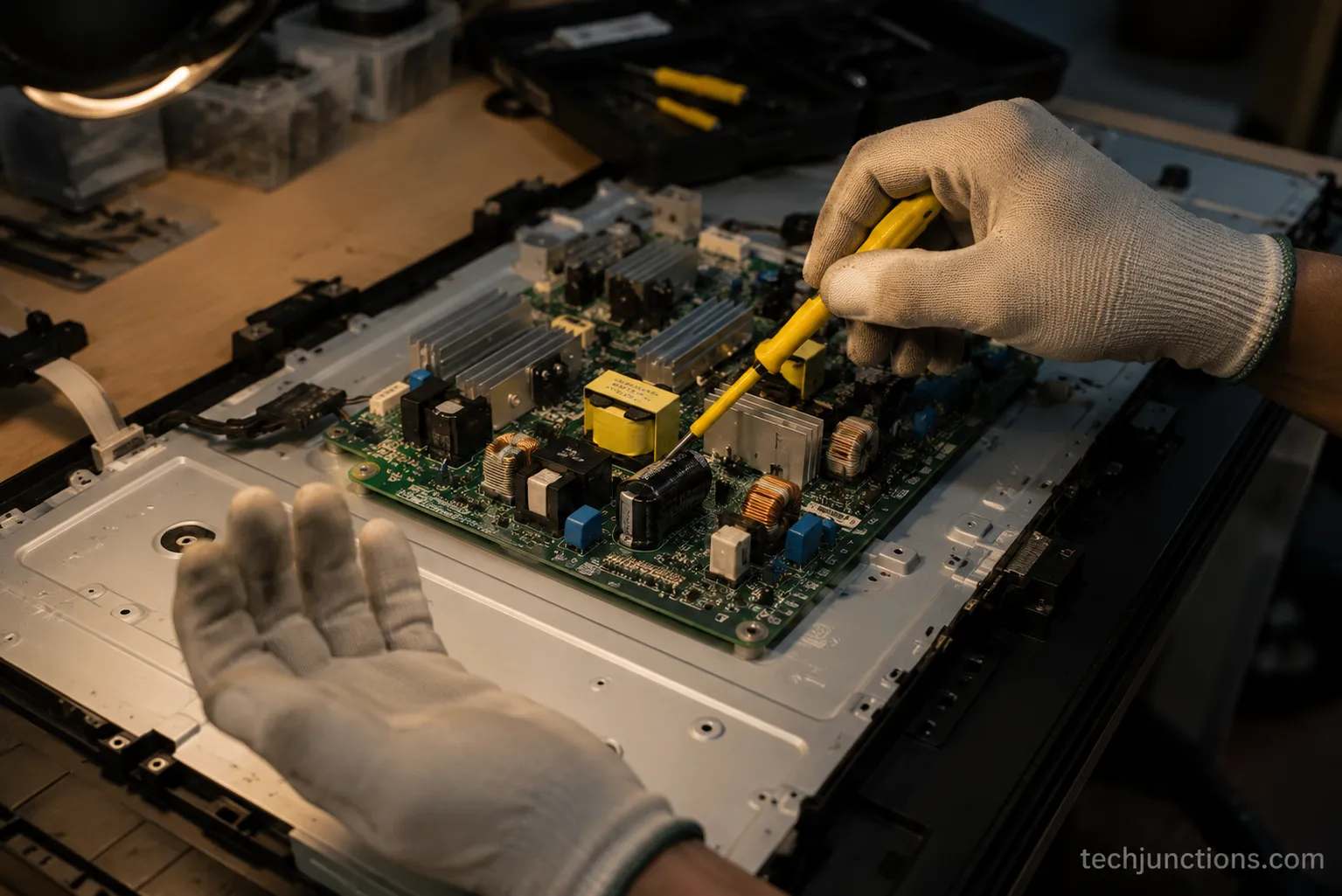
A visible clue speeds this up: pop the back cover and look for "domed" or leaking capacitors on the power board, the small cylinders with a bulged or crusty top.
Those are a cheap, common failure, and spotting them is one of the fastest wins in home TV repair, as iFixit's Vizio answers show repeatedly.
If the flashlight test and symptom map still leave you unsure, that uncertainty is itself useful information: it usually means the fault is a board you can swap cheaply rather than a panel you cannot.
Several of these faults are safely fixable at home before you call anyone, and backlight failure is the single most common issue behind a dark screen on any LED or LCD set.
One honest limit: the flashlight test narrows the diagnosis, but it cannot fully confirm a dead panel.
If a board swap does not restore the picture, the panel is the likely culprit, and that is where the repair stops making sense.
Is Vizio TV Repair Worth It? Costs and Common Failures
A Vizio TV repair is usually worth it only for cheap board-level faults.
Vizio's most common failure is the black screen with sound, typically caused by a power supply board ($30 to $40 in parts to do yourself, $200 to $475 at a shop) or backlight strips ($20 to $40 yourself, $150 to $250 at a shop), and the brand offers a one-year limited warranty and does not repair out-of-warranty sets itself, routing owners to authorized or third-party service.
On a Vizio you could replace for $250 to $350, a paid repair rarely makes sense, according to Fixr's repair cost figures for the brand.
Vizio's failures cluster in a predictable order, which is good news because the top of that list is also the cheapest to fix.
The most common Vizio faults, roughly in order, are the black-screen power board issue, backlight LED strips burning out, T-Con faults that produce lines or a half-dark screen, and simple remote or IR-sensor problems. Only the panel itself sits in expensive territory.
Here is the honest cost picture for a Vizio, split by who does the work.
Vizio fault | Do-it-yourself part cost | Typical pro repair cost | Worth it? |
|---|---|---|---|
Bad capacitors on power board | About $10 | $200 to $300 | Yes, if you can solder |
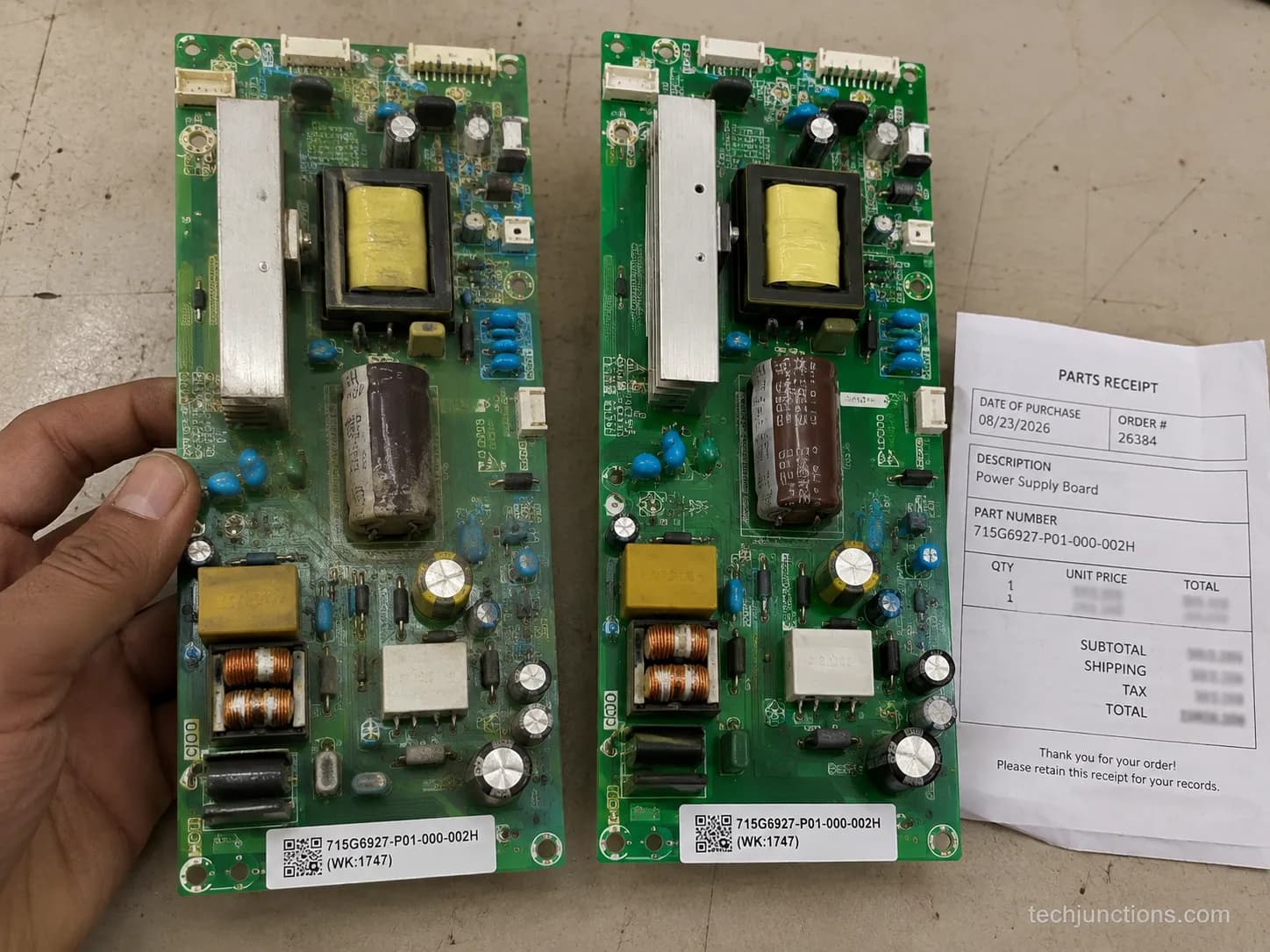
Power supply board swap | $30 to $40 | $200 to $475 | Yes as DIY, rarely as a paid job |
Backlight LED strips | $20 to $40 | $150 to $250 | Yes as DIY on larger sets |
T-Con board | $20 to $60 | $150 and up | Yes as DIY |
Cracked or dead panel | Not practical | $400 and up | No, replace |
The warranty reality trips up a lot of owners.
Vizio's standard coverage runs one year, and once you are past it, the brand does not fix the set itself, as its own support portal confirms and as forum owners repeatedly discover when they are told to call a third-party repair contractor.
That routing is exactly why so many owners report a Vizio that "died a month out of warranty" and felt stranded.
The set is not un-fixable, it just is not fixable through Vizio, which pushes cost-conscious owners toward the do-it-yourself path or a replacement.
For the full repair-or-replace picture across every fault, our complete TV repair guide runs the numbers.
If several small faults are stacking up at once, that is often the warning sign to watch that the set is near the end of its life.
Costs also shift by problem, size, and type, which is worth checking against how repair pricing works overall.
The mis-diagnosis catch. The one real risk with the do-it-yourself route is buying a board that does not fix the problem, usually because the panel was the actual fault.
Confirm the flashlight test result before you order, and keep the receipt in case the supplier accepts returns.
Cross-Brand Repair-Worth-It Comparison (8 Brands)
Across the major United States TV brands, the cheapest repairs are board-level and do-it-yourself. Vizio, TCL, Hisense, Insignia, and Onn (the Walmart Roku brand) all use inexpensive power, T-Con, and backlight parts in the $20 to $60 range, while Samsung, LG, and Sony run higher for original-brand parts and service.
The worth-it verdict stays consistent no matter the badge: a do-it-yourself board or backlight fix pays off, and a paid panel repair rarely does.
No manufacturer publishes this table, because it points buyers away from paid service. That is exactly the gap this section fills.
Read the table by matching your fault to your brand, then checking the parts and verdict columns together.
Cheap, available parts plus a do-it-yourself willingness equals a repair worth doing.
Brand | Most common failure | Typical pro repair cost | Do-it-yourself part cost | Parts availability | Worth-it verdict |
|---|---|---|---|---|---|
Samsung | T-Con or backlight | $150 to $400 | $30 to $80 | Wide, OEM pricier | DIY yes, paid borderline |
LG | Backlight or OLED panel | $75 to $400 | $30 to $90 | Wide | DIY yes, OLED panel replace |
Sony (Bravia) | Power or backlight | $150 to $450 | $40 to $100 | Available, premium priced | Borderline, DIY only |
TCL | Power board or backlight | $100 to $250 | $20 to $50 | Wide (Roku parts) | DIY yes |
Hisense | Backlight or power board | $100 to $200 | $20 to $50 | Wide | DIY yes |
Vizio | Power board (black screen) | $200 to $400 | $20 to $40 | Wide (ShopJimmy stock) | DIY yes, paid rarely |
Insignia | Power board or T-Con | $100 to $200 | $20 to $50 | Wide (Best Buy, Roku) | DIY yes, cheap sets replace |
Onn (Roku) | Power or backlight | $100 to $175 | $15 to $40 | Wide | Usually replace |
The pro-cost figures track published brand ranges, including LG at roughly $75 to $400 and Hisense around $100 to $200 per Fixr's brand cost data, with backlight strip work landing near $150 to $250 across brands according to HomeAdvisor's component costs.
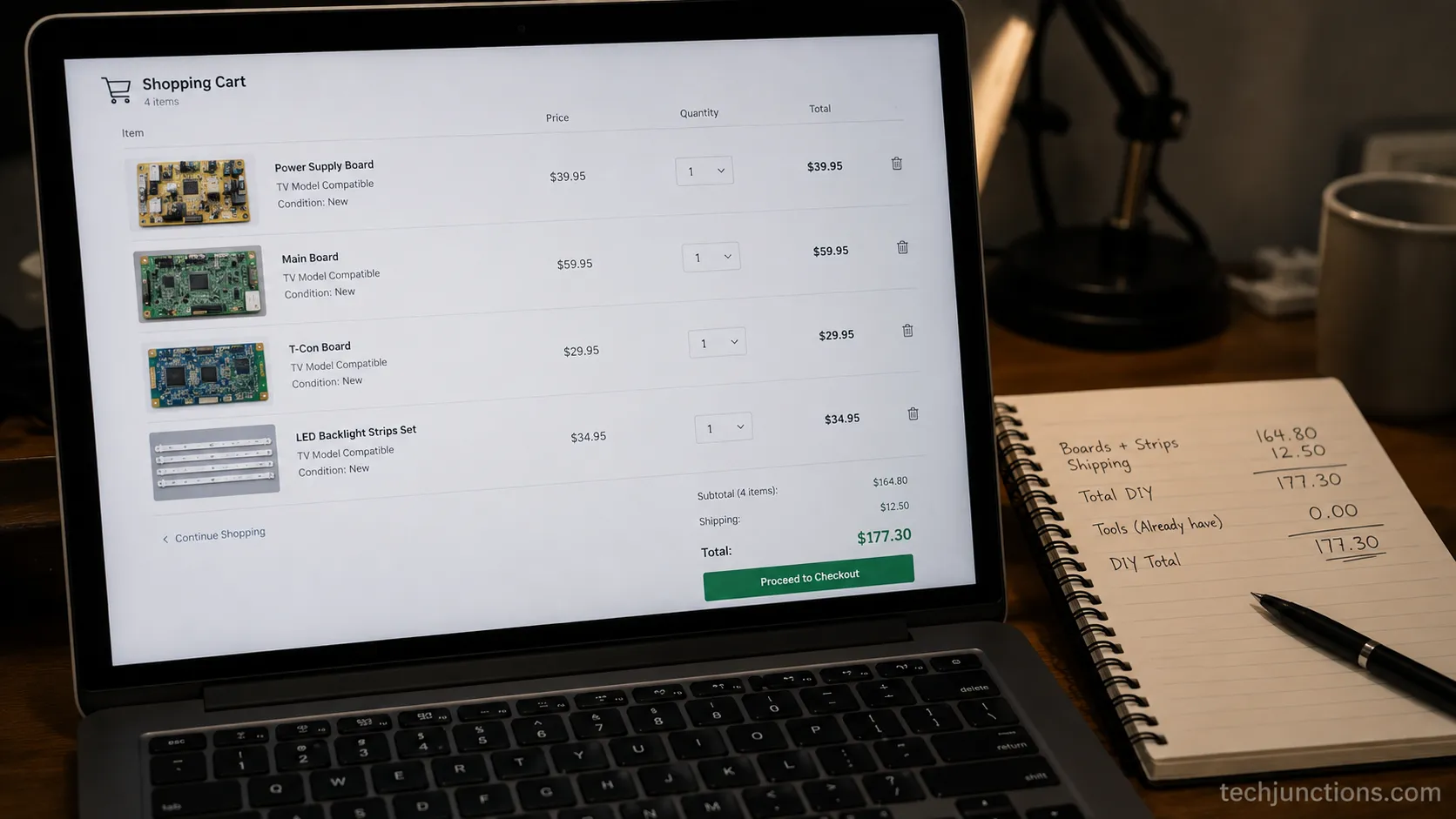
The do-it-yourself column reflects a live parts cart priced in August 2026.
A useful pattern hides in that table: the Roku-based budget brands (Onn, Hisense, TCL, and Insignia) share a cheap, interchangeable parts economy, so their board fixes are almost always the do-it-yourself kind.
A dead glass panel is the one fault where replacement wins on every brand, and you can see what a new panel costs if you want the full comparison.
Physical screen damage is a separate decision from a board fault, so a cracked screen follows its own path entirely.
Two brand-specific wrinkles matter. Some black-screen faults are actually covered as manufacturing defects depending on your plan, which is worth confirming against what warranties actually cover, and overall brand reliability shapes whether a repair is even likely to hold, which is where knowing how the big brands compare helps.
One honest limit on the table. These are United States price ranges for 2026, and your exact quote will vary by model and screen size.
Treat the columns as a decision guide, not a guaranteed invoice.
Per-Brand Breakdown: Samsung, LG, Sony, TCL, Hisense, Insignia, Roku
Each major brand fails in a characteristic way. Samsung and LG most often need a T-Con or backlight fix, Sony's Bravia line runs higher for original parts, and the Roku-based budget brands (TCL, Hisense, Insignia, and Onn) share cheap, widely available boards.
In every case the verdict tracks the fault rather than the badge: a do-it-yourself board or backlight repair is worth it, and a paid panel job is not, a pattern Angi's repair data reflects when it notes that widely available brands like Vizio and TCL have more affordable repair options.
The verdicts below use the same four data points for every brand, so you can compare them at a glance.
Samsung
Samsung sets most commonly fail at the T-Con board or backlight, with pro repairs running $150 to $400 and parts costing $30 to $80. Parts are widely available, though original Samsung components carry a premium, so a do-it-yourself fix is clearly worth it while a paid repair is borderline.
Note that blocky or pixelated picture on a Samsung is frequently a Samsung pixelation problem tied to signal, not a dead board.
LG
LG's common failures are backlight strips and, on OLED models, the panel itself. A backlight fix stays cheap at $30 to $90 in parts, but a failed OLED panel almost always means replacement.
LG owners chasing picture faults often find a settings issue first, so it is worth ruling out common LG screen faults before assuming hardware.
Sony (Bravia)
Sony Bravia sets tend to fail at the power or backlight, and while parts run higher at $40 to $100, the repair is still cheaper than a new comparable Sony.
That makes Bravia one of the few brands where a do-it-yourself repair can be worth it even on a mid-priced set, though a paid job pushes toward replacement.
TCL, Hisense, Insignia, and Onn
These four Roku-based brands share a parts economy, which is the single most useful thing to know about repairing them.
Their power boards and backlight strips cost $15 to $50 and are widely stocked, so a do-it-yourself fix almost always beats both a paid repair and a replacement on anything but the cheapest sets.
Many "dead" Roku-based sets are not broken at all, just showing an unpaired remote, which is worth checking before you open anything.
That is a two-minute fix on a Hisense Roku remote, and the same trip-up hits owners syncing an Insignia remote too.
A limit worth stating. A brand's "most common failure" is a tendency, not a guarantee.
Always run the flashlight test on your specific set before ordering a part based on the brand alone.
DIY vs Pro vs Replace: The Real Cost Math
The cheapest fixes are do-it-yourself: replacing bulged capacitors runs about $10, a power or T-Con board costs $20 to $60, and backlight strips land at $20 to $40.
A professional repair adds $60 to $125 per hour of labor, which is why a shop quote above roughly half the price of a comparable new TV means you should replace instead.
Board-level work involves mains voltage and charged capacitors, so stop and call a pro if you are not confident, per HomeGuide's labor figures.
Work the decision as a ladder, cheapest and simplest first. Each rung either fixes the set or rules out a cause for a few dollars.
Discharge and inspect the power board for bulged capacitors, then replace any bad ones (about $10).
Swap the power supply board if the set will not power on ($30 to $40).
Replace the T-Con board if you have lines or half a dark screen ($20 to $60).
Replace backlight strips if the flashlight test showed a faint image ($20 to $40).
If none of those apply, or the panel is cracked, the math tips to replacement. A new budget set carries its own fresh warranty, which a repaired older TV does not.
Electrical safety, read this first. The power board holds mains voltage and charged capacitors even after unplugging.
Discharge them with an insulated tool, keep one hand behind your back, and if any of that sounds unfamiliar, take the set to a professional instead.
This is the one place where saving money is not worth the risk.
When the numbers say replace, the old set does not have to go to a landfill, and there are responsible ways to recycle it properly.
If you would rather not open anything at all, a manufacturer service route is one option to price against, and you can see how booking a brand service compares before deciding.
TVs last about 7 to 10 years on average, so a fault on a set past that mark tilts the decision toward replacement even when the repair is cheap.
Where to Get It Fixed and Where to Buy Parts
To get a Vizio TV repaired, you have three routes: Vizio's authorized service (in-warranty only, since out-of-warranty sets get routed to third parties), a local or mobile repair shop, or the do-it-yourself path.
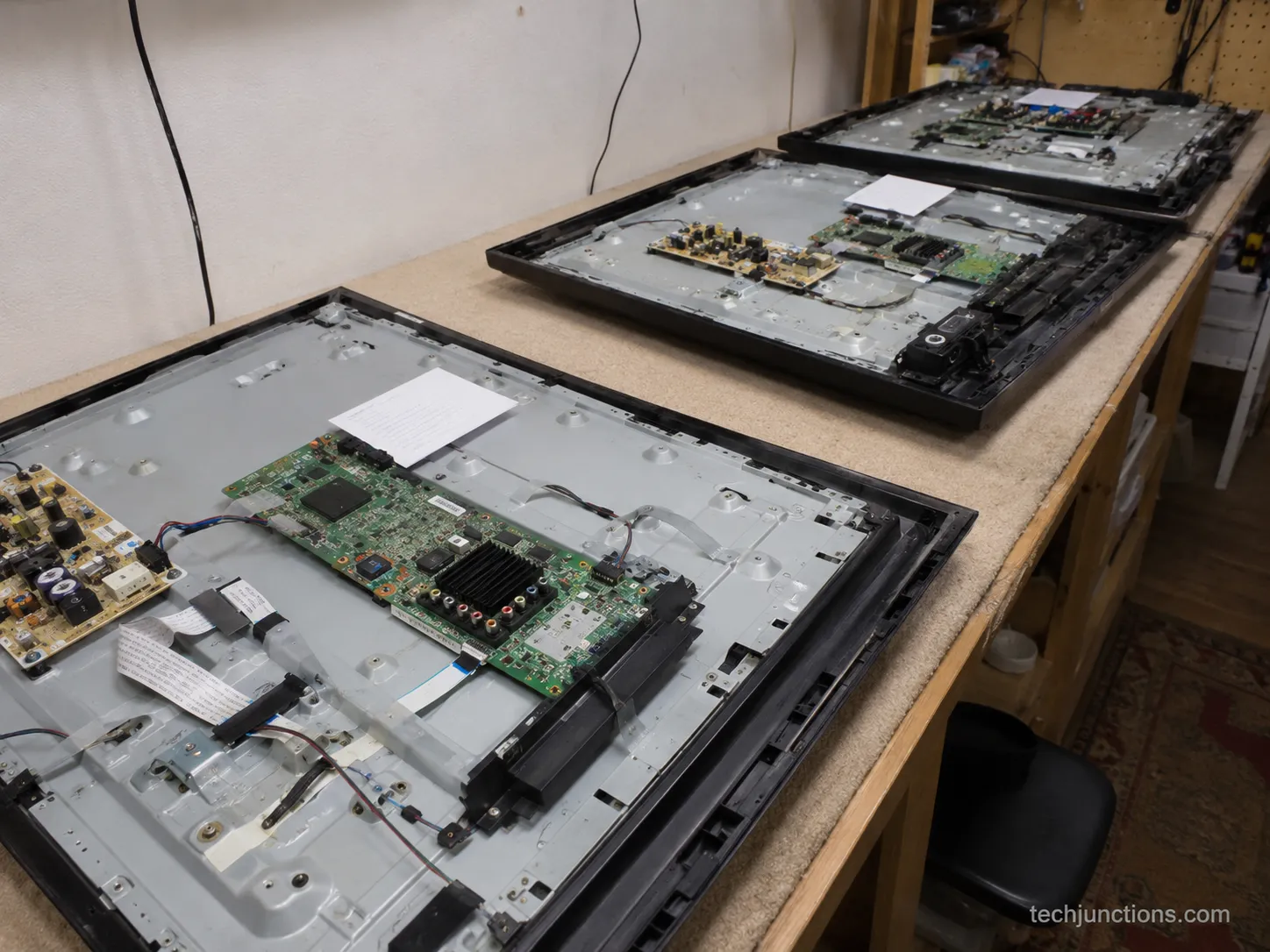
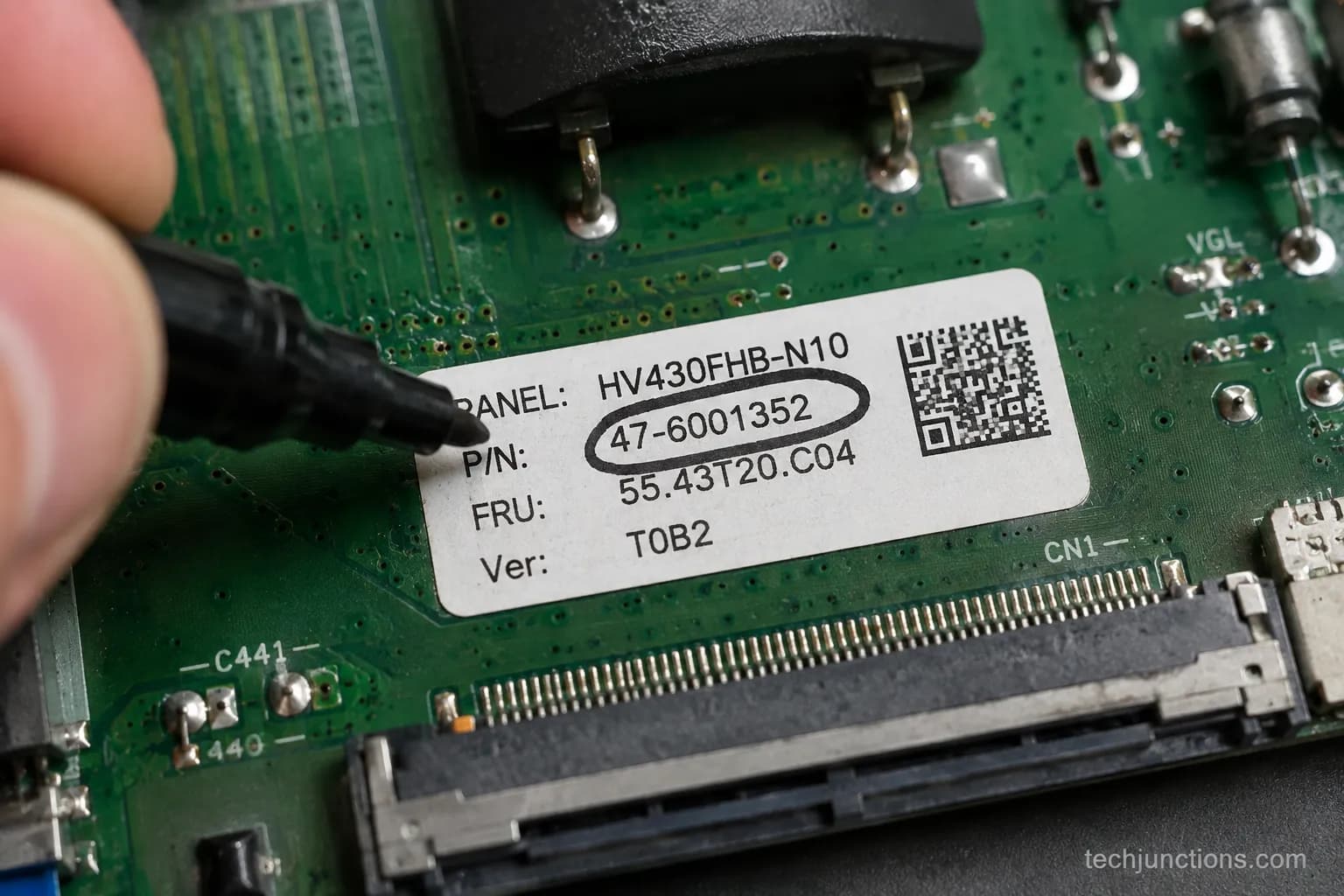
For do-it-yourself, find the part number printed on the failed board, a code in a format like 09-70CAR000-00, and search suppliers by that number rather than by your TV model, a workflow ShopJimmy's parts catalog is built around.
Each route fits a different owner. The choice is really about how much labor cost you are willing to trade for convenience.
Authorized and brand service is the hands-off option, but it is the priciest and only makes sense in warranty.
A local or mobile shop is the middle ground, useful when you want a real repair without opening the set yourself, though you should always get the quote before agreeing.
The do-it-yourself route is the cheapest by far and is where budget brands like Vizio genuinely shine.
Finding the exact part is the step that saves the most grief. The sticker code on the failed board is precise, while the TV model number often returns the wrong board revision.
For sourcing, original-brand parts last longest but cost more, third-party parts are cheaper with a shorter lifespan, and salvaged boards from a matching dead set are the budget option. Match the sticker code across all three.
A sourcing caution. Third-party parts may not match the original's lifespan, so weigh a slightly higher original-part price against a repeat failure a year later.
One more reality check before you assume hardware: sometimes the "dead" set is a streaming quirk, not a fault.
A stuck app or a remote that lost its pairing can look like a broken screen, so it is worth re-syncing a Roku remote or clearing a stuck streaming app before you order parts.
Frequently Asked Questions
Is it worth repairing a Vizio TV?
A Vizio TV repair is worth it when the fault is a cheap do-it-yourself board or backlight, which runs $20 to $60 in parts. It is usually not worth paying a shop $200 or more on a set you could replace for $250 to $350, and Vizio does not repair out-of-warranty sets itself.
Why is my Vizio screen black but the sound still works?
A black screen with working sound almost always means a backlight, power board, or T-Con fault, not a dead panel. Run the flashlight test: if a faint image appears, the backlight failed, and if nothing shows, the fault is likely the power supply or T-Con board.
Does Vizio repair TVs out of warranty?
No. Vizio's standard warranty runs one year, and once it lapses the brand does not perform the repair itself, instead routing owners to authorized or third-party service, as its support portal states. That is why the do-it-yourself route is so popular with Vizio owners.
Which TV brand is cheapest to repair?
The Roku-based budget brands (Vizio, TCL, Hisense, Insignia, and Onn) are cheapest, with common board and backlight parts in the $15 to $50 range. Samsung, LG, and Sony run higher because original parts and service cost more.
Can I fix a Vizio backlight myself?
Yes, if you are comfortable opening the set and working carefully around mains voltage. Backlight strips cost $20 to $40, and the repair is a common do-it-yourself job, but stop and call a pro if the electrical-safety steps feel unfamiliar.
How long do Vizio TVs last?
Most flat-screen TVs, Vizio included, last about 7 to 10 years with regular use. A fault on a set older than that usually tilts the decision toward replacement, even when the repair itself is cheap.
If your Samsung will not load apps, that is usually a Samsung internet problem rather than a repair, and a Samsung with no sound is often a Samsung volume problem you can fix in settings.
The bottom line on any vizio tv repair is the same one we started with: match the fault to the fix, and let who does the work decide the verdict.
A cheap board or backlight swap you handle yourself is almost always worth it, a paid repair on a budget set rarely is, and a cracked panel means it is time for a new TV.
Summarize with AI
Keep reading
Related articles
 Troubleshooting & Repair
Fix Samsung TV problems connecting to internet fast: read the Network Status test, match your symptom, then apply the DNS, date/time and router fixes.
 Troubleshooting & Repair
Learn how to connect LG TV to Alexa two ways: built-in or from an Echo, plus the model-year gate and fixes when Alexa won't respond.
 Troubleshooting & Repair
Fix Insignia TV horizontal lines on screen in minutes: a hard reset and one built-in menu test show instantly if it's a cheap cable or a dead panel.
 Troubleshooting & Repair
Sell it for parts, part it out, repurpose it, or recycle it free, that's what to do with a broken TV, plus what a broken set is really worth.
Comments
Moderated for quality. Share a correction, ask a follow-up, or tell us what worked for you - every comment is reviewed before it goes live.