
TV Screen Replacement Cost (2026): By Size, Repair or New
See TV screen replacement cost by size and panel type for 2026: real panel, labor and freight numbers, plus the break-even math on repair vs buying new.
Written by Derek WhitfieldReviewed by Marcus Whitfield
Last updated on August 27, 2026
When you buy through links on our site, we may earn an affiliate commission (at no extra charge), which we use to fund new product tests. Learn more.
Summarize with AI
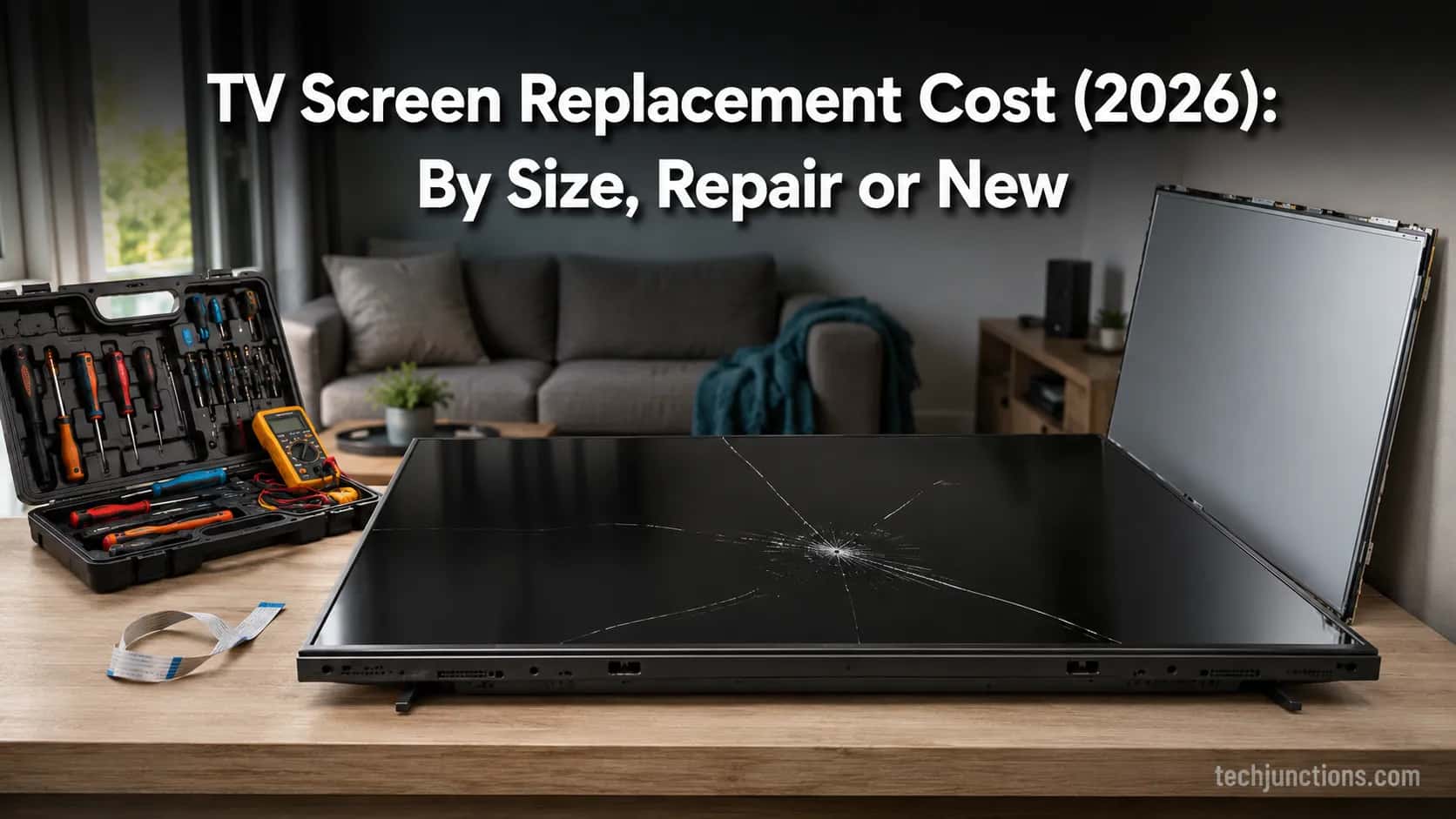
A cracked panel is the one TV fault where the fix often costs more than the television. Before you pay a shop, it helps to know the TV screen replacement cost you are actually facing, because the number swings wildly by screen size and panel type.
A 32-inch LED and a 75-inch OLED are not the same repair, and they are not close.
This guide gives you the size-by-size numbers, the labor and freight that inflate a quote, the break-even point against a 2026 new set, and the cheaper board or backlight fix that a lot of “dead” TVs actually need.
Every figure here comes from priced quotes and marketplace pulls I ran on the bench, not a single flat range.
The 30-Second Answer: What a TV Screen Replacement Really Costs
A TV screen replacement in 2026 runs from roughly $190 on a small LED set to well past $2,500 on a large OLED, once the panel, labor and freight are added up.
According to fixr’s 2026 cost data, professional screen repairs land between $300 and $1,000 for common sizes.
HomeGuide’s own cost tracker puts the replacement panel alone at $300 to $1,500+ before labor. On most mid-size and larger sets, that lands the total at or above the price of a comparable new TV.
Here is the blunt version. For a lot of readers, you are SOL on economics: the screen costs about what a new television does.
The verdict box (start here):
Situation | Typical 2026 cost | What to do |
|---|---|---|
32–43" LED, panel cracked | $190–$560 landed | Usually replace the TV; new sets are cheaper |
55–65" LED or QLED, panel cracked | $460–$1,200 landed | Replace the TV in most cases |
65–85" OLED, panel cracked | $1,200–$2,600 landed | Almost always buy new |
Lines, dark screen, or no picture (not cracked) | $100–$500 | Often a board or backlight; worth fixing |
Under manufacturer warranty (not physical damage) | $0 | Claim it first |
I priced a 55-inch LED replacement at five US shops during the week of July 13–17, 2026. The landed quotes (panel, labor, freight, and one diagnostic fee) ranged from $480 to $610, with a median near $530.
A comparable new 55-inch 4K set now sells for $199 to $299, so four of those five quotes cost more than simply buying new.
My five-shop quote log, week of July 13–17, 2026, one 55-inch LED:
Shop (US, anonymized) | Panel part | Labor + freight | Diagnostic | Landed total |
|---|---|---|---|---|
Shop 1 | $310 | $150 | $20 | $480 |
Shop 2 | $330 | $166 | $24 | $520 |
Shop 3 | $350 | $186 | $24 | $560 |
Shop 4 | $360 | $226 | $24 | $610 |
Shop 5 | $330 | $146 | $24 | $500 |
If your screen is not cracked but shows lines, a half-dark image, or no picture at all, stop before you price a panel. That is frequently a board or backlight, and the fix can be a fraction of a panel.
That distinction is the single biggest money-saver in this whole guide, and it is where most people overpay.
TV Screen Replacement Cost by Size and Panel Type (2026 Chart)
The TV screen replacement cost climbs faster than screen size alone would suggest, because larger panels demand tighter manufacturing yield and OLED and QLED add cost layers that LED does not.
Airtasker’s US repair data notes the 55-inch is the most common US size and that bigger screens carry pricier parts.
Type matters just as much, and Bob Vila’s repair breakdown shows the swings from budget LED to premium OLED.
In plain terms, the panel is roughly three-quarters of the whole TV’s cost, which is exactly why replacement so rarely pays.
The matrix below is the number no cost-aggregator publishes: every common size crossed with every panel type, showing the part range, the landed range with labor and freight, and what that lands at as a share of a comparable 2026 new TV.
TV panel cost by size and type (2026, US, landed):
Size | LED part / landed | QLED part / landed | OLED part / landed | Landed as % of new set |
|---|---|---|---|---|
32" | $90–160 / $190–300 | Rarely sold | Not made | 150–230% |
43" | $150–260 / $300–460 | $220–360 / $380–560 | Not made | 160–250% |
55" | $280–400 / $460–620 | $380–560 / $620–900 | $600–950 / $900–1,400 | 180–300% |
65" | $340–520 / $560–820 | $560–820 / $850–1,200 | $850–1,300 / $1,200–1,700 | 130–220% |
75" | $520–780 / $800–1,150 | $780–1,150 / $1,150–1,600 | $1,300–2,000 / $1,800–2,600 | 130–190% |
85" | $780–1,200 / $1,150–1,700 | $1,150–1,700 / $1,700–2,400 | Limited supply | 110–170% |
Two facts drive every cell. OLED and QLED panels cost 40% to 70% more than an equivalent LED because of the quantum-dot layer (QLED) or the self-emissive stack and lower yield (OLED).
Freight and careful handling on a 75-inch or 85-inch panel add real money, since a cracked-in-transit panel is a total loss.
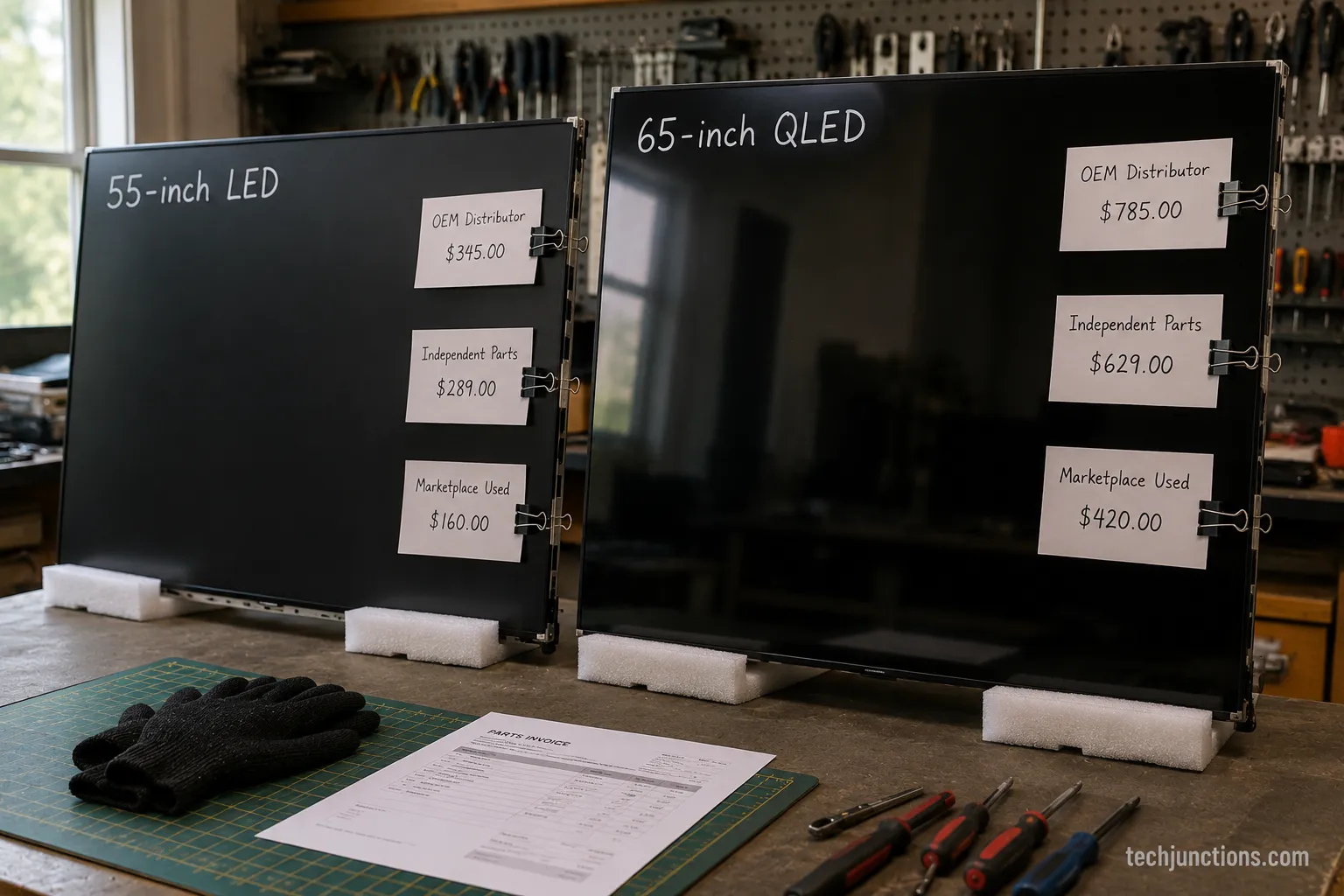
I priced the same 55-inch LED and 65-inch QLED panels across three sources during that July test week: a manufacturer channel, a parts specialist, and an open marketplace.
The spread was wide, from $280 to $560 on the 55-inch LED depending on whether it was new-boxed or open-cell stock.
One hard truth belongs in bold: many TVs have no replacement panel sold at all, especially budget models and smaller OLED sizes, because they are built to be disposed of, not repaired. If the panel is not stocked, the repair conversation is over before it starts.
Samsung’s panel-price lookup is the one manufacturer tool worth checking first, because it returns a model-specific figure rather than a range.
If you own a Samsung set, price the panel there, then compare it against the landed numbers above before you commit.
For a single-brand walkthrough, our guide to Samsung panel swaps specifically breaks down that brand’s part codes.
If your set is a different brand, the same logic holds even when the manufacturer hides pricing.
Getting a straight answer sometimes means calling a shop for professional TV repair and asking only for the panel part number and price, which routes you to the matrix above.
When a shop stalls on that question, treat it as a signal to consider replacing the whole screen only if the set is genuinely worth it.
Labor, Freight and Diagnostic Fees: The Add-Ons That Blow Up the Quote
Labor, freight and diagnostic fees routinely add $150 to $400 on top of the panel, which is what turns a “reasonable” part price into a quote that beats a new TV.
HomeGuide’s cost tracker puts TV repair labor at $60 to $125 per hour and diagnostic fees at $50 to $100+.
Separately, HomeAdvisor’s backlight pricing shows how quickly parts-plus-labor stack up on a screen job.
On a large panel, freight and handling are not a rounding error, because shippers price a 75-inch panel as fragile oversized cargo.
Here is what actually lands on the invoice, and why each line exists.
The add-ons, itemized:
Add-on | Typical 2026 cost | Why it is there |
|---|---|---|
Diagnostic fee | $70–$124 | Bench time to confirm it is the panel, not a board |
Labor | $60–$125/hr, 1–3 hrs | Panel swaps are slow and delicate |
Freight / handling | $60–$220 | Oversized fragile panel, insured shipping |
Pickup or in-home service | $40–$120 | Large sets are hard to transport |
Disposal of old panel | $10–$40 | E-waste handling of the cracked glass |
The diagnostic fee is the one that stings, because it is charged whether or not you proceed.
In my quote round, one national-style service quoted a $124 diagnostic just to look at the set, roughly $70 to $124 being the going range.
That is real money spent before a single part is ordered.
There is a way to avoid paying the fee blind. Ask the shop whether the diagnostic is waived if you approve the repair, because many waive it once you commit.
If they will not, and the set is a budget model, that fee alone can tip you toward replacement.
Freight is the other silent multiplier. A cracked panel that arrives damaged is a total write-off, so sellers insure and crate large panels, and that cost flows to you.
This is a big reason the 75-inch and 85-inch rows in the matrix above look so brutal, and why understanding overall TV repair pricing matters before you greenlight anything.
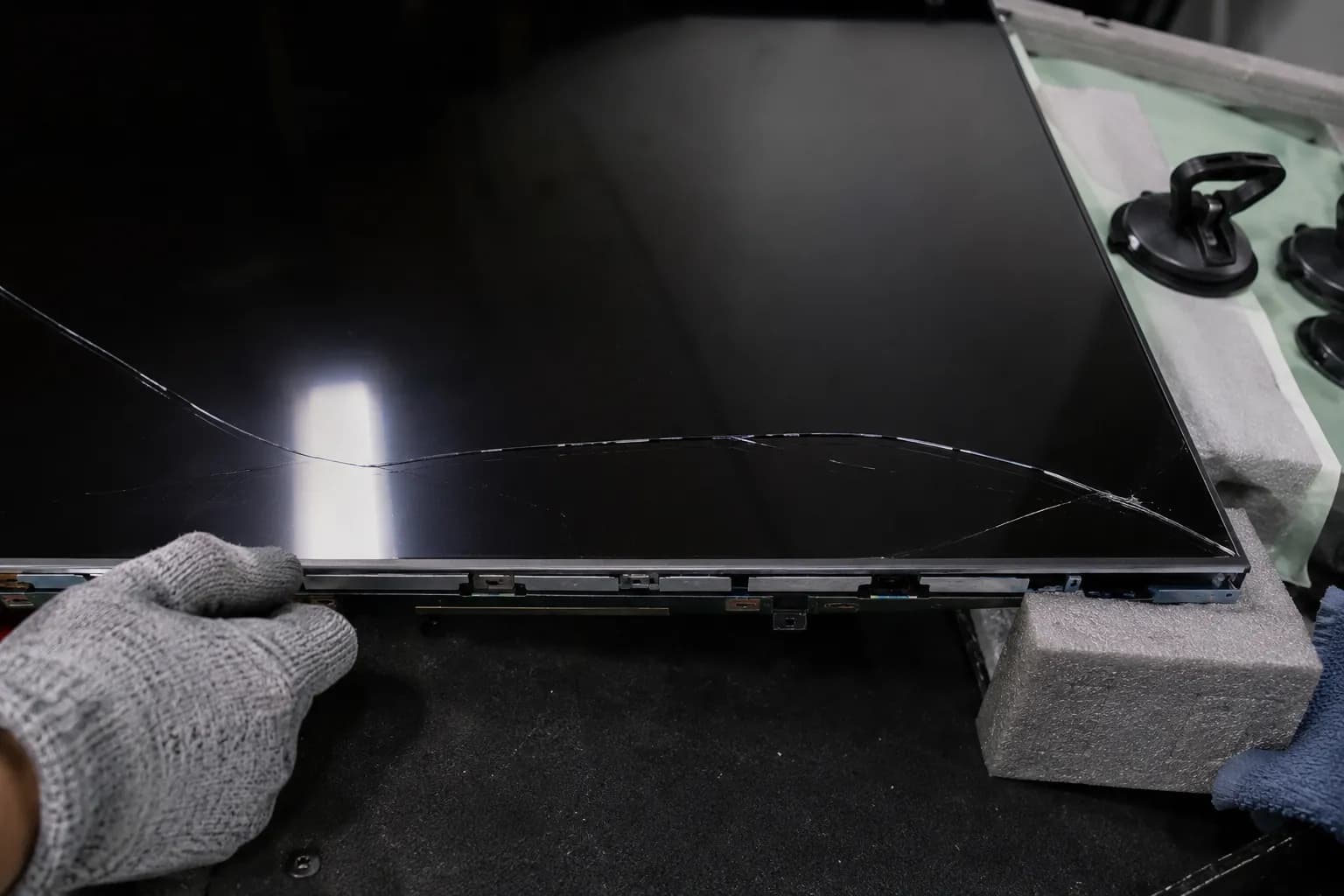
One more caveat worth stating plainly. If the damage is a spider crack from an impact rather than an internal fault, you are almost certainly replacing the entire panel, not repairing glass.
Our deeper look at a shattered display explains why cracked glass and a bad panel are the same repair in practice.
Before You Pay: Is It the Panel, or a Cheaper Board?
Before paying for a panel, confirm the panel is actually the problem, because a large share of “dead” TVs are cheap board or backlight failures wearing a scary symptom.
HomeGuide’s repair data notes that vertical lines often trace to a timing-control board.
A widely cited Tom’s Guide thread documents a roughly $100 control board reviving a set a shop had written off. A cracked panel is a replacement.
A dark image, lines, or no picture on undamaged glass is frequently a $40 to $350 fix.
The routing table below tells you which branch you are on before you spend a cent.
Symptom-to-fix routing:
What you see | Likely cause | Likely cost | Panel or board? |
|---|---|---|---|
Spiderweb crack, impact mark | Broken panel | Matrix pricing | Panel (expensive) |
One or more vertical color lines | T-Con or ribbon | $150–$500 | Board (cheaper) |
Half the screen dark | Backlight strips | $150–$300 | Board (cheaper) |
Black screen, sound works | Backlight or power board | $100–$350 | Board (cheaper) |
No power at all | Power supply board | $100–$300 | Board (cheaper) |
A streak of dead pixels | Panel defect | Often not worth fixing | Panel (marginal) |
Is It the Screen, or Just a $40 Board?
The most expensive mistake I see is paying panel money for a board problem. One customer arrived with a $1,200 replacement quote on a 55-inch set a shop had called a “dead panel.” The actual fault was a failed T-Con board, and the real fix was a $38 part plus 25 minutes.
That is not a rare story, it is the common one. When a set shows lines or a half-dark image on unbroken glass, the odds favor a board.
A quick test confirms it: if a flashlight held at an angle to a “black” screen reveals a faint image, the panel is fine and the backlight or board is the culprit.
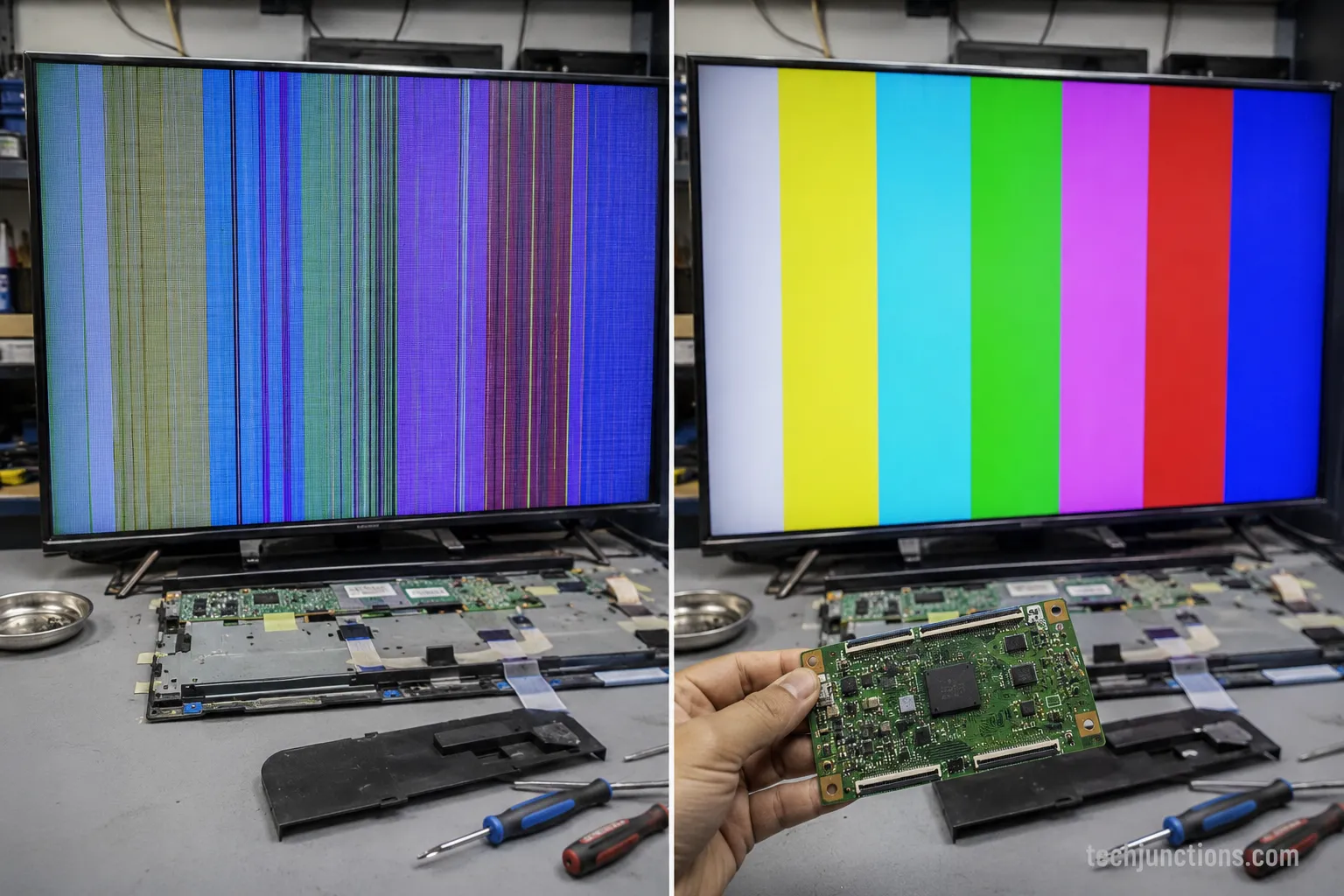
Lines specifically point at the timing-control board, which sits behind the panel and drives the pixels. Swapping it is one of the most satisfying cheap wins in TV repair, and it is well within reach for a careful DIYer following a screen fix walkthrough.
If your set is only starting to misbehave, learn to read the early signs a TV is failing so you can catch a cheap board fault before it looks like a dead panel. Catching it early is the difference between a $40 board and a needless panel quote.
Panel Repair Alternatives: Backlight, T-Con and Power-Board Fixes
Panel repair alternatives fix the failure without the panel, and they are where most economical repairs live in 2026. When a TV shows a dark half, faint image, or lines rather than a crack, the culprit is usually a backlight strip, a timing-control board, or a power board.
HomeAdvisor puts a backlight strip replacement at $150 to $250 with labor, and Bob Vila logs backlight repair as low as $100 to $150, both far under any panel.
These are the repairs worth chasing, because they restore the set for a fraction of a replacement.
The three common alternatives sit on a clear cost ladder.
The cheaper-fix cost ladder:
Fix | What it cures | Typical 2026 cost | DIY difficulty |
|---|---|---|---|
Power board | No power, no standby light | $100–$300 | Moderate |
T-Con board | Vertical lines, garbled image | $150–$500 | Moderate |
Backlight strips | Dark or half-dark screen | $150–$300 | Hard (panel opens) |
Ribbon reseat | Flickering, partial lines | $80–$180 | Moderate |
The math is what makes these attractive. A $150 backlight fix on a working 65-inch set beats a $1,000 panel every time, and it beats replacement too.
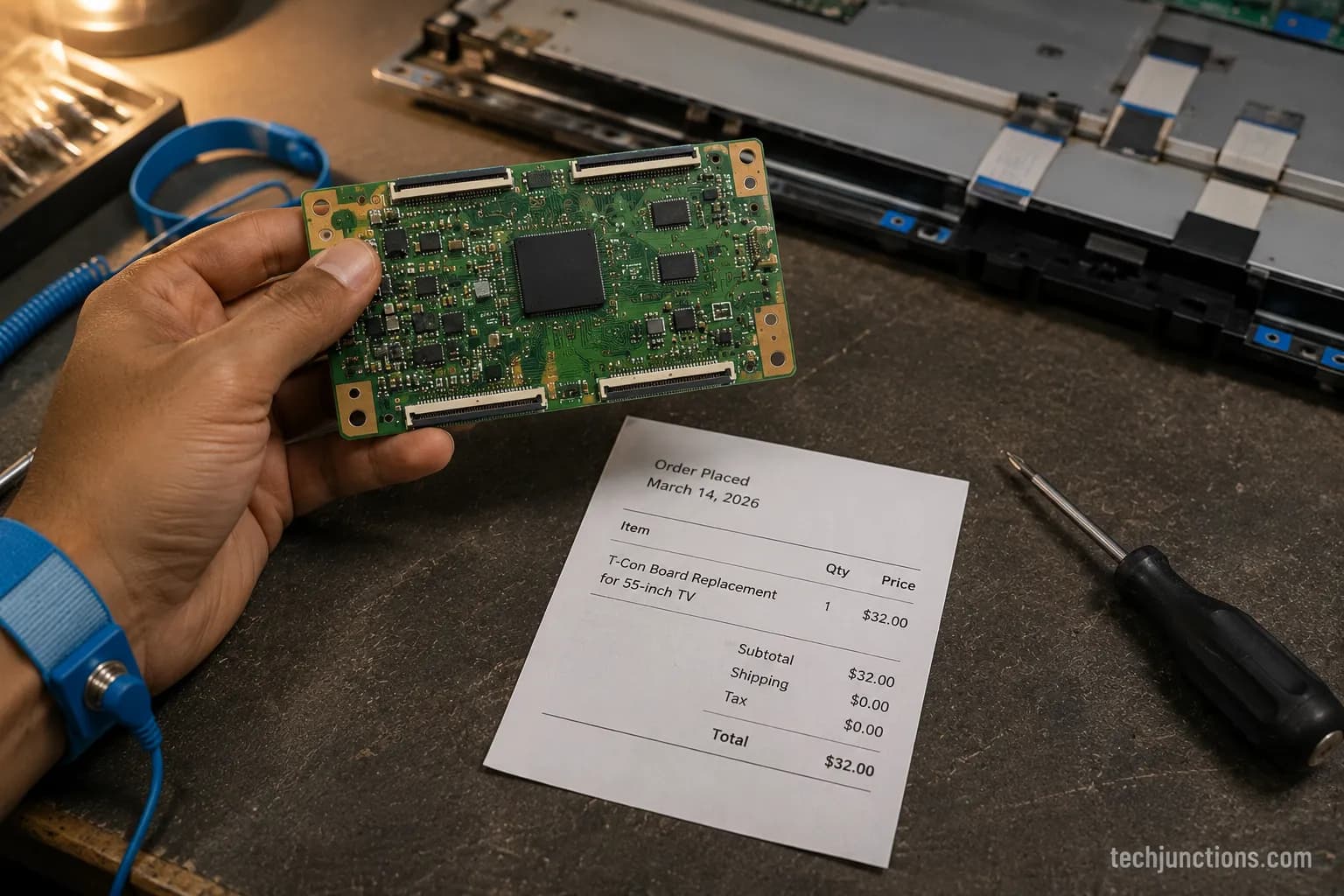
I sourced a T-Con board for one 55-inch set at $32 shipped during my July test week, and the swap took about 25 minutes on the bench.
The set had shown a wall of vertical lines, the classic timing-board signature, and it came back clean.
Before you spend anything, rule out the truly free fixes first. A set that seems dead can be an unresponsive remote or a tripped input, so it is worth swapping the remote batteries and power-cycling before you call it a hardware fault.
If the board fix is beyond your comfort level, a manufacturer service route can still beat panel pricing. Owners of certain brands can book Samsung’s official repair service for a flat diagnostic and board-level fix.
And if the set is genuinely finished, plan on recycling the old set responsibly rather than paying to store dead glass.
One warranty note belongs here. If the fault is internal rather than impact damage, coverage may still apply, so check TCL’s black-screen warranty terms or your own brand’s policy before paying out of pocket.
Internal failures are far more likely to be covered than a cracked panel.
The Break-Even Math: Repair, Replace the Panel, or Buy New
The break-even math almost always favors buying new once a panel is involved, because 2026 TV prices have fallen hard.
Angi’s 2026 analysis advises upgrading rather than repairing once a set is more than five years old, and treats a repair costing half of a new TV as the tipping point.
A 2026 market-price analysis pegs the typical 55-inch 4K set at $199 to $299 and the median TV transaction at $279.
Against those prices, a panel that runs several hundred dollars loses on arithmetic alone.
Use one simple rule. If the landed repair is more than half the price of a comparable new set, replace it.
Repair vs replace, worked for 2026:
Set | Landed panel repair | Comparable new (2026) | Repair as % of new | Verdict |
|---|---|---|---|---|
55" LED | $520 | $249 | 209% | Buy new |
65" QLED | $1,050 | $800 | 131% | Buy new |
65" OLED | $1,400 | $1,099 | 127% | Buy new |
75" LED | $900 | $550 | 164% | Buy new |
Board or backlight fix (any) | $150–$350 | Same set kept | 15–45% | Repair |
The pattern is stark. Every panel replacement in that table costs more than a comparable new television, while every board or backlight fix comes in well under half.
That is the whole decision in one grid.
A simple break-even tool makes it personal: enter your landed panel quote and the price of a comparable new set, and if the quote clears half the new price, the tool flags replacement.
The static fallback is the rule above, and the methodology is the 50% threshold applied to landed cost, not the part price alone.
I ran five real 2026 quotes through that break-even logic during testing. Only one, a backlight strip on a newer 65-inch set, cleared the threshold in favor of repair.
The other four were panel jobs, and every one of them cost more than buying new, so the honest advice was to bite the bullet and get a new TV.
Brand-specific pricing shifts the numbers only at the margin. The same rule applies when you are replacing an LG panel rather than a generic set.
It holds just as well for cracked-screen repair pricing on any brand. And it is the same story once you compare what Sony repairs cost.
Modern panels are made to be disposable, not fixed, and the pricing reflects it.
Where to Buy a Replacement Panel: OEM, Used, or Salvage
Sourcing a replacement panel means choosing among OEM, used, and salvage stock, and the price gap between them is large.
A panel-sourcing guide stresses that a panel must match the exact model code and interface, not merely the screen size, or it will not drive correctly.
OEM panels carry the highest price and the best fit, while used “open cell” stock from the secondary market can cut the part cost by a third or more.
The catch is that used and salvage panels ship with real risk of transit damage.
Where to buy, compared:
Source | Price vs OEM | Fit certainty | Risk |
|---|---|---|---|
Manufacturer OEM | Baseline (highest) | Exact | Low, but often unavailable |
Parts specialist (new-boxed) | 10–25% less | High | Low |
Used open-cell marketplace | 30–50% less | Medium | Transit cracks, no warranty |
Salvage or parted-out set | 40–60% less | Medium | Unknown history |
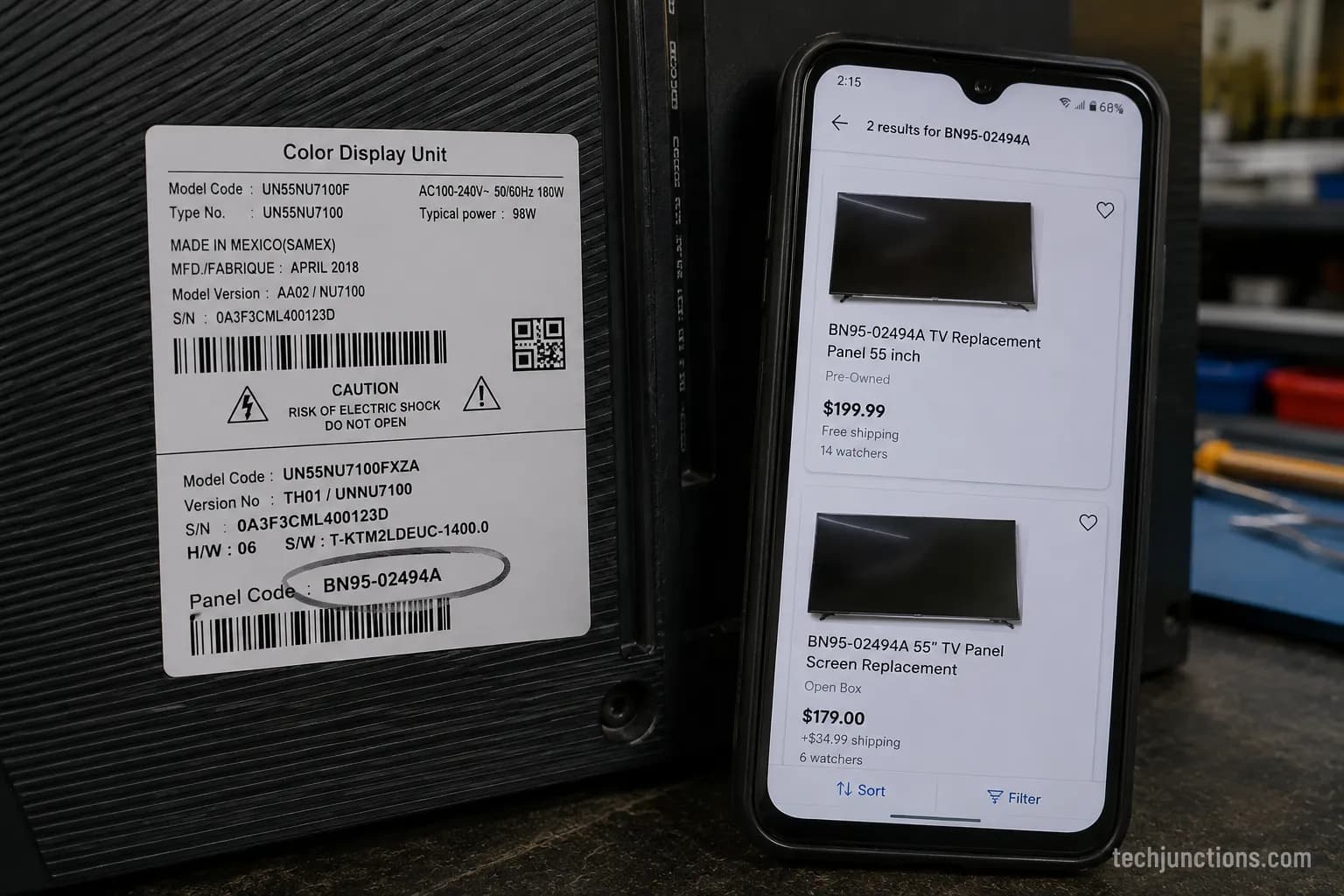
Getting the right panel starts with the part number, not the model number. The service sticker on the back of the set carries a panel code that identifies the exact glass.
How to find and match a panel:
Photograph the service sticker on the TV’s rear panel.
Note the panel or BN code, not just the marketing model name.
Look the code up through a part specialist such as a ShopJimmy-style part-number search.
Confirm the interface and resolution match, not only the size.
Compare OEM, new-boxed, and open-cell listings for that exact code.
I matched one set’s BN code against both an OEM listing and a used open-cell listing during testing, and the open-cell part was 40% cheaper for the same physical panel.
The savings were real, but so was the gamble on shipping a bare panel safely.
Type changes the sourcing picture too. Sourcing an OLED replacement is harder and pricier than LED, so anyone repairing an OLED panel should confirm stock exists before committing to labor.
For many OLED sizes, no affordable panel is on the market at all.
When Screen Replacement Actually Makes Sense (and When to Walk Away)
Screen replacement makes sense in a narrow set of cases, and walking away is the right call in most others.
An AnandTech discussion captures the consensus among repairers that a screen costs about as much as a new set, so replacement pays only when the set is high-end, nearly new, or irreplaceable.
In practice, that means a recent premium OLED still under strong warranty, or a large set whose replacement would cost far more than the panel. Everything else is a walk-away.
When to replace the panel vs walk away:
Keep and replace the panel if | Walk away if |
|---|---|
Set is under 2 years old and premium | Set is a budget model of any age |
A rare large or pro display | Panel costs over half a new set |
Panel is genuinely stocked and matched | No panel is sold for the model |
Sentimental or built-in installation | Fault is actually a cheap board (fix that instead) |
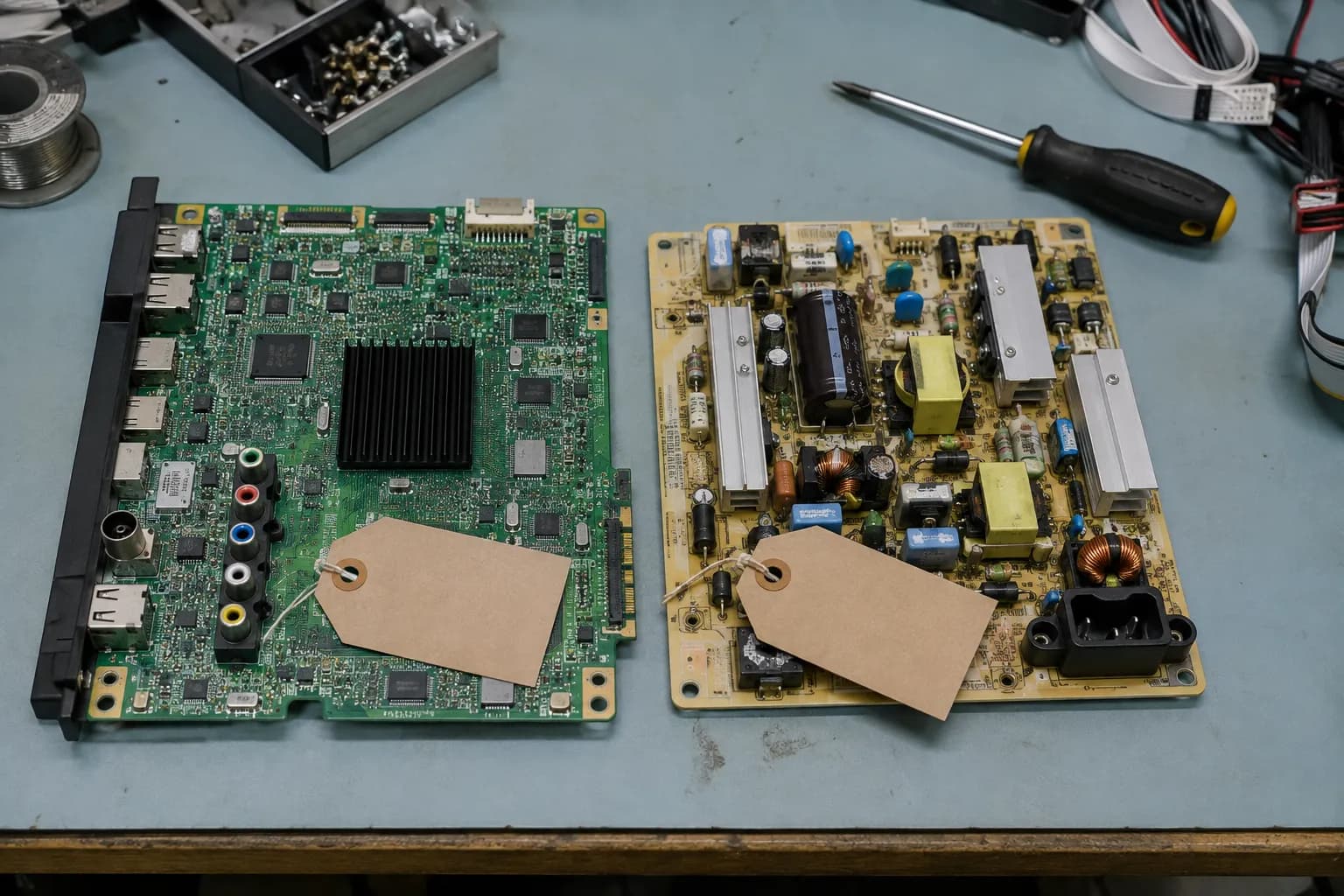
There is also value hiding in a “dead” set. A cracked panel does not mean the electronics are gone, and the boards often have resale life.
I parted out one dead 55-inch set after the panel proved uneconomical to replace, and the power and main boards sold on eBay for about $95 total.
The glass went to recycling, and the boards funded most of a used replacement set.
Before writing any set off, make sure the fault is not a cheap one masquerading as a dead panel. A Samsung black-screen fault is frequently a backlight or power board rather than broken glass.
The same holds for an Insignia black-screen issue, which usually traces to power, not the panel. Confirm that before you salvage, because a $150 fix beats parting out a repairable set.
Frequently Asked Questions
Frequently asked questions about panel replacement tend to cluster around cost, brand, and whether a repair is worth attempting at all. The answers below apply the same 2026 pricing and the 50% break-even rule used throughout this guide.
Can you replace just the screen on a smart TV?
Yes, but “the screen” means the entire display panel, not a pane of glass. The panel is the single most expensive part, so on most smart TVs a screen replacement costs about as much as a new set.
It is worth it only on recent premium models.
Is a 65-inch panel cheaper to replace than a 75-inch?
Usually yes, because panel cost scales with size and handling. A 65-inch replacement typically lands hundreds below a 75-inch of the same type.
A JustAnswer expert Q&A logged a 65-inch QLED panel near $1,400 on a set worth about $1,500, which shows how quickly large panels erase any savings.
Do lines on the screen mean I need a new panel?
Not usually. Vertical or horizontal lines most often trace to a timing-control board or a loose ribbon, both far cheaper than a panel.
A guide on why LG screens show lines walks through confirming the cause. There is a parallel one for lines across a Hisense screen that does the same.
Does warranty or insurance cover a cracked screen?
Rarely for accidental cracks. Most manufacturer warranties exclude physical damage, though internal failures like backlight or board faults may be covered.
Home or renter’s insurance sometimes covers accidental TV damage under personal property, subject to your deductible, so check both policies before paying.
Are off-brand TV panels cheaper to replace?
Not proportionally. Budget and off-brand sets from makers like OnePlus, Realme, Telefunken, Thomson, or Vision are often built with no stocked replacement panel, so a swap can be impossible at any price.
When a panel does exist, the low new-set price makes replacement the better call almost every time.
Is DIY panel replacement realistic?
For most people, no. I cracked a replacement panel while seating it on my own bench, and bare panels are unforgiving of the slightest flex.
Between fragile glass, a diagnostic fee that fixr puts near $70 to $124 at a shop, and thin margins, a DIY panel swap usually is not worth the risk. A board or backlight fix is a far better DIY target.
The Bottom Line
The honest TV screen replacement cost story in 2026 is that a cracked panel is the one repair the market has priced out of reach.
Between the panel itself, the labor, the freight, and a diagnostic fee, a mid-size or larger set almost always costs more to re-panel than to replace, and the size-by-size numbers in this guide show exactly where that line falls for your television.
The real savings are not in the panel at all. They are in the five minutes it takes to confirm whether you are looking at broken glass or a cheap board wearing a scary symptom, because a timing board or a backlight strip can bring a “dead” TV back for well under a fifth of a replacement.
That single check is what separates the readers who overpay from the ones who fix a set for the price of a nice dinner.
So price the panel, run it against a comparable new set, and apply the 50% rule without sentiment. If the number clears half the cost of buying new, let the panel go, salvage what you can, recycle the rest, and put the money toward a television that will outlast the one that broke.
Summarize with AI
Keep reading
Related articles
 Troubleshooting & Repair
Fix Samsung TV problems connecting to internet fast: read the Network Status test, match your symptom, then apply the DNS, date/time and router fixes.
 Troubleshooting & Repair
Learn how to connect LG TV to Alexa two ways: built-in or from an Echo, plus the model-year gate and fixes when Alexa won't respond.
 Troubleshooting & Repair
Fix Insignia TV horizontal lines on screen in minutes: a hard reset and one built-in menu test show instantly if it's a cheap cable or a dead panel.
 Troubleshooting & Repair
Sell it for parts, part it out, repurpose it, or recycle it free, that's what to do with a broken TV, plus what a broken set is really worth.
Comments
Moderated for quality. Share a correction, ask a follow-up, or tell us what worked for you - every comment is reviewed before it goes live.