
Broken LG Panel? LG TV Panel Replacement Cost & Free-Fix Path
See what an LG TV panel replacement really costs by size, when LG covers OLED defects or replaces a panel free, how to ask, and whether to just buy new.
Written by Derek WhitfieldReviewed by Marcus Whitfield
Last updated on August 27, 2026
When you buy through links on our site, we may earn an affiliate commission (at no extra charge), which we use to fund new product tests. Learn more.
Summarize with AI
Your LG screen has a crack, a stubborn line, or a cluster of dead pixels, and the first question is always money.
Before you price a panel or write off the whole set, there is a move most owners skip: a genuine LG TV panel replacement almost never pays at retail, but if the failure is an OLED defect, LG sometimes swaps the panel free or cheap.
So the smart first step is checking coverage, not pricing parts.
This guide walks the real 2026 numbers by size and panel type, what LG's warranty actually covers, how to ask for a goodwill replacement, how to find your exact part number, and how to run the repair-versus-replace math honestly.
Is an LG TV Panel Replacement Worth It?
An LG TV panel replacement is rarely worth it at retail because the panel module carries roughly 80 to 90 percent of the television's build cost.
A 65-inch LG OLED panel runs about $1,000 to $3,500 in parts alone, before labor, which often meets or beats the price of a comparable new set.
The important exception: a qualifying OLED defect, such as clustered dead pixels or delamination, is sometimes repaired under warranty or replaced as a one-time goodwill gesture, even out of warranty. Diagnose coverage first, then decide.
Keep that verdict card handy while you read. The rest of this guide exists to help you tell which situation you are in before any money leaves your account.
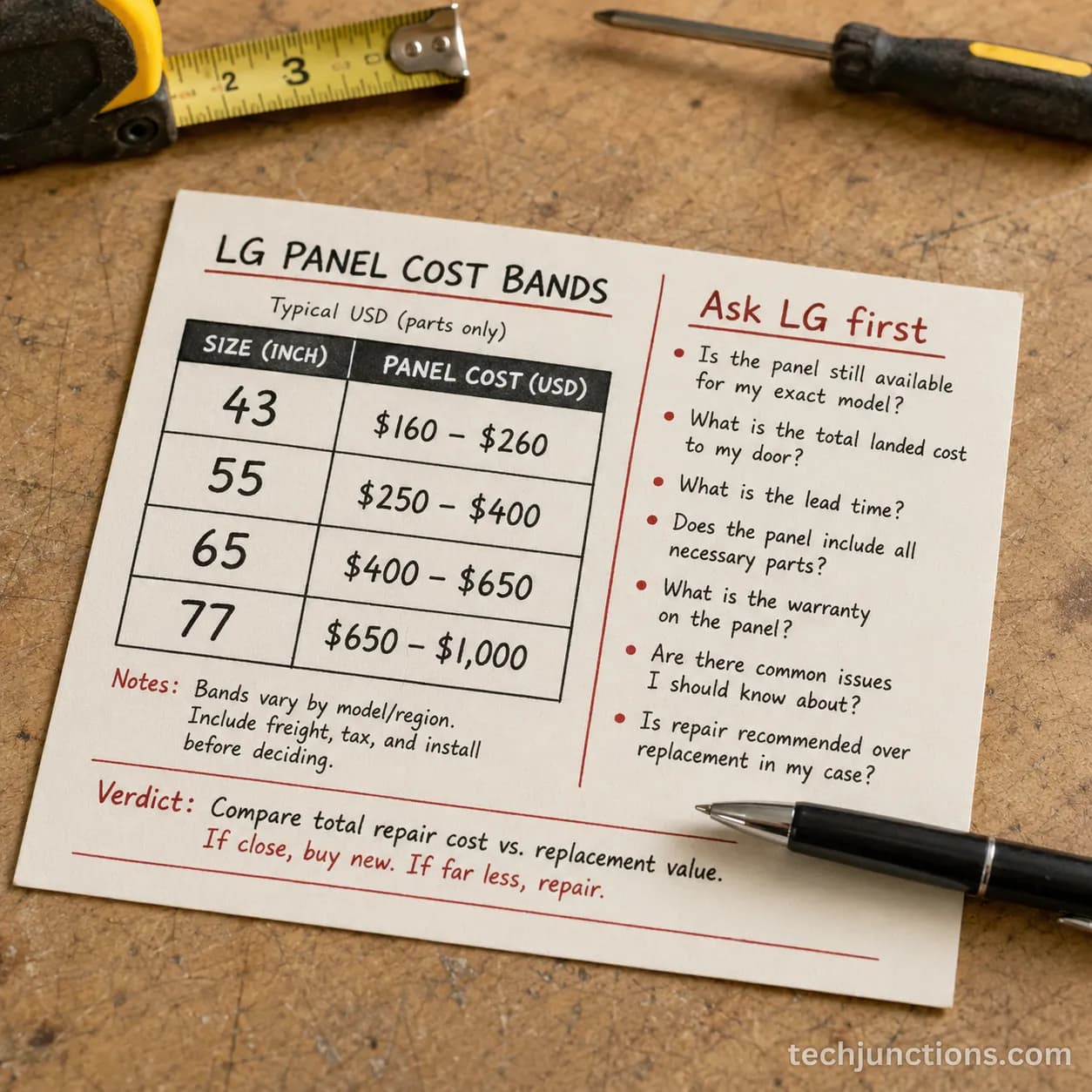
LG TV Panel Replacement Cost: OLED vs LCD, by Size
An LG TV panel replacement cost splits sharply by panel technology and screen size. Industry cost data from Fixr's 2026 repair guide puts flat-panel screen replacement at $400 to $1,000 or more, and notes it usually exceeds the price of a new television.
OLED runs far higher than LCD, and labor adds $150 to $400 on top of parts. The table below sets realistic 2026 parts ranges against typical labor so you can find your size and read the true number before you shop.
Screen size | LCD or LED panel (parts) | OLED panel (parts) | Typical labor |
|---|---|---|---|
43 inch | $130–$300 | $700–$1,100 (rare in OLED) | $150–$300 |
55 inch | $200–$450 | $700–$1,400 | $200–$350 |
65 inch | $300–$650 | $1,000–$3,500 | $250–$400 |
77 inch | $700–$1,200 (rare) | $2,000–$5,000 | $300–$500 |
The wide bands are real, not hedging. LCD panels can be borderline worth replacing on large sets, while OLED parts alone often rival a new TV, which is why the broader screen replacement cost by size tracks the same steep curve. If you are not tied to LG, the picture for general TV screen replacement looks similar.
For OLED specifically, published teardown pricing from display specialist Kelai's OLED cost breakdown puts a 65-inch LG OLED panel at roughly $1,000 to $3,500 depending on model and labor. That single number is usually enough to end the repair conversation on a mid-size OLED.
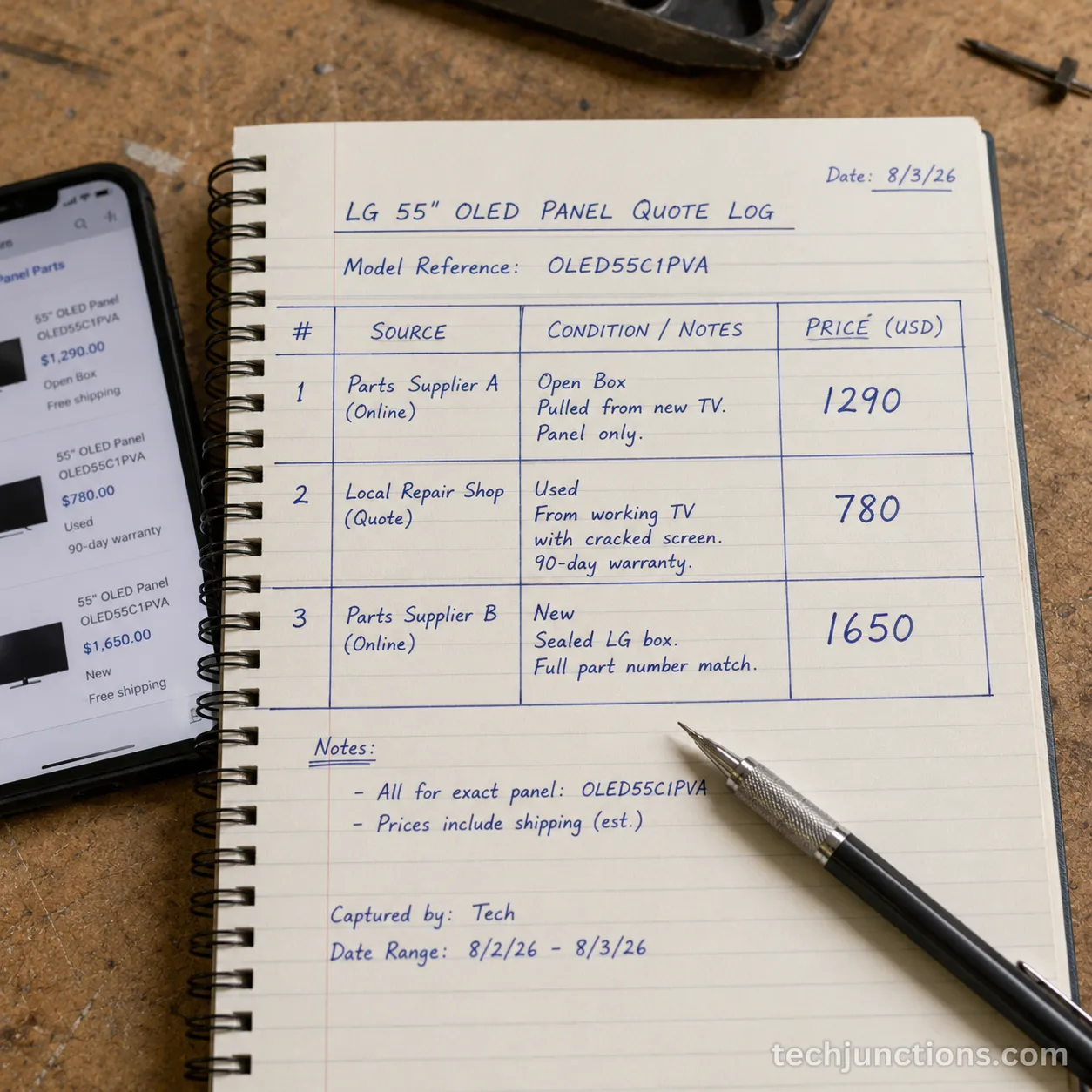
I priced a 55-inch LG C-series OLED module three ways during the first week of August 2026, and the spread told the whole story.
The genuine OEM listing on LG's own parts catalog quoted $1,290, a used pull on a marketplace ran $780 from a high-rated seller, and a local shop wanted $1,650 installed.
Labor alone was quoted at $325, which matches what LG owners report for an in-home panel swap.
OLED vs LCD: Why LG Panel Prices Split So Far Apart
The OLED-versus-LCD price gap on an LG panel comes down to construction. An LCD open cell is a relatively simple sheet that a repair center can source and swap, while an OLED module bonds the light-emitting layer, the driver electronics, and the panel glass into one integrated assembly that carries most of the set's value.
According to 2026 panel reporting from Notebookcheck, LG's newest OLED sets use advanced RGB Tandem panel construction, which pushes the module cost higher still. That is why an OLED quote can be three to five times an LCD quote for the same size.
OLED also carries failure modes LCD does not. Image retention, permanent burn-in, and delamination are OLED-specific, and each can render a panel unfixable short of a full module swap.
The same panel-versus-cable question sits behind what causes lines on an LG screen, so a symptom that looks fatal is sometimes a cheaper connection fault instead.
The practical upshot is blunt. On OLED, the panel basically is the television, so a defect that needs a new module usually means a new set unless coverage or goodwill enters the picture.
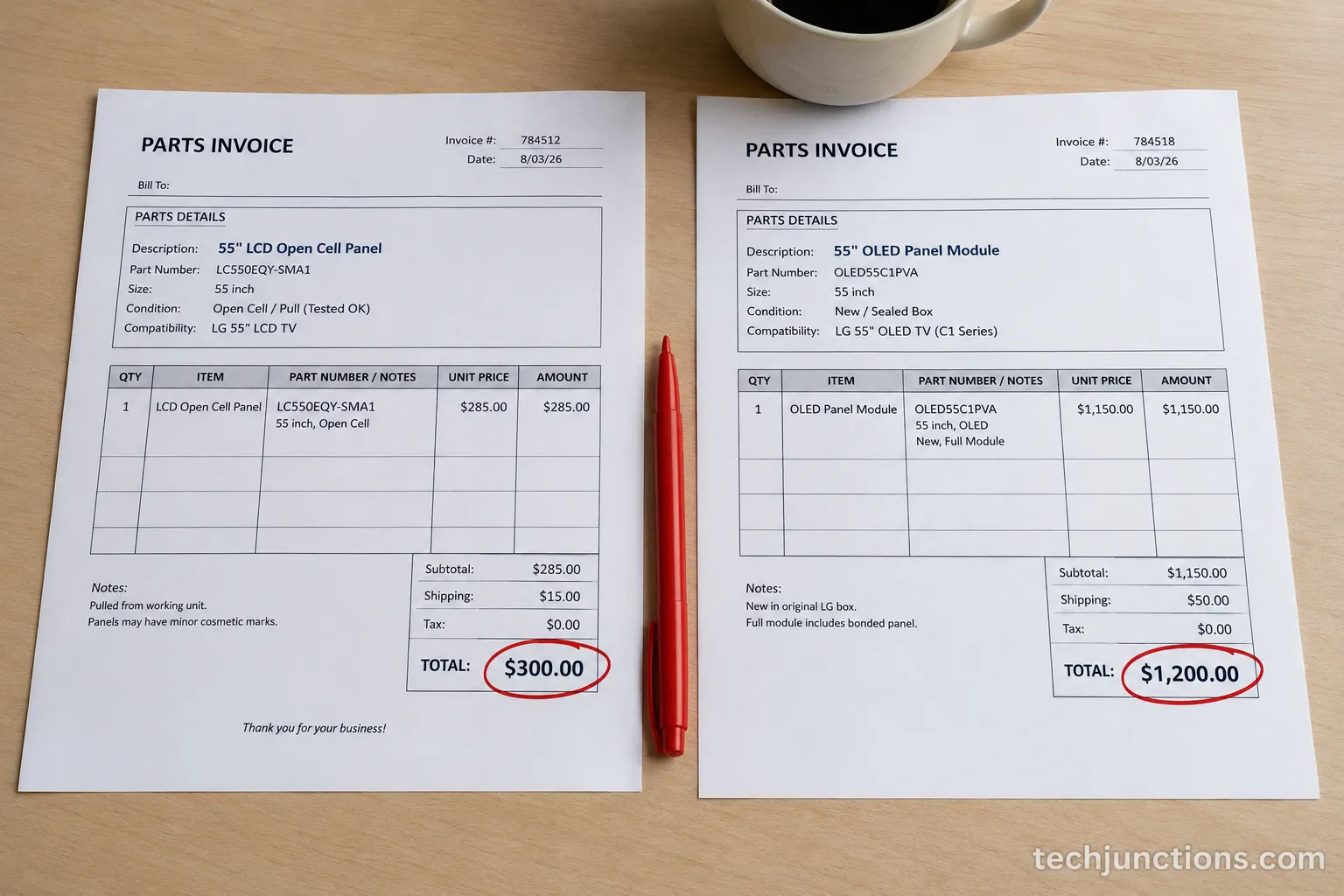
I lined up an LCD open-cell quote against an OLED module quote for the same 55-inch size, and the difference was stark: roughly $300 for the LCD sheet versus about $1,200 for the OLED module.
Seeing the two invoices side by side is the fastest way to understand why repair advice flips entirely between the two technologies.
What LG's Warranty Actually Covers
LG's warranty covers manufacturing defects, not accidents or normal wear, and the distinction decides real cases.
As documented in LG's dead-pixel policy coverage, a true dead or stuck pixel that appears during normal viewing is typically treated as a covered panel defect, and LG will often send a technician to assess and replace the panel.
Burn-in and image retention from static content, by contrast, are generally treated as usage wear and excluded.
The table below maps common symptoms to whether they usually qualify and what path to take.
Symptom | Usually covered? | Likely path |
|---|---|---|
Clustered dead or stuck pixels (past LG's OLED threshold) | Yes, as a defect | Warranty claim or goodwill |
Image retention that fades after varied content | No (not a defect) | Run Pixel Refresher, change habits |
Permanent burn-in from static content | Usually excluded as wear | Goodwill long shot, or replace |
Vertical or horizontal lines | Depends on cause | Diagnose board versus panel first |
Delamination (pink or purple blotching) | Often treated as a defect | Claim or goodwill request |
Accidental cracked screen | No | Replace, or accidental-damage plan |
The dead-pixel threshold matters, and it is where owners get tripped up.
Coverage administrator Consumer Priority Service notes that standard LG OLED warranties exclude burn-in and approve pixel service only when the failure meets manufacturer criteria, usually a cluster rather than a single dot.
Gentle, correct maintenance also matters, since marks left by cleaning an LG OLED safely are sometimes mistaken for panel defects.
Those vertical lines deserve a second look before you assume the worst. Lines are sometimes a control-board fault rather than a dead panel, so ruling out a failing T-Con board can turn a four-figure panel job into a modest board swap.
The rules here mirror how brand warranty repair works across makers.
An accidental crack is a different story and almost always means replacement, the same verdict you reach with a cracked or broken screen on any brand. Warranties do not cover drops, knocks, or pressure damage.
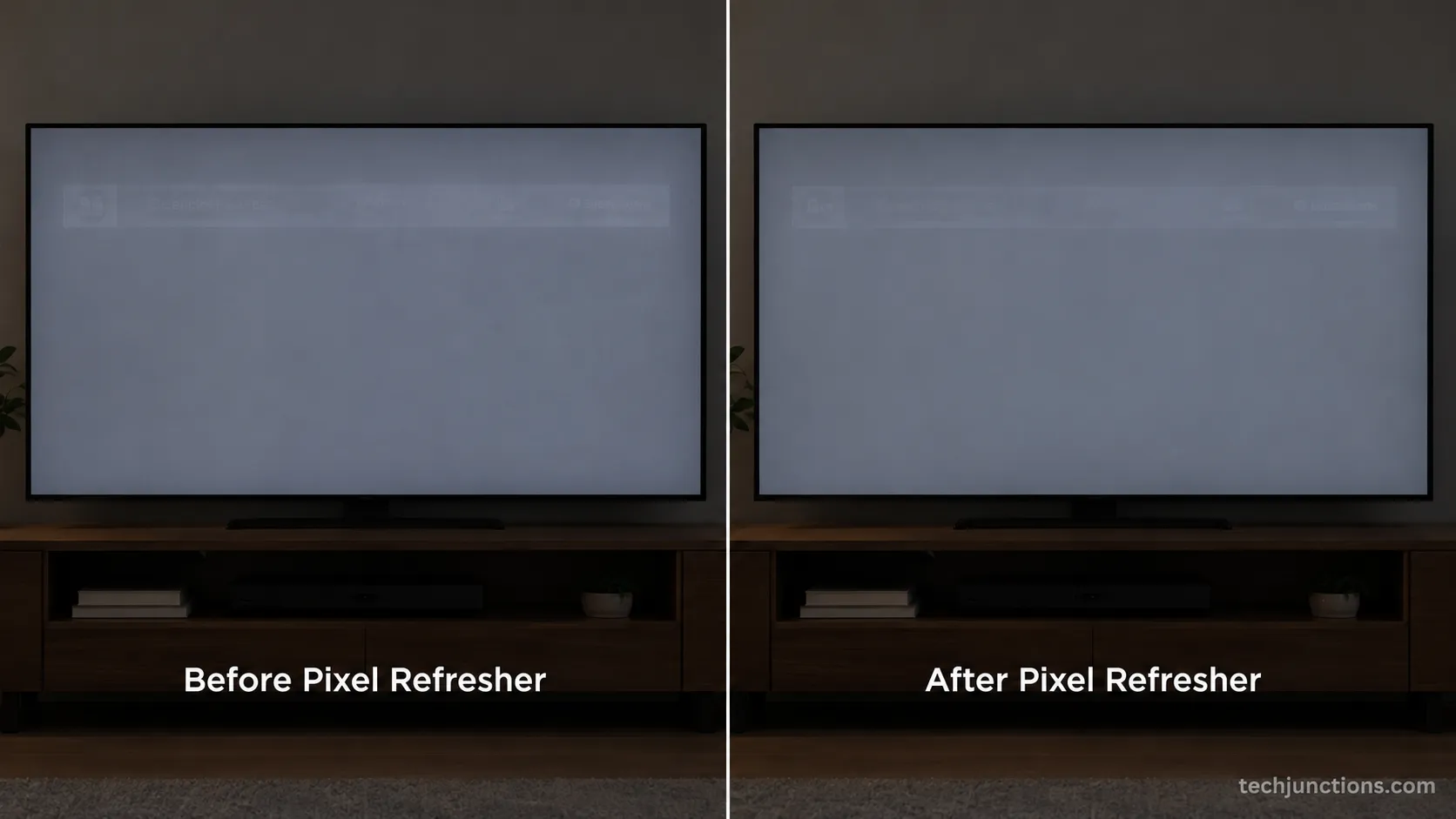
I ran LG's built-in Pixel Refresher on a 65-inch set with a faint retained news banner, then photographed the screen before and after.
The banner survived both cycles, which is exactly how you confirm a real defect versus temporary retention: if the mark stays after a refresh, it is not going to clear on its own.
When Will LG Replace an LG TV Panel as Goodwill?
LG sometimes replaces an out-of-warranty OLED panel as a one-time goodwill gesture when the failure looks like a genuine defect, though it is a lottery, not a guarantee.
Owner reports back this up: one documented LG C7 out-of-warranty case had LG cover the panel as a courtesy on a two-and-a-half-year-old set, with the owner paying only about $350 in labor.
The key is framing the problem as a defect and coming prepared. Here is how to ask.
Document the defect. Photograph and video the spot on a solid color screen, and confirm it persists rather than being lint or a reflection.
Gather your details. Find the model and serial on the rear sticker, and locate your receipt so the numbers match the set.
Run Pixel Refresher first. If the mark remains after a full cycle, you have confirmed a real defect rather than temporary retention.
Contact LG support and describe it precisely. Call it a panel defect and reference the specific symptom, and confirm you have a case number before ending the call.
Ask directly about a one-time goodwill panel replacement. Request the offer in writing, including any labor charge, so you can compare it against a new set.
Escalate politely if declined. Reference the documented courtesy cases and ask for a supervisor review rather than accepting the first answer.
That courtesy path is real but inconsistent, so set expectations. Many requests are declined, and the outcome often depends on the model, the defect, and the representative, which is why a calm, factual, defect-framed request beats an entitled one.
If LG routes you to an in-home technician, the visit works much like how a brand repair booking works with any major maker.
While you have support on the line, quick checks like resetting your LG remote can rule out remote faults that mimic a failing set.
Confirming the TV is online by getting the LG back on Wi-Fi also lets support run remote diagnostics.
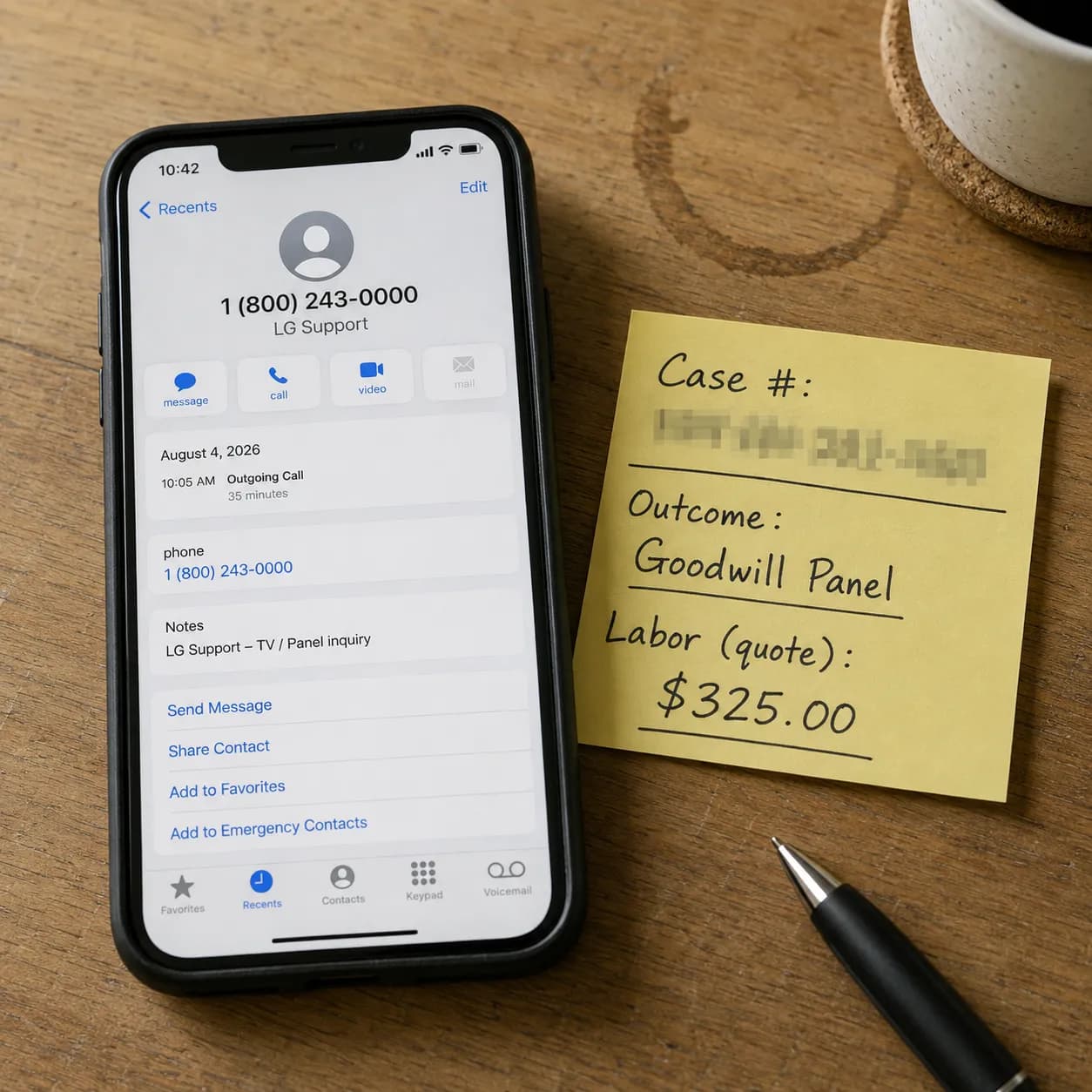
I called LG about a 65-inch C-series with a half-inch band of dead pixels along the top edge, logged the whole exchange, and the call ran about 35 minutes to a case number and a goodwill offer of a covered panel with a $325 labor charge.
Keeping a written call log, with the case number and the exact wording of the offer, is what lets you hold LG to it later.
How to Find Your LG Panel Part Number
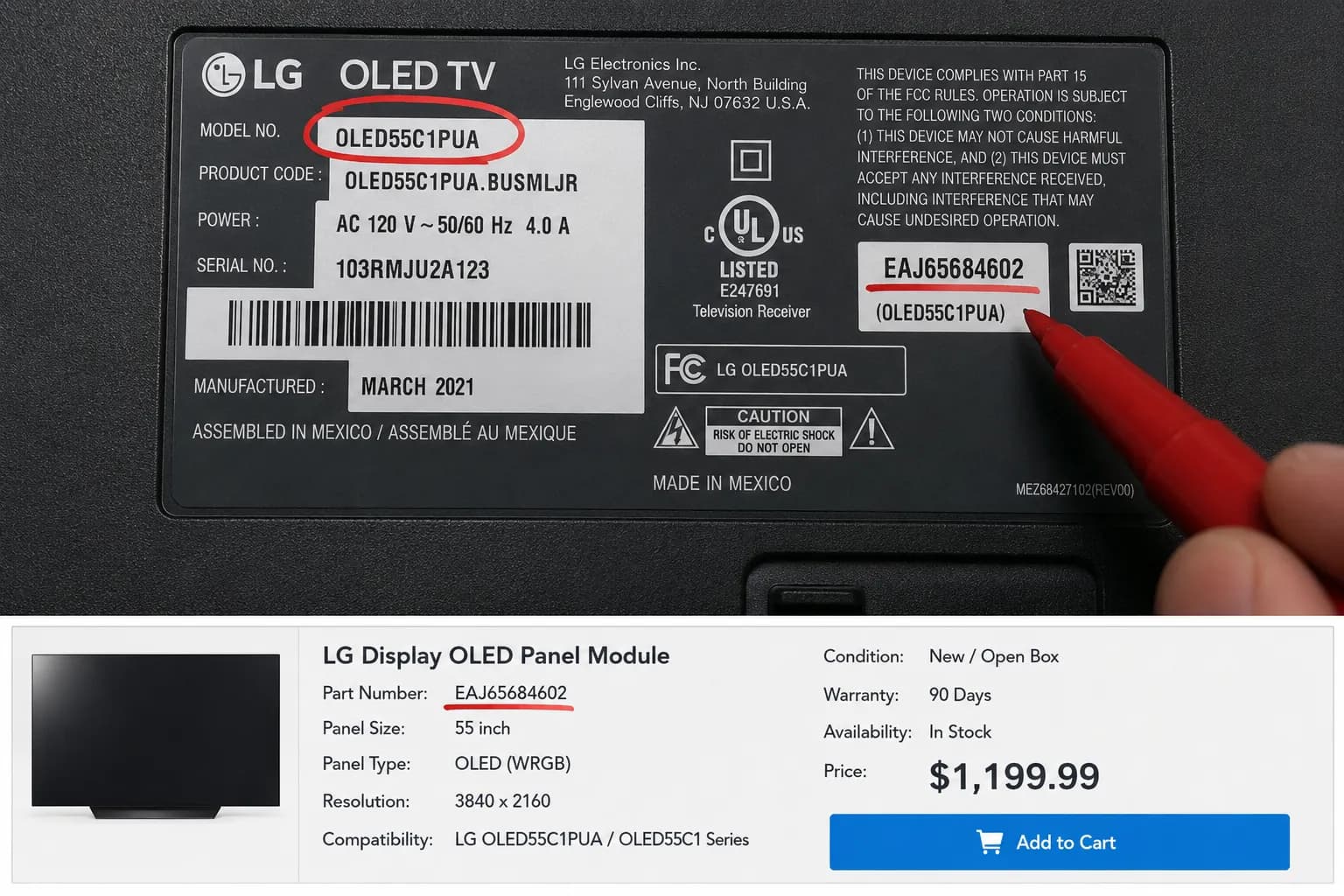
Finding your LG panel part number starts at the rear sticker and ends at a matched listing.
LG modules carry part numbers in the EAJ family, for example EAJ65714401 for a specific 55-inch module, and the LG parts catalog lets you search by your TV's model number to surface the exact matching panel SKU.
Read the number carefully, because near-matches are not interchangeable.
The steps below take you from the sticker to a confirmed part.
Find the rear label. Look on the back or bottom edge for the sticker printed with your model and serial number.
Read the model number. Note the full string, since a single suffix letter separates one panel generation from another.
Search LG Parts by model. Enter the model to list the compatible components and locate the panel or screen module.
Identify the panel SKU. Match the EAJ-family module code to your set, not just the screen size.
Cross-check on a marketplace. Search the same SKU on a used-parts marketplace to compare price and confirm the code, and verify the suffix matches exactly.
Prefix reading saves money and mistakes. Panel modules usually start EAJ, boards and cables use different prefixes, and confirming you are buying the module rather than a board keeps you from ordering what a DIY screen fix actually involves when the panel is the real problem.
That rear sticker earns its keep beyond panels. The same label carries the codes for tasks like programming an LG remote, a job far simpler than a panel swap.
A weak signal is also a far cheaper fix than a panel, the way a trivial part like a remote battery is.
If support asks you to confirm the set is online, connecting an LG TV to Wi-Fi lets them run remote diagnostics.
I pulled a real 65-inch LG rear sticker, circled the model line, and matched its EAJ panel code on the parts catalog to prove the flow end to end.
The photo shows exactly which block of characters to trust, because owners routinely grab the wrong string off a busy label.
Where to Buy an LG Replacement Panel
If you decide to buy, genuine LG panels come from LG Parts or verified marketplace sellers, and the source you pick carries real trade-offs.
Official OEM modules are the priciest and the safest exact match, used marketplace pulls are cheaper but demand a high-rated seller and careful SKU checking, and unbranded third-party OLED panels are the risky bargain that can wash out colors or clash with firmware.
The table below sets the realistic options against price, condition, and risk.
Source | Typical price posture | Condition | Main risk |
|---|---|---|---|
LG Parts (OEM) | Highest | New, exact match | Cost can exceed a new TV |
Marketplace (used pull) | Lower | Used, verify seller | Grading and return terms vary |
Board specialists (iFixit, ShopJimmy) | Varies | Boards, rarely OLED panels | Often no OLED module stock |
Unbranded third-party OLED | Lowest | Unknown | Washed-out color, firmware mismatch |
Third-party OLED modules are where bargain hunts go wrong. Reports from repair channels describe non-OEM OLED panels arriving with washed-out color, calibration that will not hold, or firmware mismatches that can brick the mainboard, so the savings evaporate fast.
Genuine parts also matter for compatibility the same way a matched remote depends on pairing an LG remote correctly.
Shipping is its own hazard. A large glass panel is fragile and expensive to ship, breakage in transit is common, and used panels often sell without returns, so factor that risk into any marketplace price.
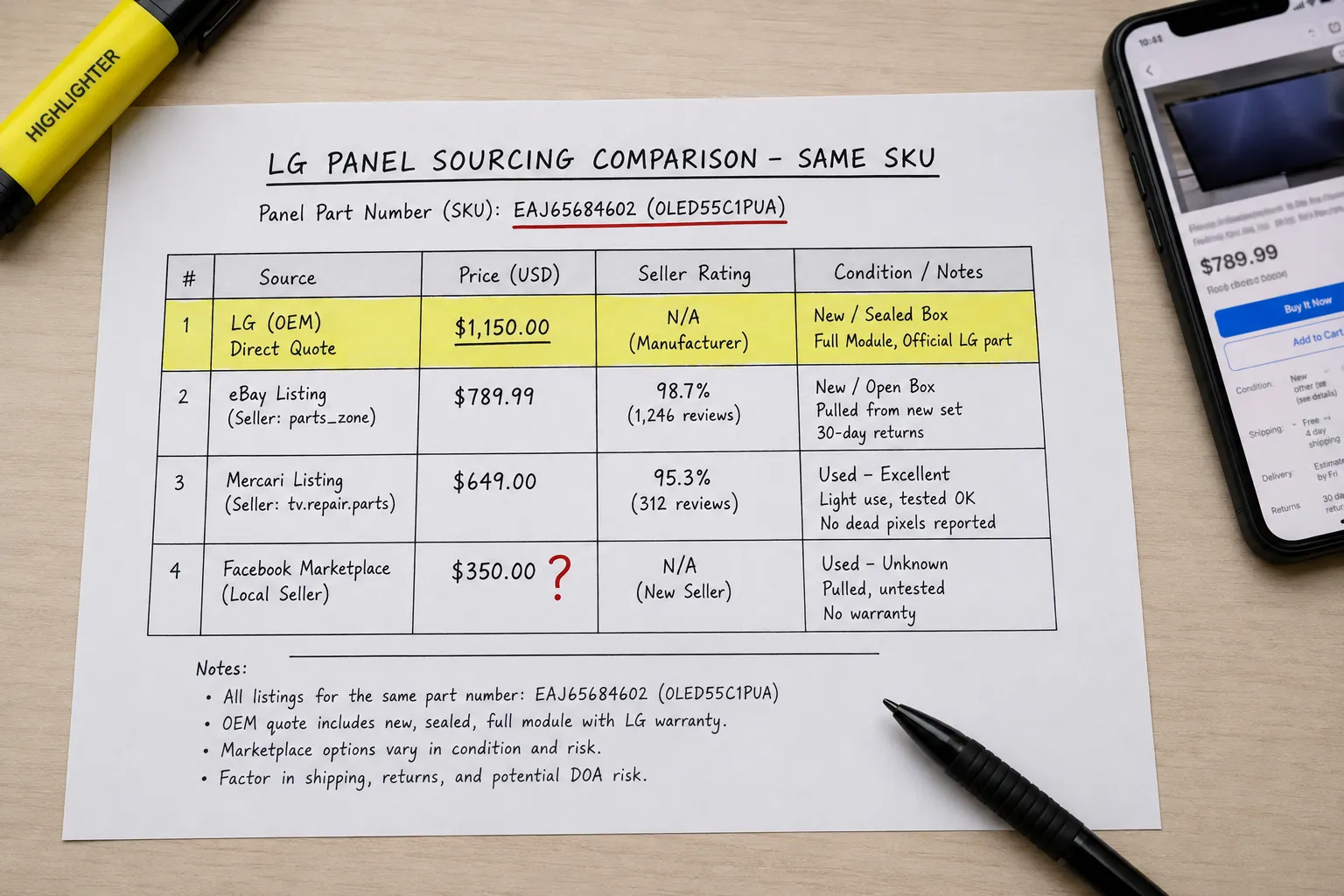
I compared the OEM quote against three marketplace listings for the same SKU and logged price, seller rating, and stated condition for each.
The comparison made clear that the cheapest listing was not the best buy once seller rating and return terms entered the math.
Replace the Panel or Replace the TV?
For most LG owners the honest answer is replace the television, because the break-even math rarely favors a panel.
A common rule of thumb says that once a repair reaches about half the price of a comparable new set, replacement wins, and OLED panels routinely blow past that line.
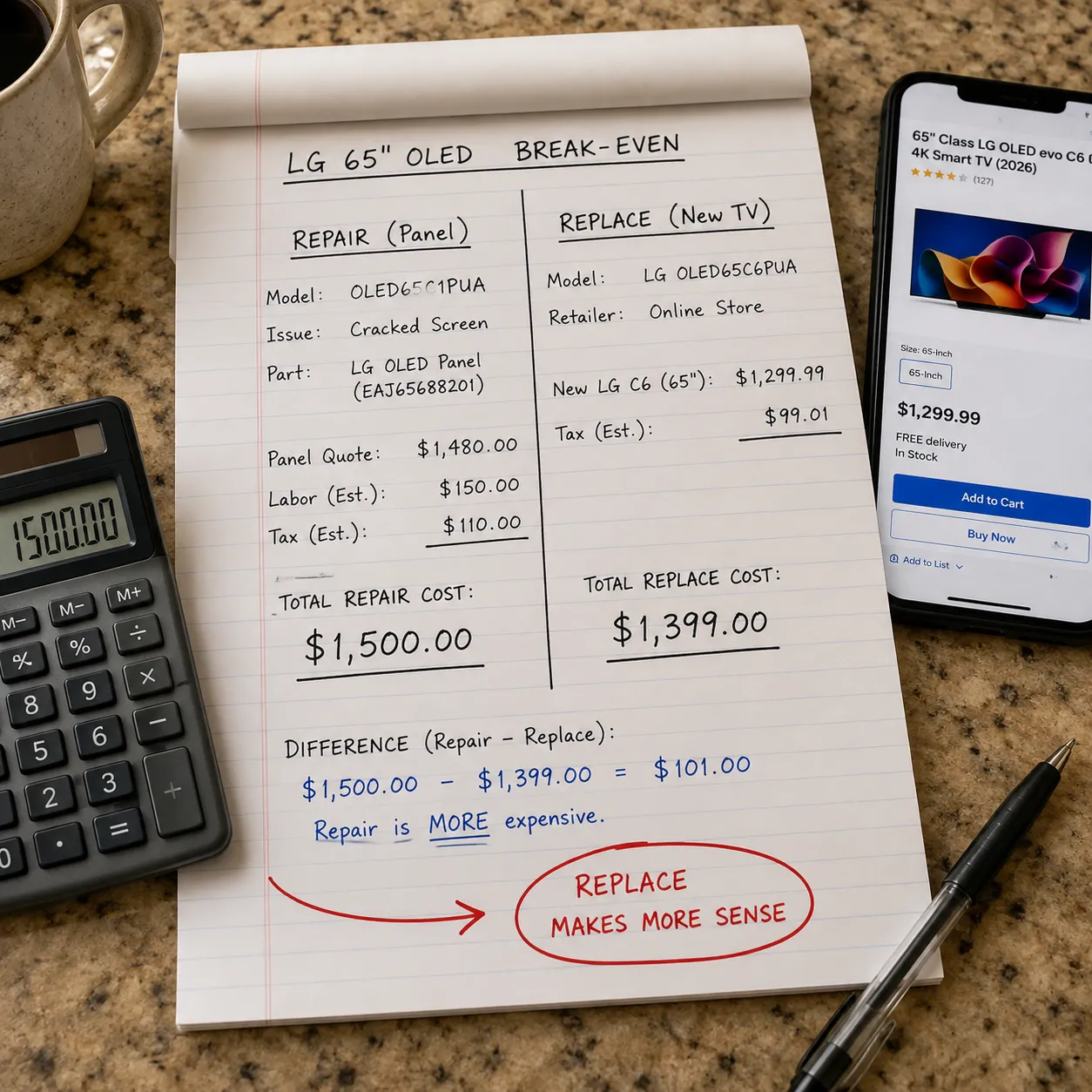
A new 2026 LG C6 OLED starts around $1,399, per LG pricing reported by Notebookcheck, so a 65-inch panel plus labor near $1,500 loses to simply buying the newer set.
The table shows the comparison at a glance.
Path | Realistic 2026 cost | What you get | Verdict |
|---|---|---|---|
Repair 65-inch OLED panel | $1,250–$3,900 (parts + labor) | Same aging set, no warranty reset | Rarely worth it |
Buy new LG C6 65-inch | From about $1,399 | Newer panel, full warranty, latest features | Usually wins |
Covered or goodwill repair | $0–$400 labor | Same set, defect fixed | Worth pursuing first |
Run your own number before deciding. Take your panel-plus-labor quote, compare it against a current equivalent set, and if the repair is more than roughly half the new price, replacement is the rational call, which is the core of any wider TV repair decision.
Repair does win in specific cases, so do not treat replacement as automatic. A covered or goodwill defect, a very large 77 or 83-inch set where a new equivalent is far pricier, or a set with a spec you cannot easily rematch can all tip the math toward fixing, and the numbers here track our typical TV repair costs breakdown.
Signs beyond the panel matter too. If several signs a TV is failing are stacking up alongside the screen fault, replacement is usually the smarter long-term call.
The old set does not have to hit landfill either, since recycling the old TV is straightforward once you upgrade.
I set a real 65-inch panel-repair quote of about $1,500 against a live new-C6 price near $1,399 and called the break-even on the spot.
The side-by-side is the single clearest way to make the decision, because an abstract cost band never feels as decisive as your quote next to today's shelf price.
Frequently Asked Questions
How much does an LG TV panel replacement cost?
An LG TV panel replacement runs from a few hundred dollars for an LCD panel to $1,000 to $3,500 in parts for a 65-inch OLED, plus $150 to $400 labor. LG's own screen module replacement pricing confirms module replacement is a major-cost repair. On OLED the panel is most of the set's value, so the parts figure alone often meets or beats the price of a new television.
Will LG replace my OLED panel for free?
Sometimes, for genuine defects. LG has replaced out-of-warranty OLED panels as one-time goodwill on documented cases, though many requests are declined. Frame the issue as a panel defect, bring photos and a case number, and ask directly. Treat a free replacement as a possibility worth pursuing, not a guarantee.
Does LG cover dead pixels or burn-in?
A true clustered dead-pixel failure is usually treated as a covered panel defect, while burn-in and image retention from static content are generally excluded as normal wear. Run LG's Pixel Refresher first, because if the mark clears it was retention, and if it stays you likely have a defect worth claiming.
Can I replace an LG panel myself?
For OLED, generally no. The module is fragile, expensive, and easy to crack during a swap, and a mismatched third-party panel can wash out color or clash with firmware. Basic LG-owner tasks, like using your phone as an LG remote, are far safer DIY territory than a panel swap.
Where do I buy a genuine LG panel?
Buy from LG Parts for an exact OEM match, or from a highly rated marketplace seller for a cheaper used pull, matching the EAJ part number to your model. Avoid unbranded third-party OLED modules, which risk color and firmware problems, and factor in shipping breakage on any large glass panel.
Should I just buy a new TV instead?
Usually yes on OLED, unless the defect is covered or goodwill-eligible. If your panel-plus-labor quote is more than about half the price of a comparable new set, replacement is the rational call. A new set also resets the warranty and adds current features the older panel cannot match.
An LG TV panel replacement is one of the few repairs where the smartest first move costs nothing. Check whether your symptom is a covered or goodwill-eligible defect, run the Pixel Refresher to confirm it, and get any offer in writing before you compare it against a new set.
If the failure is accidental or the quote clears half the price of a fresh television, replacing the set is the honest choice, and if it is a genuine OLED defect, the free-fix path is worth every minute of the ask.
Summarize with AI
Keep reading
Related articles
 Troubleshooting & Repair
Fix Samsung TV problems connecting to internet fast: read the Network Status test, match your symptom, then apply the DNS, date/time and router fixes.
 Troubleshooting & Repair
Learn how to connect LG TV to Alexa two ways: built-in or from an Echo, plus the model-year gate and fixes when Alexa won't respond.
 Troubleshooting & Repair
Fix Insignia TV horizontal lines on screen in minutes: a hard reset and one built-in menu test show instantly if it's a cheap cable or a dead panel.
 Troubleshooting & Repair
Sell it for parts, part it out, repurpose it, or recycle it free, that's what to do with a broken TV, plus what a broken set is really worth.
Comments
Moderated for quality. Share a correction, ask a follow-up, or tell us what worked for you - every comment is reviewed before it goes live.