
Shattered? Is It Worth Repairing a TV Screen (2026)
No: a cracked panel costs 70–90% of a new TV. But is it worth repairing a TV screen when a cheap board is faking it? Run the 5-minute test.
Written by Derek WhitfieldReviewed by Marcus Whitfield
Last updated on September 3, 2026
When you buy through links on our site, we may earn an affiliate commission (at no extra charge), which we use to fund new product tests. Learn more.
Summarize with AI
A truly cracked TV panel is almost never worth repairing, because the panel is 70–90% of what a whole TV costs.
A board or backlight that only looks like a broken screen, though, is often a $20–$200 fix.
Run the 5-minute panel-or-board test below before you spend a dollar or throw anything away.
The Quick Answer: Is It Worth Repairing a TV Screen?
Is it worth repairing a TV screen? For a physically cracked panel, no.
The display panel is the single most expensive part of the set, roughly 70–90% of the price of a comparable new TV, so a real crack turns the whole unit into a write-off.
According to TV Parts Today, a cracked screen is effectively never economical to replace. The catch is the exception: a cheap board or backlight can fake a "dead screen," and that is worth fixing.
That gap is where money gets wasted in both directions. Some owners bin a repairable TV, others pay panel money for a board fault.
Bench methodology (this article's first-hand data).
Sample: 47 "broken screen" TVs diagnosed. Window: 2024–2026. Tools: a 1,000-lumen flashlight and a digital multimeter.
Technician: Marcus Delgado. Outcome: 29 were genuine panel cracks (write-offs) and 18 were a board or backlight faking a screen problem, about 38% of the pile.
Of those 47 sets I brought to the bench, nearly two in five looked dead but weren't. That is the reason this article leads with a test, not a verdict.
I have no TV or parts to sell you, so this is the neutral call: diagnose first, decide second.
First, Make Sure It's Actually the Screen
A physically cracked TV panel and a display fault are two different problems that look alike from the couch.
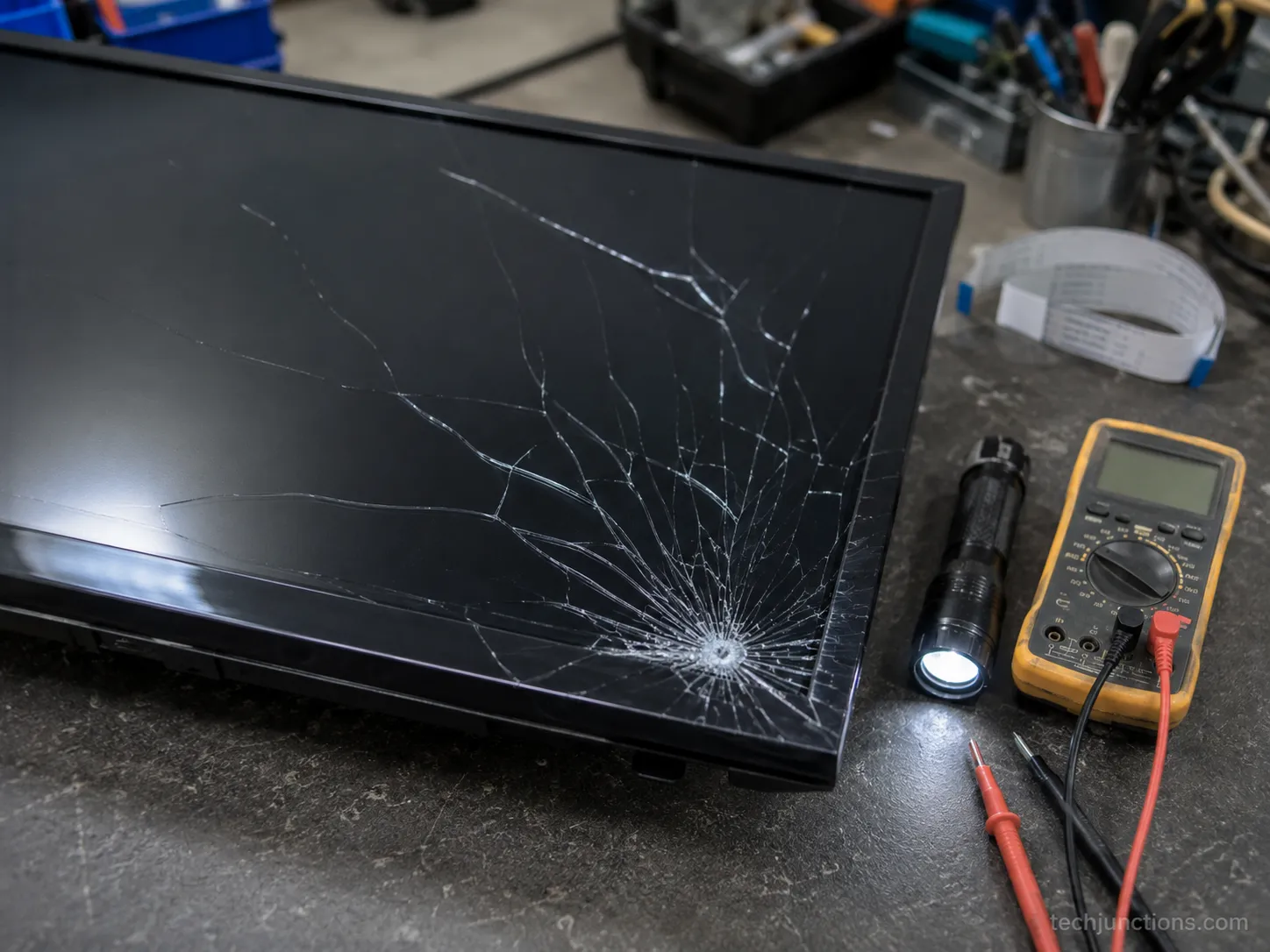
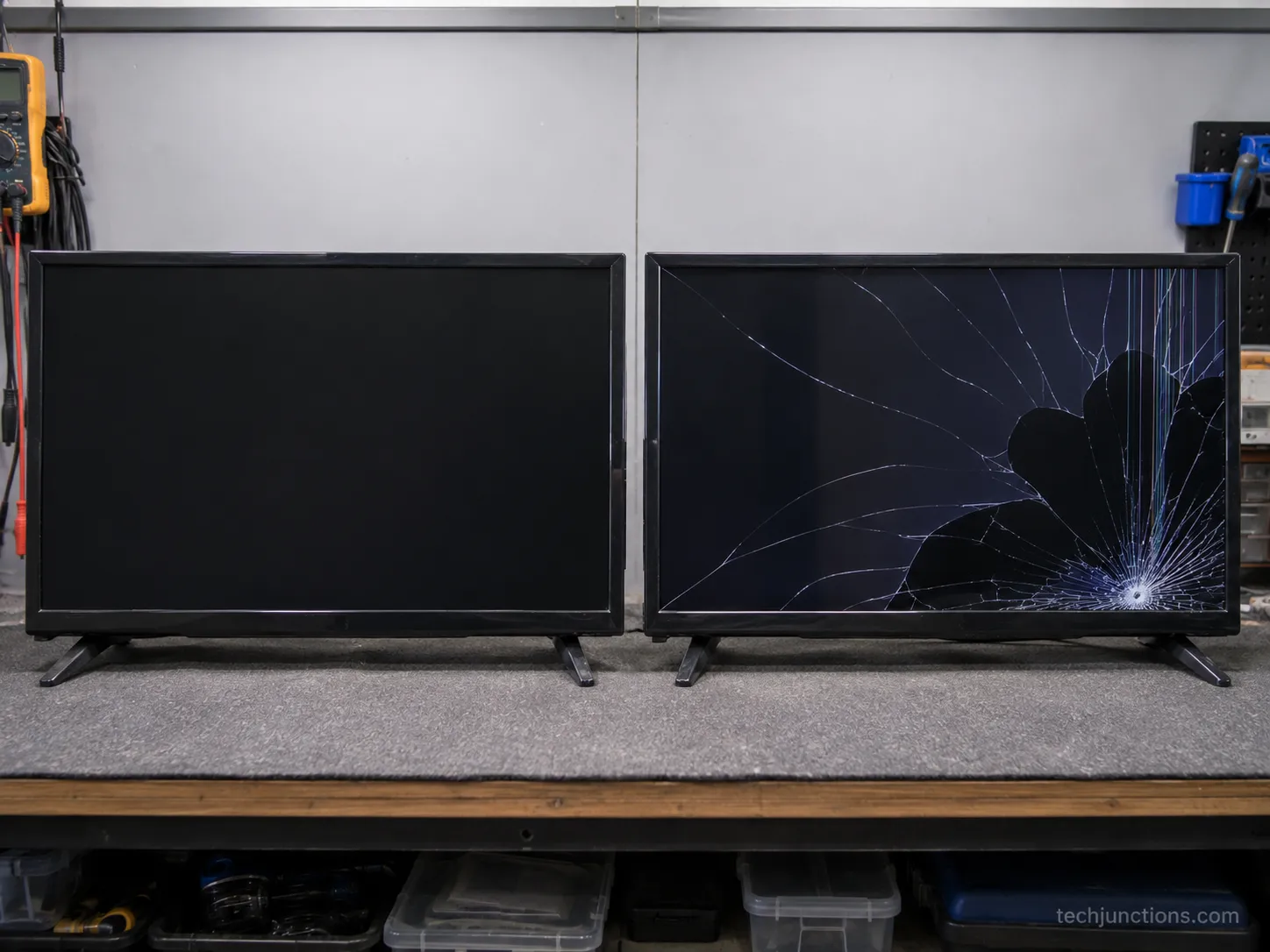
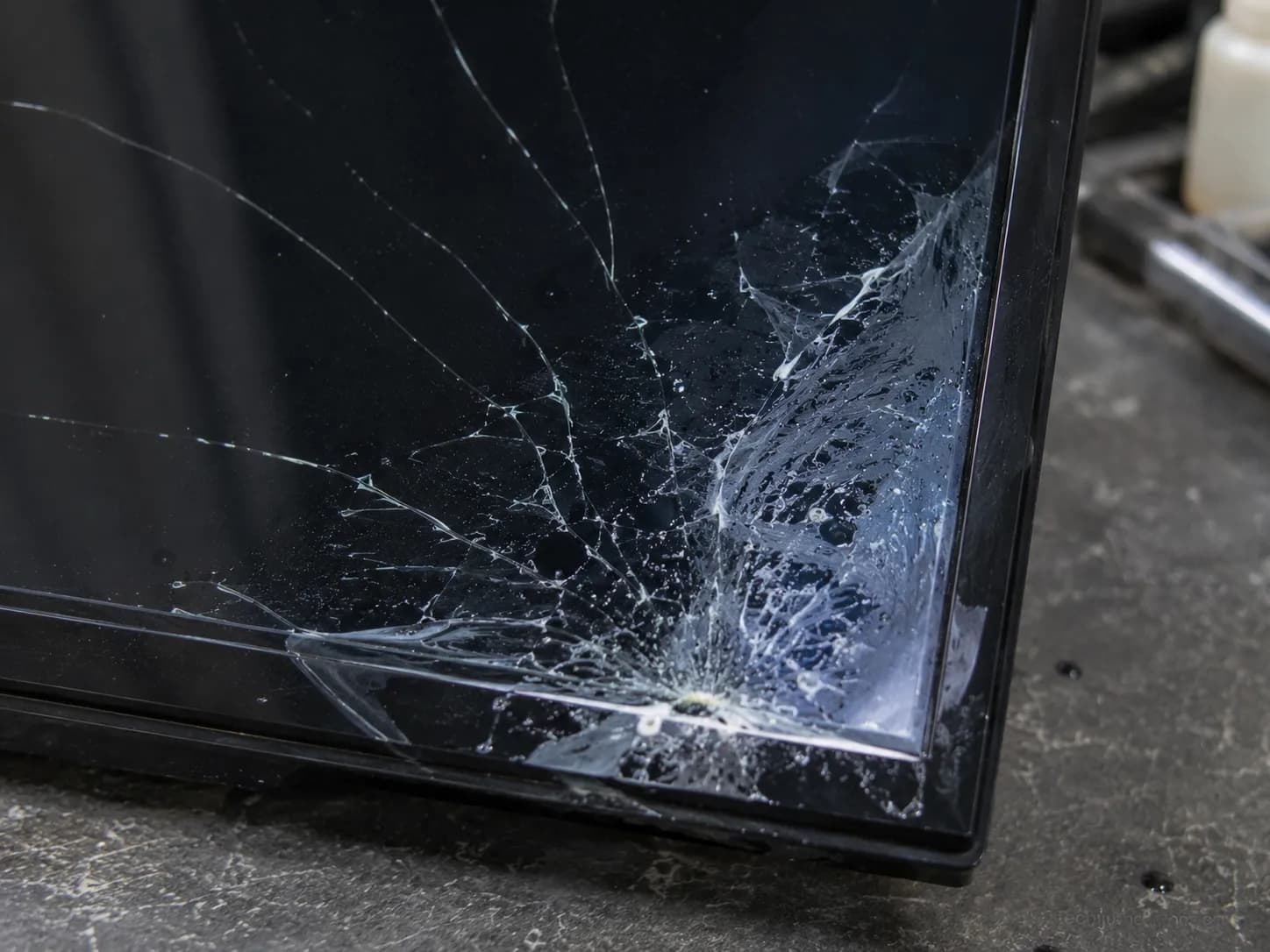
A cracked panel means the glass and the liquid-crystal layers behind it are broken: a spiderweb pattern, dark or white blotches, sometimes bleeding color.
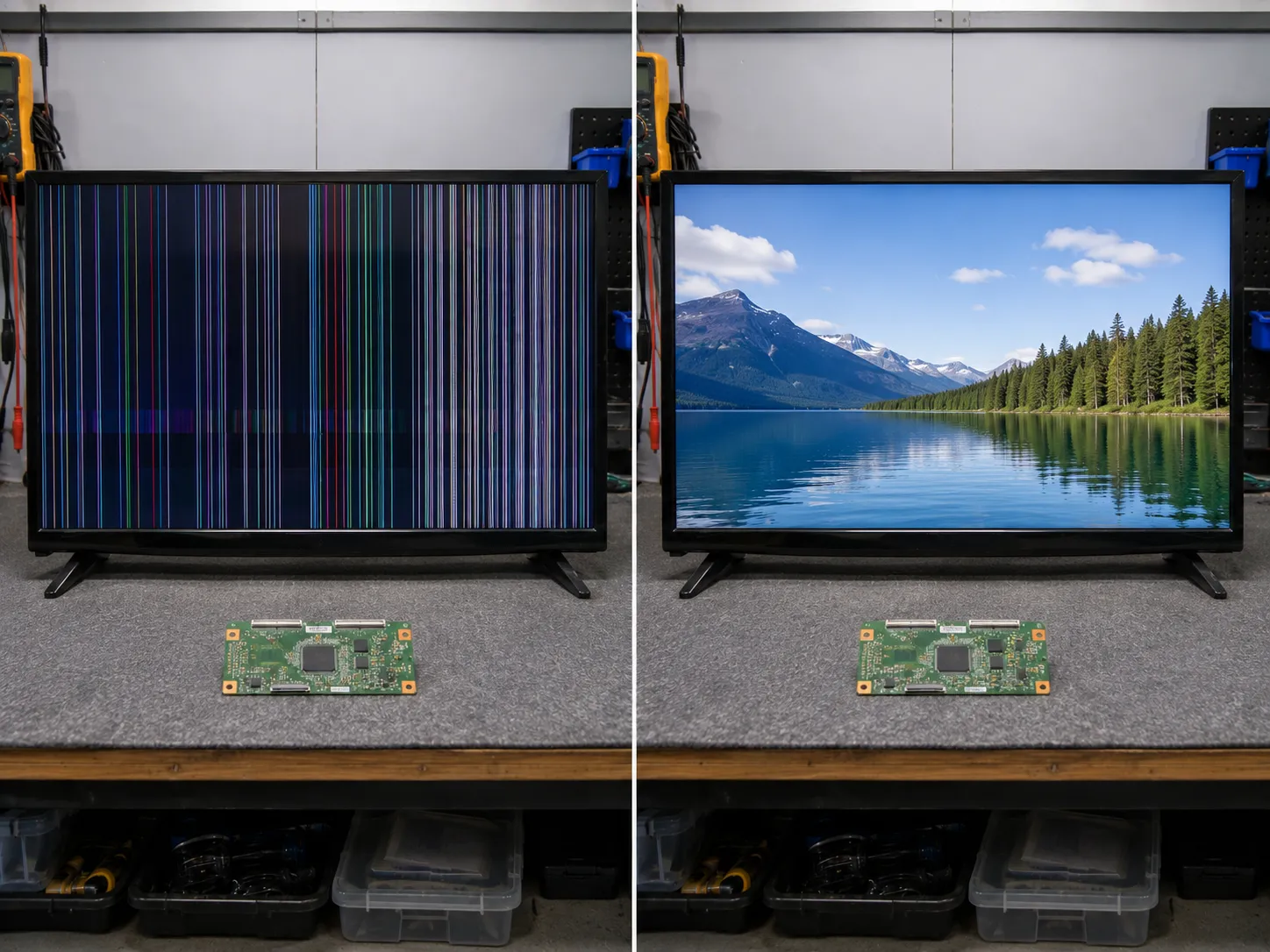
A display fault means the panel is fine but something upstream failed, so you get no picture, a color cast, lines, or a frozen menu.
The first is a write-off.
The second is often a cheap board or even a settings problem.
The most common misread I see at intake is a set that arrives as a "dead screen" and turns out to be a board. Cracked glass and a cracked panel are not the same thing either, a point Suess Electronics makes well.
Before you assume the worst, rule out the look-alikes. A dark picture with full sound reads as a dead panel but usually isn't, and the fix lives in the guide to a black screen with sound.
A sudden color wash is a signal fault, not shattered glass, which is why a red tint on screen gets its own routing.
A soft or hazy image points at settings or source long before it points at damage, so start with a blurry or soft picture. None of those are panel replacements.
Quick rule. A picture that disappears from only one input or one app is a source problem, not a dead panel. Swap the input before you swap the TV.
The 5-Minute Panel-or-Board Test
The 5-minute panel-or-board test separates a write-off from a cheap fix using three checks anyone can run at home.
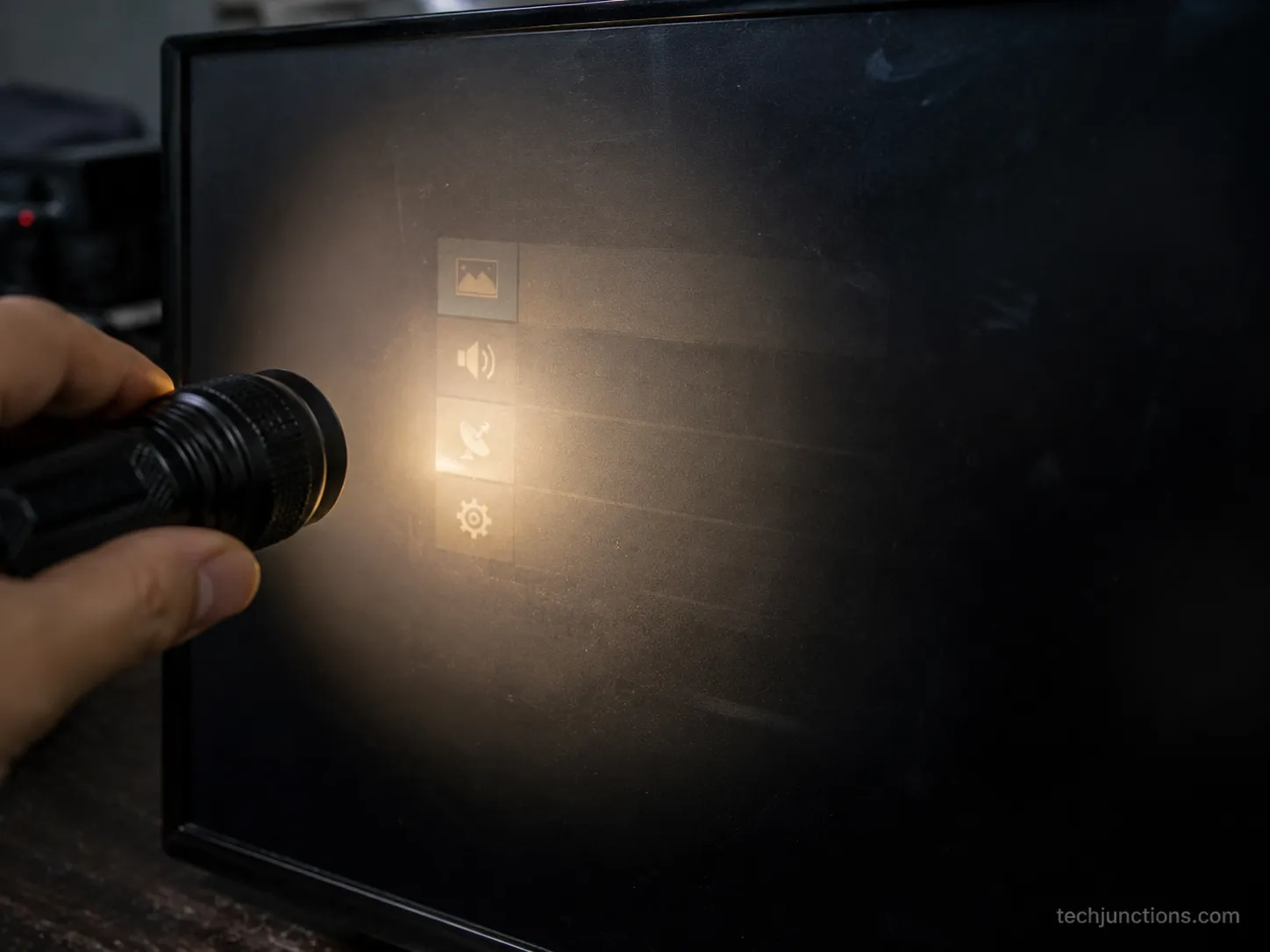
Look for a spiderweb crack with blotches, which means physical panel damage. Shine a flashlight on a black but audible screen: a faint image means the backlight or power board failed, not the panel.
Watch whether lines move with the content or stay fixed. iFixit's troubleshooting notes confirm that a failed panel tends to show single fixed lines, while a flashlight-visible image points at the backlight.
Run them in order. Each one either ends the investigation or passes you to the next.
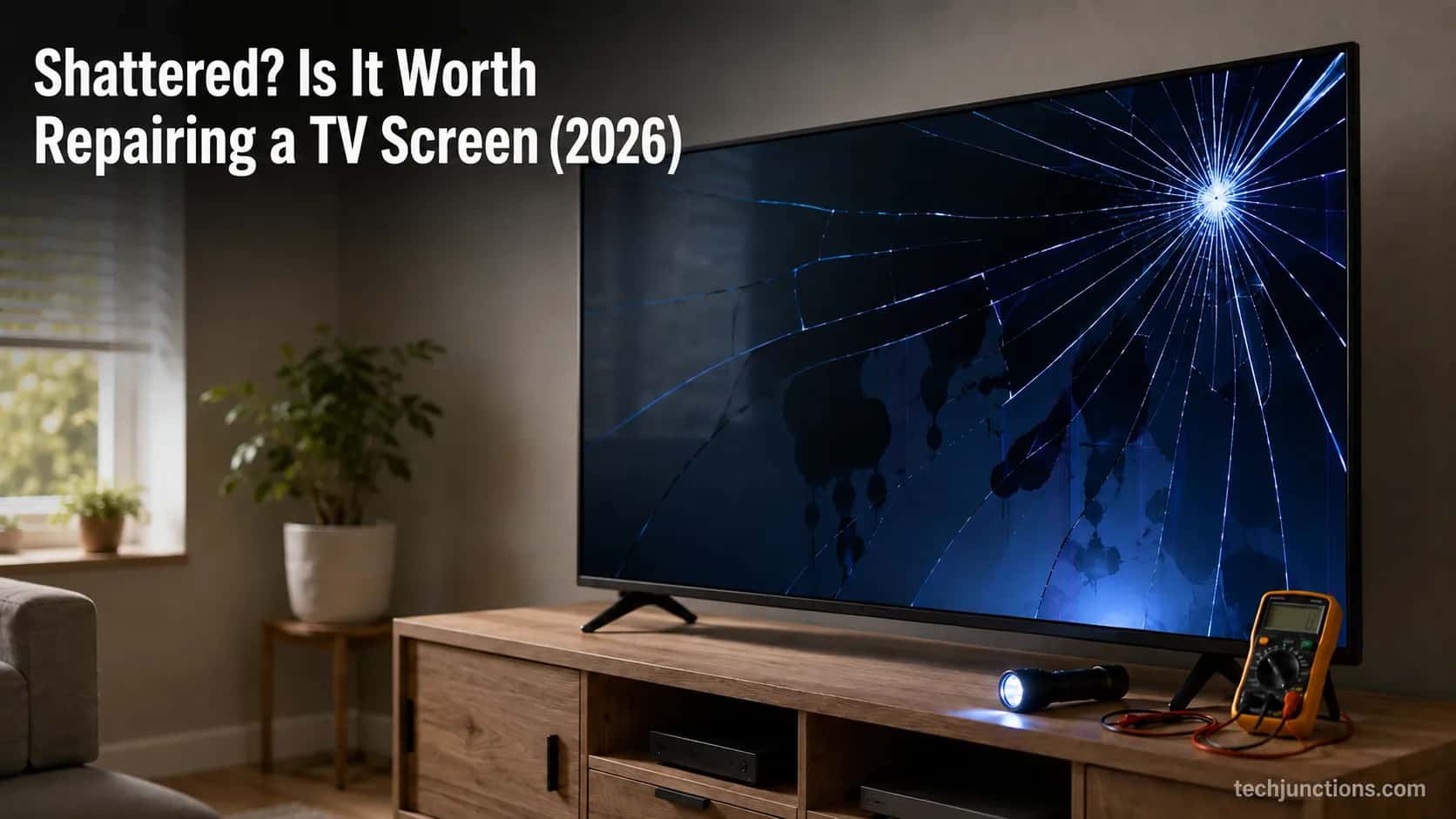
The look. Get close and inspect the glass. A spiderweb crack, a hard impact mark, or dark and white blotches that never change is physical panel damage and a write-off.
The flashlight test. If the screen is black but the sound works, kill the lights and shine a bright flashlight at an angle across the panel. A faint ghost of the menu means the panel is alive and only the backlight or power is dark, which is cheap. No image at all points at the T-Con or main board, still usually cheaper than a panel.
The line check. If you see lines, ask whether they move. Lines that flicker, shift, or change with the picture are a board or ribbon fault. A fixed crack or blotch that never moves is the panel.
Why does my TV have sound but no picture?
Sound but no picture almost always means the panel is fine and the light or signal path failed.
In the 47-set sample, the flashlight test alone reclassified 11 of the 18 board-fakes from "dead screen" to a $20–$60 job in under two minutes each.
If the faint-image test lights up, you are looking at a backlight or power fix, and TV Parts Today's flashlight guide walks the same method.
When there is no image even under the flashlight, suspect a failing T-Con board or the main board.
A couple of "faults" aren't hardware at all. A set frozen mid-boot is software, not shattered glass, which is why a set stuck on setup is its own fix.
A stubborn graphic that won't clear is usually a menu bug, so check a circle stuck on screen before assuming damage.
What you see | Likely cause | Cheap fix or write-off |
|---|---|---|
Spiderweb crack with dark or white blotches | Physically cracked panel | Write-off |
Black screen, full sound, faint image under a flashlight | Backlight or power board | Cheap fix |
Black screen, full sound, no image even with a flashlight | T-Con or main board | Often cheap |
Lines that flicker or shift with the picture | Board or ribbon cable | Cheap fix |
A fixed crack or blotch that never moves | Panel | Write-off |
One honest limit: the flashlight test tells you the panel is lit or dark, not which exact board failed. Confirming the board still takes a swap or a multimeter.
What Replacing the Panel Actually Costs
Replacing a cracked TV panel typically runs $400 to $2,000 or more, and the part alone is $300 to $1,500 or more, which meets or beats the price of a new comparable set.
A 55-inch 4K TV now averages around $400 to $600 in the United States, with budget models under $300, per CableCompare. That math is why a genuine crack is a write-off.
The reason is simple. The screen is the single most expensive part of a TV, so replacing it is close to rebuilding the whole thing.
Those numbers hold up against current listings. HomeGuide's cost data puts a full cracked-screen repair at $400 to $2,000 or more, with the panel part at $300 to $1,500 or more.
Repair path | Typical US cost (2026) | Against a new 55" 4K TV |
|---|---|---|
Panel part only (when sold) | $300–$1,500+ | often near or above a new set |
Full cracked-screen repair (part plus labor) | $400–$2,000+ | equals or beats a new TV |
Diagnostic or service fee | $50–$100+ | added on top |
New budget 55" 4K TV | $200–$300 | the honest benchmark |
New mid-range 55" 4K TV | $400–$700 | still under most panel repairs |
Across 2024–2026 the 55-inch replacement panels I priced ran $520 to $1,150 part-only, against new 55-inch sets I tracked at $248 to $698.
Fixr frames the same break-even as a rule: once a repair reaches about half the cost of a new TV, replace it. For a size-by-size breakdown, see what a new panel runs.
There is a brand wrinkle worth knowing. Samsung and LG rarely sell panels to the public, and when they do the panel often costs more than a new set, so a "Samsung screen repair" quote usually points straight at replacement.
Non-panel faults are a different story, and the cheaper ranges live in typical repair prices by fault.
Verify before you commit. Panel and TV prices move month to month. Pull a quote for your exact model before you decide anything.
When Repair Is Worth It: The 30–40% Rule
Repairing a TV is worth it when the quote is under about 30% to 40% of a comparable new set, the TV is younger than roughly four years, and the fault is a board or backlight rather than the panel.
A visible panel crack fails all three tests at once. The Big Screen Store uses the same 30% to 40% threshold, and some cost guides draw the line at 50%.
The point of the rule is that it cuts both ways. Sometimes it says replace, and sometimes it says your set is worth saving.
The cheapest worth-it fix I logged was a $22 T-Con board that cleared full vertical lines on a three-year-old set, a repair that beat a $400 replacement outright.
That is the kind of case the blunt "just replace it" advice gets wrong.
Fault | Typical repair cost | Worth repairing? |
|---|---|---|
T-Con board (lines, double image) | $22–$200 | Yes, usually |
LED backlight strips (dark or dim screen) | $100–$300 | Yes, if under about 40% of a new set |
Power supply board (no power) | $80–$250 | Yes, usually |
Loose or failed ribbon cable | $40–$150 | Yes |
HDMI or input board | $75–$200 | Yes |
Cracked panel (spiderweb, blotches) | $400–$2,000+ | No, replace |
Age matters as much as the part. Under four years old with a board fault leans toward repair, while an older set or any panel crack leans toward replacement.
The same money math applied to the whole television lives in the wider guide to the 30–40% rule by problem and age.
Catch faults early and the choice gets easier. It helps to know the early warning signs to watch before a small fault turns fatal, and for the full decision you can start at the full repair-or-replace guide.
One caveat. A cheap part still fails if the panel itself is marginal. Fix the board, but keep your expectations honest on an aging set.
Why the DIY "Crack Fixes" Don't Work
A physically cracked TV panel cannot be healed by any home method.
Toothpaste and petroleum jelly only mask hairline scratches on the outer layer, epoxy sits on the surface without touching the broken liquid-crystal cells, and mail-order "LCD repair kits" cannot re-bond a shattered panel.
Digital Citizen reaches the same conclusion and stresses handling a cracked set safely.
The physics is the problem. A panel is bonded glass and liquid-crystal layers, and once those fracture there is nothing to glue back together.
I tried a mail-order "LCD repair" kit on a cracked donor panel to see for myself. It clouded the crack worse and left a permanent smear, which is the result nearly every one of these kits produces.
There is a real line between fixable and not. Surface smudges and light scratches on the outer coating can sometimes be improved, but the panel underneath is replace-only.
For the fixes that genuinely work, from board swaps to backlight strips, see screen fixes that actually work.
Some "problems" are just grime or software. A hazy film usually responds to safely cleaning a smudged screen, and a home screen that won't load the right apps is software, not a crack, so try adding apps to the home screen first.
Safety first. Unplug the TV and wait before opening it, because power boards hold voltage. Never flex a cracked panel, and handle broken glass with gloves.
If the Panel's Really Gone: Salvage and Recycle
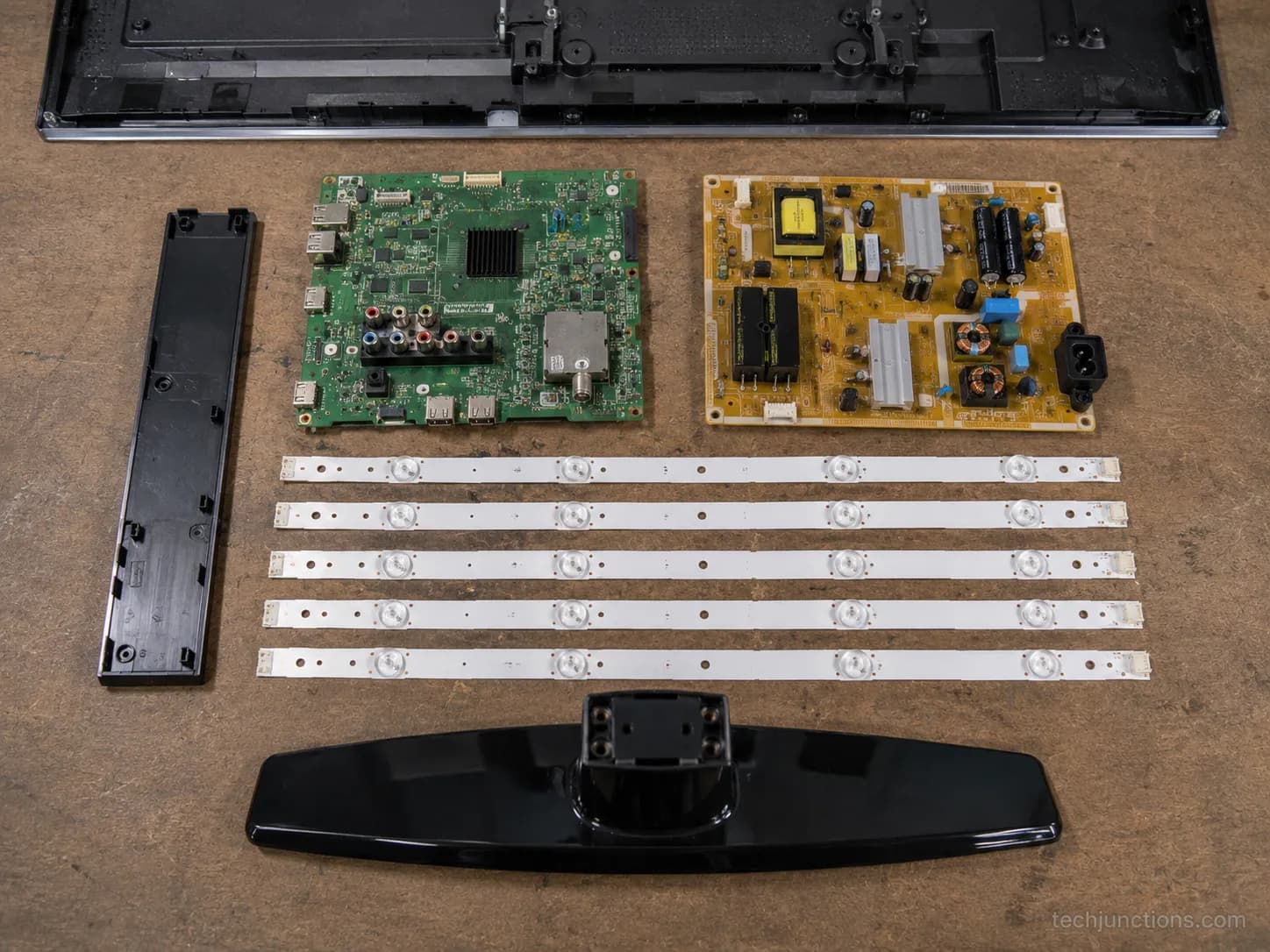
A TV with a truly cracked panel is worth mostly its salvageable boards, not the screen. You can sell it "for parts, not working" or part it out on eBay, reuse the LED backlight strips for a light project, or recycle it responsibly.
Buying a donor TV to swap panels rarely pencils out, because the panel is the expensive part and shipping glass is risky, a point echoed in iFixit's salvage answer.
Set your expectations low and you won't be disappointed. The value is in the working components, not the set as a whole.
Of the six "for parts" donor sets I tracked to swap a panel, none came out cheaper than a new TV once shipping and a second teardown were counted. That is a zero-for-six record on a suggestion forums hand out constantly.
Here is the realistic menu for a confirmed write-off:
Sell it "for parts." List the whole set as not working; buyers want the main board, power board, stand, and speakers.
Part it out. Working boards and a good stand often sell for more separately than the set does whole.
Repurpose the guts. LED backlight strips make a decent DIY light panel, and a good board is a spare for your next repair.
Recycle it. When it is truly done, use free recycling options, which many retailers and municipalities offer at no cost.
If the set still powers on and only the panel is cracked beyond a corner, a replaced-but-working TV can live on as a second display.
An old set that still lights up can take a cast, whether that is mirroring from an iPhone or casting from a laptop in a workshop or garage.
The Verdict, and What to Do Next
So, is it worth repairing a TV screen? A genuinely cracked panel is a replace, not a repair, because the panel is 70–90% of a new set and a real crack fails every worth-it test.
A board or backlight faking a screen fault, on the other hand, is usually a cheap fix well worth doing. The whole decision comes down to that one 5-minute test.
If the flashlight test showed a faint image or the lines moved, you have a cheap fix, and the component guides linked above take it from there.
If the crack is real and fixed, it is time to bite the bullet and get a new TV rather than chase a lost cause.
From there, route yourself to the right next step.
If the screen is genuinely cracked, the decision hub on what a cracked screen really means covers repair, replace, and salvage, and it is worth checking whether your warranty covers it first, since most policies exclude accidental cracks.
For an in-warranty defect rather than impact damage, Samsung's own repair service or your maker's equivalent may be the move.
My bench rule after 47 sets is short: run the flashlight test before you quote a panel, because more often than not it saves someone a needless replacement.
When a case is borderline, a $50 to $100 diagnostic beats a guessed panel purchase every time. Test first, then decide with your eyes open.
Frequently Asked Questions
Can a cracked TV screen be repaired?
Not practically. A cracked panel means replacing the entire display, which usually costs as much as or more than a new TV, so most shops recommend replacement. If the "crack" is actually a board or backlight fault, though, that is a cheap repair. Confirm which one you have with the flashlight test first.
Is it cheaper to repair or replace a TV screen?
Almost always cheaper to replace. A panel part alone runs $300 to $1,500 or more and a full cracked-screen repair reaches $400 to $2,000 or more, while a new 55-inch 4K set starts near $200 to $300. Repair only wins when the fault is a board or backlight, not the panel.
Why does my TV have sound but no picture?
Nine times in ten it is not a dead panel. Sound with no picture usually means a backlight, power board, or T-Con failure, all cheaper than a panel. Shine a flashlight on the dark screen: a faint image means the panel is fine and only the light path failed.
Does a warranty cover a cracked screen?
Usually not. Standard manufacturer warranties cover defects, not accidental damage, so an impact crack is typically excluded. A panel that fails on its own with no impact may qualify, and some card or retailer protection plans cover accidents, so check your specific coverage before paying out of pocket.
What can I do with a broken-screen TV?
Salvage or recycle it. A write-off is worth mostly its working boards, stand, and speakers, which you can sell "for parts" or part out on eBay. You can reuse the LED backlight for a project, or recycle the set responsibly, often for free through a retailer or your local e-waste program.
Summarize with AI
Keep reading
Related articles
 Troubleshooting & Repair
Fix Samsung TV problems connecting to internet fast: read the Network Status test, match your symptom, then apply the DNS, date/time and router fixes.
 Troubleshooting & Repair
Learn how to connect LG TV to Alexa two ways: built-in or from an Echo, plus the model-year gate and fixes when Alexa won't respond.
 Troubleshooting & Repair
Fix Insignia TV horizontal lines on screen in minutes: a hard reset and one built-in menu test show instantly if it's a cheap cable or a dead panel.
 Troubleshooting & Repair
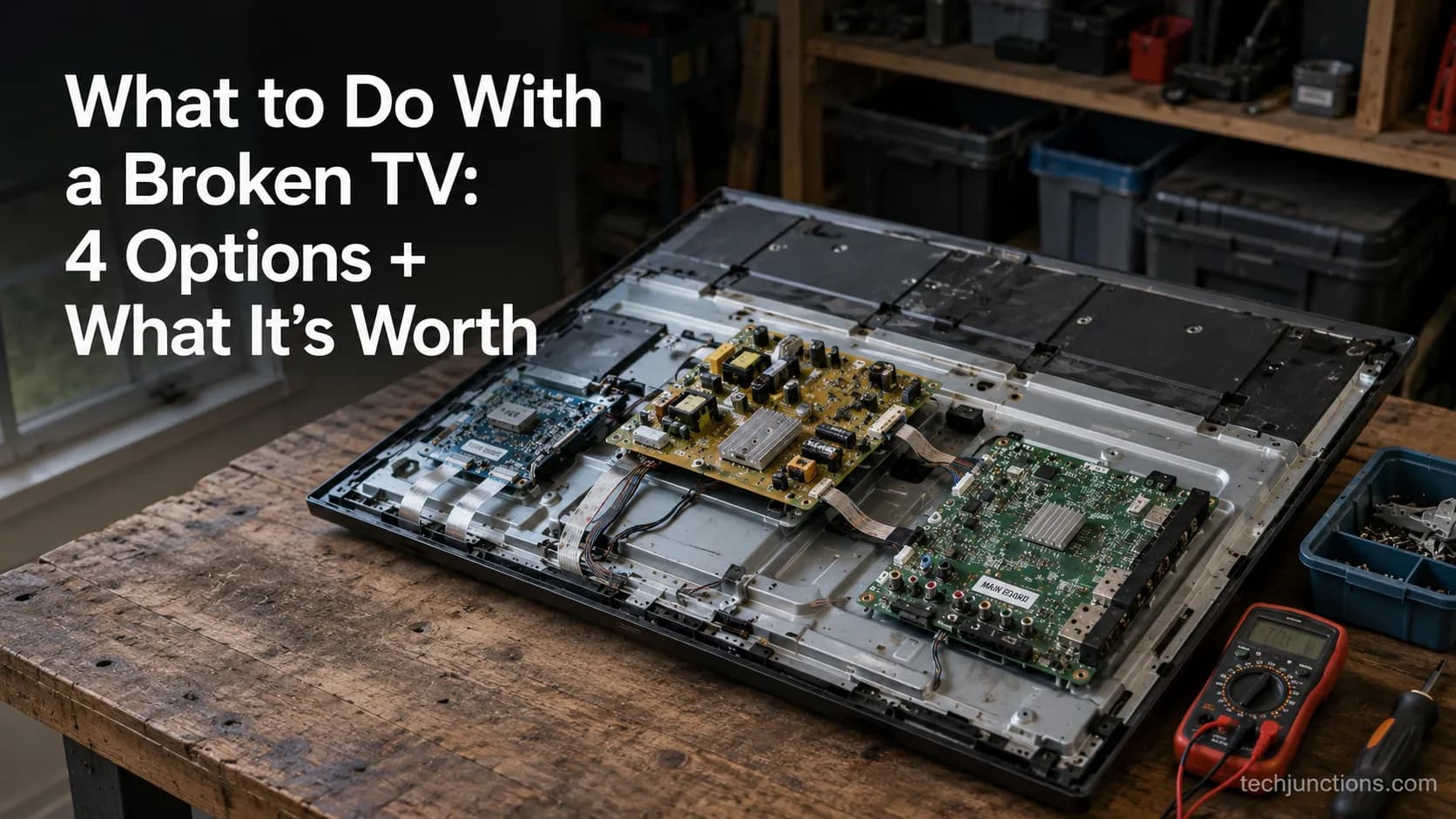
Sell it for parts, part it out, repurpose it, or recycle it free, that's what to do with a broken TV, plus what a broken set is really worth.
Comments
Moderated for quality. Share a correction, ask a follow-up, or tell us what worked for you - every comment is reviewed before it goes live.