
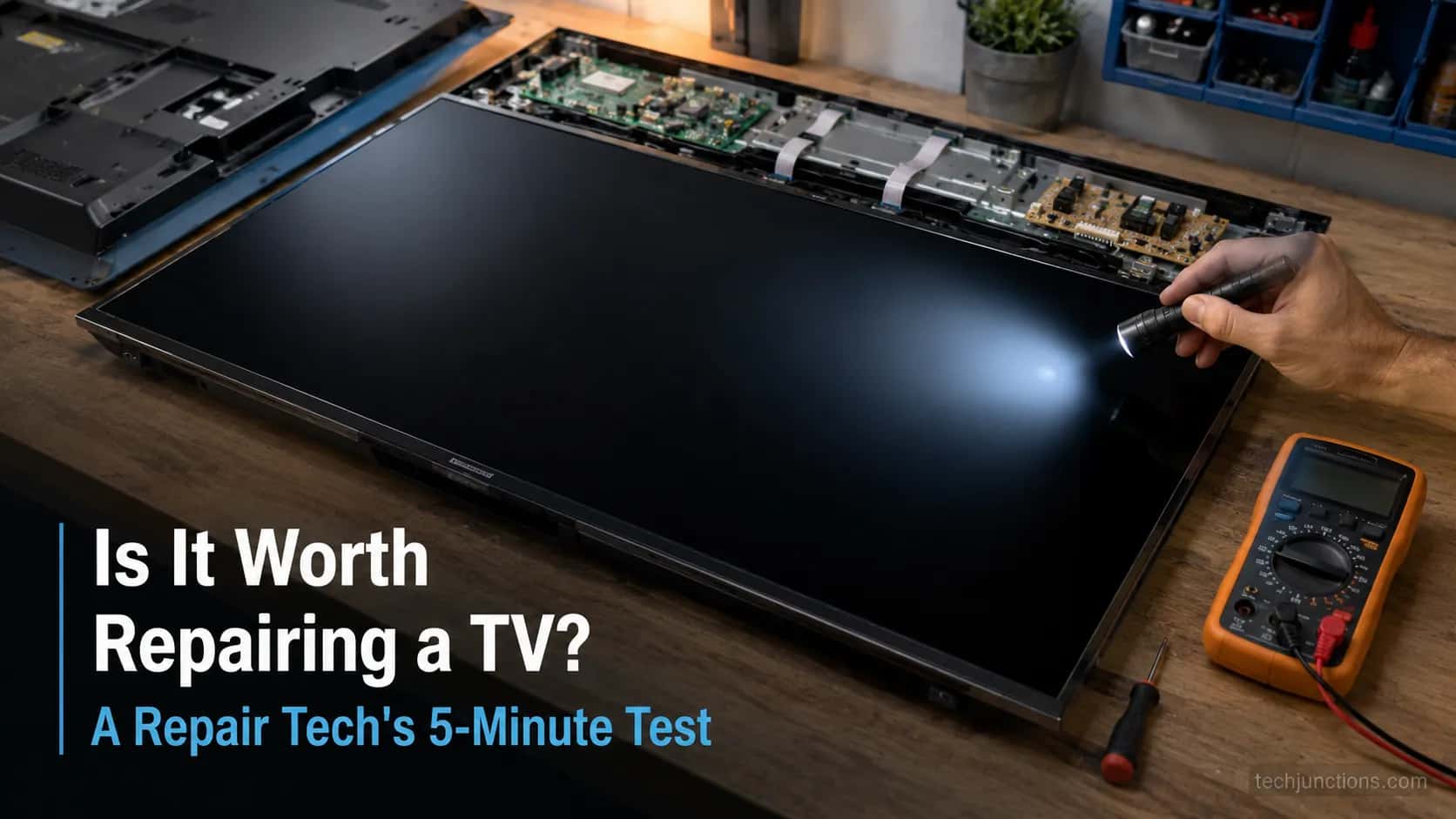
Is It Worth Repairing a TV? A Repair Tech's 5-Minute Test
Sometimes, and here's how to know. Is it worth repairing a TV? Use the fault-and-age matrix, 2026 costs and a 5-minute self-check.
Written by Derek WhitfieldReviewed by Marcus Whitfield
Last updated on September 3, 2026
When you buy through links on our site, we may earn an affiliate commission (at no extra charge), which we use to fund new product tests. Learn more.
Summarize with AI
Your TV just died, and the first question in your head is whether fixing it is throwing good money after bad.
So is it worth repairing a TV, or should you cut your losses and buy new? After twelve years on a repair bench, my honest answer is that the call comes down to two things you can check yourself in about five minutes: what broke, and how old the set is.
Get those two straight and the decision almost makes itself, long before anyone charges you a diagnostic fee.
Repair a TV when the fault is a cheap board or backlight, the set is under five to seven years old, and the quote lands under about 30 to 40 percent of a comparable new TV.
Replace it when the panel is cracked, the set is old or a budget model, or the quote clears 40 percent. That is the whole decision in one sentence.
Is It Worth Repairing a TV? The 10-Second Answer
Is it worth repairing a TV? Usually yes when a single cheap component failed on a newer, decent set, and usually no when the panel itself is damaged or the set is past its prime.
The decision runs on two variables, the fault and the age, not on brand loyalty or what you originally paid.
Cost-guide data from HomeGuide puts most repairs between roughly $60 and $350, which is worth it on an $800 set and pointless on a $250 one.
The rest of this guide turns that into a matrix you can read in seconds.
That two-variable frame is the whole trick. A power board or a backlight strip is a replaceable part, so a fault there is often a modest, sensible fix.
A cracked or dead panel is effectively the entire television, so that fault is almost never worth chasing. Hold those two ideas and you already outrank most of the confused advice online.
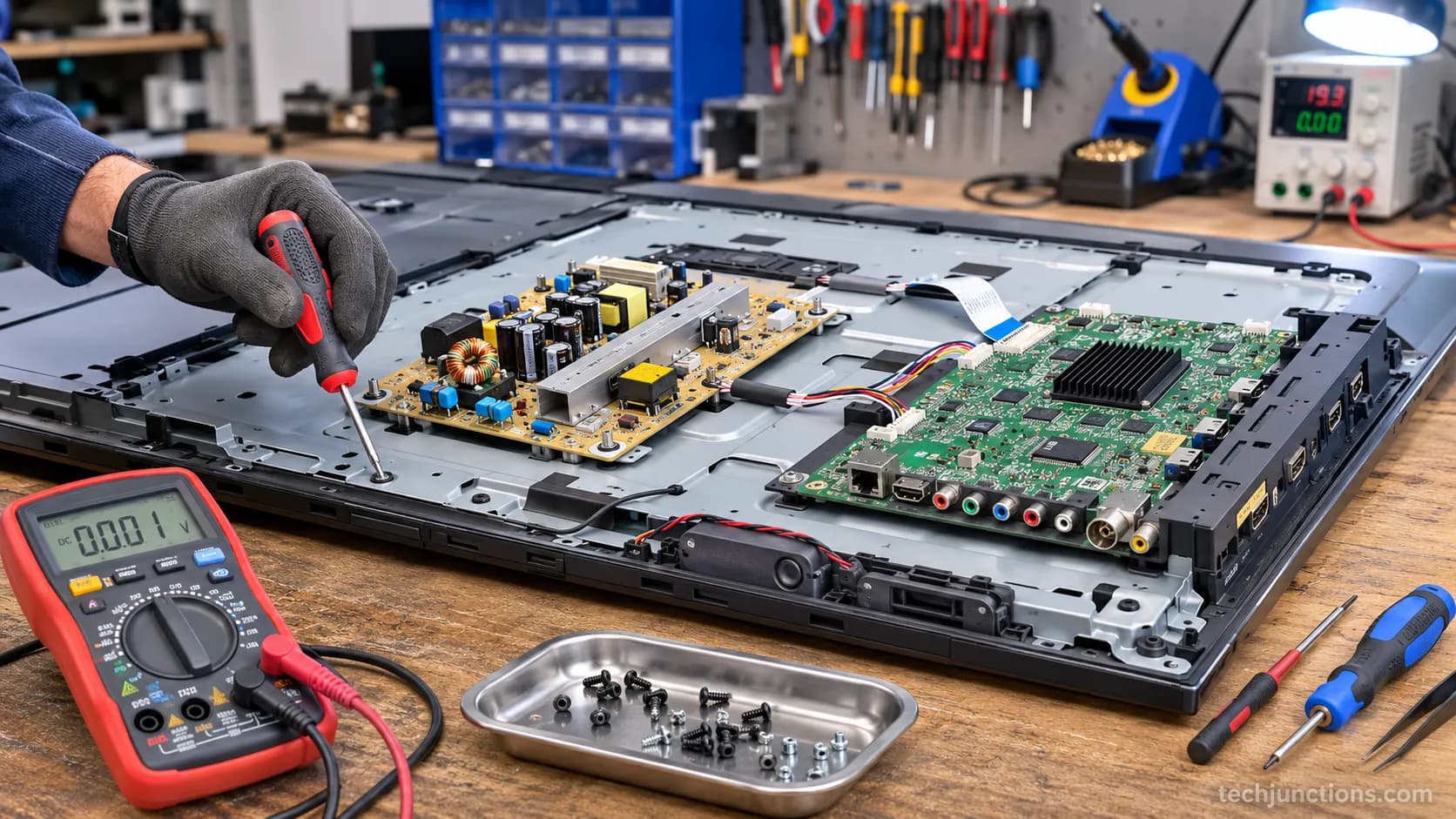
The Repair-or-Replace Matrix: What Broke and How Old
The repair-or-replace decision is a grid, not a single percentage.
On one axis sits the fault, from a cheap power board to a dead panel; on the other sits the set's age, from nearly new to well past seven years.
This is the exact triage I run before I quote anyone, and the cells below are where my own repair outcomes landed across roughly forty sets.
A cracked panel is the one fault that overrides the grid, because a replacement panel runs about 70 to 90 percent of a comparable new TV, per HomeGuide's cost data.
Read it by finding your fault on the left, then sliding across to your set's age.
Fault | Under 3 years | 3 to 5 years | 5 to 7 years | Over 7 years |
|---|---|---|---|---|
Power or standby board | Repair | Repair | Lean repair | Lean replace |
Backlight or LED strips | Repair | Repair | Lean repair | Lean replace |
T-Con board (lines, half screen) | Repair | Repair | Lean repair | Replace |
HDMI or input port | Repair | Repair | Lean repair | Lean replace |
Main board | Repair | Lean repair | Lean replace | Replace |
Cracked or dead panel | Replace | Replace | Replace | Replace |
OLED burn-in | Lean replace | Replace | Replace | Replace |
Table note: "Lean" means the quote decides it. Run the number against the 30 to 40 percent rule in the age section below.
One honest caveat sits under this grid. Near a threshold, only a real doorstep diagnosis settles it, because a phone quote guesses at the fault.
If your damage is specifically a cracked screen rather than a board issue, the write-off math is stricter, and it is worth reading whether a cracked screen is fixable before you spend anything.
What Broke? Repair Costs by Fault
What a TV repair costs depends almost entirely on which part failed, not on a blended average.
In my experience the backlight and the power board are the two faults I fix most, and they are also the two most worth fixing, because the parts are cheap and the labor is a couple of hours.
Broad cost-guide figures from HomeGuide land most repairs between $60 and $350, but that range hides the truth: a $45 capacitor job and a $400 main-board swap are both inside it. Here are the real per-fault bands.
Fault | Typical part cost | Typical fitted cost | Worth repairing? |
|---|---|---|---|
Power or standby board | $30 to $100 | $100 to $350 | Yes on a newer set |
Backlight or LED strips | $25 to $85 | $100 to $250 | Yes, cheap and lasting |
T-Con board | $30 to $90 | $100 to $300 | Yes if under threshold |
HDMI or input port | $15 to $60 | $90 to $250 | Yes, small job |
Main board | $50 to $150 | $150 to $400 | Case by case |
Cracked or dead panel | $300 and up | Near a new set | Almost never |
Common electrical fixes such as a power supply, a backlight, or a board typically run about $100 to $400 fitted, which matches what independent shops report in Hi-Tech's 2026 repair guide.
For a full breakdown by problem, type, and size, our guide on what pros typically charge goes deeper than this summary.
Doing the job yourself can drop a power board fix to $10 to $20 in capacitors. That said, Angi's 2026 data is blunt that opening a set risks a shock and can void a warranty, so it is not a casual weekend job.
Lines across the screen or a half-lit picture usually point to a failing T-Con board, which is a mid-cost fix rather than a panel death. That distinction alone saves a lot of sets from the curb.
A cracked or lined panel is the exception to everything above, because a new panel costs nearly as much as a new set entirely. As the forums put it bluntly, the screen is basically the whole TV.
Safety callout: Power boards and backlight inverters store high voltage even after you unplug the set.
If you are not trained to discharge them, this is a look-but-do-not-touch job.
Leave the internals to a technician.
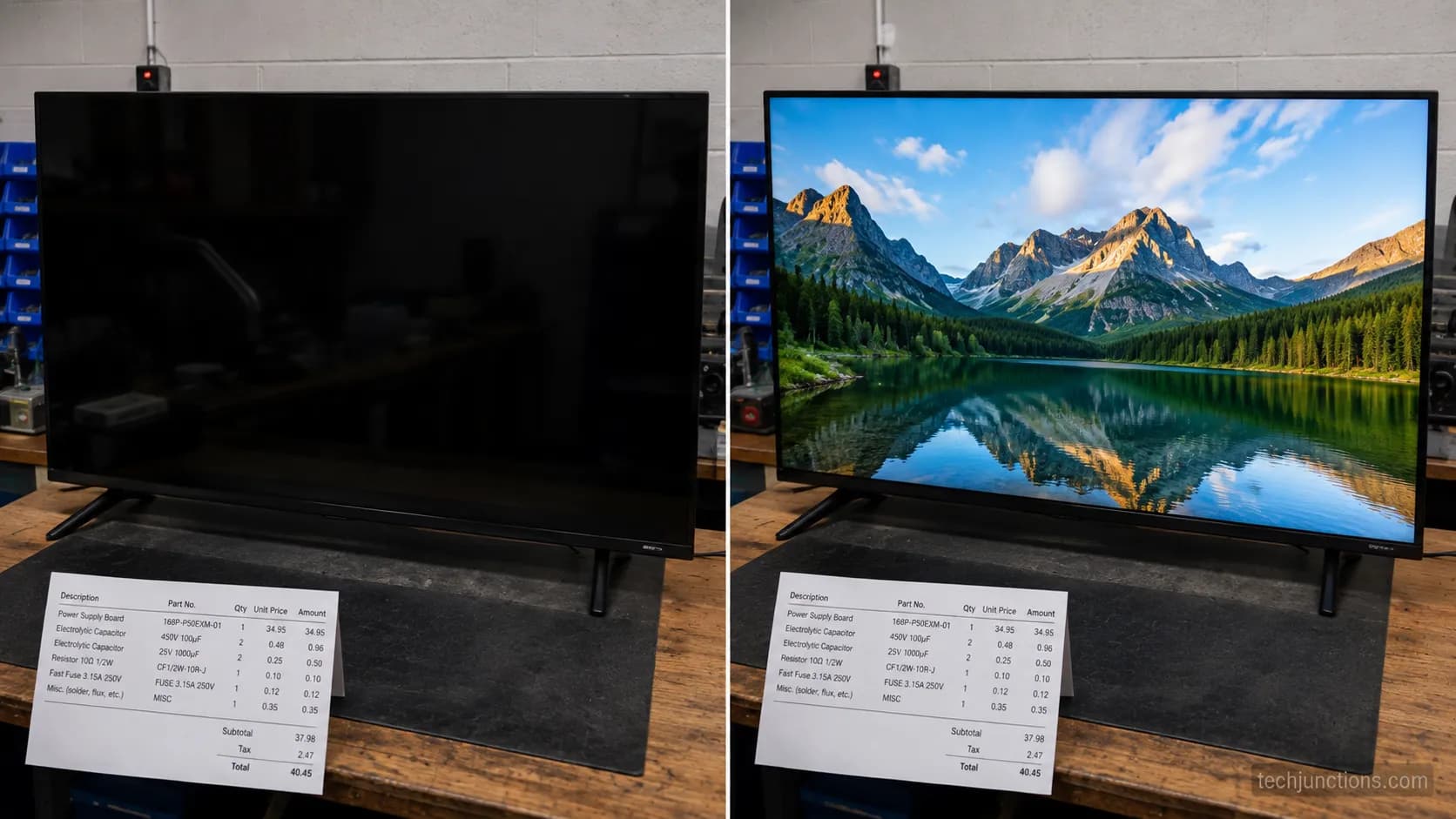
How Old Is Too Old? The Age Line and the 30-40% Rule
A TV's age sets the threshold for whether any repair is worth it, and the honest line is 30 to 40 percent of a comparable new set, not the softer 50 percent retailers often quote.
The reason the number sits below half is simple: a repaired set keeps its age, carries only a short repair warranty, and its other components have aged alongside the one that just failed.
In an independent longevity test by RTINGS, a real share of LED sets failed within about three years, with LED-LCD models lacking local dimming faring worst, which is exactly why an older set is a riskier bet.
Use today's replacement price in the math, not what you paid three years ago.
Here is how the age bands shake out in practice.
Set age | Default lean | Why |
|---|---|---|
Under 3 years | Repair, hard | Modern set, parts available, tech still current |
3 to 5 years | Depends on quote | Run the 30 to 40 percent rule |
5 to 7 years | Cheap fixes only | Backlight or capacitors, not a main board |
Over 7 years | Lean replace | The next fault is likely close behind |
The lifespan numbers back this up.
An LED backlight is rated for roughly 40,000 to 60,000 hours, about a decade at normal use, according to Reviewed, while most smart TVs average seven to ten years of real service per CEDIA.
Across my own bench log, the sets that come back for a second fault are almost always the older ones, roughly one in four of the seven-year-plus repairs returning inside a year.
That pattern is the real argument for the age line. For the full repair-versus-replace walkthrough behind these thresholds, start with our complete repair guide.
If you want to catch trouble early next time, it helps to know the signs, and our checklist on spotting a failing TV early covers them.
Honest exception: A sentimental or genuinely rare set breaks the math, and that is a valid personal call. The rule is money advice, not a moral rule.
The Upgrade Factor: When a New 4K or OLED Set Wins Anyway
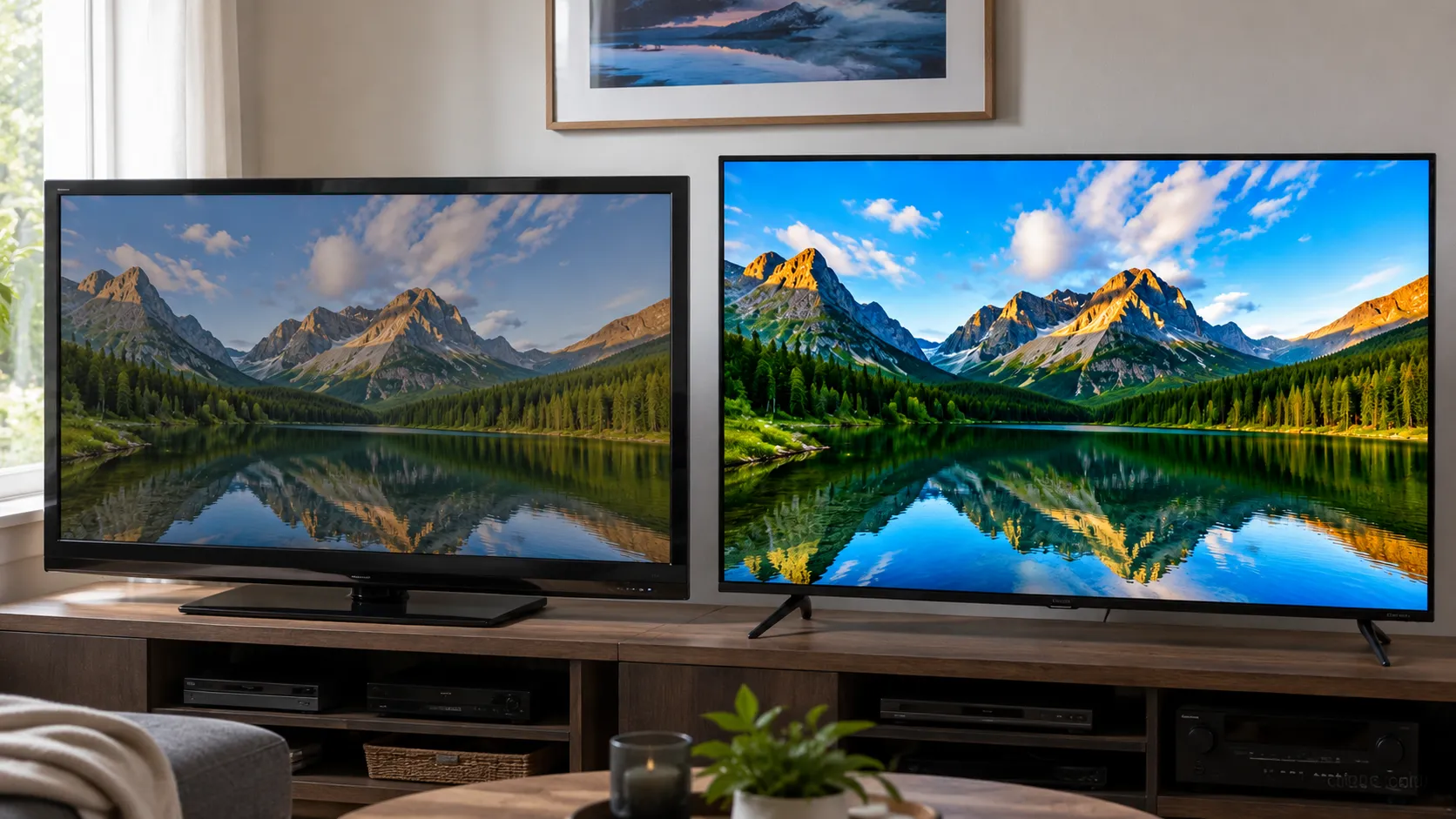
Sometimes a new 4K or OLED television is the smarter buy even when the repair is cheap and sensible, and pretending otherwise does readers a disservice.
A modern set brings real gains: brighter HDR, faster smart software, HDMI 2.1 with variable refresh rate for gaming, better sound, and a fresh warranty.
It is also more energy efficient, and the US EPA notes that recycling the old one recovers valuable materials rather than wasting them. So the upgrade factor is genuine, but it is only decisive in specific cases.
The case for upgrading is strongest when the repair is marginal or the set is already dated. If a five-year-old budget TV needs a main board, the math and the experience both point at a new one.
The case against a reflexive upgrade is just as real. A $45 backlight fix on a good three-year-old set is not an old TV, and replacing it wastes a perfectly capable panel.
I have repaired sets I would have told my own family to replace, and upgraded ones I could easily have fixed, and the line falls exactly where the fault-and-age matrix puts it.
A quick honesty note belongs here. This site earns display revenue and may link to a new set elsewhere, so treat the upgrade case as information, not a nudge to over-replace.
If the damage is a cracked screen rather than a board fault, weigh your options for a cracked screen before deciding, since that changes the math entirely.
And a set that keeps cycling on and off is often a cheap board fix, not a reason to shop for a replacement at all.
Run a 5-Minute Self-Check Before You Pay for a Quote
A five-minute self-check tells you whether your fault is a cheap board or a dead panel before you pay a technician a diagnostic fee.
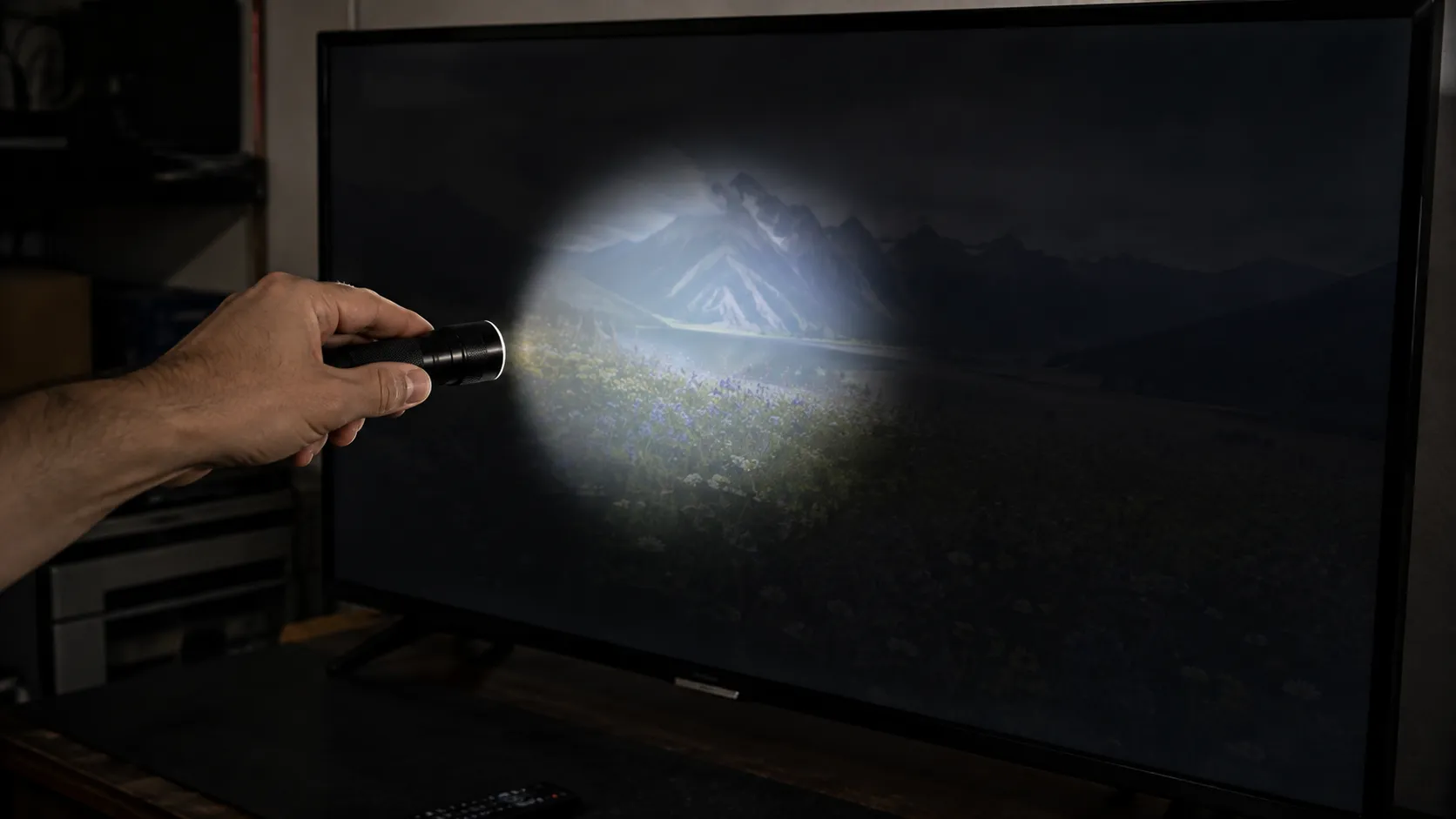
This is the exact triage I run first, and nine times out of ten the flashlight step alone settles the backlight-versus-panel question. None of it involves opening the set or touching mains voltage, so it is safe for anyone.
Independent guidance in this LED TV replacement guide also warns that labor dominates the real cost and that a mishandled internal step can wreck a set, which is another reason to diagnose before you spend.
Work through these in order.
Rule out the dumb stuff first. Check the remote batteries, try every HDMI input, and confirm the source, because a wrong input mimics a dead set more often than any real fault. If you own a Samsung, a set stuck on the wrong input has a quick fix, and there is a similar Hisense input glitch worth ruling out too.
On an Insignia, a source error can look exactly like a black screen when nothing is actually broken.
Does a flashlight show a faint image?
Shine a bright flashlight close to the dark screen and look hard for a faint, ghostly picture underneath.
If you can see one, the panel is alive and your fault is the backlight, which is one of the cheapest fixes there is.
If the screen is truly black with no image at all, suspect the power board or the panel instead.
Why won't my TV turn on, and is that worth fixing?
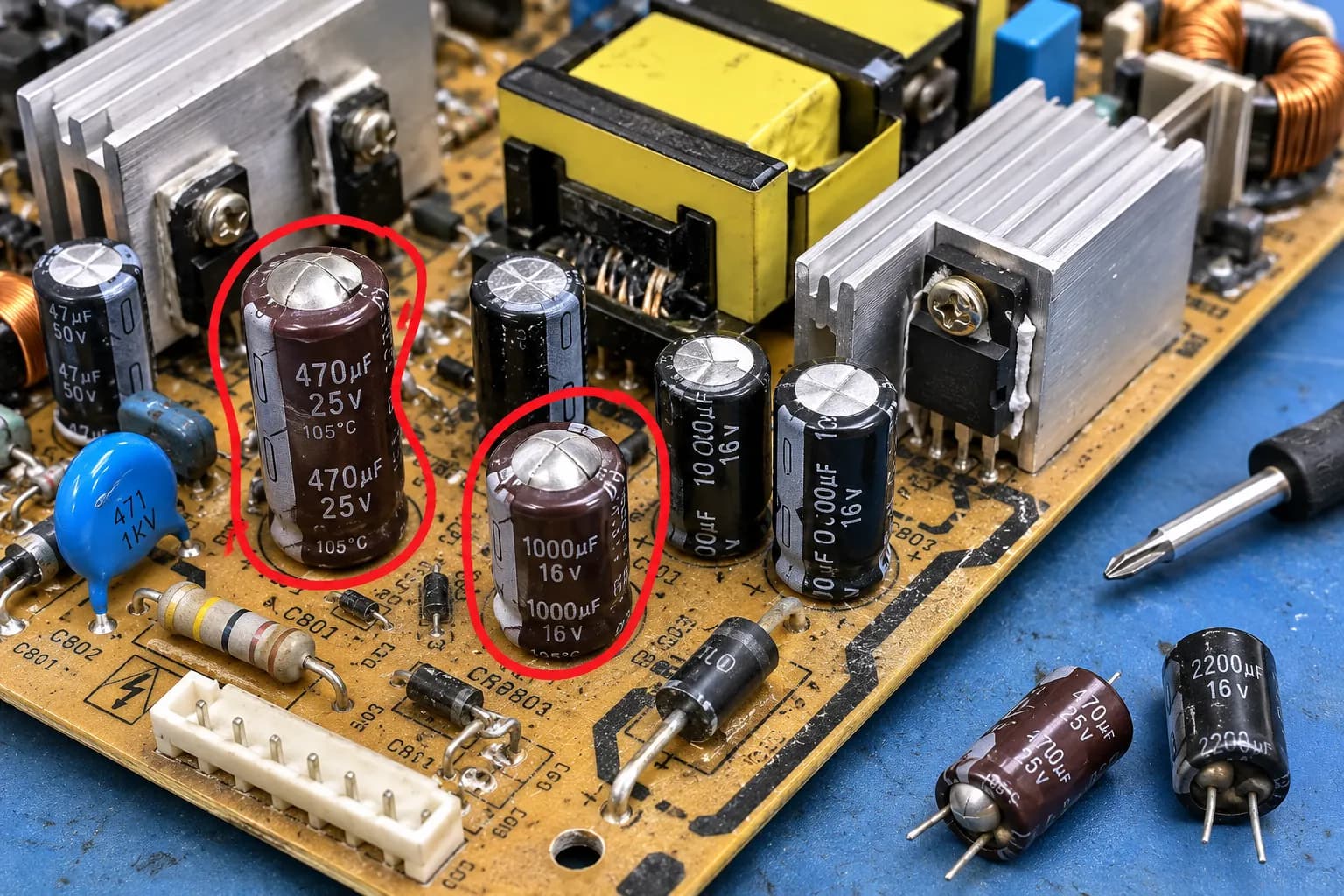
If the set clicks, shows a flashing red standby light, or power cycles, that "no power, flashing red light" pattern is usually the power board, and often just a few bulging capacitors.
Those swollen, domed little cans are a classic cheap fault, and if you are comfortable and the fix is small, our guide to safe DIY screen fixes covers what actually works.
A completely dead set with no standby light at all is a harder case worth a professional look.
Finally, inspect the screen surface in raking light for cracks or a single spreading line. Physical cracks or spider-webbing mean panel damage, which the matrix already sends to replace.
Stop and call a pro if: the set is a CRT tube TV, you smell burning, or the fix means opening the chassis and you are not trained to discharge stored voltage.
There is no shame in a doorstep diagnosis, and it usually costs less than a wrong guess.
Made Your Call? Get a Quote or Retire the Old Set
Once you have decided, the next step splits cleanly into two paths, and both have a right way to do them.
If you are repairing, insist on a doorstep or in-shop diagnosis, ask exactly what failed, get the repair warranty in writing, and check your manufacturer warranty first, since a defect may be covered free.
If you are replacing, do not bin the old set: putting a TV in the trash is illegal in many US states, as Illinois EPA and roughly two dozen other state programs spell out.
On the repair path, a trustworthy quote names the fault and the part, not just a round number.
If you would rather hand it to a professional, our walkthrough on booking a Samsung repair shows how the process and pricing actually work.
Before you pay a cent, though, it is worth a minute to check what your warranty covers, because a covered defect changes everything.
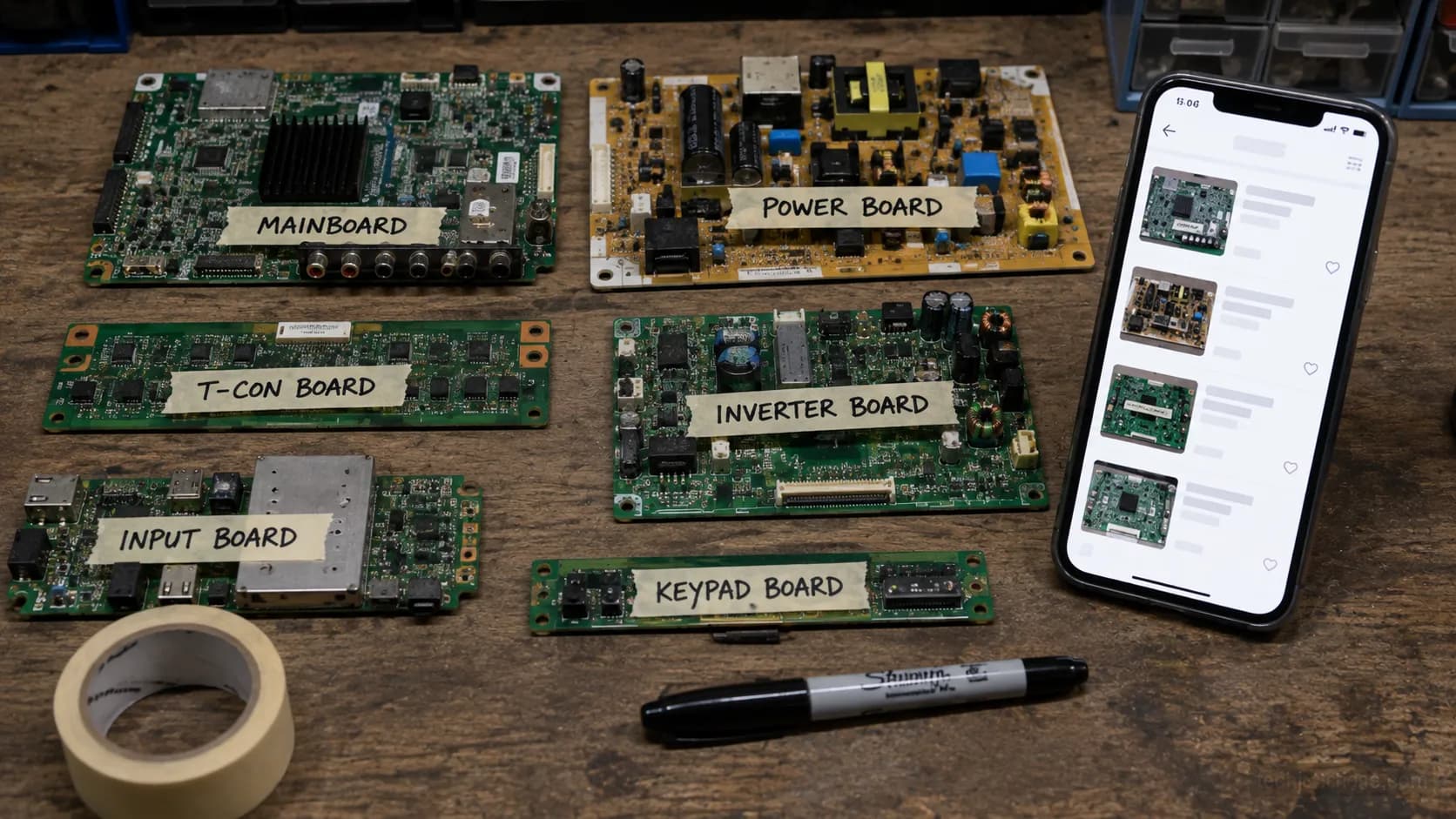
On the replace path, squeeze a little value from the carcass. The boards I pull from write-off sets still sell, and a working power board or T-Con can fetch $30 to $80 from other repairers, so you can part it out before you recycle the shell.
When it is time to let go, recycle the old set responsibly, often for free at a registered collector.
Honest expectation: A broken TV will not make you rich. Beyond salvageable boards it is worth very little, so weigh your time against a realistic few dollars.
Frequently Asked Questions
Is it worth repairing a TV or buying a new one?
It is worth repairing when a cheap component failed on a set under five to seven years old and the quote is under about 30 to 40 percent of a comparable new TV. Buy new when the panel is cracked, the set is old or budget, or the quote clears 40 percent.
What is the average cost to repair a TV?
Most TV repairs run roughly $60 to $350 fitted, but the fault decides everything. A backlight or power board is often $100 to $250, while a cracked panel costs $300 or more and rarely makes sense. Ask for a price tied to the specific part, not a blended average.
Is it worth repairing a 5-year-old TV?
A five-year-old set sits right on the line. Repair it if the fault is a cheap board or backlight and the quote stays under about 30 to 40 percent of a new equivalent. Lean toward replacing if it needs a main board or the set was a budget model to begin with.
Is a cracked TV screen worth fixing?
Almost never. A replacement panel costs about 70 to 90 percent of a comparable new TV, so a cracked or physically broken screen is usually a write-off. The screen is effectively the whole television, which is why board faults are worth fixing and panel faults are not.
Is it worth fixing a TV that won't turn on?
Often yes. A set that clicks, flashes a standby light, or power cycles usually has a failing power board, and that is one of the cheapest fixes there is, sometimes just a few bulging capacitors. A completely dead set with no standby light is a harder case worth a professional diagnosis.
Can I throw a broken TV in the trash?
No, in much of the United States. Around 25 states plus DC ban televisions from landfill and regular trash, so recycle at a registered collector, often for free through a manufacturer take-back program. You can also sell working boards for parts before recycling the shell.
The Bottom Line
So is it worth repairing a TV? Run the two numbers first and the answer stops being a gamble.
Match your fault against your set's age, price the fix against a comparable new TV, and honor the 30 to 40 percent line, and you will know within five minutes whether to book a repair or start shopping.
A cheap board or backlight fault on a decent set under about five to seven years old is genuinely worth saving, and a cracked panel or a tired budget set is not.
The best move now is the smallest one: try the flashlight test, rule out a wrong input, and only then decide.
Whichever way it goes, repair it well or retire it responsibly, and you will have made the call that actually protects your money.
Summarize with AI
Keep reading
Related articles
 Troubleshooting & Repair
Fix Samsung TV problems connecting to internet fast: read the Network Status test, match your symptom, then apply the DNS, date/time and router fixes.
 Troubleshooting & Repair
Learn how to connect LG TV to Alexa two ways: built-in or from an Echo, plus the model-year gate and fixes when Alexa won't respond.
 Troubleshooting & Repair
Fix Insignia TV horizontal lines on screen in minutes: a hard reset and one built-in menu test show instantly if it's a cheap cable or a dead panel.
 Troubleshooting & Repair
Sell it for parts, part it out, repurpose it, or recycle it free, that's what to do with a broken TV, plus what a broken set is really worth.
Comments
Moderated for quality. Share a correction, ask a follow-up, or tell us what worked for you - every comment is reviewed before it goes live.