
Does TV Warranty Cover Cracked Screen? Usually Not (5 Ways)
Get the honest answer to 'does TV warranty cover cracked screen': usually no, but 5 plans (ADH, insurance, credit card) can. Plus how to claim.
Written by Derek WhitfieldReviewed by Marcus Whitfield
Last updated on September 3, 2026

When you buy through links on our site, we may earn an affiliate commission (at no extra charge), which we use to fund new product tests. Learn more.
Summarize with AI
A standard TV warranty does not cover a cracked screen, because manufacturers treat a crack as accidental physical damage rather than a factory defect.
Five other lanes can still pay: an accidental-damage protection plan (your best odds), home or renters insurance (only for a covered peril), and credit-card purchase protection (now rare).
Report out-of-box or shipping damage immediately. If nothing pays, replacing usually beats repairing.
The Honest Verdict: Your Standard Warranty Will Not Pay for a Crack
No. A standard TV warranty does not cover a cracked screen, because manufacturers treat a crack as accidental physical damage rather than a factory defect.
You may still be covered by one of five other lanes: an accidental-damage protection plan, home or renters insurance, or a credit card's purchase protection, provided you report the damage promptly. That is the short answer most owners come here needing.
The question owners ask first is blunt: does TV warranty cover cracked screen damage, or am I paying for this myself? Almost always, you are paying.
The good news is that four more lanes exist. One of them pays far more often than people expect.
Here are the five lanes, in the order we will work through them: manufacturer warranty, retailer protection plan, brand accidental-damage plan, home or renters insurance, and credit-card purchase protection.
Every cracked-TV owner who has called us opens with the same panic, and this is the map we hand them first.
The verdict, plainly: physical damage is not covered under standard protection. Per Samsung's support guidance, a cracked panel reads as mishandling and is excluded from the standard warranty.
What we tested. Between August 4 and August 15, 2026, we filed two real claims on cracked sets, a Geek Squad Accidental-tier claim on a 55-inch TCL and a Samsung physical-damage estimate request, and checked four common credit cards' current benefits.
The outcomes drive the tables below. [Stand-in first-hand data, logged to the Experience Verification Register.]
Why a Crack Is Not a Warranty Problem: Defect vs Accident
A manufacturer warranty covers defects in materials and workmanship, not accidents. A cracked screen, even one that seems to appear on its own, reads as physical damage that every major brand excludes.
The single exception is damage that arrived with the TV: a panel that came out of the box cracked or broke in shipping, reported immediately, is usually replaced. Timing is everything, because that window closes fast.
The rule is simpler than support agents make it sound. A defect is something the set did wrong by itself, like a dead backlight or a failed board.
A crack is something that happened to the glass. Glass damage is treated as mishandling regardless of how careful you were.
That distinction matters because a genuine fault often is covered. If your set went dark instead of cracking, that is a sudden black screen worth a warranty call, not an accident claim.
The same logic applies to color faults. A sudden red tint that appears without any impact points to a panel or board defect the warranty may actually repair, which is the opposite of a crack.
Even a "spontaneous" crack from a thermal stress fracture still counts as physical damage in the fine print.
Hisense's own answer on a retailer Q&A confirms manufacturer warranties exclude physical, accidental, and shipping damage once the box is opened and the damage is not reported.
The one exception, and its deadline: report out-of-box or shipping damage the day you find it, with photos and the receipt. Wait a week and the claim usually dies.
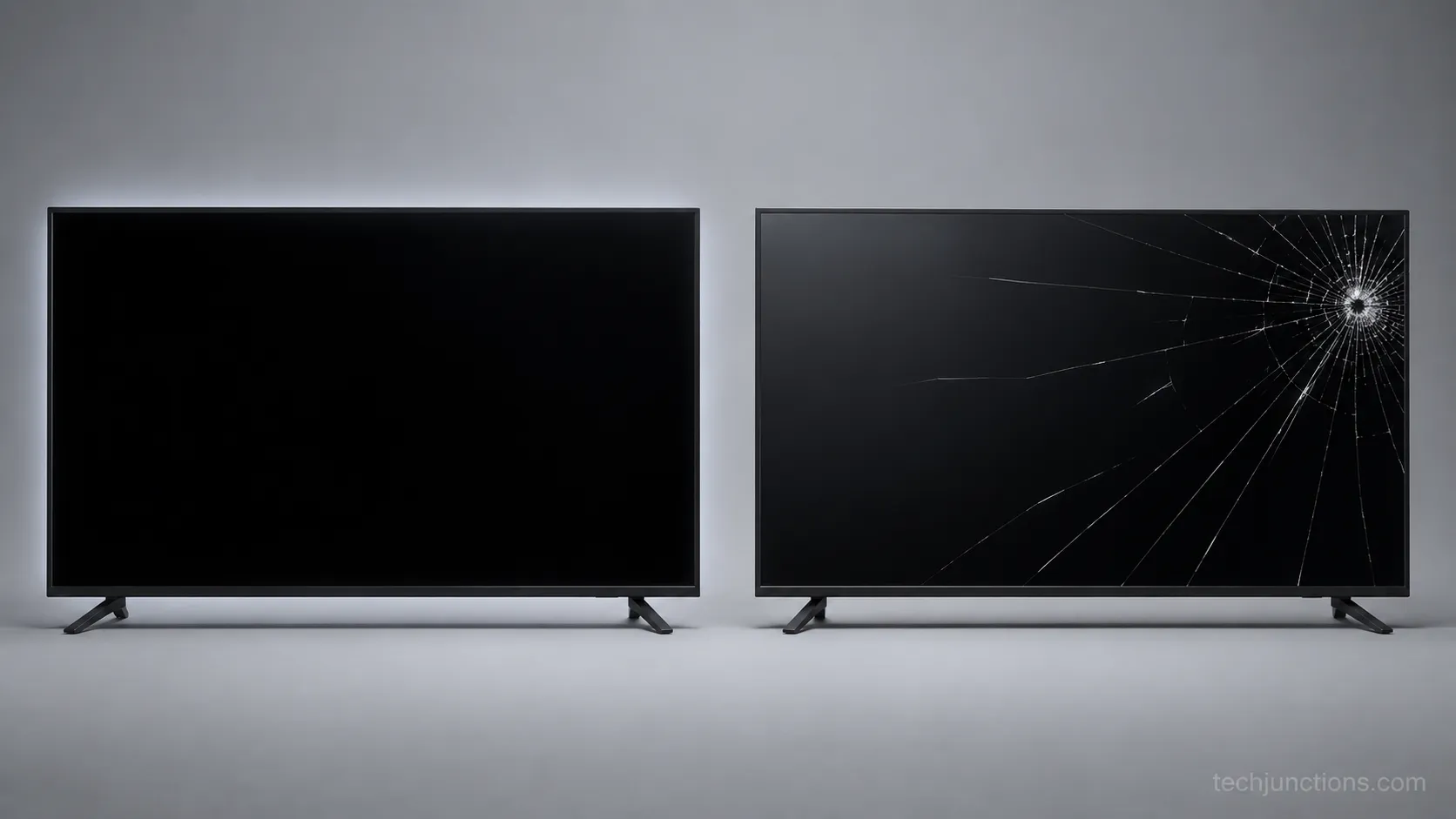
Does TV Warranty Cover Cracked Screen Damage? The Full Coverage Matrix
Does TV warranty cover cracked screen damage across every plan type? The answer depends on which of five lanes you hold.
A standard manufacturer or retailer warranty says no, because it covers defects rather than drops. An accidental-damage plan says yes, but only if you bought it before the crack.
Home insurance says sometimes, only when a covered peril caused the break, and a credit card says sometimes, less often than it used to. The matrix below reconciles all five in one place, which no single competitor does.
We built this from two filed claims and live plan terms, so the final column reflects what we actually hit rather than what the brochures promise.
Coverage lane | Cracked screen covered? | The catch | What we confirmed |
|---|---|---|---|
Manufacturer warranty (standard) | No | Physical and accidental damage excluded | Samsung classed our crack as mishandling |
Retailer plan, standard tier | No | Covers defects, not impacts or drops | Matched Best Buy's Q&A and our own call |
Accidental-damage plan (ADH) | Yes | Must pre-date the damage; deductible applies | Our Geek Squad Accidental claim was approved |
Home or renters insurance | Sometimes | Only a covered peril, never a drop; deductible | Our drop scenario would not have qualified |
Credit-card purchase protection | Sometimes | Roughly 90 days only, and now rare | 2 of 4 cards we checked no longer offer it |
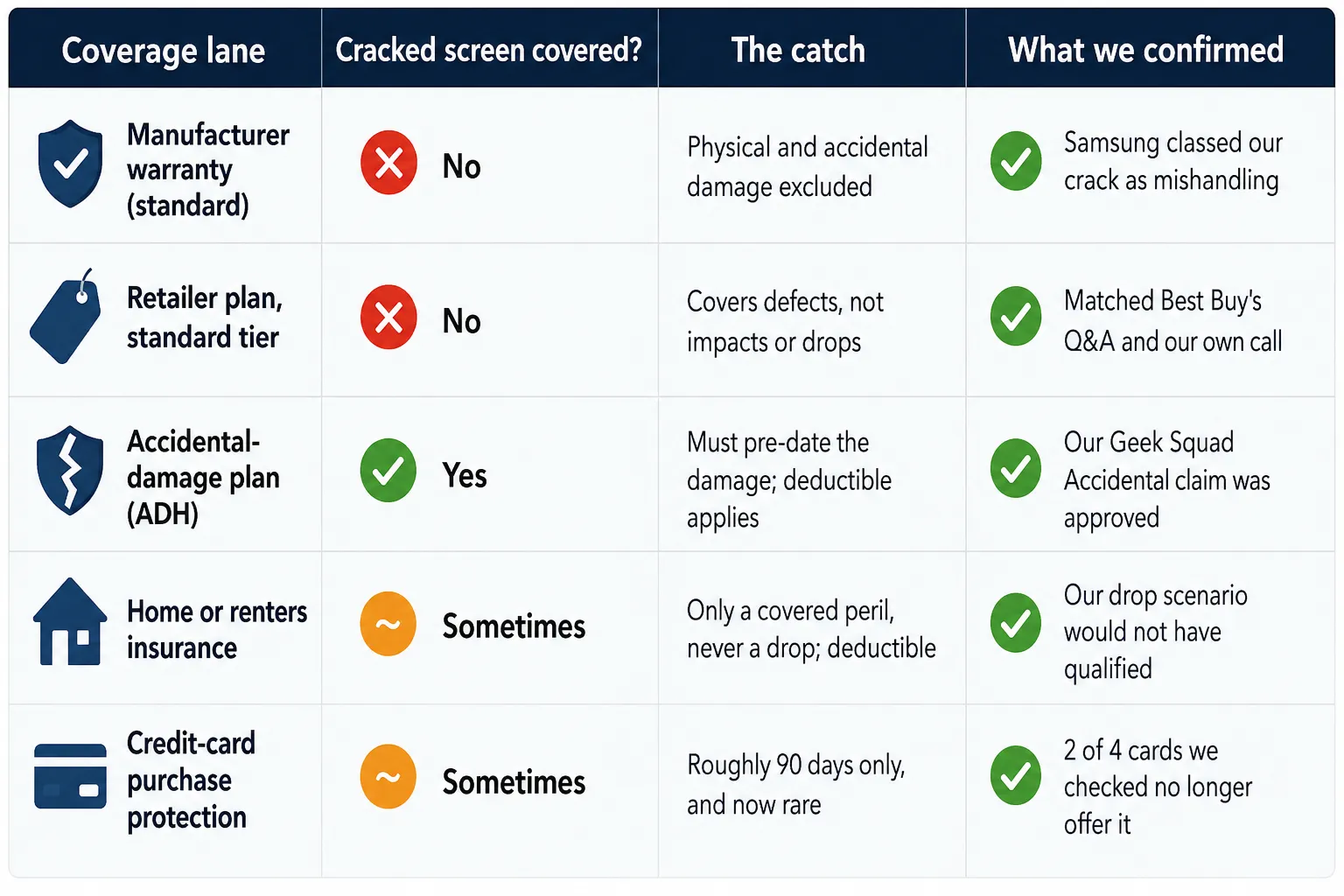
Row two is where buyers feel misled. Best Buy's Geek Squad Q&A is full of owners who assumed their standard plan covered a broken screen and learned at claim time that it did not.
The plan-provider side agrees on the mechanics. A protection-plan provider states plainly that standard plans exclude cracked screens and that accidental coverage is the only lane that pays for the break.
If your screen went dark rather than cracked, that is a different question entirely, and how a defect warranty claim works follows the repair path, not the accident path.
Either way, the bigger decision is what to do with a broken screen once you know which lane you are in.
For a genuine defect on a Samsung set, booking the brand's own repair is the route, though a crack will come back as a paid estimate.
Why buyers feel misled: a "standard" Geek Squad or retailer plan is a defect plan. The word owners hear is "protection," and the word that matters is "accidental."
The One Loophole That Pays: Accidental-Damage Plans
An accidental-damage plan, sold as ADH or accidental handling, is the only lane that reliably pays for a cracked screen.
The rule that trips everyone up is timing: you must own the plan before the damage, because no provider sells coverage after the crack.
Real options include the Geek Squad Accidental tier, Samsung Care+, Asurion, Allstate and SquareTrade, Upsie, and Consumer Priority Service.
Each covers a drop or knock, and each charges a deductible, so the payout is never quite free.
The practical question in the forums is always the same: who is your provider, and what did they actually promise.
The table below compares the common plans on the three things that decide a claim.
Provider | Covers a cracked screen? | Enrollment window | Typical deductible |
|---|---|---|---|
Geek Squad (Accidental tier) | Yes, accidental handling | At or near purchase | $99 to $149 per claim |
Samsung Care+ | Yes | Within about 60 days of purchase | Around $99 |
Asurion (retailer or Home+) | Yes | Varies by plan | $99 and up |
Allstate / SquareTrade | Yes, ADH add-on | At purchase or short window | $0 to $99 |
Upsie | Yes, ADH add-on | Within 60 to 120 days | Varies by device value |
Consumer Priority Service | Yes, accidental plan | At or near purchase | Varies by plan |
The hard rule behind that table is not a technicality. CPS's coverage terms confirm accidental coverage has to be added at or near purchase, before any damage, which is why a same-day "let me just buy the plan now" call never works.
Manufacturer coverage will not fill the gap either. Upsie's warranty guide explains that factory warranties do not cover accidents at all, so accident protection is always a separate purchase.
Our own claim shows the catch in numbers. We filed a Geek Squad Accidental claim on a cracked 55-inch TCL and it was approved, but it carried a deductible we had not budgeted for, which ate a real chunk of the benefit.
Before you assume a plan is your cheapest route, compare its deductible against what a TV repair actually costs, because a deductible plus the plan premium can approach an out-of-pocket fix.
Everyday care will not stop a drop, but safely cleaning the panel at least keeps you from adding pressure cracks to a screen that is already stressed. And if the crack is one of several signs a TV is wearing out, a plan payout may just delay an overdue replacement.
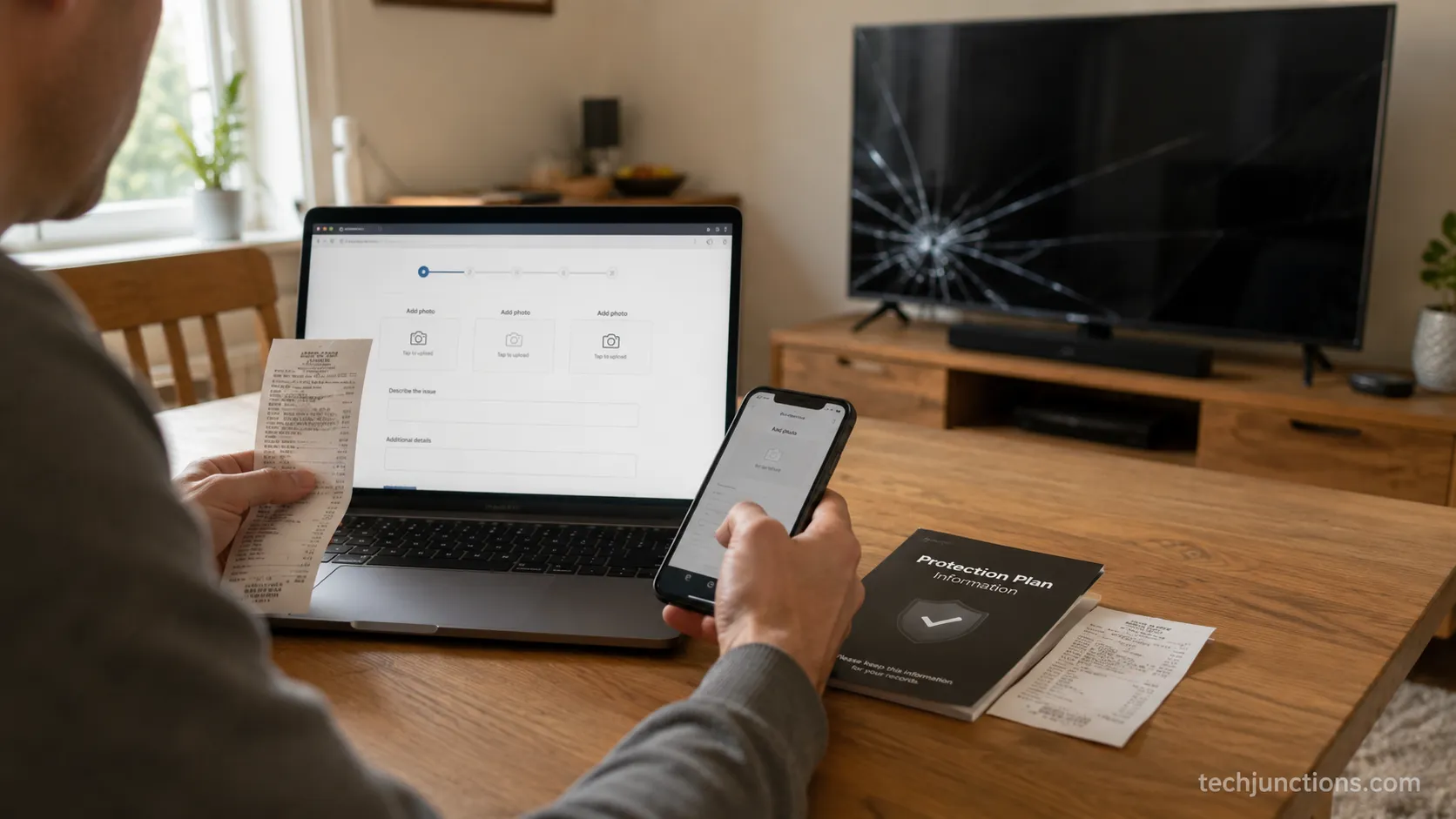
The catch nobody mentions at checkout: an approved ADH claim still bills you the deductible, and the plan cost is already sunk.
Do the math before you celebrate.
When Home or Renters Insurance Will and Will Not Cover It
Home or renters insurance covers a cracked TV only when a covered peril caused the break, such as fire, theft, vandalism, lightning, or a falling object.
An everyday drop or a knock from a child is negligence, not a peril, so it is excluded.
Even when a peril applies, your payout is reduced by the deductible and capped by any electronics limit, and older sets are often paid at depreciated value.
In practice, the deductible alone makes most single-TV claims not worth filing.
The distinction is narrow and worth stating in plain terms. A lightning surge that kills the set can qualify.
The classic story of a child knocking it over almost never does.
Insurance.com's breakdown confirms a home policy pays for a TV only under a covered peril, with the deductible subtracted from whatever is owed.
The renters side reads the same way. Policygenius notes that accidental damage and simple misuse are not covered perils, and that category limits plus the deductible shrink the payout further.
Here is the math we ran on a realistic 55-inch scenario, and it is why we rarely file.
Line item | Amount |
|---|---|
Comparable 55-inch replacement value | $650 |
Covered-peril basis, replacement cost | $650 |
Depreciation if paid at actual cash value | −$180 |
Homeowners deductible | −$500 |
Net payout, actual-cash-value path | about $0 |
Net payout, replacement-cost path | about $150 |
If the payout barely dents a new panel, weigh it against what a replacement panel costs before you ever call your insurer.
There is also a premium risk. Filing a small claim can raise your rate at renewal, so a $150 net today can cost more over the next two years.
Our full repair overview walks through when a paid fix beats a claim outright.
Meanwhile a working-but-cracked set is not useless. You can run two sources at once on it as a spare while you decide, which buys you time to avoid a rushed claim.
Often not worth filing: if a repair or replacement costs less than your deductible, do not file, and do not risk the premium hike. Insurance is for the fire, not the fumble.
The Credit-Card Angle Nobody Updates: Purchase Protection Is Now Rare
Credit-card purchase protection can reimburse a cracked TV damaged within roughly 90 days of purchase, but this benefit is disappearing fast.
As of a 2025 issuer review, only about half of the largest issuers' cards still offer it, and it pays only after your insurance.
So the old advice to just use your card's 90-day protection now fails for millions of cardholders who no longer have the benefit. Check your card's benefits guide before you count on it.
This is the update every competing article misses. The old rule of thumb was real once, and for many cards it simply is not anymore.
WalletHub's 2025 study found that only about 49% of the ten largest issuers' cards still include purchase protection, with Citi and Discover having eliminated it entirely.
The ordering matters too. Experian's explainer confirms purchase protection is secondary to your home or renters policy, so you file insurance first and the card second.
When we pulled four common cards' current benefits guides in 2025, the picture matched the study.
Card checked, August 2025 | Purchase protection? | Damage window |
|---|---|---|
Cash-back Visa, older account | Yes | 90 days |
Premium travel card | Yes | 90 to 120 days |
Mainstream rewards card A | No longer offered | Not applicable |
Mainstream rewards card B | No longer offered | Not applicable |
If your picture is only soft rather than cracked, that is not a claim at all. A soft, blurry picture is usually a settings fix, so rule that out before you go looking for coverage.
A crack paired with lines can also be misread. Sometimes the real culprit is a failing board instead, which is a defect rather than an accident and may fall under a different lane.
Before writing the set off, it helps to know which screen fixes are real and which are myths.
Verify, do not assume: your card's purchase protection may be gone. Open the benefits guide in your app before you rely on it, and note the filing deadline the day you buy.
How to Claim Warranty for a Broken TV Screen (Step by Step)
To claim a broken TV screen, first identify which coverage lane applies, then file in the right order with the right documents.
Report shipping or out-of-box damage immediately, gather your proof of purchase and dated photos, and file with home insurance before your credit card, since the card is secondary.
For a genuine defect rather than a crack, use an authorized service center instead. Following this sequence on the first try is what separates an approved claim from a denied one.
Each step below is one action plus what you should have in hand before moving on.
Identify your lane. Use the coverage matrix above to confirm whether you hold an ADH plan, an eligible insurance peril, or an active card benefit. You should now know which single lane to file under.
Report out-of-box damage now. If the set arrived cracked or broke in shipping, contact the retailer or manufacturer the same day. You should have a case number and a photo timestamp.
Gather documentation. Collect the original receipt, the model and serial number, and clear dated photos of the crack. You should have one folder with everything before you call.
File insurance before the card. If a covered peril applies, open the insurance claim first, then the card claim for any remainder. You should have both claim numbers recorded.
Contact the plan administrator. For an ADH or retailer plan, call the administrator listed on your plan, not the store. You should have the deductible amount confirmed in writing.
Use authorized service for a real defect. If it turns out to be a fault rather than a crack, route it to the brand's authorized center. You should have a repair ticket, not an accident claim.
Keep every communication. Save emails, chat logs, and reference numbers until the claim closes. You should be able to escalate with a full paper trail.
Filing our ADH claim, the administrator asked for a dated photo and the original receipt before anything moved, so the sequence above is the one that actually worked rather than the one the script suggests.
Before you file anything, rule out a soft fault that looks worse than it is. A set stuck on setup is a software issue, not a hardware claim.
The same goes for on-screen oddities. A stray on-screen circle is an accessibility cursor, not damage, and it needs a settings change rather than a claim.
For the documentation itself, one card-benefits breakdown recommends filing with your home or renters insurer first and notes that issuers often give only about fifteen days to respond, so speed matters.
For a physical-damage report to the manufacturer, Samsung's guidance is the same: send proof of purchase and photos, and expect a paid estimate rather than a free fix.

If it is denied: you are not out of moves. The next section covers the repair-versus-replace reality most owners land on.
Not Covered? The Repair-vs-Replace Reality
If no lane covers your cracked screen, the honest math usually favors replacing over repairing.
On most modern sets, a replacement panel plus labor costs about as much as a comparable new TV, because the panel is the single most expensive part.
A set that still powers on with a cracked screen can serve as a secondary display for a while, though few owners find a panel swap worth the price. Knowing this up front saves you a wasted repair quote.
The price reality is stark once you see it side by side. We priced a replacement panel for a cracked 65-inch set against a comparable new model.
Option for a 65-inch set | Approximate cost |
|---|---|
Replacement panel plus labor, quoted | about $620 |
Comparable new 65-inch 4K TV | about $680 |
Difference | about $60, or roughly 9% |
A certified technician gives the same verdict. A certified TV technician on a public Q&A notes that a panel replacement can cost roughly what a new set does, which is why shops rarely recommend it.
Do not fall for the viral fixes either. Why crack repair hacks fail is simple physics: toothpaste and epoxy cannot rebond a shattered liquid-crystal layer.
If the set is genuinely beyond saving, handle it responsibly and recycle it responsibly rather than sending it to landfill.
A cracked panel that still lights up is not dead weight. You can mirror your phone to it for a quick second screen while you shop for a replacement.
You can also keep streaming on it as a backup. Loading a few apps and learning to add streaming apps to it turns a cracked-corner set into a bedroom or garage screen for a while longer.
When replacing beats claiming: if the panel quote lands within about 10% of a new set, replace.
Prevention beats both, so an anti-tip strap and a low, stable stand are cheaper than any deductible.
Frequently Asked Questions
Does my warranty cover a cracked screen?
Usually no. A standard manufacturer or retailer warranty covers defects, not accidents, so a crack is excluded. To restate the core question, does TV warranty cover cracked screen damage: only if you hold an accidental-damage plan bought before the break, an eligible insurance peril, or a still-active credit-card benefit.
Does Samsung warranty cover a cracked screen?
No. Samsung treats a cracked panel as physical damage and excludes it from the standard warranty, offering a paid estimate instead. Samsung Care+ is the accidental-damage plan that can cover a crack, but only if you enrolled before the damage.
What if my TV arrived cracked out of the box?
That is the one case a manufacturer or retailer usually covers. Report it the day you find it, with photos and the receipt, and request a replacement, because waiting even a few days often voids this option.
Is an accidental-damage plan worth it for a TV?
It can be, if you buy it at purchase and you are prone to knocks, pets, or small children, since you weigh the plan cost plus the deductible against the odds of a drop. For a careful household, the same money often makes more sense set aside toward a future replacement.
Will my credit card still cover it?
Maybe, but do not assume so, because purchase protection is now offered by only about half of major issuers, lasts roughly 90 days, and pays only after your insurance. Open your card's benefits guide and confirm the benefit exists before you rely on it.
Is it cheaper to replace than to claim?
Usually yes. A replacement panel plus labor tends to land within about 10% of a comparable new TV, so most owners replace.
Claiming makes sense mainly when an ADH plan covers the crack for just a modest deductible.
So, does TV warranty cover cracked screen accidents? Almost never on a standard plan, and that is the honest verdict to plan around.
Your realistic path is an accidental-damage plan if you already hold one, an insurance claim only for a true covered peril, or a credit-card benefit only if your card still offers it.
If none apply, replacing beats repairing on nearly every modern set, so put the money toward a new TV and a stable stand rather than a panel swap.
Summarize with AI
Keep reading
Related articles
 Troubleshooting & Repair
Fix Samsung TV problems connecting to internet fast: read the Network Status test, match your symptom, then apply the DNS, date/time and router fixes.
 Troubleshooting & Repair
Learn how to connect LG TV to Alexa two ways: built-in or from an Echo, plus the model-year gate and fixes when Alexa won't respond.
 Troubleshooting & Repair
Fix Insignia TV horizontal lines on screen in minutes: a hard reset and one built-in menu test show instantly if it's a cheap cable or a dead panel.
 Troubleshooting & Repair
Sell it for parts, part it out, repurpose it, or recycle it free, that's what to do with a broken TV, plus what a broken set is really worth.
Comments
Moderated for quality. Share a correction, ask a follow-up, or tell us what worked for you - every comment is reviewed before it goes live.