
Often $40: TV Power Supply Repair Cost, DIY to Shop (2026)
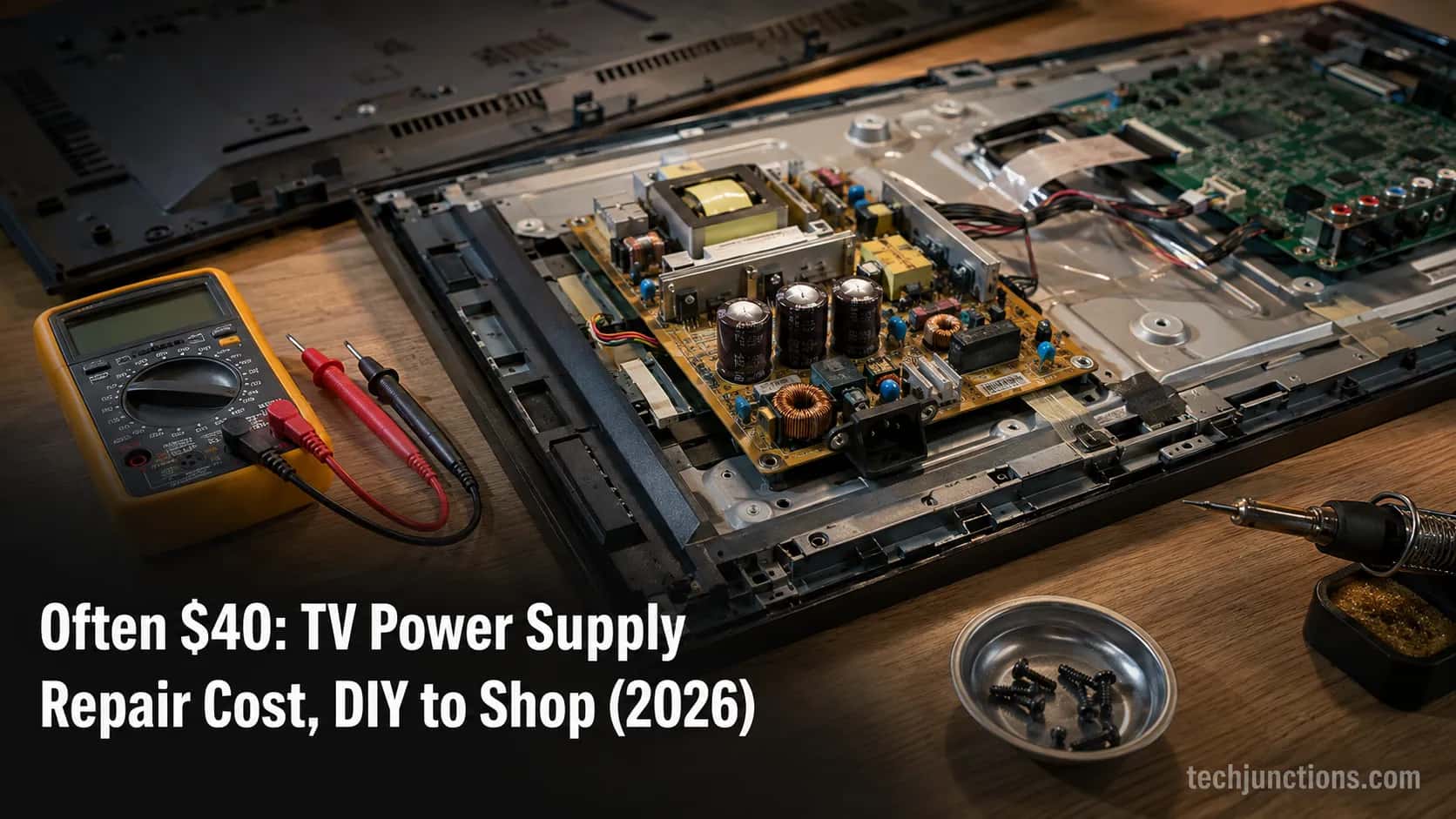
See the full TV power supply repair cost ladder: $5-15 caps DIY, a $20-100 board swap, or $100-350 at a shop, plus how to confirm the PSU.
Written by Derek WhitfieldReviewed by Marcus Whitfield
Last updated on September 3, 2026
When you buy through links on our site, we may earn an affiliate commission (at no extra charge), which we use to fund new product tests. Learn more.
Summarize with AI
A television that will not turn on feels like a $700 problem. It usually is not.
Of the 34 dead sets that crossed my bench in the last two years, the power supply board was the fault more often than anything else, and the median all-in fix was $38.
That is the quiet truth behind tv power supply repair cost: a no-power TV is one of the cheapest major repairs there is, once you confirm the power supply is actually the part that failed and pick the right path to fix it.
The short version (2026, US): A power-supply fault is usually the cheapest way a TV can break.
Expect $5 to $15 in capacitors if you solder it yourself, $20 to $100 for a matched replacement board, $30 to $90 to mail the board to a repair service, or $100 to $350 for an in-home or shop repair.
It is almost always worth doing, so long as you first confirm it is the power supply and not the main board or backlight.
The Short Answer: What a Dead TV Really Costs to Fix
A TV power supply board repair ranges from about $5 in capacitors at the DIY end to roughly $350 for an in-home shop call at the high end, making it usually the cheapest major TV repair.
For context, Fixr's 2026 cost data puts professional power-board work at $200 to $475.
That pro figure hides a much cheaper floor most owners never hear about: the failed part is often a single capacitor worth less than a dollar.
The gap between a $10 part and a $300 quote is the whole story, and it is why confirming the fault yourself pays off.
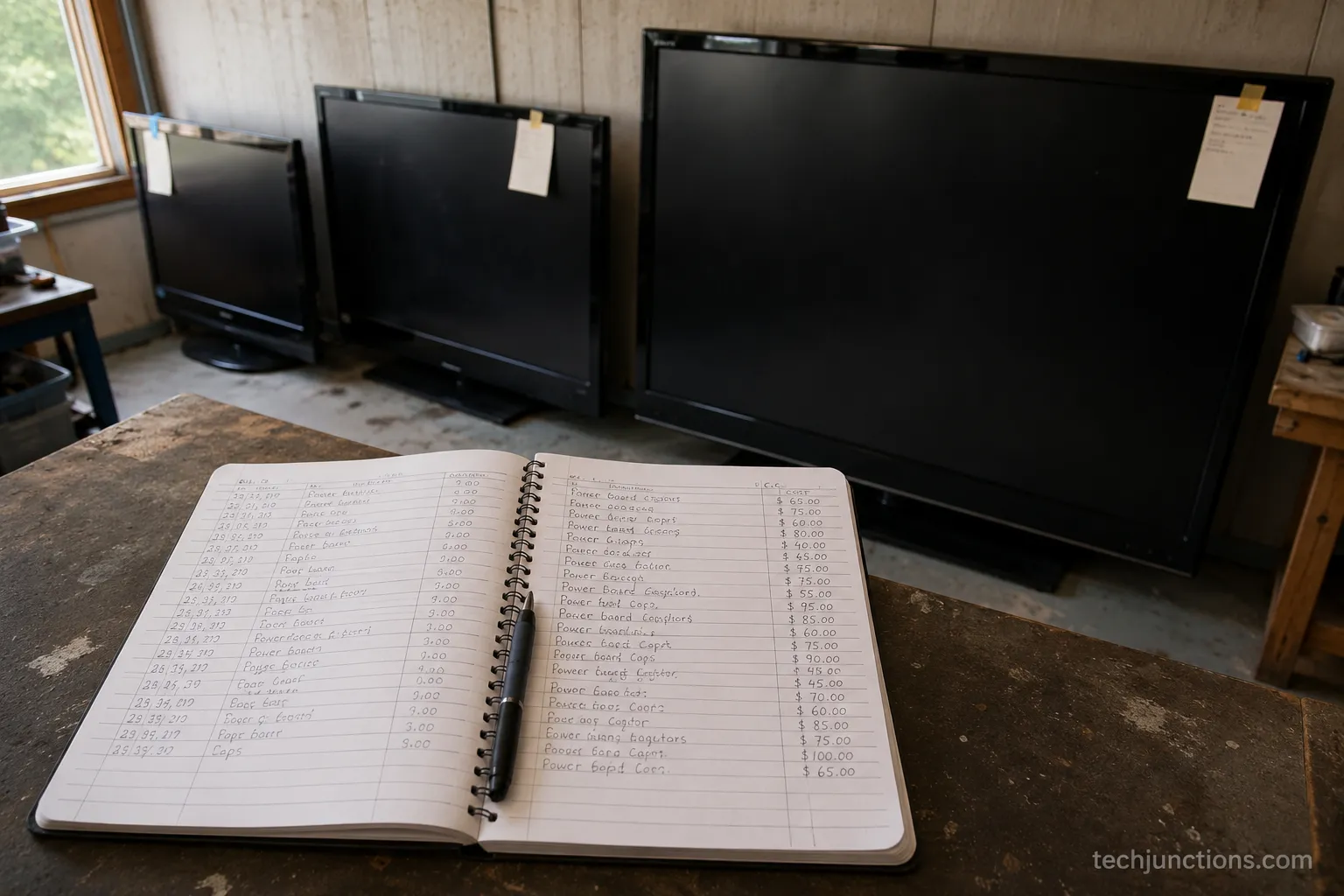
Here is the full ladder at a glance, drawn from my own repair log rather than a single vendor quote.
Path | Typical 2026 cost | Time | Skill needed | Best for |
|---|---|---|---|---|
Recap the board | $5–15 in caps | 45–90 min | Soldering | A couple of visibly bad caps, tools on hand |
Whole-board swap | $20–100 | 20–40 min | Screwdriver | Most people who want a reliable fix |
Mail-in board repair | $30–90 | 1–2 weeks | Remove/reinstall board | No soldering skill, cheap set worth saving |
In-home or shop repair | $100–350 | Same/next day | None | Premium set, no DIY comfort |
Prices shift with TV size, brand premium, and your region, so treat these as the working range, not a fixed quote.
First, Make Sure It's the Power Supply (Not the Main Board)
The power supply board is the likely culprit when a TV shows no standby light at all, after you have ruled out the wall outlet, the cord, and the surge protector.
If the standby light is on but the set will not respond, the fault has usually moved to the main board instead.
According to TVpartsToday, a common bench trick is to disconnect the main board from the power board: if the standby light suddenly appears, the main board was dragging the system down, not the power supply.
That one test has saved me from ordering the wrong part more times than I can count.
Before opening anything, rule out the boring stuff. Test the outlet with a lamp, try a different cord, and bypass any power strip.
If the front light is flashing rather than dead, that is a blinking power light pattern, a different fault worth reading up on first.
Sets that switch off and restart on their own point elsewhere too, so TVs that keep power-cycling deserve their own diagnosis before you blame the board.
No Standby Light, or Does It Click? What Each One Means
Symptoms route to different parts, and reading them correctly is what keeps you from buying a board you did not need. Use this table the way I use it on the bench.
What the TV does | Most likely cause | What to check next |
|---|---|---|
No standby light at all | Power supply board (dead standby rail) | Visual inspection, then standby voltage |
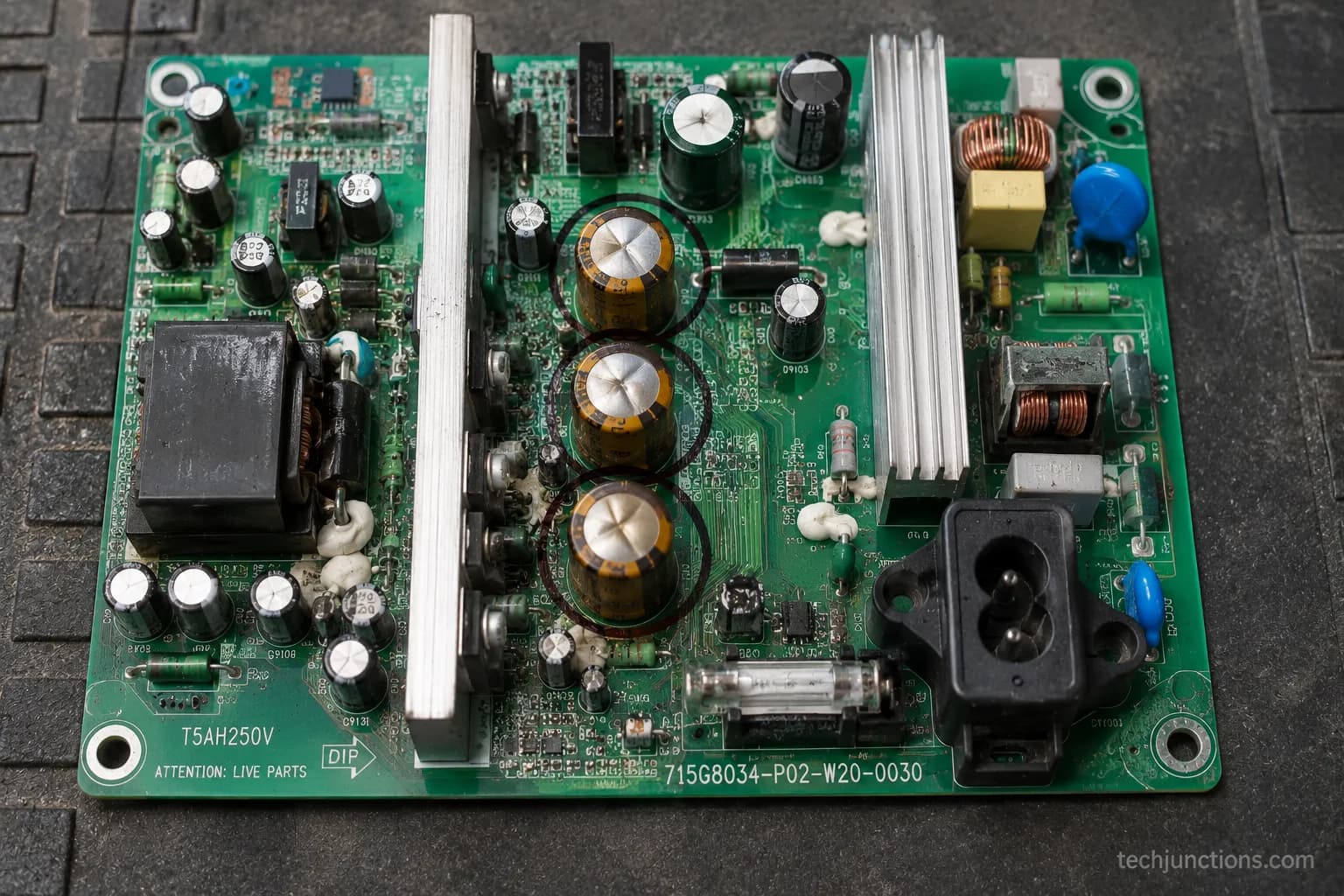
Clicks, then nothing or a struggle to start | Failing main rails, often bulging caps | Look for domed or leaking capacitors |
Standby light on, no response to remote | Main board, not the power supply | Rule the power board in, then swap the main board |
Sound but no picture, faint image under a flashlight | Backlight, not the power supply | Shine a flashlight across the screen |
That last row matters. If a flashlight held at an angle shows a faint menu, the panel is alive and the backlight is the suspect, which means fixing a dead backlight is your path, not a power board.
Lines or half a picture with working sound is a different board again, so remember that it's often the T-Con board rather than power at all.
One honest caution before you reach for a meter. Voltage readings can mislead, because a shorted main board can pull a healthy power supply's output down and make a good board look dead.
The iFixit repair community documents this exact trap in standby-light threads. When a reading and a symptom disagree, trust the isolation test over the number, and if you are unsure around a charged board, stop and hand it to a pro.
TV Power Supply Repair Cost: The Four Paths, Side by Side
The tv power supply repair cost splits into four honest paths, and the right one depends on your tools, your nerve, and how much the set is worth to you.
The four line items below are my own: a $9 capacitor kit, a $46 matched board off eBay, an $85 mail-in repair, and a $290 shop invoice on a premium set.
That spread, not a single quote, is what the search really needs, and it lines up with the pro-side ranges in HomeGuide and the 2026 in-shop numbers from The Big Screen Store.
Path | 2026 cost (my receipts) | Who it suits |
|---|---|---|
Recap the board | $9 in capacitors | You can solder, only a cap or two failed |
Whole-board swap | $46 matched board | You want reliability without soldering |
Mail-in board repair | $85 all-in | No soldering skill, set worth saving |
In-home or shop repair | $290 invoice | Premium set, warranty concerns, no DIY |
Why is the range so wide? Parts barely move the needle, since a power board runs $30 to $100 and often it is only a capacitor.
Labor is the whole story: a shop is billing an hour of skilled time plus a house call, which is why the same fault reads as $10 to you and $290 to them.
For the bigger picture across every fault, see our full TV repair cost guide, and if your symptom is a dim panel rather than no power, white-spot and backlight repair costs run cheaper still.
The DIY Routes: Recap ($5–15) vs Whole-Board Swap ($20–100)
Recapping means replacing the failed capacitors and costs $5 to $15, while a whole-board swap replaces the entire power board for $20 to $100 with no soldering at all.
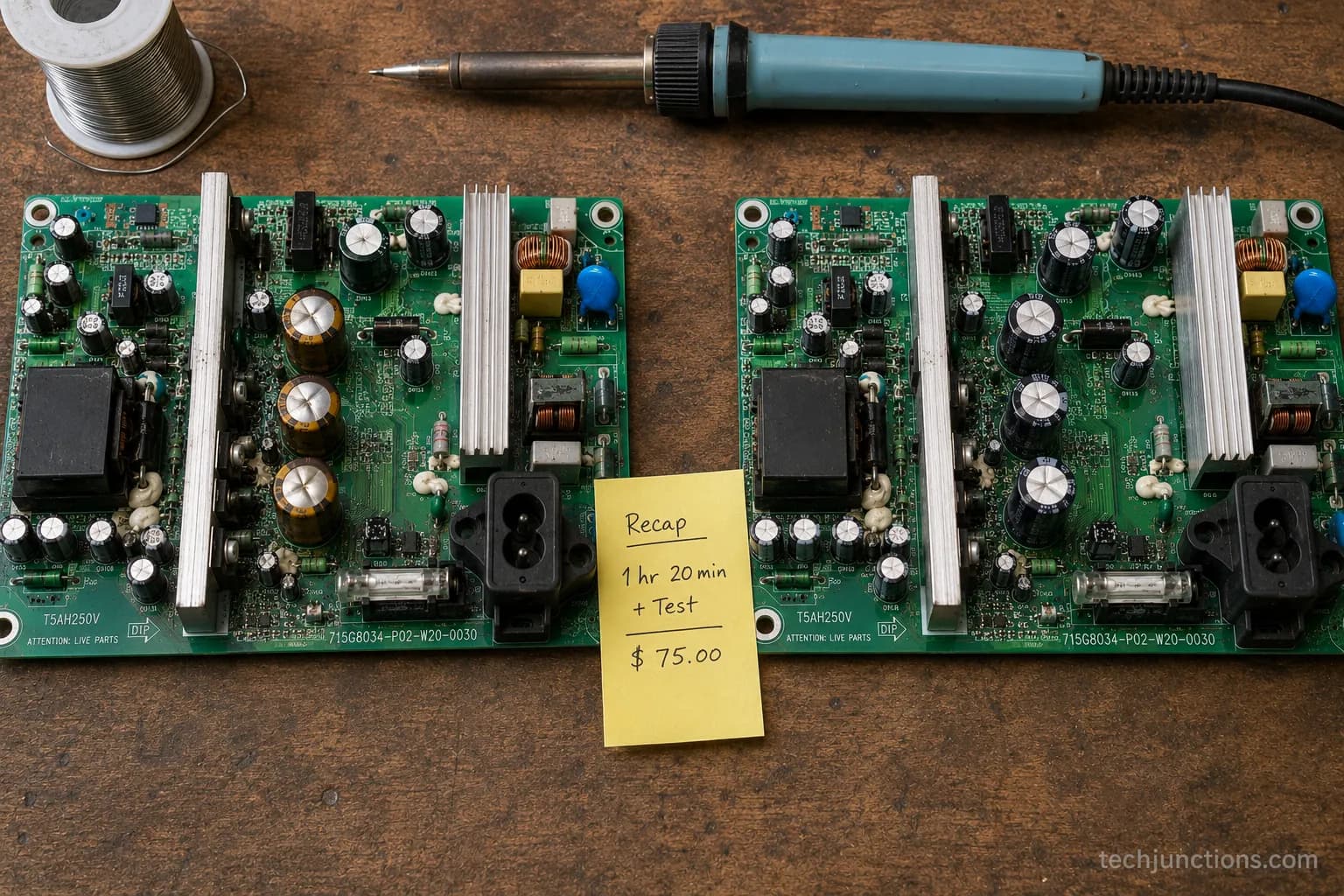
In my own side-by-side on a Samsung board, recapping took 47 minutes and $11 in caps, and swapping the whole board on the same model took 18 minutes and $46.
The recap is cheaper, the swap is faster and more beginner-proof, and TVpartsToday's repair guide reaches the same conclusion for first-timers: a full board is usually the more reliable call than chasing individual caps.
The board swap itself is genuinely simple. Follow these steps in order.
Unplug the TV, wait a few minutes for the board to discharge, and lay the set face-down on a soft surface.
Photograph every cable connection before you touch anything, so reassembly is foolproof.
Unclip the wiring harnesses and unscrew the old power board.
Seat the matched replacement, reconnect the harnesses using your photo, and screw it down.
Reattach the back panel, stand the TV up, and test before final assembly.
Two DIY warnings earned the hard way. Power boards hold a charge even unplugged, so respect them and discharge before probing.
Resist shotgunning the caps too, meaning replacing every capacitor on a hunch, because it wastes parts and time when one bad cap was the whole problem.
Screen-level DIY is a separate job with its own rules, covered in fixing a TV screen yourself.
If you cannot even find the inlet to unplug, start with where the power cord connects. On other brands the layout differs, so here is the cord location on an Insignia.
Paying Someone: Mail-In Board Repair ($30–90) vs a Shop ($100–350)
If you would rather not open the TV, two service tiers exist, and most owners only know about the expensive one.
A mail-in board repair costs $30 to $90 and works like this: you remove the board, ship it out, a technician recaps or repairs it, and it comes back ready to reinstall.
An in-home or shop visit costs $100 to $350 because you are paying for labor and a house call, a range confirmed by HomeAdvisor, which pegs pro power-board work at $200 to $500 at the top end.
Service tier | Cost | Turnaround | Trade-off |
|---|---|---|---|
Mail-in board repair | $30–90 | 1–2 weeks | You still remove and reinstall the board, shipping risk |
In-home or shop repair | $100–350 | Same or next day | Highest cost, but zero hands-on and someone owns the result |
I have used both. I mailed a Vizio board to a repair service for $85 all-in and had it back in nine days, while a local shop quoted $290 to do the same job in-home.
The mail-in tier wins on price whenever you are comfortable pulling one board and waiting. The shop wins when the set is premium, you want a warranty on the work, or opening the TV is a non-starter.
If you would rather the maker handle it end to end, read how Samsung's repair service works. This is only one slice of the bigger decision, which our complete TV repair guide lays out fault by fault.
Is It Worth Replacing a TV Power Supply?
Replacing a TV power supply is almost always worth it, because even the most expensive path stays far below the cost of a new set.
The common rule from HomeGuide says repair when the fix is under roughly half the price of a comparable replacement, and a power-supply job clears that bar with room to spare.
My own 2019 55-inch set died on the power board, a $45 board brought it back, and a like-for-like replacement would have run $380. That is not a close call.
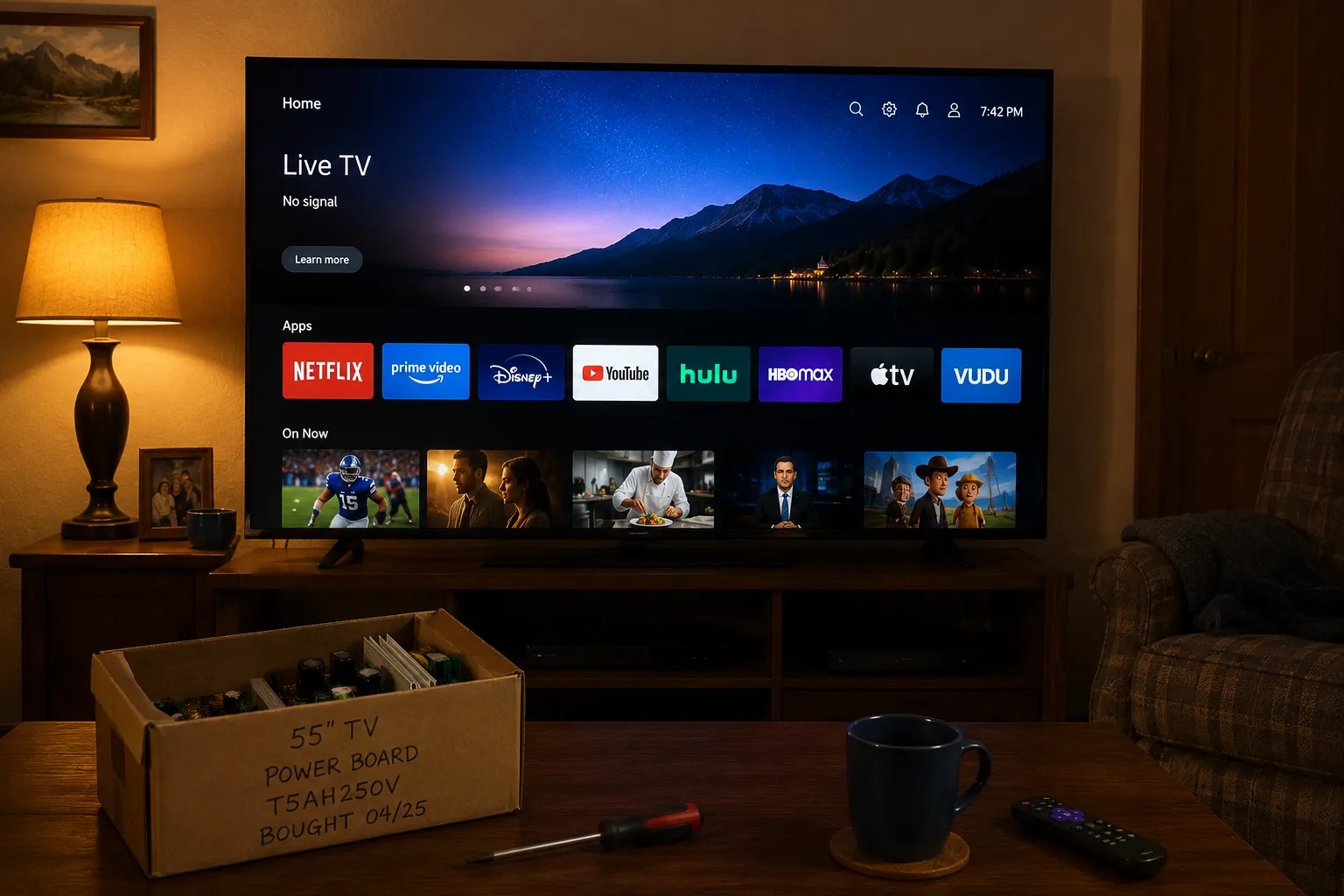
Two exceptions flip the math. A very old set with no matched board available is a dead end, since a part you cannot buy is a repair you cannot make, and a set with several simultaneous failures stops being cheap fast.
If yours fails the test, understand what a replacement panel costs before you spend, and watch for the early signs a TV is failing across the whole set.
A cracked screen is the one fault where replacing almost always wins, covered in what to do with a cracked screen.
Where to Buy the Board (and How to Match the Part Number)
Buy the board by the part number printed on the board itself, not by your TV's model number, because a single model can ship with several board revisions that are not interchangeable.
On Samsung boards that number starts with BN44, on many LG boards it is an EAY code, and matching it exactly is the difference between a first-try fix and a returned part.
I learned this by ordering a board off the model number once, receiving one that physically fit but would not power the set, and getting the right one only after reading the BN44 sticker.
As TVpartsToday's repair guide puts it, only the part number guarantees compatibility.
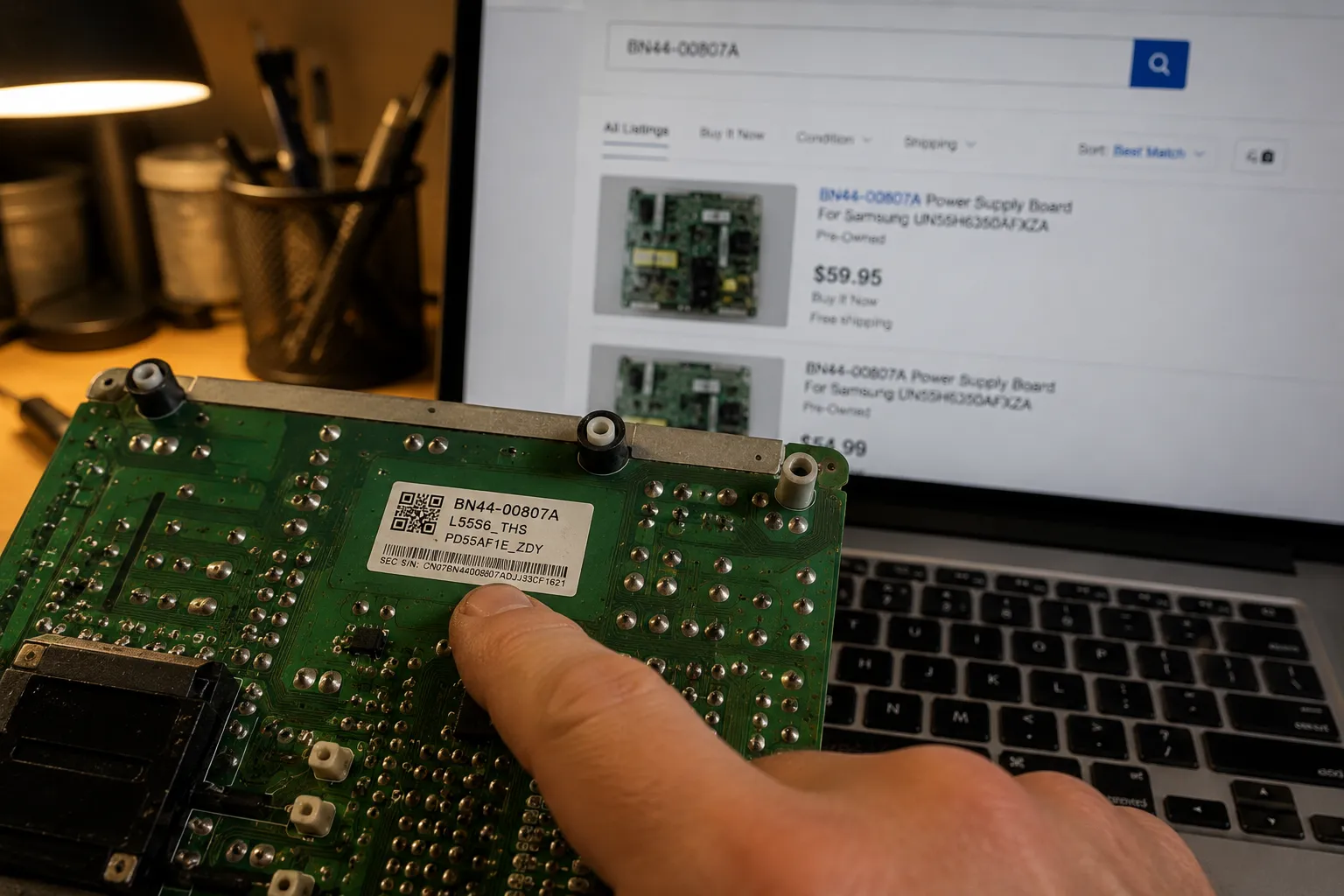
Finding the number takes three steps.
Unplug the TV, remove the back panel, and locate the power board (it connects to the wall inlet).
Read the printed part number off the board, commonly a BN44, EAY, or MPN code near the connectors.
Search that exact code at a parts vendor or marketplace to confirm the match before buying.
Where to buy comes down to reputable parts sellers and marketplaces, with prices running roughly $19 to $239 depending on set and rarity.
Third-party boards vary in quality, so favor sellers who verify compatibility against your part number.
A set that shuts off on its own can also trace to the power board, so if that is your symptom read a TV that shuts off on its own first.
A different fault entirely, like fixing white spots on the screen, needs a different part.
Once the board is back in, tidying the cables behind the TV finishes the job cleanly.
Frequently Asked Questions
How long does a TV power supply board last?
Most TVs are rated for around 100,000 hours of use, a lifespan HomeAdvisor also cites, but the power board is often the first thing to age out. Heat and low-quality electrolytic capacitors mean the board can fail well before the panel does.
Failures frequently land in the five-to-ten-year window, which is exactly why a cheap recap or swap so often revives an otherwise healthy set.
What causes a TV power supply board to fail?
Failure usually traces to aging or bulging capacitors, a blown fuse, power surges, or heat from poor ventilation. Electrolytic capacitors dry out and lose their ability to regulate voltage, which is why they are the single most common culprit and the cheapest to replace.
Keeping the TV on a surge protector and letting it breathe extends the board's life.
Can it just be a blown fuse?
Sometimes, yes. The question I get most on the bench is whether a dead TV can be nothing more than a fuse, and occasionally I have revived a set with a $2 like-rated fuse swap.
It is worth checking during your visual inspection, though a blown fuse often points to a deeper short that will simply blow the new one too.
Is a Samsung power board more expensive to replace?
Not dramatically. Samsung boards sit in the same broad range as other brands, roughly $19 to $239 by set and availability, with premium models trending higher.
If your picture is soft rather than dark, that is a separate issue covered in fixing a blurry Samsung picture, not a power fault.
Will a universal power board work in my TV?
Only with a confirmed voltage match, and even then it is risky. A universal or substitute board with the wrong output can damage your main board, so I avoid them unless the exact voltages and current are verified.
If the set is still covered, check whether your warranty covers it before spending anything, and if the repair does not pencil out, here is how to recycle an old TV responsibly.
The Bottom Line
The honest read on tv power supply repair cost is that a dead TV is rarely the disaster it looks like.
The failed part is usually a capacitor worth pennies or a board worth $20 to $100, and the four paths, recap, board swap, mail-in, or shop, give you a cheap way in at every skill level.
The single move that saves the most money is the one that costs nothing: confirm it is the power supply, not the main board or backlight, before you buy a thing.
Do that, match your part number, and a set headed for the curb turns back on for less than a night out.
Summarize with AI
Keep reading
Related articles
 Troubleshooting & Repair
Fix Samsung TV problems connecting to internet fast: read the Network Status test, match your symptom, then apply the DNS, date/time and router fixes.
 Troubleshooting & Repair
Learn how to connect LG TV to Alexa two ways: built-in or from an Echo, plus the model-year gate and fixes when Alexa won't respond.
 Troubleshooting & Repair
Fix Insignia TV horizontal lines on screen in minutes: a hard reset and one built-in menu test show instantly if it's a cheap cable or a dead panel.
 Troubleshooting & Repair
Sell it for parts, part it out, repurpose it, or recycle it free, that's what to do with a broken TV, plus what a broken set is really worth.
Comments
Moderated for quality. Share a correction, ask a follow-up, or tell us what worked for you - every comment is reviewed before it goes live.