
Insignia TV Horizontal Lines on Screen: Panel or Fix?
Fix Insignia TV horizontal lines on screen in minutes: a hard reset and one built-in menu test show instantly if it's a cheap cable or a dead panel.
Written by Derek WhitfieldReviewed by Marcus Whitfield
Last updated on September 24, 2026
When you buy through links on our site, we may earn an affiliate commission (at no extra charge), which we use to fund new product tests. Learn more.
Summarize with AI
The 2-Minute Verdict: Reset First, Then Test
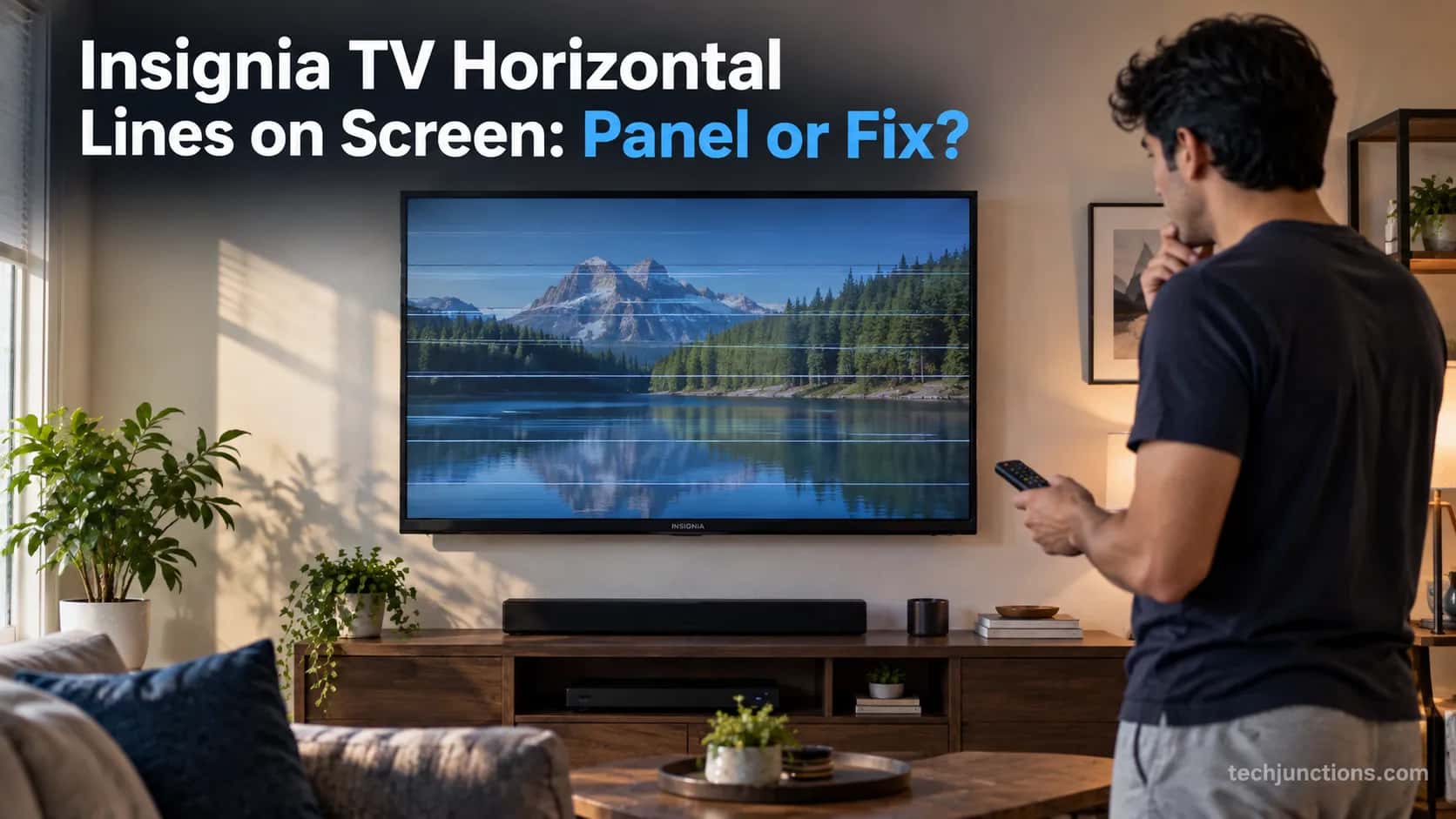
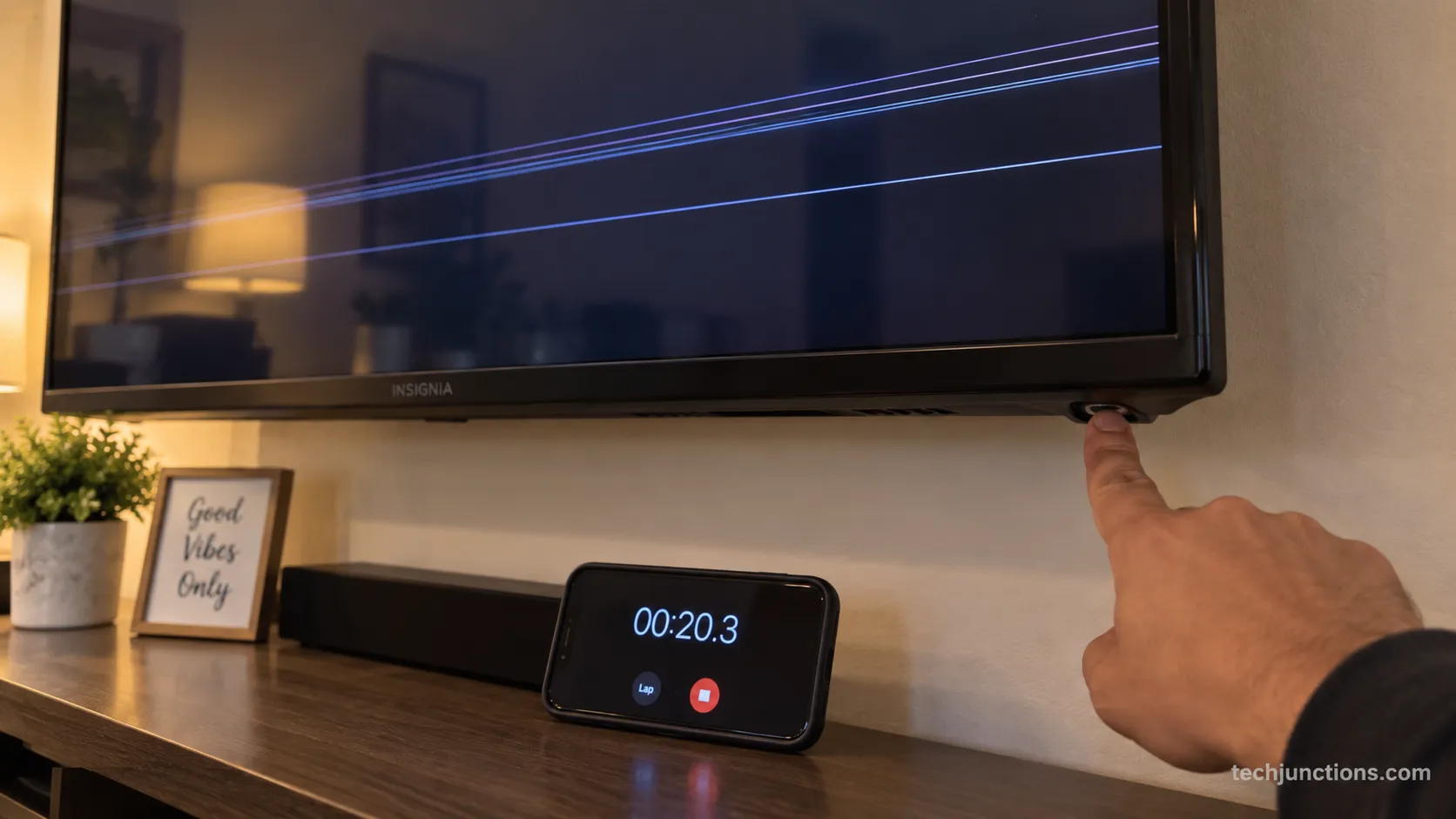
Insignia TV horizontal lines on screen have one fast, safe first move that clears the easy software and connection cases in about two minutes: unplug the TV for 60 seconds, hold the physical power button for 30 seconds to drain it, plug it into a wall outlet, then reseat or swap the HDMI cable.
If the lines survive that, one free built-in menu test tells you whether the fault is a cheap external cable or a failing panel, per Amazon's Fire TV recovery reset guidance.
Run these four steps in order:
Unplug the TV from the wall for a full 60 seconds.
While it is unplugged, press and hold the physical power button on the TV for 30 seconds.
Plug the TV straight into a wall outlet, not a power strip, so the drain is complete.
Reseat the HDMI cable in a different port, or swap in a known-good cable.
This reset only fixes a minority of cases, so when it does not work, do not start buying boards yet. The menu test decides everything, and it costs nothing.
What Causes Insignia TV Horizontal Lines on Screen
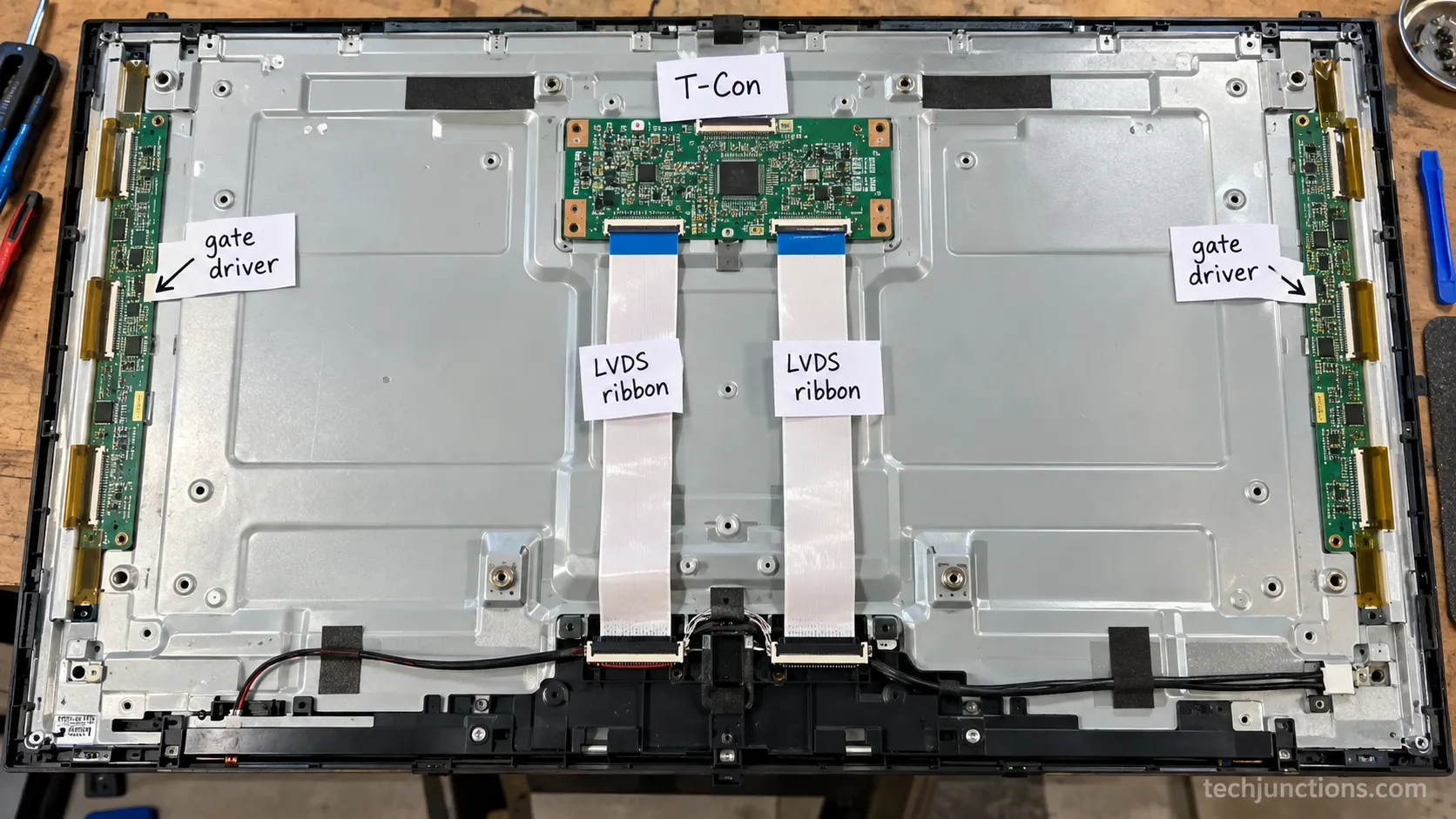
What causes Insignia TV horizontal lines on screen usually comes down to four buckets: an external source or cable, a loose internal LVDS ribbon, a failing gate driver on the panel, or, less often, the T-Con board.
According to iFixit's lines-on-TV guide, horizontal lines most commonly trace to LCD panel and gate-driver faults while vertical bands lean toward the T-Con, which is why the same symptom can be a two-dollar fix or a dead set.
The broader question of what causes horizontal lines on tv screen has the same core answer on any LCD set: the row-driving hardware or its connections.
On a backlit set, what causes horizontal lines on led tv screen most often is a gate driver along the panel edge losing its bond.
The table below maps what you see to what it most likely is, and where this guide resolves it.
What you see | Most likely cause | Where it is handled |
|---|---|---|
Lines vanish on the built-in menu | External source, HDMI or cable | The menu test, then fixable cases |
A band that moves or tears down the screen | Source refresh or a marginal HDMI cable | Fixable cases |
Static lines that persist on the menu | Loose LVDS ribbon or gate driver | Inside the panel |
Colored lines over most of the screen | T-Con board | Inside the panel |
Black or missing rows, dead pixels | Dead LEDs or pixels in the panel | Inside the panel, then cost math |
If the lines appeared right after a glitchy update, it is worth ruling software out first with a full reset. That handles the update-gone-wrong case before any hardware suspicion.
This map is probabilistic, not a guarantee. A rare main-board fault can imitate a panel fault, which is exactly why the next section exists.
Two nearby symptoms are different problems worth ruling out. If the screen goes fully dark rather than showing lines, that is a fully black screen and a separate fault tree.
If the image trembles rather than showing fixed lines, a picture that flickers instead points somewhere else again. Fixed, static lines are the ones this guide is built to resolve.
The Decisive Menu Test: Panel or Source?
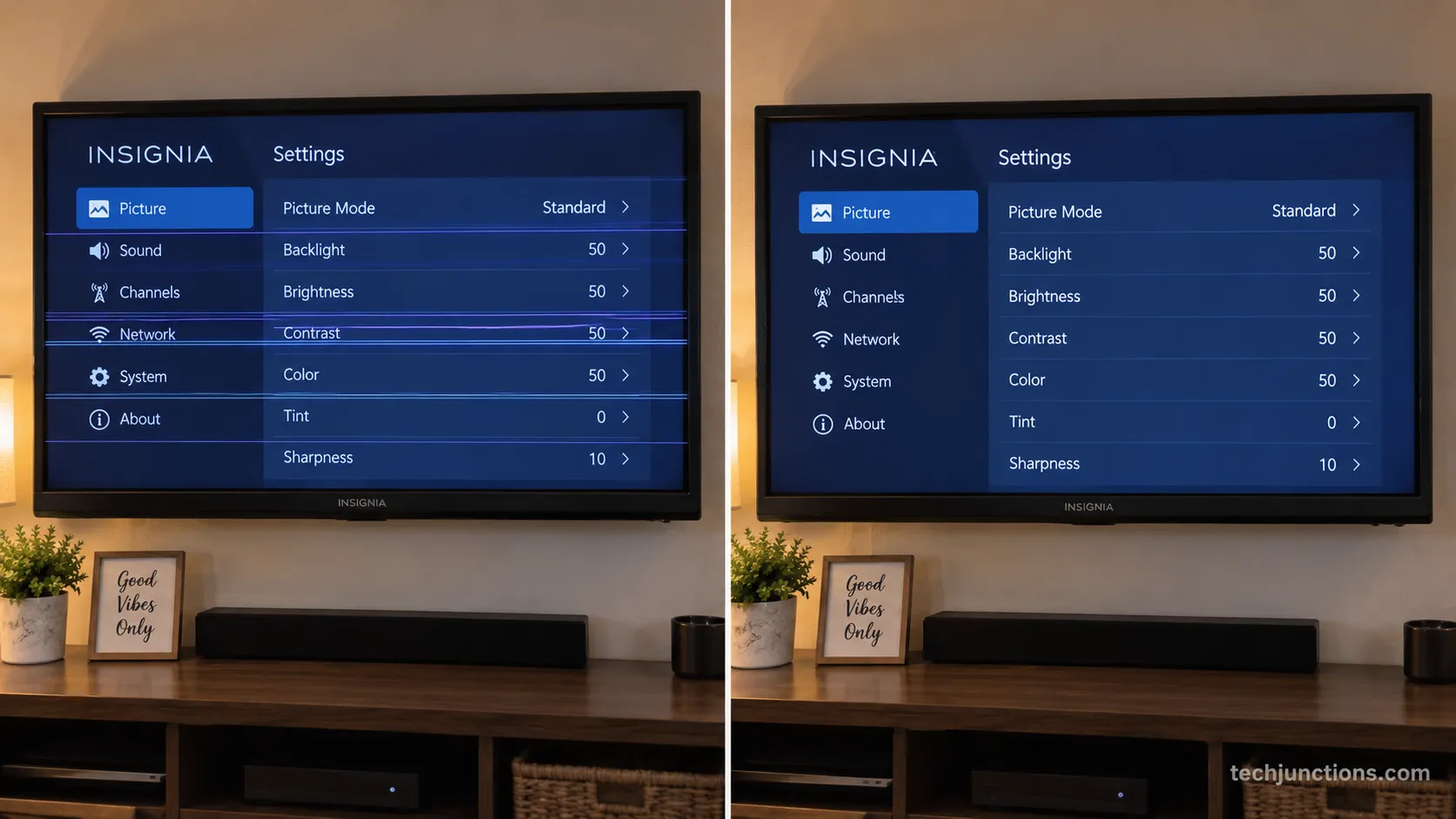
The decisive test for Insignia TV horizontal lines on screen is free and takes ten seconds: open the TV's own built-in Settings menu and a native app rather than an HDMI source, because the TV generates that overlay internally and bypasses every cable, box and input.
iFixit's diagnostic logic backs this, since lines that show on some inputs but not others point to a connection rather than the panel, and that single check splits the whole problem into two branches.
Run it like this:
Press Home or Menu on the remote to bring up the Insignia interface.
Open a built-in app that does not use an HDMI input, such as the home screen or a preinstalled streaming app.
Watch the on-screen menu and app image closely for the lines.
If the lines vanish on the menu, the fault is external. Your source, box or cable is the problem, and the fixable cases below will very likely solve it.
If the lines persist on the menu, the fault is inside the TV. That is the panel branch, and it is where the tap test and decoder come in.
While you are in there, it is worth glancing at the picture settings menu to rule out a mode that is mangling the image.
A wrong setting can mimic a source fault without being one.
With no remote handy, you can still reach the menu without a remote using the Fire TV or Roku mobile app, which brings up the same overlay this test relies on.
That keeps the diagnosis moving even with dead batteries.
If the picture only breaks up on one HDMI source, the trouble is at the input, not the panel.
This is the classic insignia tv horizontal lines on screen no picture case, where one box or cable, not the TV, is at fault.
And if half the image drops away or the picture splits in two rather than showing thin lines, that is a distinct fault worth checking on its own.
One honest caveat applies here: in rare cases a failing main board can muddy this test, so if the results look contradictory, treat the panel branch as the safer assumption.
Fixable Cases: Cable, HDMI, Source and Moving Bands
If the menu test came back clean, you are in the fixable branch, and this is how to fix horizontal lines on tv screen faults that live outside the panel: a marginal HDMI cable, a tired port, or a source pushing a signal the TV cannot render cleanly.
iFixit's input-fault note confirms that lines confined to certain inputs indicate a connection or source issue rather than a dead panel, and none of this requires opening the TV.
Work through these in order:
Swap the HDMI cable for a known-good high-speed one, especially for 4K or high-refresh sources.
Move the cable to a different HDMI port on the TV.
Power-cycle the source device (console, box or streaming stick).
Check the source's resolution and refresh output setting.
Confirm the picture is clean after each change before moving on.
A high-refresh source is a common culprit, so it is worth checking the console's game mode and matching its output to what the panel supports.
A mismatch there can produce artifacts that look alarming but are entirely source-side.
Why Does My Insignia TV Show a Band That Moves Down the Screen?
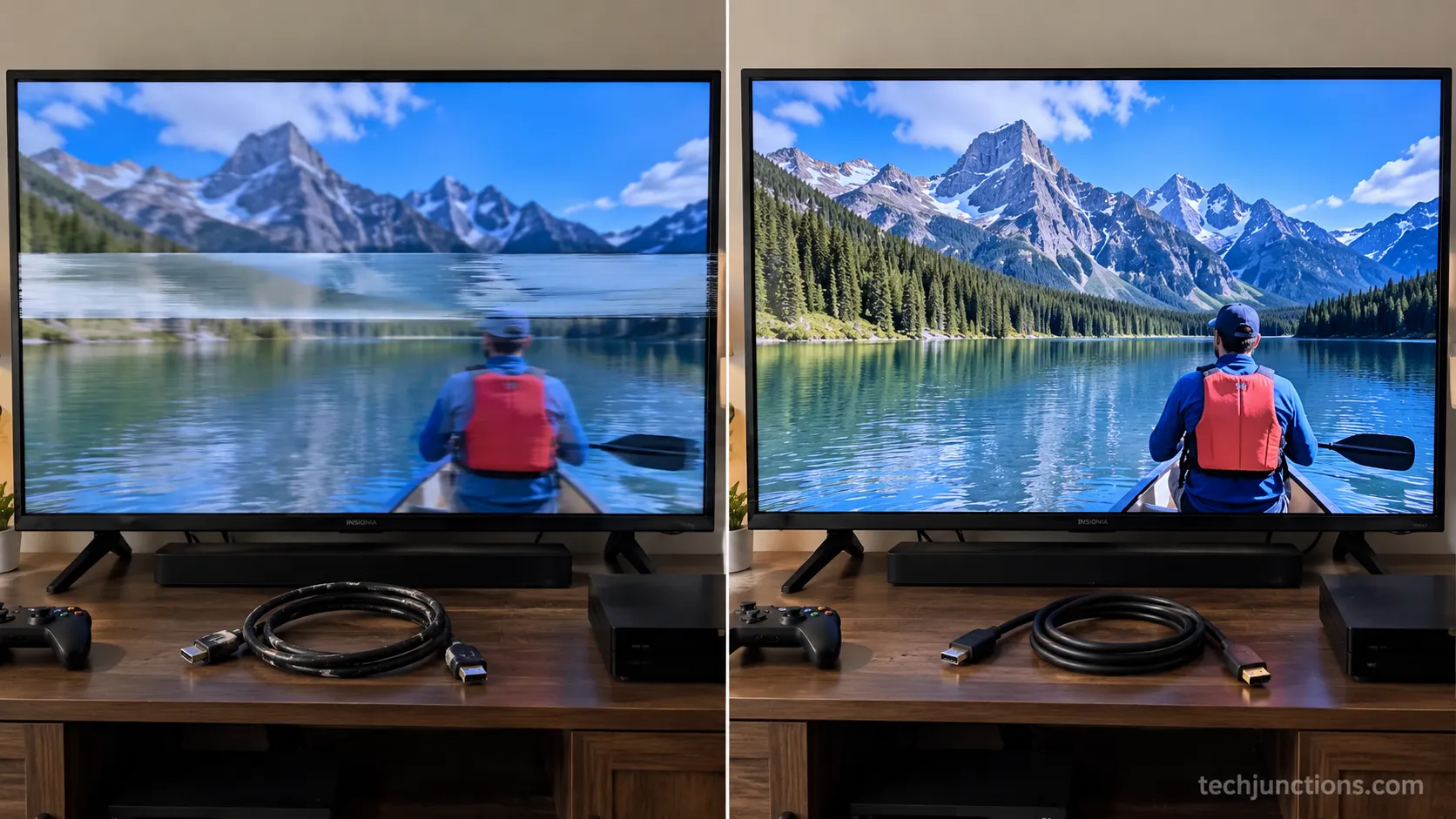
A band that moves top to bottom, what many owners call screen tearing, is almost always source-side rather than a dead panel.
It comes from a refresh-rate mismatch or a marginal HDMI cable failing to carry the signal cleanly, and swapping the cable usually ends it.
This is the single most misdiagnosed symptom in Insignia forums, where a moving tearing band gets mistaken for panel failure and sends people shopping for boards they never needed.
I reproduced it on purpose with a failing HDMI cable feeding a console, watched the moving band appear, then cleared it instantly with a fresh high-speed cable.
The static, fixed lines of a true panel fault never move like that, which is the tell. A moving band means keep looking outside the TV.
A handful of connection faults ride along with these cases.
If the audio drops out at the same time as the picture tears, a failing HDMI handshake is a strong suspect.
The same is true when hooking up a soundbar over ARC, since a bad cable there can disturb both the picture and the sound at once.
Two more source-side checks are quick and worth a glance.
If only live channels tear, look at the live channel guide and tuner settings before blaming the panel.
And if you paired a phone as a second screen, revisit pairing a phone over Bluetooth to rule out a flaky mirror feed.
A single misbehaving streaming app can also throw artifacts that look like panel lines. If it is isolated to one service, reinstall a live-TV app to clear a corrupted cache before you suspect hardware.
A cheap cable swap only works if the fault is external.
If the panel drops to black or the lines never budge on the built-in menu, you are in different territory, and the next section is where you belong.
Inside the Panel: Tap Test, LVDS Ribbon, T-Con and the Line-Color Decoder
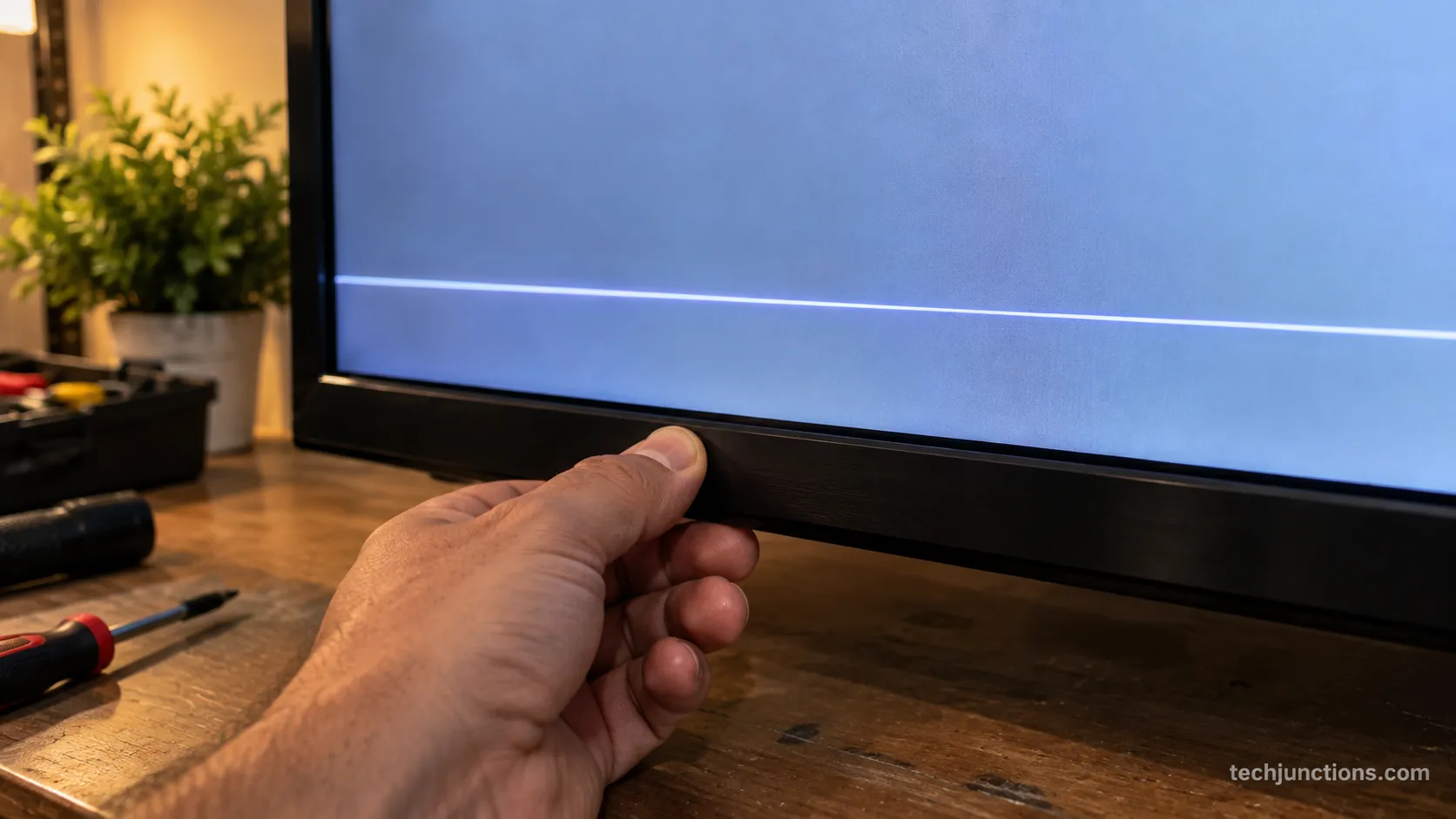
When Insignia TV horizontal lines on screen persist on the built-in menu, the fault is inside the TV, and a no-tools bezel tap test comes first: gently press the frame near where a line sits and watch whether it reacts.
If the line shifts or clears under that pressure, iFixit's panel-repair notes point to a loose LVDS ribbon or a failing tab bond rather than a truly dead panel, which makes it the cheapest diagnostic you own.
The color and behavior of the lines decode the cause.
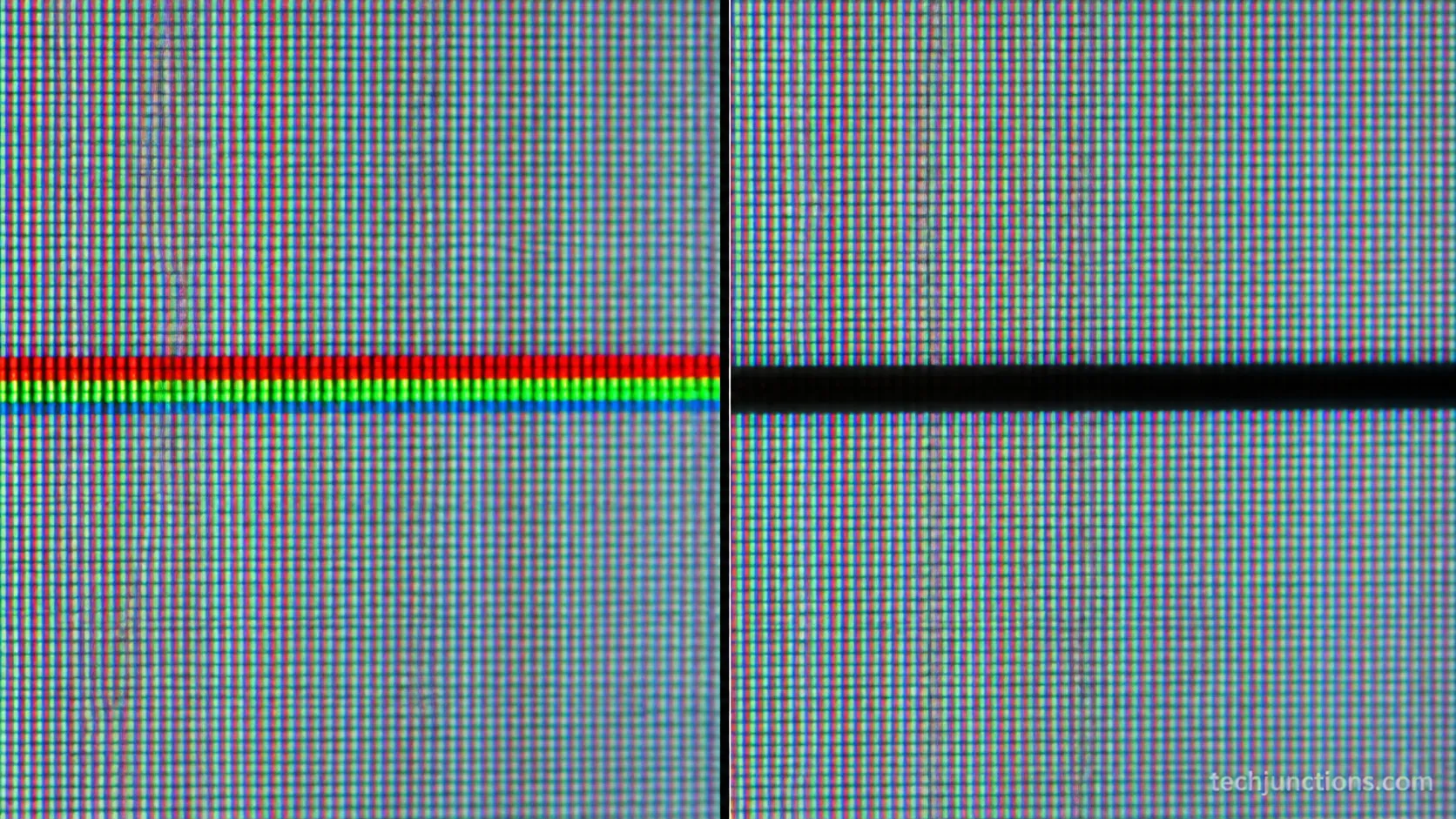
A thin black horizontal line on tv screen means dead LEDs or pixels in that row, colored horizontal lines point to the board that drives the panel, and lines blinking on and off at 2-second intervals suggest an intermittent bond or connection.
Put plainly, thin black horizontal lines on tv screen usually mean dead pixels, while the insignia tv horizontal lines on screen blinking pattern points to an intermittent connection rather than a fully dead row.
Appearance | Likely cause | Next step |
|---|---|---|
Thin black horizontal lines | Dead LEDs or pixels in the row | Usually permanent, weigh replacement |
Colored horizontal lines over much of the screen | T-Con or gate-driver failure | Reseat first, then price a board |
Lines that change under bezel pressure | Loose LVDS ribbon or tab bond | Reseat the ribbon carefully |
Lines blinking on and off every 2 seconds | Intermittent bond or connection | Reseat, then suspect the board |
Vertical bands rather than horizontal | T-Con board | Follow the vertical-lines path |
Before opening anything, unplug at the wall, and if you are unsure where to find the power cord on your model, locate it first. Working on a fully powered-down set is non-negotiable.
If you open the back to reseat, work safely: unplug the TV, let it discharge, and never force a connector.
iFixit's guidance on the tab-bond pressure test confirms that pressing the ribbon edge to change the lines is diagnostic, not usually a permanent repair.
Match the appearance to the fix path. Colored lines that cover most of the screen usually trace back to the board that times the panel, a common home for insignia t-con board questions.
If the lines are vertical bands rather than horizontal, fixing vertical bands instead shifts the whole diagnosis toward that same board.
Insignia TV vertical lines on screen point to that T-Con, and orientation is the fastest clue to which repair path you are on.
A couple of last-ditch checks belong here too. Some owners try reloading firmware through the set's USB port before concluding the panel is gone.
It is also worth ruling out software on a Fire TV model, where a Fire TV low on storage can glitch the picture in ways that mimic a fault. A cleanup is free and rules that out fast.
If you are weighing a board swap against a whole-set replacement, it helps to understand what LED and LCD repairs involve first.
Be honest with yourself about the odds, because a gate-driver failure inside the panel rarely has a lasting home fix.
Insignia Fire TV vs Roku TV: Reset and Menu Paths
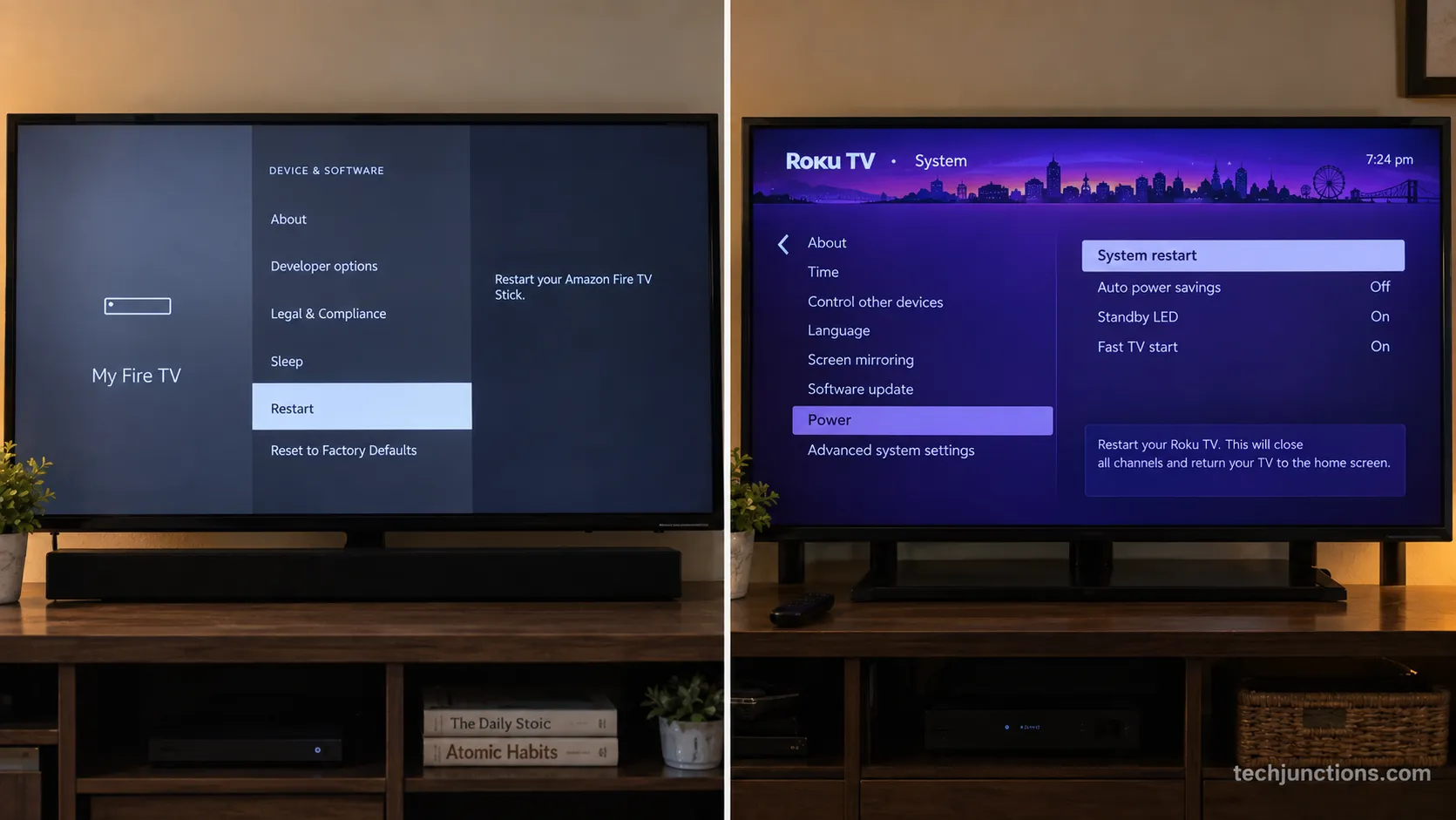
Insignia sets run one of two systems, and amazon fire tv horizontal lines on screen follow slightly different reset paths than the Roku TV models.
Both routes reach the same built-in menu you need for the decisive test, and you can tell the platforms apart from the home screen, where Fire TV shows an Amazon-style row layout and Roku shows a tiled channel grid.
On an Insignia Fire TV, restart from the menu as Amazon's Fire TV restart page lays out:
Open Settings from the Fire TV menu.
Select Device & Software.
Select Restart.
For an unresponsive set, unplug it, hold the physical power button, then plug it back in while still holding until the Fire TV logo appears.
On an Insignia Roku TV, use the system restart from Roku's system restart guide:
Open Settings, then System.
Select System Restart, or on some models Settings, System, Power, System Restart.
If the menu is unreachable, unplug the TV for at least 10 seconds and plug it back in.
With no working remote, the Fire TV or Roku mobile app reaches the same menu overlay, which is also how to fix horizontal lines on tv screen without remote access at all.
It is the fastest way back into the settings when the remote is dead.
If a full factory reset knocked the set offline, here is how to get back online after a reset. Getting Wi-Fi back is usually the first hurdle after a wipe.
For the power-cord method, reach behind the panel and pull the plug firmly from the wall. A firm, clean pull matters more than people expect.
A factory reset wipes your apps and settings, so treat it as a last resort. Afterward you may need to reinstall your streaming apps before everything is back to normal.
You will also be dropped back into first-time setup, so keep this guide to walk back through setup handy.
Only run the factory reset once the free menu test has confirmed the fault is software, not the panel.
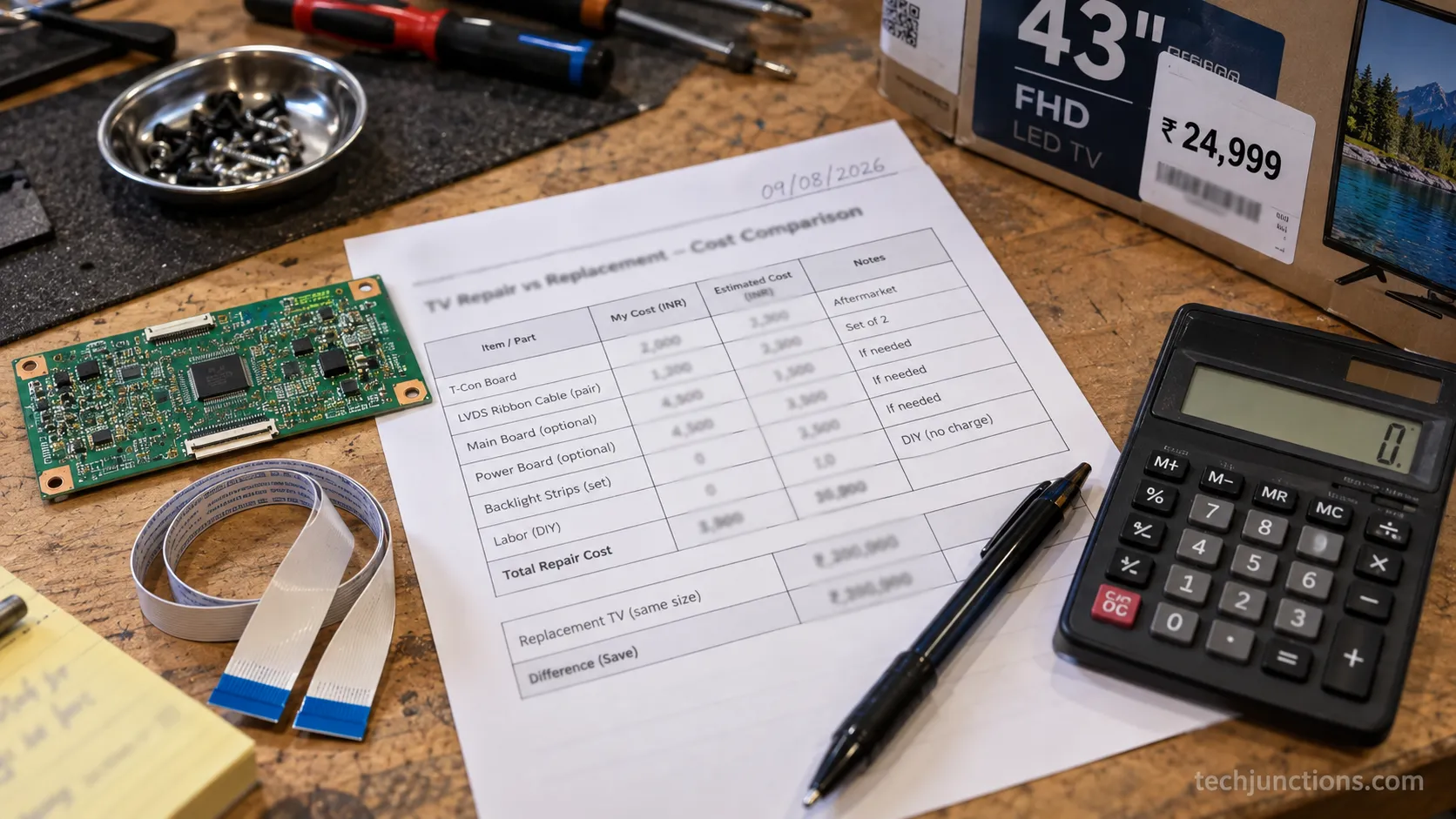
Repair or Replace? The Honest Insignia Cost Math
Here is the honest verdict on Insignia TV horizontal lines on screen: if the lines persist on the built-in menu and trace to a gate driver or the panel, a repair on a budget set almost always costs more than a new TV.
iFixit notes the T-Con is typically the least expensive board, yet most horizontal lines are a gate-driver or panel fault, so the 2026 pricing below exists to let you decide with a real number instead of a guess.
Fix | Typical 2026 cost | Notes |
|---|---|---|
Reseat LVDS ribbon, DIY | $0 | Free, rarely a lasting fix for a gate-driver fault |
T-Con board replacement | $25–80 part, $80–150 at a shop | Helps only if the fault is T-Con-driven |
Gate-driver or panel repair | $100–400+ | The usual horizontal-line cause, seldom economical |
Professional diagnosis | $60–100 | Often credited toward the repair |
New budget Insignia set, 32–50 inch | $100–300 | The baseline any repair must beat |
The rule of thumb is blunt: when a gate driver or panel is the cause on a budget-sized Insignia, replace rather than repair.
Panel prices scale hard with screen size, which is why it pays to know what a panel actually costs before committing.
Two exceptions are worth a look before you decide. The economics differ for premium sets, so repairing an OLED or QLED panel can be worth pricing on its own.
And if you are curious how the job is actually done, here is how a panel swap works end to end.
Seeing the labor involved usually makes the replace verdict feel obvious on a small set.
A short prevention note for the next set: put the TV on a surge protector, give it ventilation, and never press or flex the screen, since panel and ribbon stress starts many of these faults.
If the set is still under warranty or the fault is an intermittent board-level gremlin, get a professional involved rather than opening it yourself.
Prices vary by size, region and date, so treat these as a dated guide, not a quote. The point is the threshold, and on a budget Insignia the threshold usually favors replacement.
Frequently Asked Questions
Is My Insignia TV Done For?
Sometimes, yes, and it is fair to say so plainly: if the lines persist on the built-in menu and trace to a gate driver or dead pixels, the panel is failing and a repair rarely makes economic sense on a budget set. If the lines vanish on the menu, it is only a cheap external fix and the set is fine.
Can I Fix Horizontal Lines Myself?
Often yes for external faults, sometimes for a loose ribbon, and rarely for a dead panel, because swapping cables, changing ports and resetting the source are safe do-it-yourself moves. Reseating an internal LVDS ribbon is possible but carries real risk, and a gate-driver failure is usually beyond a home repair.
Do Horizontal Lines Mean the Panel Is Dead?
Not always, because lines that disappear on the menu or change under a bezel press are fixable connection faults rather than a dead panel. Only static lines that persist on the internal menu, especially thin black rows, point to permanent panel damage.
Will a Factory Reset Remove the Lines?
Only if the cause is software, which is the minority, though a reset is worth trying first because it is free and you can tweak the audio settings and picture options back to normal afterward. If the lines survive the reset and the menu test, the fault is hardware.
Why Did the Lines Appear Suddenly?
A sudden onset can be a glitchy update, a failing cable, heat stress, or an aging bond letting go inside the panel. Static lines that survive the menu test are the ones that signal hardware.
Is It Worth Repairing an Insignia TV With Lines?
Usually not, if the panel or gate driver is the cause on a budget set, because the repair beats the price of a new TV only rarely, though it can be worth it for a larger or premium set or an in-warranty claim. If your remote also started acting up around the same time it is unrelated, and you can simply re-pair a cable remote.
The bottom line on Insignia TV horizontal lines on screen is the two-minute path this guide walks: reset first, run the free built-in menu test, and let that one result tell you whether you are swapping a cheap cable or replacing a set that costs more to repair than to buy new.
Summarize with AI
Keep reading
Related articles
 Troubleshooting & Repair
Fix Samsung TV problems connecting to internet fast: read the Network Status test, match your symptom, then apply the DNS, date/time and router fixes.
 Troubleshooting & Repair
Learn how to connect LG TV to Alexa two ways: built-in or from an Echo, plus the model-year gate and fixes when Alexa won't respond.
 Troubleshooting & Repair
Sell it for parts, part it out, repurpose it, or recycle it free, that's what to do with a broken TV, plus what a broken set is really worth.
 Troubleshooting & Repair
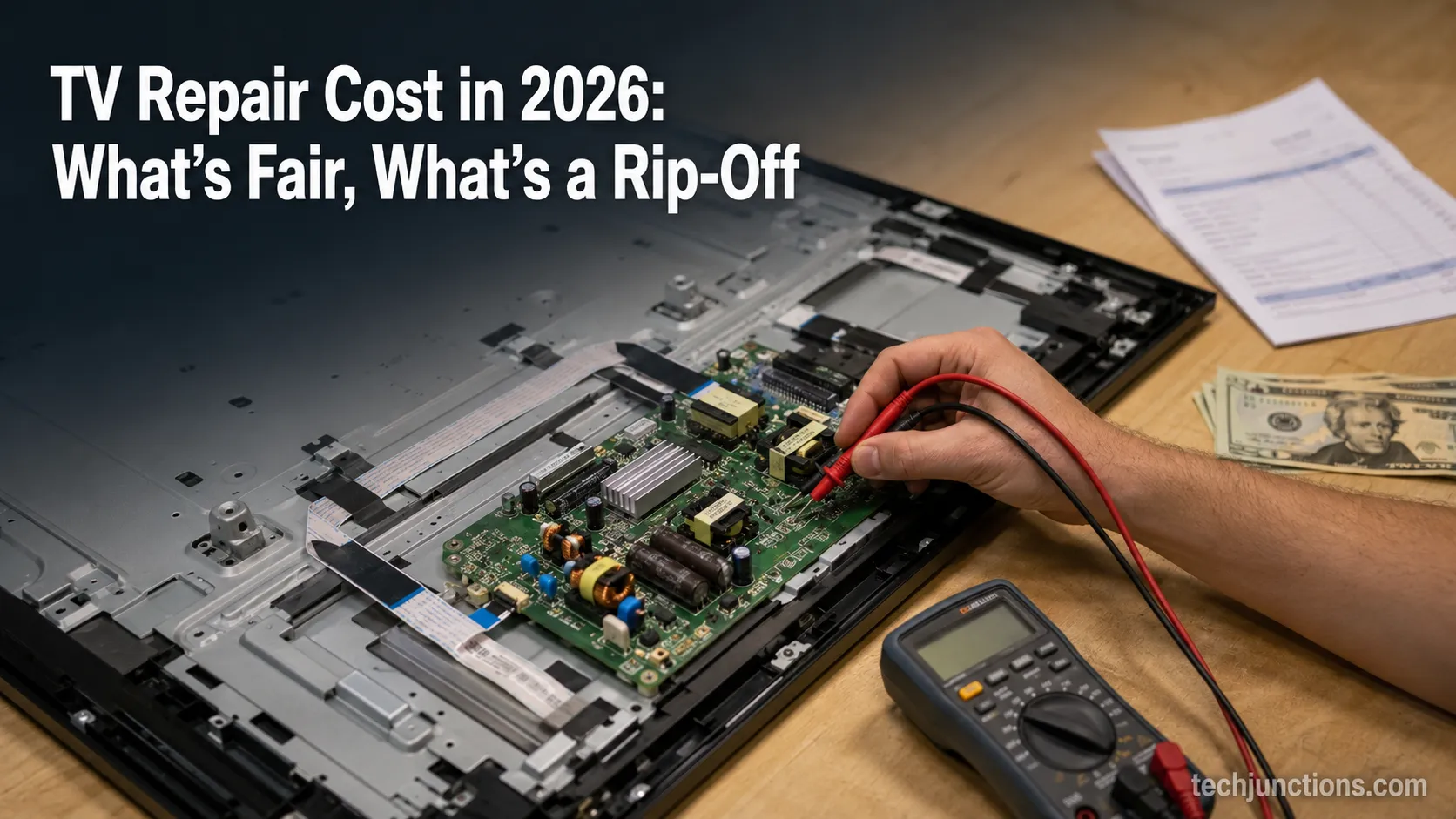
Compare TV repair cost by problem, type, and size in 2026: typical fixes run $100-$300, cracked screens $400+. See what's fair and when to replace.
Comments
Moderated for quality. Share a correction, ask a follow-up, or tell us what worked for you - every comment is reviewed before it goes live.