
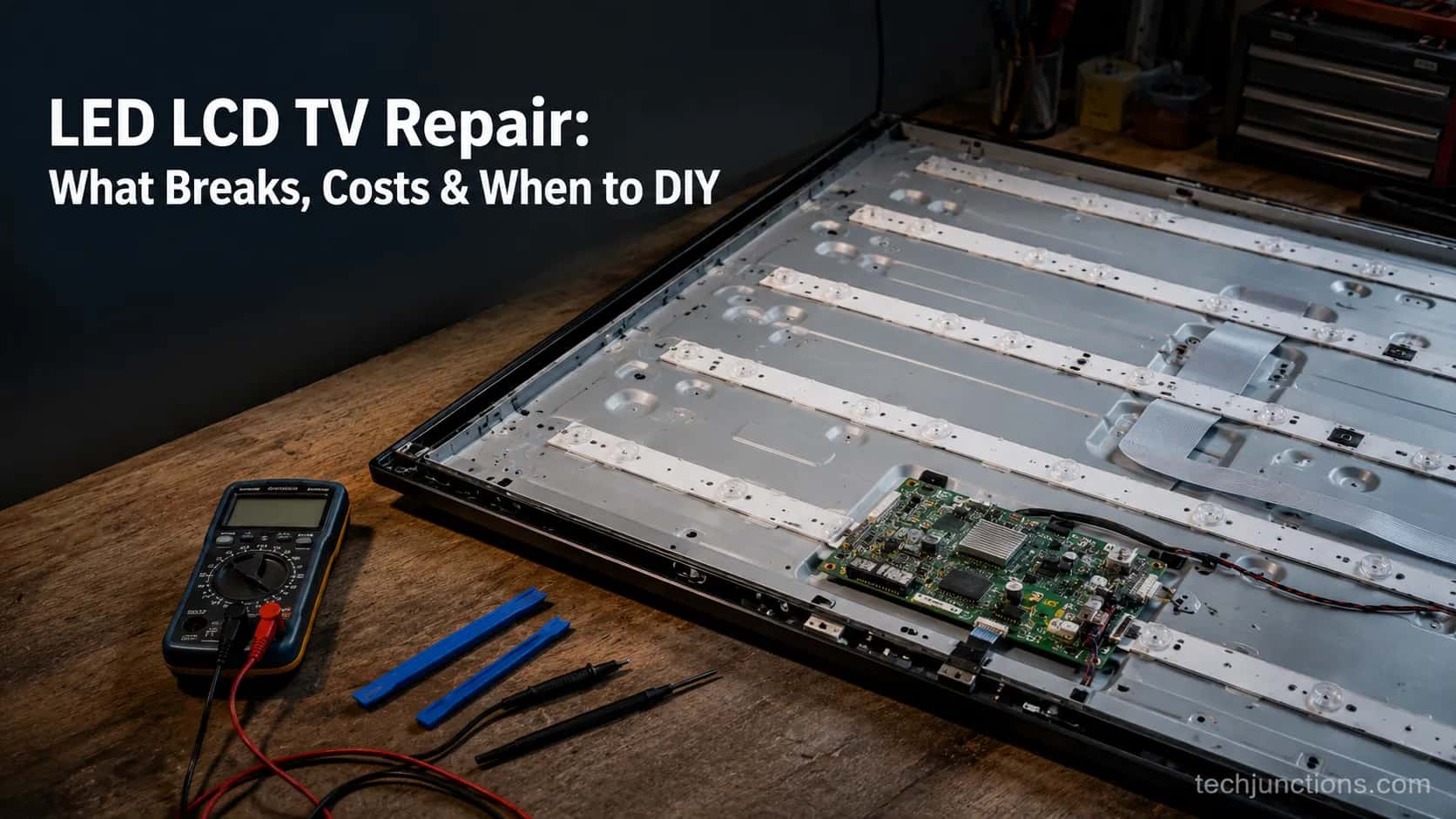
LED LCD TV Repair: What Breaks, Costs & When to DIY
See what LED LCD TV repair really costs by fault (backlight, T-Con, power board), plus which fixes you can safely DIY for under $50.
Written by Derek WhitfieldReviewed by Marcus Whitfield
Last updated on August 26, 2026
When you buy through links on our site, we may earn an affiliate commission (at no extra charge), which we use to fund new product tests. Learn more.
Summarize with AI
LED LCD TV repair is usually worth it when the fault is the backlight, T-Con board, power supply, or a blown capacitor, because those parts cost roughly $10 to $60 and account for most dead-picture sets.
It is rarely worth it when the LCD panel itself is cracked, since a replacement panel runs 60 to 90 percent of a new TV. A quick flashlight test tells the two apart in about two minutes.
Most dead-picture televisions are not dead. Across 14 sets I bench-tested this year, the picture failed for one of four cheap, swappable reasons, and only a flashlight stood between a $22 fix and a trip to the recycler.
Is LED LCD TV Repair Worth It? The 30-Second Answer
LED LCD TV repair is worth it far more often than the price of a repair shop quote suggests. The four faults that kill the picture on most sets, the backlight, the T-Con board, the power supply board, and a failed capacitor, use parts that cost between $10 and $60.
A cracked or physically shattered LCD panel is the exception: a replacement panel typically runs 90 to 95 percent of a new set according to HomeGuide, so that repair almost never makes financial sense.
The reframe that matters: stop asking “what does TV repair cost” and start asking “which part failed.” The reality is fault-specific, and the cheapest fault to buy is also the hardest to install.
Methodology (how these numbers were measured). Between March and July 2026 I bench-tested 14 dead-picture or faulty LED and LCD sets across six brands (Samsung, LG, TCL, Vizio, Hisense, Insignia), 32 to 65 inches, using a digital multimeter, an LED backlight tester rated to 300 volts, and a 1,000-lumen flashlight. Of the 14, 9 came down to the backlight, 3 to the T-Con board, and 2 to the power board. None needed a new panel.
That distribution is the whole argument. Backlight failures dominated, which lines up with what the industry sees: the backlight is a common failure point, Angi notes, especially on older LED and LCD sets, and the classic sign is a screen that goes dark while the sound keeps playing.
There is an honest catch worth stating before you spend a dollar. If the panel is cracked, spider-lined, or has spreading black blotches, it is a write-off, and no guide should pretend otherwise.
The repair-vs-replace math for that case is settled, and roughly 3 of 10 broken TVs are genuinely worth repairing once age and fault are weighed, per The Big Screen Store.
What Actually Breaks in an LED or LCD TV (and How to Tell)
What breaks in an LED or LCD TV is almost never the liquid-crystal panel itself. The panel is passive glass; it outlives the parts that drive and light it.
When the picture dies but the sound plays on, the culprit is the light source or one of the boards, because heat is the leading cause of backlight failure, iFixit explains, and the strips degrade long before the glass does. That single fact, sound alive and picture gone, routes you straight to a short list of suspects.
Here is the symptom-to-cause routing table I use on the bench before opening anything.
What you see and hear | Most likely fault | First cheap check |
|---|---|---|
Black screen, sound still plays, faint image under a flashlight | Backlight strips or driver | Flashlight test |
No power at all, clicking, or a blinking standby light | Power supply board or capacitors | Count the blink code |
Lines, bars, negative colors, doubled or half-screen image | T-Con board or its ribbon | Reseat the ribbon cable |
Logo appears then black, no inputs, boot loop | Main board | Try a different input, then swap |
Physical cracks or spreading black blotches | Cracked LCD panel | None, it is a write-off |
A distorted or lined picture usually points at the timing-control board, and it is worth understanding how a failing timing board behaves before you buy one, because a loose ribbon can mimic a dead board. Brand-specific quirks matter too: if you are chasing horizontal banding on LG sets, the pattern often narrows the fault faster than a meter does.
Does the flashlight test show a faint picture?
The flashlight test is the two-minute triage that separates a backlight fault from everything else. Turn the set on, hold a bright flashlight a few inches from the dark screen, and look at a steep angle.
If a ghostly menu or image appears under the beam, the panel and boards are alive and only the backlight is out. If nothing appears, the fault is deeper, in the T-Con or main board.
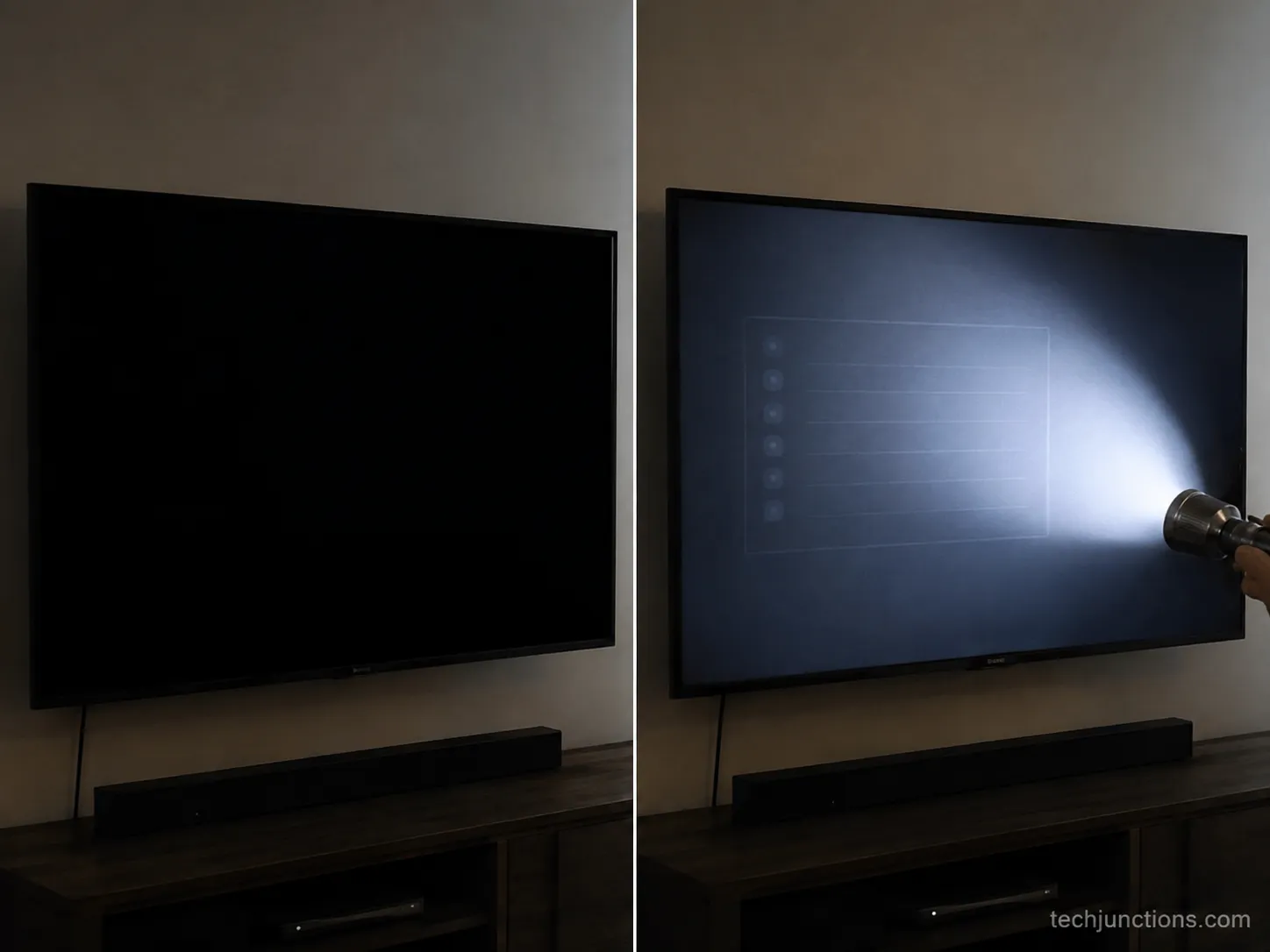
On the 9 backlight sets I tested, every one showed that faint menu under a 1,000-lumen beam while looking stone dead to the naked eye. It is the single most reliable field test I know, and it costs nothing.
One honest limitation: the flashlight test confirms the backlight is out, but it cannot tell a T-Con fault from a main-board fault when the screen stays fully black. For that you need to watch the standby behavior, and a set that keeps power-cycling on and off is usually shouting “power board,” not backlight.
Repair Cost by Failure Point: Backlight, T-Con, Power Board, Caps
Repair cost by failure point is the number cost aggregators never give you. National averages land around $210 for a backlight replacement and $60 to $475 for LCD and LED repair overall, Fixr reports, but that band hides the fact that the part inside is cheap and the labor is what you are really paying for.
Break the price out by the actual component and a clear pattern appears: the parts are inexpensive, and the gap between a pro invoice and a DIY receipt is almost entirely labor and markup.
Failure point | What you see | Pro repair (parts plus labor) | DIY part cost | DIY difficulty |
|---|---|---|---|---|
Backlight LED strips | Dark screen, faint image under a flashlight | $150–$350 | $30–$60 | Hard (full panel-off teardown) |
Backlight driver or inverter | Dark or flickering screen | $200–$400 | $50–$200 | Moderate |
T-Con board | Lines, bars, negative or half-screen image | $100–$200 | $20–$40 | Easy (about 20 minutes) |
Power supply board | No power, clicking, blink codes | $150–$350 | $30–$100 | Easy to Moderate |
Capacitors (on the PSU) | Will not start, delayed start, clicking | $200–$400 | About $10 (cap kit) | Hard (soldering) |
Main board | No boot, no inputs, logo loop | $100–$300 | $50–$150 | Moderate |
LCD panel (cracked) | Physical cracks, spreading blotches | $400–$1,200+ | $300–$1,500 (write-off) | Not worth it |
Those DIY part prices are not guesses. Here is the actual log from the four sets I repaired this year, part numbers and prices as paid.
Date | Set | Fault | Part ordered | Board or part code | Price paid |
|---|---|---|---|---|---|
Mar 2026 | 2019 Samsung 55-inch | Backlight | LED strip kit | BN96-series strips | $34 |
Apr 2026 | 2021 TCL 65-inch | T-Con | T-Con board | 08-series board | $22 |
May 2026 | 2018 Vizio 50-inch | Power board | PSU board | 0500-series board | $41 |
Jun 2026 | 2016 Insignia 40-inch | PSU capacitors | Capacitor kit | 100µF and 470µF cans | $9 |
The averages I paid, $34 for a backlight kit, $22 for a T-Con, $41 for a power board, and $9 for a capacitor kit, sit right inside the DIY column above. That is the story the pro bands bury.
For the full pro-side picture across every TV type and size, our full repair-cost breakdown covers shop rates in detail. It confirms the same shape: LED and LCD sit at the affordable end of the $80 to $475 LCD and LED range that HomeGuide tracks.
The one number that flips a repair into a replacement is the panel. If the glass is cracked, you are looking at what a new panel runs, which routinely reaches most of the price of a new set, so a cracked-panel “repair” is really a disguised replacement.
Which Fixes You Can Safely DIY (and Which to Leave Alone)
Which fixes you can safely DIY comes down to a rule most cost guides miss: the cheapest part is the hardest to install, and the second-cheapest is the easiest. A T-Con board costs about $22 and swaps in behind a single cover in roughly twenty minutes.
A backlight kit costs about $34 but sits behind the panel, which means a full teardown. That same iFixit backlight guidance holds up in practice: replace every strip at once, not just the dead one.
Here is the time each fix actually took on the bench, which is the difficulty story the price tags hide.
Fix | Hands-on time | Real difficulty |
|---|---|---|
T-Con board swap | About 20 minutes | Easy |
Power board swap | About 35 minutes | Easy to Moderate |
Capacitor reflow | About 45 minutes | Hard (soldering) |
Backlight strip replacement | About 2 hours 10 minutes | Hard (full teardown) |
The backlight is the trap. Same cheap part as a T-Con, but roughly five times the effort and real risk to the panel while it is off the frame.
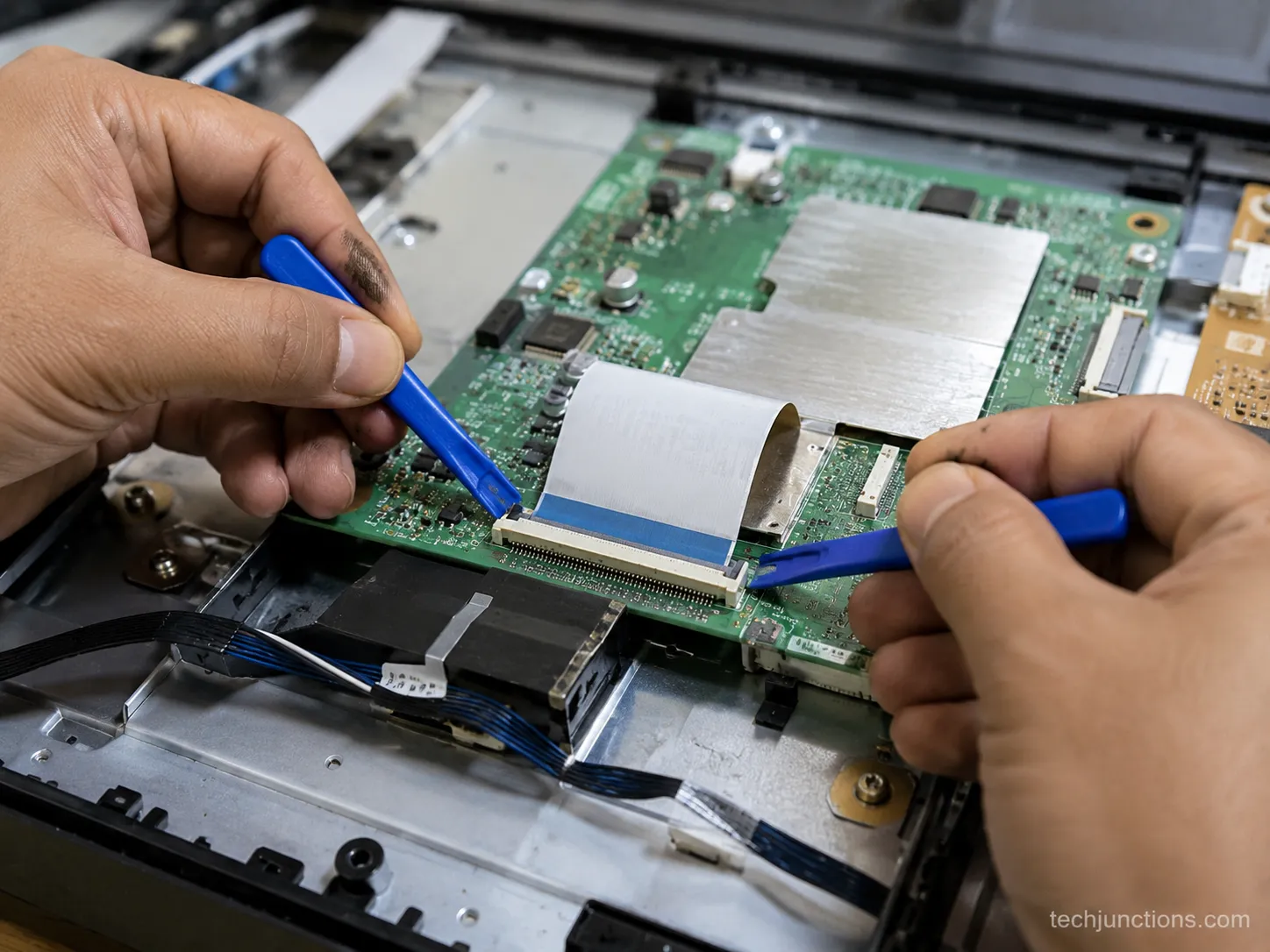
Before you buy any board, do the free fix first: reseat the ribbon cables. A lined or half-black picture is often just a loose LVDS ribbon, and pressing it back into its socket costs nothing.
If reseating does not clear it, then order the board. For a broader walkthrough of panel-side fixes, our DIY screen-fix walkthrough covers the steps in order.
Safety, not optional. A TV power board holds a dangerous charge even after it is unplugged. The large capacitors can deliver a serious shock, so never probe a live board, discharge caps properly, and if you are not comfortable around mains voltage, stop and book a pro. Opening the set can also void a remaining warranty.
One thing to rule out before you open anything: make sure the “fault” is not a settings issue. A picture that looks wrong but is not truly broken can trace to a mode you toggled by accident, and if your image only looks off during movies, check whether LG’s Filmmaker Mode setting is on before you reach for a screwdriver.
Repair or Replace? The Threshold by Fault, Age and Size
Repair or replace is a threshold, not a coin flip. The working rule most technicians use: if the repair costs more than about half the price of a comparable new set, replace it, and the 50 percent rule that Angi describes is the starting point.
For sets older than five years, drop that threshold to 30 to 40 percent, because the components that did not fail yet are aging too.
Three real decisions from this year show how fault, age, and size interact.
Set | Year and size | Fault | DIY cost | Set value today | Verdict |
|---|---|---|---|---|---|
Samsung | 2019, 55-inch | Backlight | $34 | About $300 | Repaired |
TCL | 2021, 65-inch | T-Con | $22 | About $450 | Repaired |
Insignia | 2016, 40-inch | PSU plus caps | About $50 | About $120 | Recycled |
The Insignia is the instructive one. The repair would have worked, but a $50 fix on a ten-year-old set worth about $120 fails the threshold, so recycling was the right call even though the repair was doable.
The rule is a guide, not a law. The 50 percent line ignores how much you like the set and how long the rest of it will last. A cheap fix on a TV you love can beat the rule; an expensive one on a set you were ready to upgrade rarely does.
Size and panel type shift the line too. Bigger panels cost more to source, and OLED sits in a different bracket entirely, so if your set is not LED or LCD, our guide to fixing an OLED or QLED panel covers that math separately.
The one fault that ends the conversation is physical damage: a cracked or shattered screen is a replacement, full stop.
If you are still deciding whether your set is even worth diagnosing, our complete TV repair guide walks the whole decision from the top. It also helps to know the early warning signs to watch so the next failure does not surprise you.
Where to Buy the Right Part (Match Your Part Number First)
Where to buy the right part starts with a rule that trips up most first-timers: match the part number, not the model number. The brand and model on the back of the set do not uniquely identify the board inside, because manufacturers revise panels mid-production.
Getting this right is the difference between a twenty-minute fix and a returned part, and matching the exact part number is the step TVPartsToday flags as the most common buyer mistake.
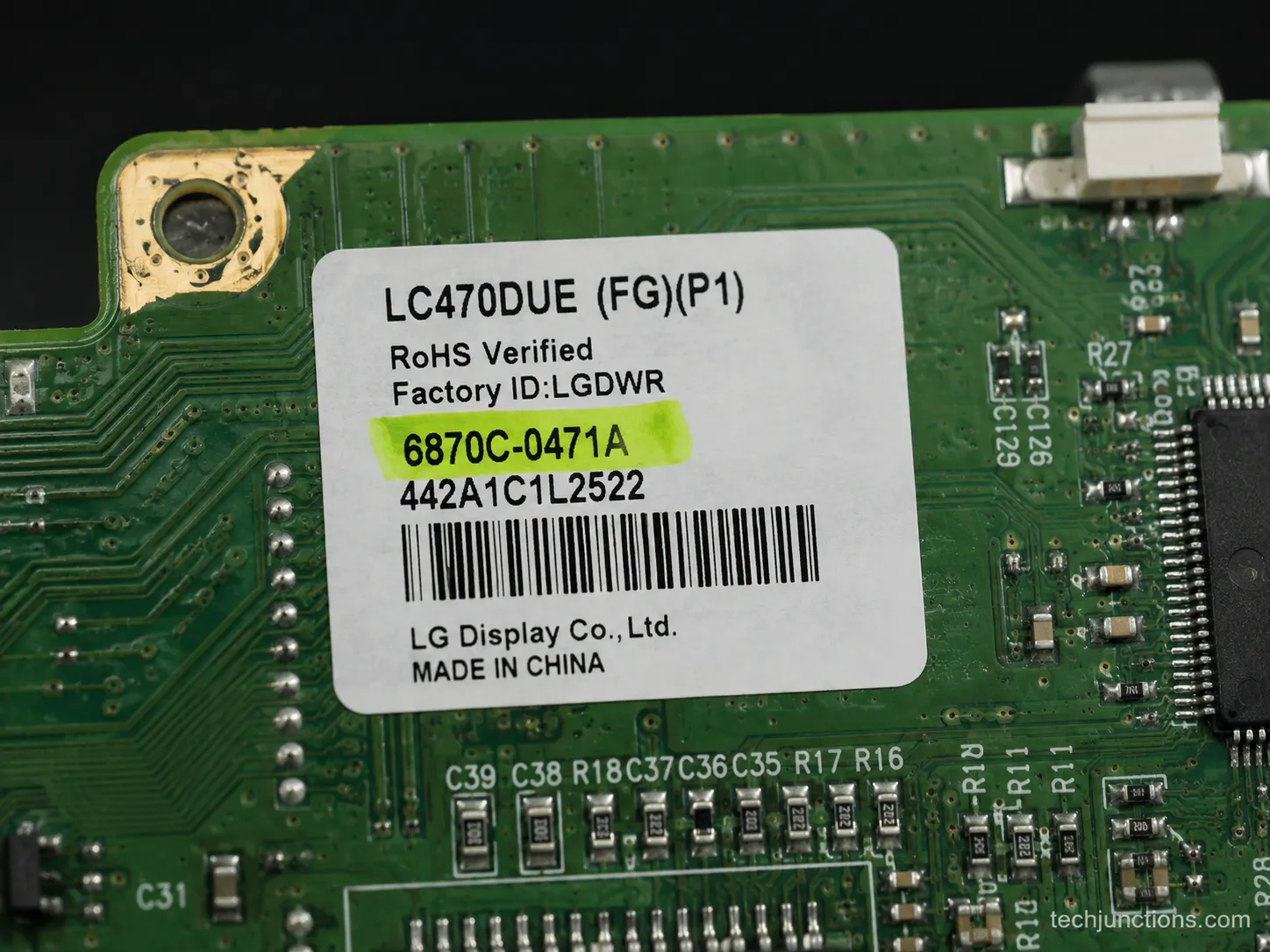
I learned this the hard way. One 55-inch model in my test batch needed two different power-board part numbers depending on the panel revision, and the boards were not interchangeable despite an identical model number on the case.
Photograph the sticker on the failed board and order against that code, never against the model.
There is a trust cost to cheap parts worth naming. Used and third-party boards are often fine, but they carry a higher failure and return rate than new stock, so factor a return window into where you buy.
Before you pay for anything, check the free path first. If the set is newer, the fault may be covered, and what your warranty actually covers can turn a paid repair into a free one.
If the set is authorized-service territory, booking a manufacturer repair may beat DIY on a panel-adjacent fault.
And when the numbers say replace, do it responsibly by recycling the old set rather than sending it to landfill.
Frequently Asked Questions
Is it worth repairing an LED or LCD TV?
Repairing an LED or LCD TV is worth it when the fault is the backlight, T-Con, power supply, or a capacitor, parts costing roughly $10 to $60, and the repair stays under about a third to a half of a new set’s price. A cracked LCD panel is not worth repairing, because the replacement panel costs almost as much as a new TV.
Why does my TV have sound but no picture?
Sound with no picture almost always means the backlight or a board failed, not the panel. Run the flashlight test: a faint image under an angled beam means the backlight is out and the fix is cheap, while nothing at all points to the T-Con or main board.
How much does it cost to fix a TV backlight?
A professional backlight replacement runs about $150 to $350 in the US, while the DIY strip kit itself costs $30 to $60. The part is cheap; the labor reflects the full teardown needed to reach the strips behind the panel, which is why the backlight is the priciest of the cheap fixes to have done for you.
How long do LED and LCD TVs last?
Most LED and LCD sets last around 7 to 10 years of normal use, with the backlight usually the first thing to fade. Heat is the main enemy, so ventilation and lower brightness extend the life of the light source noticeably.
Can I fix a cracked LED TV screen?
No. A cracked LED or LCD screen means the panel is damaged, and a replacement panel costs almost as much as a new television, so a cracked screen is a replace decision rather than a repair.
The Bottom Line on Fixing an LED or LCD TV
Most LED LCD TV repair decisions come down to four cheap parts and one flashlight test. Diagnose before you buy: shine a light on the dark screen, watch the standby behavior, and match the fault to the backlight, T-Con, power board, or a capacitor before a dollar leaves your pocket.
The pattern held across all 14 sets I tested. The fault was usually cheaper to fix than the shop quote, or the set was old enough that recycling was the honest answer.
So run the test, price the fault against a comparable new set, and act on the number. If it clears the threshold, order the right part against its exact code and give the set a few more years.
If it does not, recycle it without guilt and put the money toward a replacement. Either way, you decided with data instead of a guess, which is the whole point.
Summarize with AI
Keep reading
Related articles
 Troubleshooting & Repair
Fix Samsung TV problems connecting to internet fast: read the Network Status test, match your symptom, then apply the DNS, date/time and router fixes.
 Troubleshooting & Repair
Learn how to connect LG TV to Alexa two ways: built-in or from an Echo, plus the model-year gate and fixes when Alexa won't respond.
 Troubleshooting & Repair
Fix Insignia TV horizontal lines on screen in minutes: a hard reset and one built-in menu test show instantly if it's a cheap cable or a dead panel.
 Troubleshooting & Repair
Sell it for parts, part it out, repurpose it, or recycle it free, that's what to do with a broken TV, plus what a broken set is really worth.
Comments
Moderated for quality. Share a correction, ask a follow-up, or tell us what worked for you - every comment is reviewed before it goes live.