
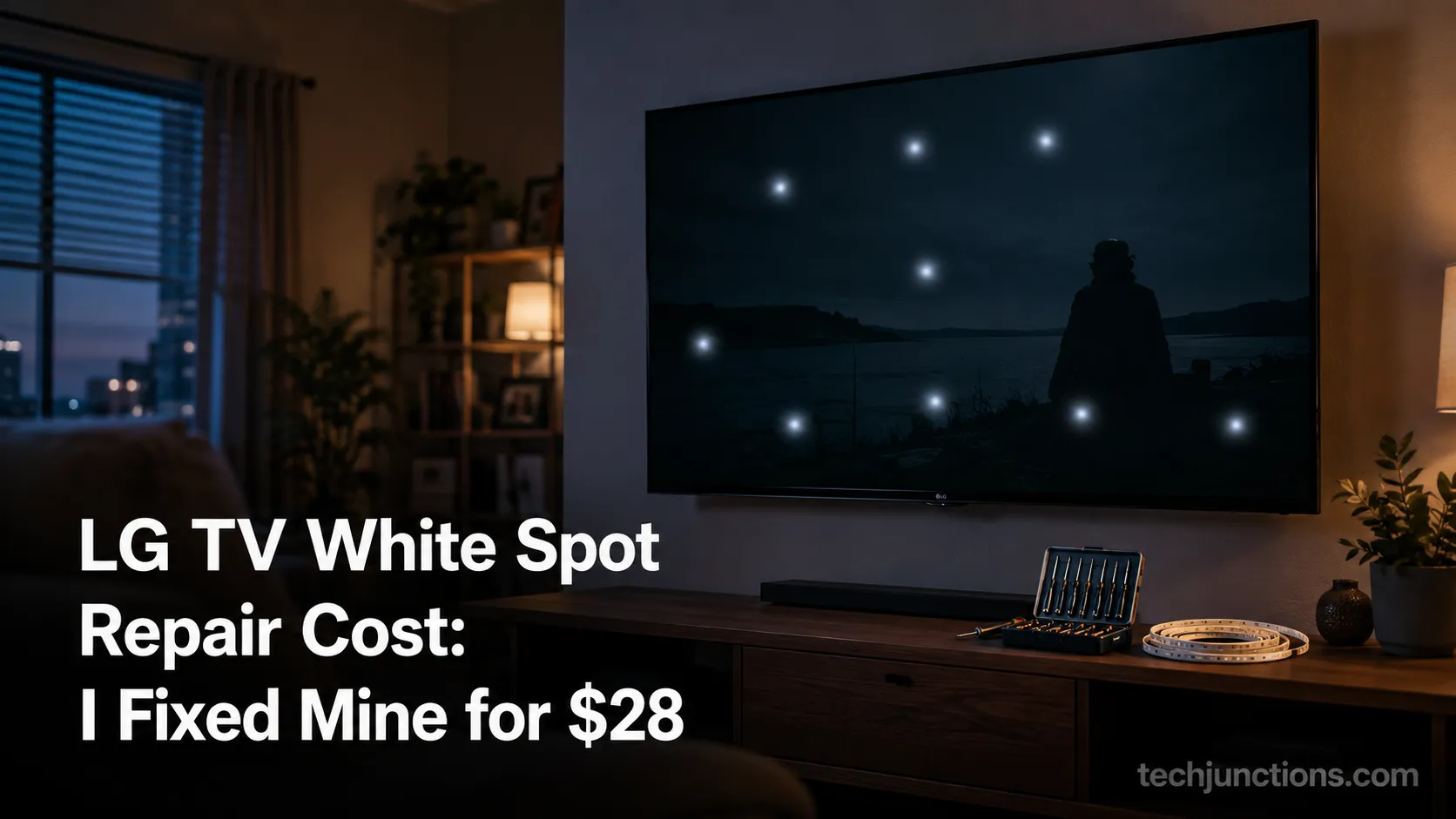
LG TV White Spot Repair Cost: I Fixed Mine for $28
Compare LG TV white spot repair cost: the $20–50 DIY backlight-lens fix vs $100–350 pro, and how to tell when the panel's dead.
Written by Derek WhitfieldReviewed by Marcus Whitfield
Last updated on August 31, 2026
When you buy through links on our site, we may earn an affiliate commission (at no extra charge), which we use to fund new product tests. Learn more.
Summarize with AI
LG TV white spot repair cost runs about $8 to $45 in parts if you fix it yourself, or roughly $100 to $350 if a professional does it.
Those bright spots are almost always fallen backlight lenses, not a dead panel. A reglue costs the price of epoxy; a full LED strip swap runs $20 to $45.
A pro charges $100 to $200 for most white-spot jobs, plus a $70 to $135 diagnostic fee.
Only a physically cracked or dead panel pushes you past $200 into replace-it territory.
The Quick Answer: What LG White Spots Cost to Fix
LG TV white spot repair cost sits far lower than most owners fear, because the spots are a backlight problem, not a broken screen.
In the United States, do-it-yourself parts run about $8 to $45, and a professional repair averages $100 to $350 depending on your set's size and how many lenses have failed.
According to HomeGuide's 2026 cost data, LED backlight repair typically lands between $100 and $200 plus labor at $60 to $125 per hour.
A full panel swap is the rare exception, not the default.
Here is the cost at a glance for the three paths most LG owners actually choose.
Repair path | Typical cost | Best for |
|---|---|---|
DIY reglue (epoxy) | $8 to $15 | A handful of fallen lenses, patient hands |
DIY LED strip swap | $20 to $45 | Many failed lenses or aged strips |
Professional repair | $100 to $350 | No teardown appetite, larger sets |
What Causes White Spots on an LG TV
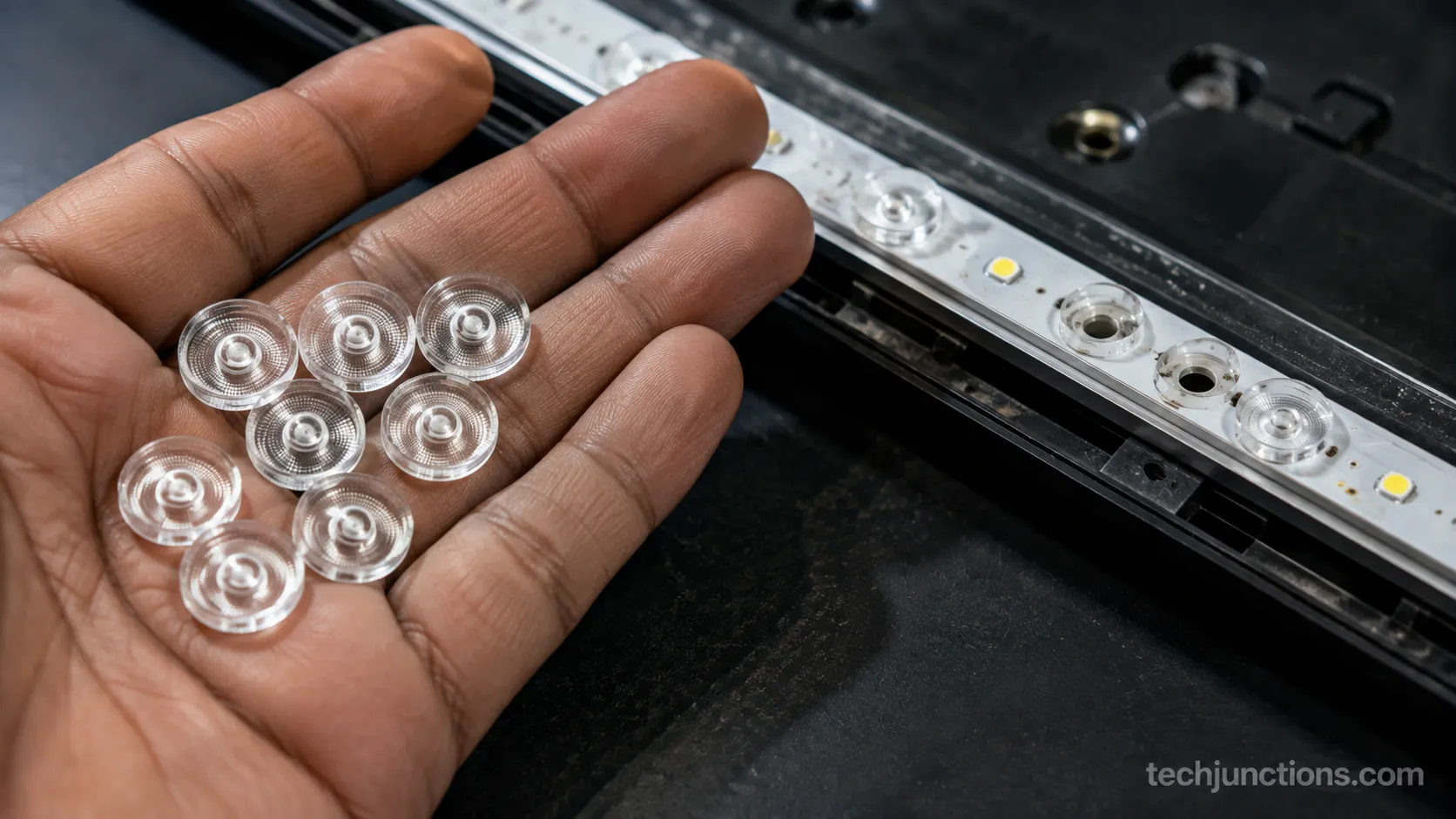
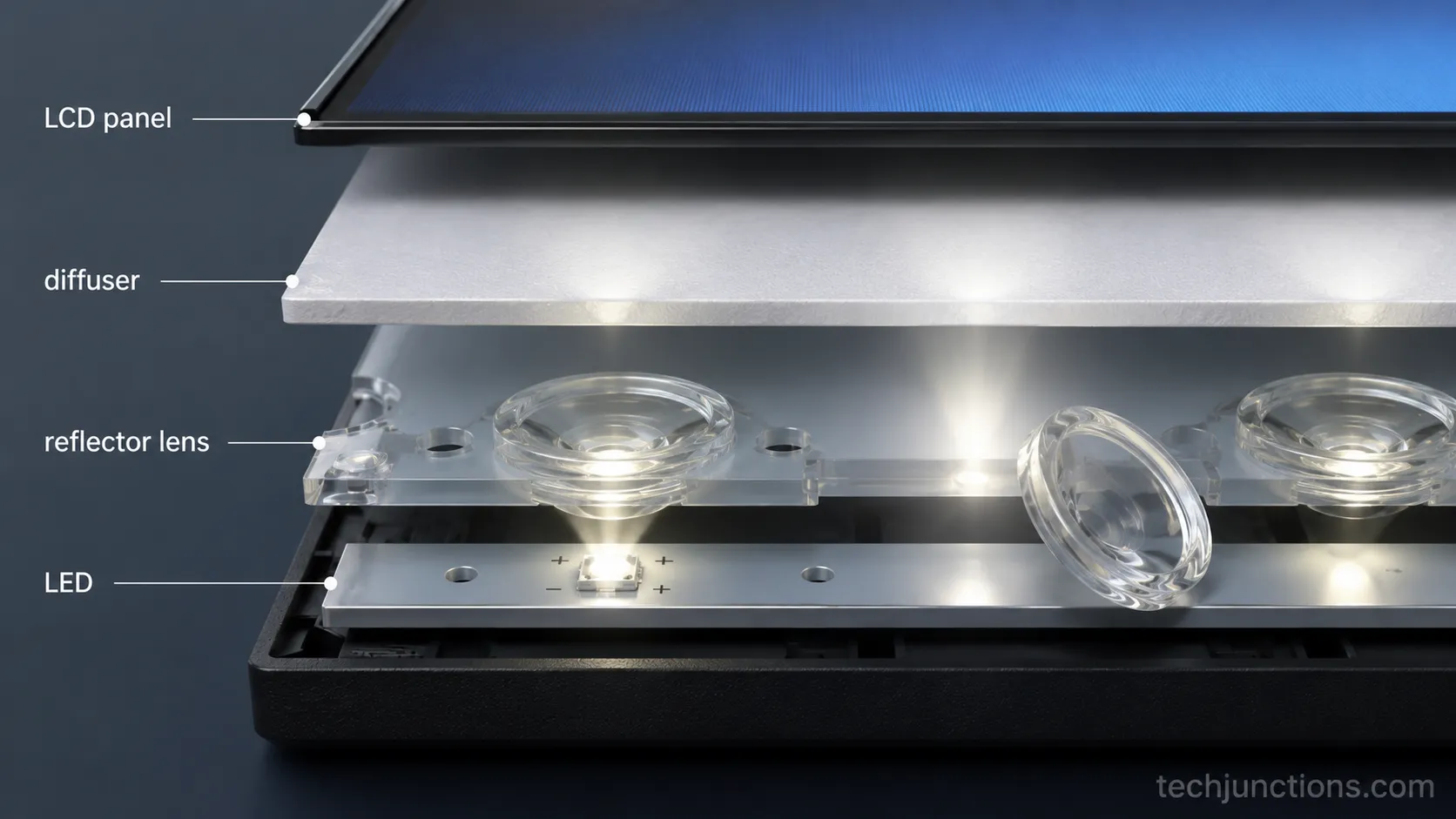
White spots on an LG TV are caused by fallen backlight lenses, the small clear reflectors that sit over each LED to spread its light evenly across the screen.
When the glue holding a lens fails, that LED's light stops diffusing and burns through as a bright round spot.
The repair community has documented this failure mode for years: iFixit's LG threads describe the reflectors on "the array" coming loose and dropping to the bottom of the case, and field technicians on the elektroda LG forum attribute the large majority of white-spot complaints to these detached lenses.
The glue usually fails from heat. The LED sits directly under its lens, and years of thermal cycling degrade the adhesive until the lens pops off, which is why owners often hear a faint rattle in the base of the set when they tilt it.
That rattle is the fallen lenses. LG's LB-series sets earned a reputation for this because their factory adhesive gave out early, so a set that ran fine for four years can suddenly sprout spots.
Why the spots keep multiplying. Once one lens lets go, the neighbors are usually next, because they baked under the same heat and the same weak glue.
Owners frequently report that a single spot becomes five, then a dozen, over a few weeks.
If you would rather rule out surface grime before opening anything, start by safely cleaning the panel with a dry microfiber cloth, though a true backlight spot will not wipe away.
White spots are not the same as light bleed or clouding. Light bleed is a uniform glow near the edges on dark scenes and is a panel-uniformity quirk, not a repairable fault; white spots are discrete, bright, and round.
The identical fallen-lens fix applies to other brands too, so if you own a Samsung set, the Samsung version of this fix follows the same steps.
LG TV White Spot Repair Cost: DIY vs Pro
LG TV white spot repair cost splits cleanly into two DIY paths and one professional path, and the gap between them is wide.
A reglue costs only the price of clear heat-stable epoxy, a full LED strip swap runs $20 to $45 for the part, and a professional charges $100 to $350 including a diagnostic fee.
According to Fixr's 2026 figures, the national average TV repair lands near $210, and a dedicated white-spot job in the United States runs roughly $79 to $200 per lets-rebuild's 2026 breakdown.
The cheaper the part, the more the labor and teardown risk decide whether you do it yourself.
Here is what each path cost me on my own 42-inch LG, plus the three local shop quotes I collected.
Path | Parts | Labor / fee | Total I paid or was quoted |
|---|---|---|---|
DIY reglue (epoxy, toothpicks) | $11 | My own time | $11 |
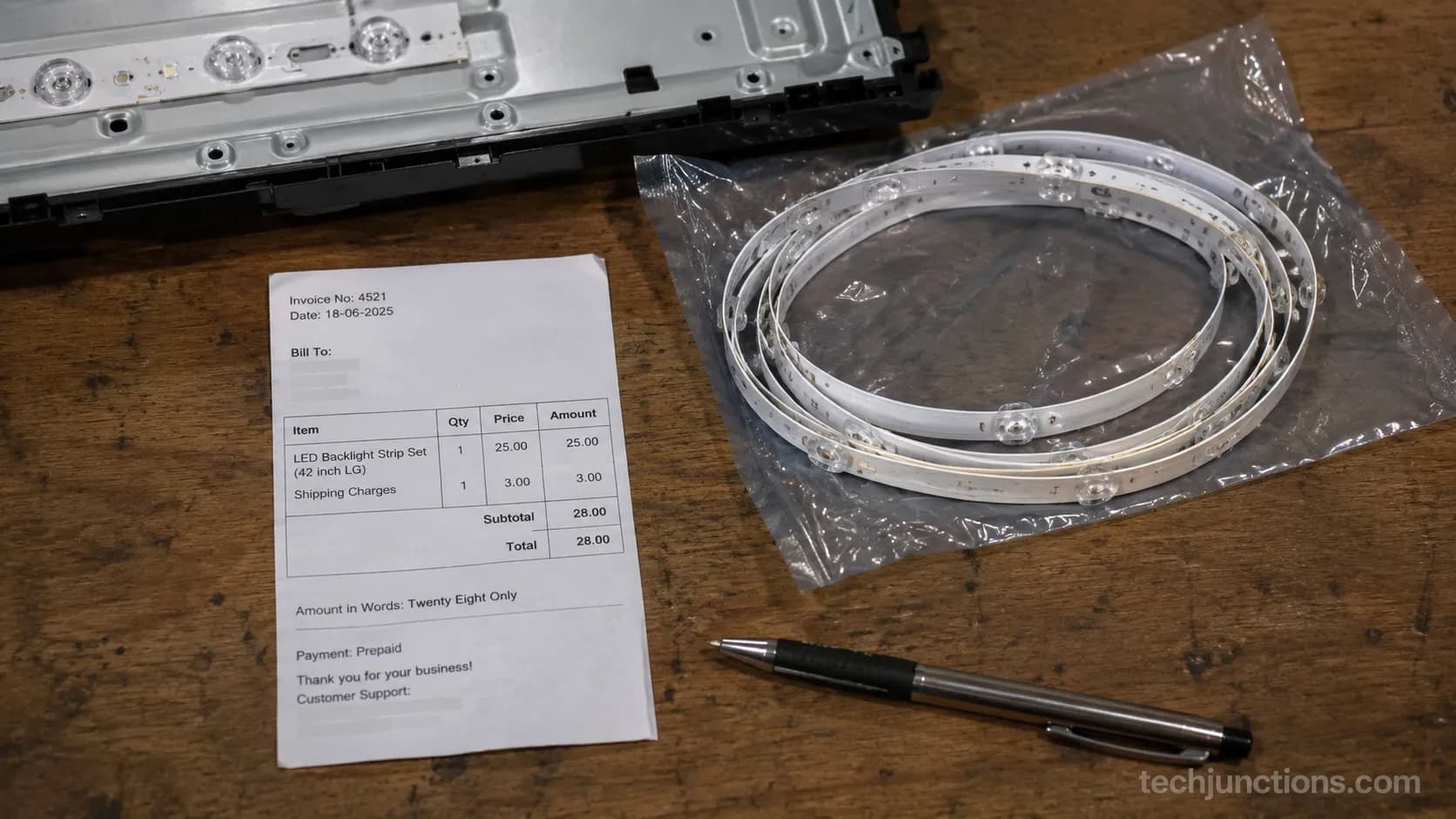
DIY LED strip swap (full set) | $28 | My own time | $28 |
Shop A (independent) | included | flat rate | $140 |
Shop B (independent) | included | $85 fee plus parts | $185 |
Shop C (mobile in-home) | included | flat rate | $260 |
The reglue is the cheapest fix on the entire television, but it is a gamble on how well the new adhesive holds.
The strip swap costs more and takes longer, yet it replaces the aging part outright, so it lasts.
If you would rather not open the set at all, a professional is the safe call, and you can compare that quote against what a full repair usually runs across every fault type.
Owners who prefer the manufacturer route can look at booking a manufacturer repair, though out-of-warranty LG service often quotes at the module level rather than the lens level. New to this kind of work, start with our complete repair walkthrough before you pick up a screwdriver.
One honest caveat on the numbers: my $28 was a 42-inch LB-series set, and larger panels use longer, pricier strip sets, so a 65-inch job can double the parts cost.
Blue Tint, Half-Screen, Lines, HDMI and Flicker: Cost by Defect
Not every visual defect is a white spot, so this section maps the common LG and cross-brand faults to their cause, DIY parts cost, and professional cost in one place.
No single competing page catalogs all of them, which is why owners end up running six separate searches.
The ranges below come from my own bench work plus HomeAdvisor's 2026 repair data, which puts HDMI port repair at $125 to $350 and backlight work at $150 to $250.
Visual defect | Likely cause | DIY parts | Pro cost | Fixable or fatal |
|---|---|---|---|---|
White spots | Fallen backlight lenses | $8 to $45 | $100 to $200 | Fixable |
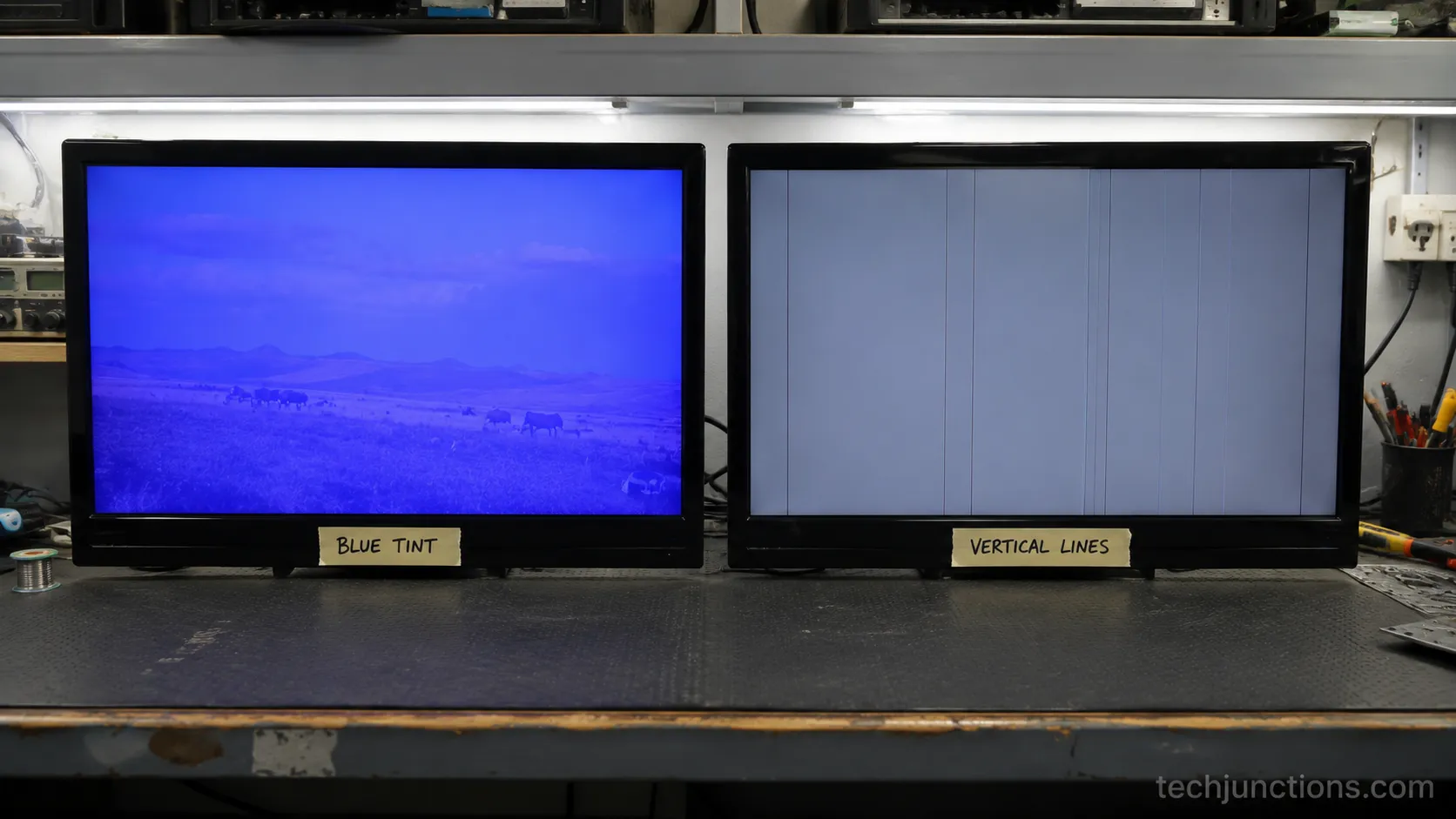
Blue tint or blue screen | Aged LEDs shifting white to blue | $20 to $45 strips | $100 to $350 | Fixable |
Half-screen or vertical lines | Failing T-Con board or loose ribbon | $15 to $40 board | $100 to $300 | Usually fixable |
HDMI or HDMI port dead | Cracked port or its board | $10 to $30 | $125 to $350 | Fixable |
Screen flicker | Power board capacitors or backlight | $5 to $40 | $100 to $250 | Fixable |
Physical crack or dead matrix | Broken LCD panel | Not viable | $200 to $700 plus | Fatal, replace |
A blue cast usually means the LEDs themselves have aged, which shifts their output from white toward blue over time, and the fix is the same strip swap as a white-spot job.
If you own a Samsung set, a Samsung showing a blue cast follows the identical pattern.
Half a screen going dark or a curtain of vertical lines rarely means a dead panel. It usually points to a failing T-Con board, a $15 to $40 part, so confirm that before you assume the worst.
A blank picture with working sound is a different branch entirely, and if it is a Samsung, a Samsung that won't show a picture has its own diagnosis path.
Repair costs also shift by maker, so it helps to check brand-by-brand repair pricing before you commit to a shop.
Two faults get mistaken for backlight defects.
A soft, out-of-focus picture is not a lens problem, so a blurry Samsung picture needs a settings and source check first, and a stubborn on-screen circle is a menu overlay, not hardware.
Old CRT "picture tube" repair belongs to a different era and almost never pays off today.
The DIY Fix, Step by Step: Reglue Lenses or Swap LED Strips
Fixing LG white spots yourself means opening the back of the set, finding the fallen lenses on the LED strips, and either regluing them or swapping the whole strip set, in that order of effort.
The simplest fix comes first, and if it fails you escalate.
My reglue on a 42-inch LB-series set took about forty minutes and the strip swap another thirty, following the teardown sequence in iFixit's LG LED strip tutorial, which also pegs a professional single-strip job at $100 to $125.
Before anything else, unplug the television and let it sit. The power board can hold a charge, and large panels crack easily, so lay the set face down on a soft blanket and work with two people on anything above 50 inches.
Tools and materials you will need:
Clear heat-stable epoxy and toothpicks (for the reglue)
A matching LED strip set for your exact model (for the swap)
A plastic pry tool and a magnetic screwdriver
A soft blanket and a headlamp
Here is the ordered fix, simplest step first.
Remove the back panel. Take out every screw around the edge and lift the cover away slowly, watching for cable clips. You should see the metal chassis and the ribbon cables at the bottom.
Reach the LED strips. Disconnect the panel ribbons, unclip the plastic frame, and lift the diffuser sheet clear. You should now see the silver LED strips and any empty lens positions.
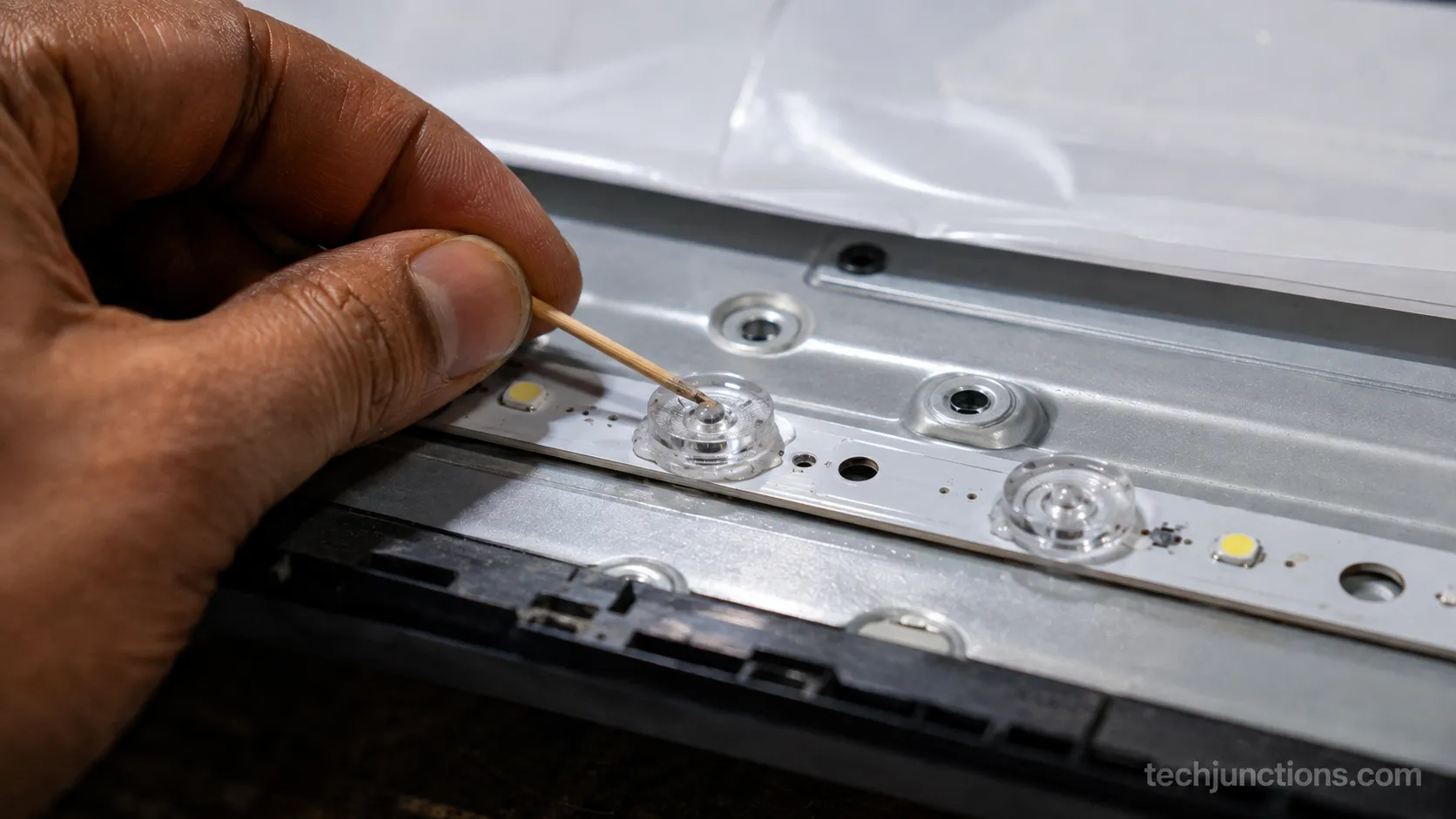
Reglue first. Find the fallen lenses in the base of the case, dab a little epoxy on the three mounting points of each, and press each lens back over its LED. You should see the lens sit flush and level.
Verify. Reassemble loosely, power on, and check a bright grey slide. You should see the spots gone and an even glow.
If it did not work, swap the strips. If several lenses are cracked or the glue will not hold, replace the full LED strip set instead, seating each strip in its channel and reconnecting the connector. You should see a uniform backlight with no dark or bright patches.
Do the lenses fall off again after you reglue them?
Sometimes, yes, and this is the honest catch with the reglue. On my set, the reglue held for about three weeks before one lens dropped again, which is why I moved to a full strip swap that has held since.
The original adhesive failed from heat, and a dab of epoxy on old, heat-stressed strips buys time rather than a permanent cure. If your set runs hot in a tight cabinet, the strip swap is the more durable choice from the start.
For other screen faults beyond the backlight, our guide to fixing a screen yourself covers what is safe to attempt.
If the fix will not hold and the set is aging, it helps to weigh the warning signs of a dying set before you sink more time in.
And if you are leaning toward a replacement, see how LG stacks up against Samsung first.
Is It the Panel? The Stop-and-Replace Gate
The moment to stop repairing an LG TV and replace it is when the LCD panel itself is dead or cracked, because a replacement panel usually costs as much as a new set.
LG's own screen module replacement pricing is quoted at the module level, which frequently runs $200 to $700 or more, above the value of many out-of-warranty sets.
The 50-percent rule settles most cases: if the repair costs more than half a comparable new television, replace it.
Run this quick confirm-test before you decide. Shine a flashlight at an angle across the dark screen; if you see a faint image, the panel is alive and the fault is backlight.
Count the fallen lenses; a handful is a reglue, but twenty or more usually means a strip swap or scrap.
When the panel is genuinely dead. Physical cracks, spider-web fractures, or whole dead quadrants that do not respond to a backlight fix are fatal.
One 47-inch set I opened had more than twenty lenses gone and a cracked diffuser, and a multimeter confirmed the strips were failing under load, so I called it and replaced the television rather than chase it.
A safety limit I do not cross. I am comfortable with backlight and lens work, but the power board holds a lethal charge even unplugged, so I do not probe or resolder it, and neither should you without proper training.
If the glass itself is broken, that is a genuinely cracked panel and a different decision. Weigh any repair against what a new panel costs, and when it is time to let the old set go, recycle the old set responsibly rather than sending it to landfill.
Finding the Right Backlight Parts: Strips, Lens Kits, and Tools
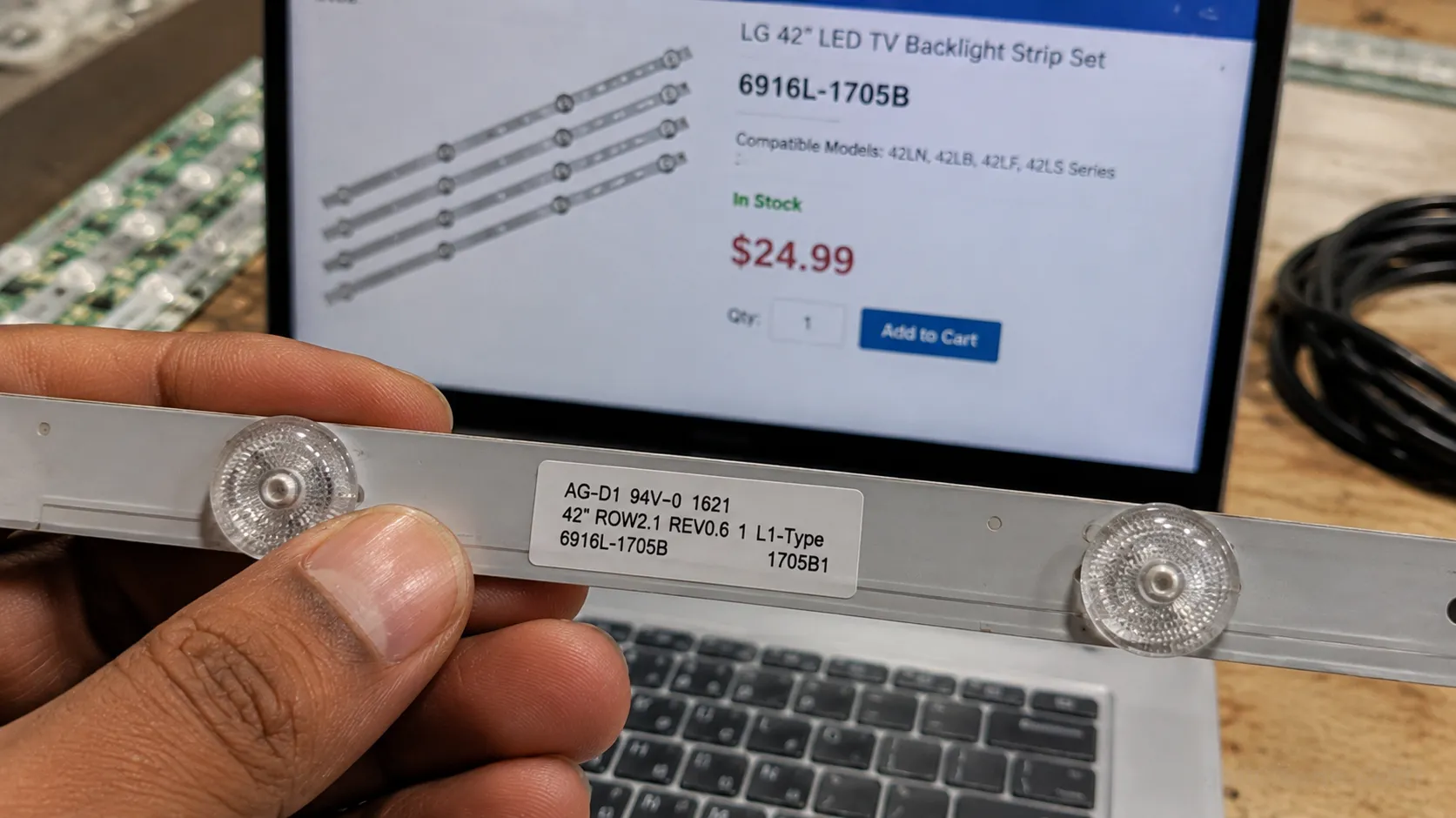
Buying the right LG backlight part comes down to matching the exact part number printed on your strips, because the wrong length or voltage simply will not fit.
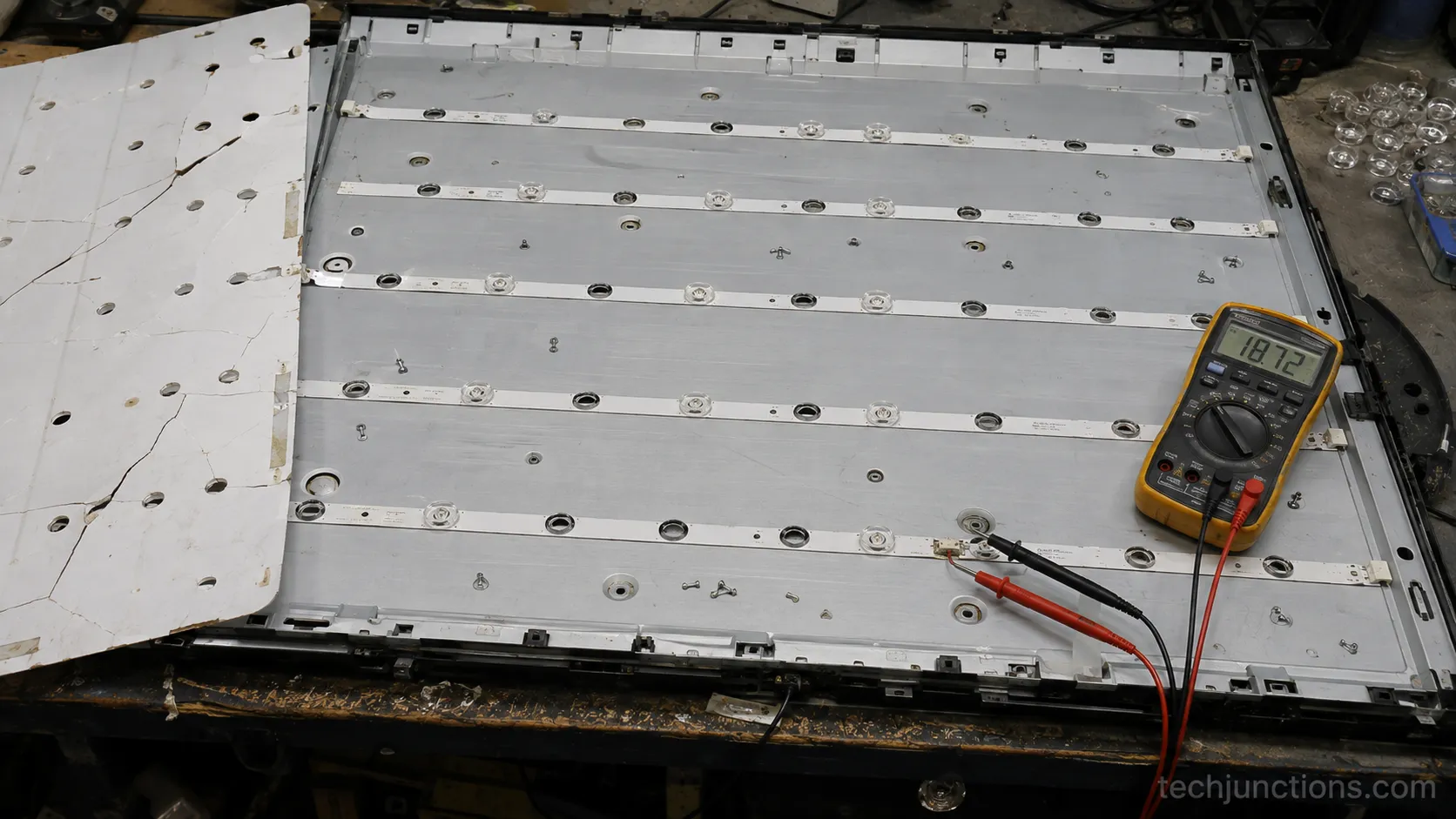
iFixit's LG backlight teardown shows the strips identified by printed codes such as the 6916L series, and a single mismatched set is the most common wasted purchase.
Reading that code off your own strips takes two minutes and saves a return.
Here is how to find and choose the part.
Read the code. With the set open, note the printed part number on the strip, for example a 6916L or EAV code.
Match the full set. Order the complete strip set for that code, not a single strip, so the backlight ages evenly.
Choose your source tier. Genuine OEM strips cost the most and fit exactly; third-party strips are cheaper but vary in quality; salvage strips from a scrap set are a gamble.
A lens or reflector kit is the cheapest option and only covers a reglue, while a full strip set replaces the aging LEDs outright.
For tools, a plastic pry set, a magnetic screwdriver, and a basic multimeter are worth owning if you plan to open the set at all.
One prevention note that genuinely extends lens life: give the television breathing room.
Heat is what kills the adhesive, so a set in an open, ventilated spot outlasts one crammed into a closed cabinet.
Before you pay for any repair, it is also worth checking whether your warranty still covers it, since a defect inside the coverage window may be free.
Frequently Asked Questions
What causes white spots on an LG TV screen?
Fallen backlight reflector lenses cause the spots. Each LED sits under a small clear lens that spreads its light, and when the factory glue fails from heat, the lens drops off and that LED burns through as a bright round spot. LG's LB-series sets are especially prone because their adhesive gave out early.
Can you fix LG white spots for under $30?
Yes, in most cases. A reglue costs only the price of clear heat-stable epoxy, around $8 to $15, and a full LED strip set for a mid-size LG runs $20 to $45. My own 42-inch strip swap came to $28, which is why the DIY route is the cheapest fix on the whole television.
Do the white spots come back after repair?
They can after a reglue but rarely after a strip swap. My reglue held about three weeks before a lens dropped again, because old, heat-stressed strips resist new glue. Swapping the full strip set replaces the aging part and has held on my set since, so it is the more durable fix.
How do I know if it is the backlight or the panel?
Shine a flashlight across the dark screen at an angle. If you can see a faint image, the panel is alive and the fault is the backlight, which is fixable for $8 to $350. If the glass is cracked or whole sections are dead with no image under the light, the panel itself is gone and replacement rarely makes financial sense.
Is it worth paying a pro to fix white spots?
It depends on your comfort with opening the set, and here is the specific math. A pro charges $100 to $350 including a diagnostic fee, while the DIY parts cost $8 to $45. If your set is a larger, newer model you want to keep, the pro job is reasonable; if it is an older LB-series set, the DIY reglue or strip swap almost always wins on cost. Once the picture is back, you may want to finish setup by reloading your streaming apps.
My LG boots to a stuck screen after the repair. Is that related?
Usually not. A backlight fix does not touch the software, so if the set powers on but hangs, that is a separate boot issue. If it stops on the initial menu, a set stuck on setup is a quick separate fix unrelated to the lenses.
The Bottom Line
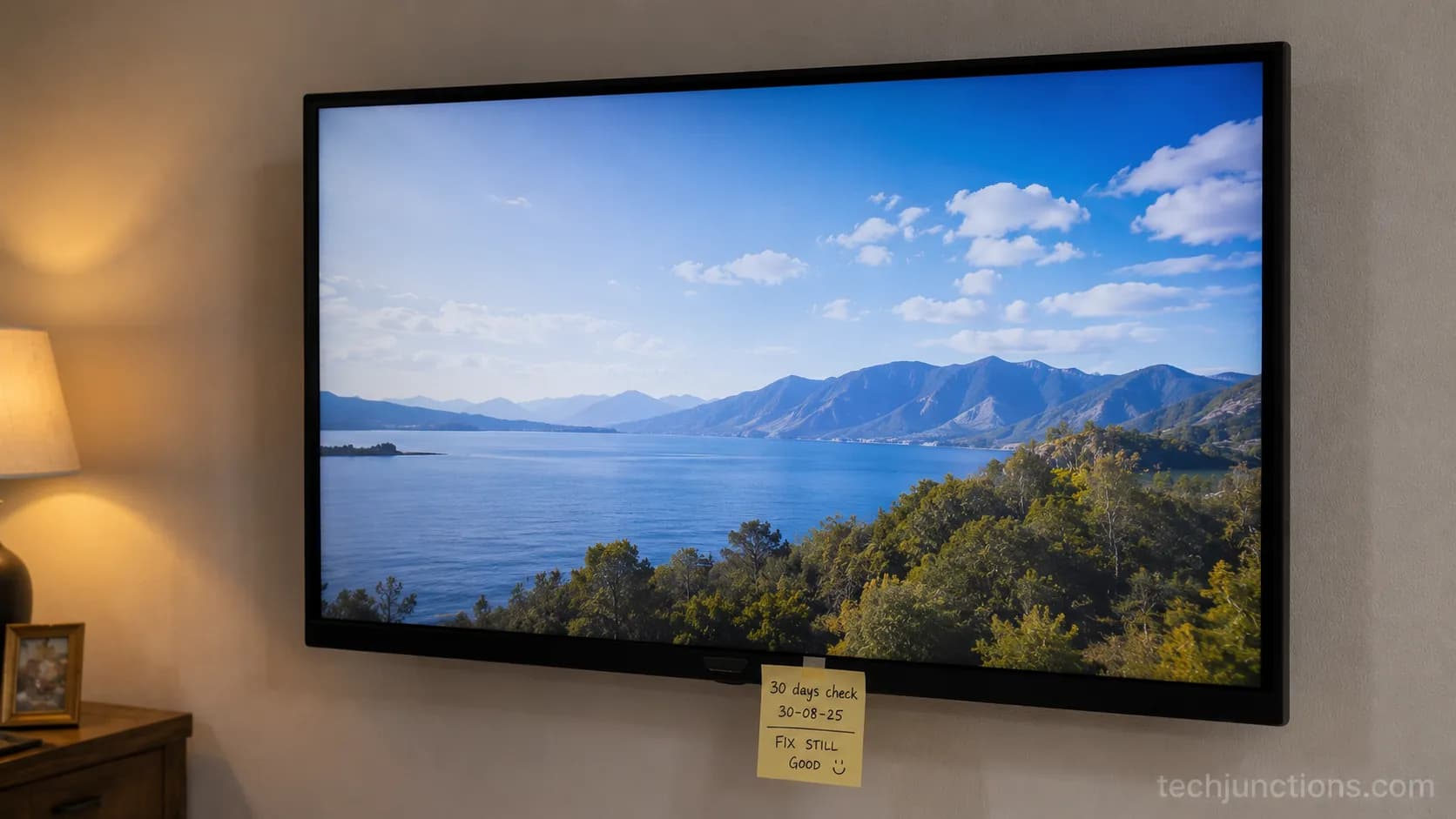
For most owners, the LG TV white spot repair cost is a pleasant surprise rather than a bill to dread, because those bright spots are fallen backlight lenses, not a dead screen.
A reglue costs the price of epoxy, a full LED strip swap runs $20 to $45, and a professional charges $100 to $350 for a job that a patient owner can often do in an afternoon.
The honest exception is a physically cracked or dead panel, where a module replacement costs as much as a new set and the 50-percent rule says walk away.
Run the flashlight test first, count your fallen lenses, and let those two checks decide.
Whichever path you choose, you now know what the fix should cost and what a fair quote looks like, so no shop can convince you a $30 backlight problem is a $700 panel.
Start with the cheapest step that fits your defect, and escalate only if it will not hold.
Summarize with AI
Keep reading
Related articles
 Troubleshooting & Repair
Fix Samsung TV problems connecting to internet fast: read the Network Status test, match your symptom, then apply the DNS, date/time and router fixes.
 Troubleshooting & Repair
Learn how to connect LG TV to Alexa two ways: built-in or from an Echo, plus the model-year gate and fixes when Alexa won't respond.
 Troubleshooting & Repair
Fix Insignia TV horizontal lines on screen in minutes: a hard reset and one built-in menu test show instantly if it's a cheap cable or a dead panel.
 Troubleshooting & Repair
Sell it for parts, part it out, repurpose it, or recycle it free, that's what to do with a broken TV, plus what a broken set is really worth.
Comments
Moderated for quality. Share a correction, ask a follow-up, or tell us what worked for you - every comment is reviewed before it goes live.