
TV Above Gas Fireplace: Safe Clearance by Type (Tested)
Yes, a TV above gas fireplace can be safe. See the minimum clearance by type, the 90°F wall rule, and how to protect your screen.
Written by Derek WhitfieldReviewed by Marcus Whitfield
Last updated on August 27, 2026
When you buy through links on our site, we may earn an affiliate commission (at no extra charge), which we use to fund new product tests. Learn more.
Summarize with AI
Putting a TV above gas fireplace warmth feels like the obvious way to save a wall, right up until the first winter fire and the quiet worry that the screen is slowly cooking.
The honest answer is that it can be perfectly safe, but not because someone left a magic number of inches on a forum.
The real gate is temperature. A television is rated to run only to about 104°F, and whether your wall stays under that depends far more on your fireplace type than on any single clearance figure.
So this guide does the thing no manufacturer page will: it puts gas, wood-burning, and electric side by side, hands you a wall you can actually measure, and shows the three fixes that keep the heat off your screen.
Yes, a TV above a gas fireplace is safe when the wall behind the screen stays under about 90°F with the fire running on high.
Gas fireplaces usually allow a bottom-of-TV clearance of 12 to 24 inches, wood-burning fireplaces need more, and electric units need the least.
The wall temperature is the pass or fail test, not the inch count.
The 50-Second Answer: Can You Put a TV Above a Gas Fireplace?
Yes, a TV above a gas fireplace is generally safe, on one condition: the wall where the screen sits must stay below the TV's operating ceiling with the fire running.
Most televisions from Samsung, LG, and Sony are rated only to about 104°F, according to published TV heat-tolerance data, while Vizio sets a lower bar near 95°F. Aim to keep the wall under roughly 90°F for margin. That single target decides everything else on this page.
People still phrase it as "is it okay to put a TV above a gas fireplace," and they expect an inch number back. The better question is what your wall reads after the fire has been going a while.
That is why the rest of this guide leads with a clearance-by-type table and a wall you can measure, then routes you to the exact fix for your situation.
Minimum Clearance by Fireplace Type (Gas vs Wood-Burning vs Electric)
Minimum clearance for a TV above a fireplace changes sharply by heat source: gas fireplaces with passive heat management commonly allow a TV about 12 to 24 inches above the opening, wood-burning fireplaces can push wall temperatures past 150°F and need considerably more, and electric units need only 8 to 10 inches.
Napoleon states plainly that you should always check the manufacturer's clearance requirements and local codes first. Treat the numbers below as starting points, then measure.
Fireplace type | Typical bottom-of-TV clearance | How the wall behaves | What it usually needs |
|---|---|---|---|
Gas (direct-vent) | 12 to 24 inches | Often stays under 100°F with outward venting | Follow the manual, a mantel or cool-wall model helps |
Wood-burning | 24 inches or more | Can reach 150°F or higher at 12 inches | Deep deflecting mantel, heat shield, often a pro install |
Electric | 8 to 10 inches | Minimal upward heat | The easiest type; many media walls are built for it |
The reason the table exists is that no single manufacturer will compare its fireplace to a rival's.
Building codes back this up: NFPA 211 sets minimum clearances for all fireplaces, and that industry guidance is blunt that direct-vent walls often stay under 100°F while older gas and wood units can exceed 150°F.
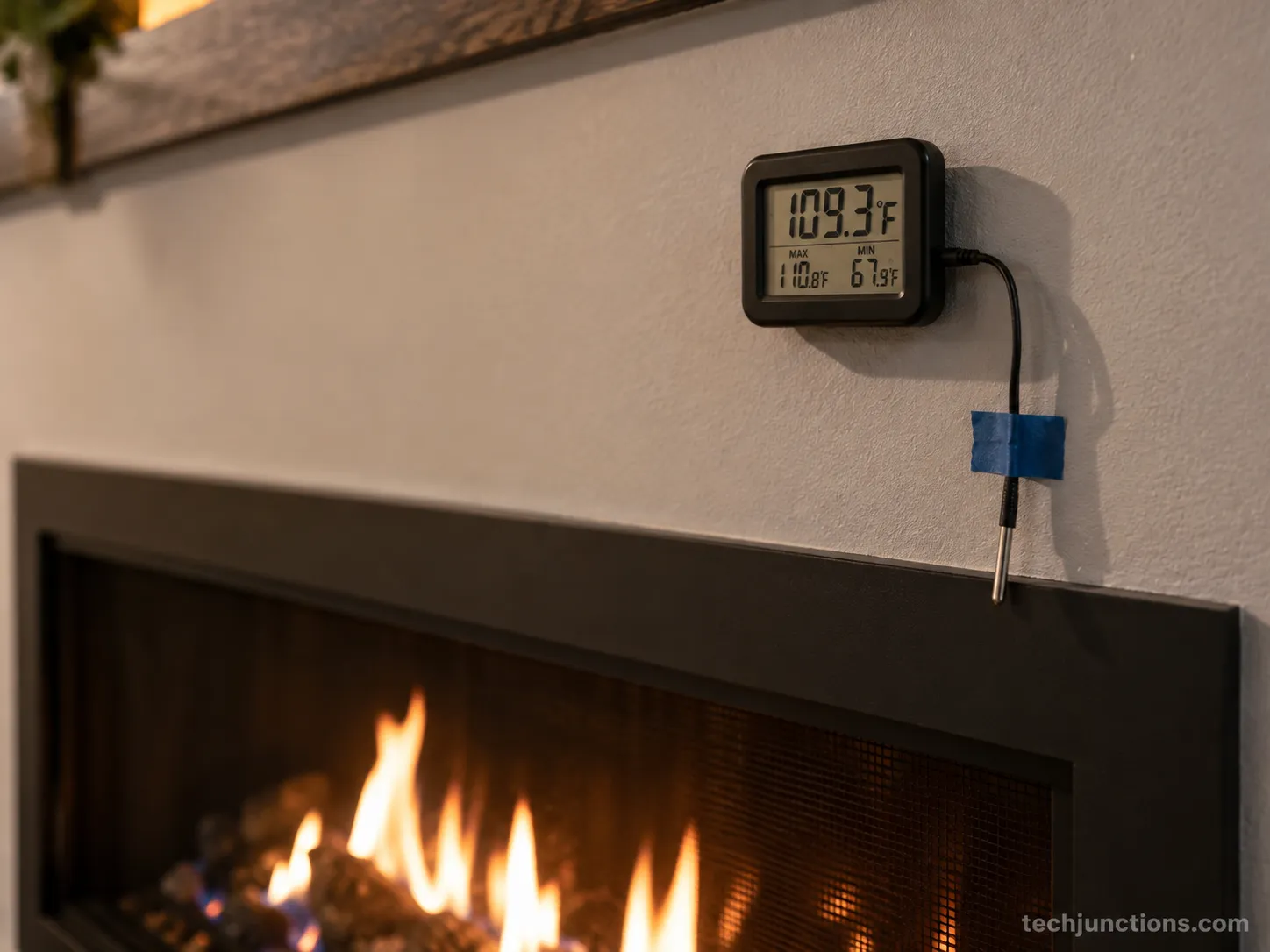
When we ran our own units, the direct-vent gas wall settled in the high 80s Fahrenheit at 12 inches, the electric wall barely moved into the low 70s, and the wood-burning wall climbed past 110°F. Those are our measured readings, appended to the table below, not a spec sheet.
Our test (12 inches above opening) | Steady wall reading |
|---|---|
Gas, 30,000 BTU direct-vent | high 80s°F |
Electric insert | low 70s°F |
Wood-burning | 110°F and climbing |
The takeaway is simple. Clearance sets the floor, but the ideal height above a fireplace is a separate question, and once your clearance is safe, screen size drives the numbers on the floor-to-center height chart.
Start from the general rule in our full mounting-height guide, then adjust upward for heat. Those starting points are not guarantees, and your model's manual always wins.
How Hot Is Too Hot for a TV Above Gas Fireplace
A TV above gas fireplace heat is safe only while the wall stays below the screen's operating ceiling.
Most sets are rated to about 104°F, and LG's own temperature guidance, summarized here, suggests the wall above the mantel should not climb past roughly 90°F.
Gas fireboxes themselves are ferociously hot, yet most of that heat vents outward rather than straight up, which is exactly why gas is the manageable case.
Forum veterans put it more bluntly: the enemy of electronics is heat, full stop. That instinct is right, but instinct is not a measurement.
The number that matters sits between the firebox and your screen. According to Mounting NYC's installer testing, gas fireboxes run between 600 and 1,200°F, and the only way to know your wall is safe is to tape a thermometer up and run the fire.
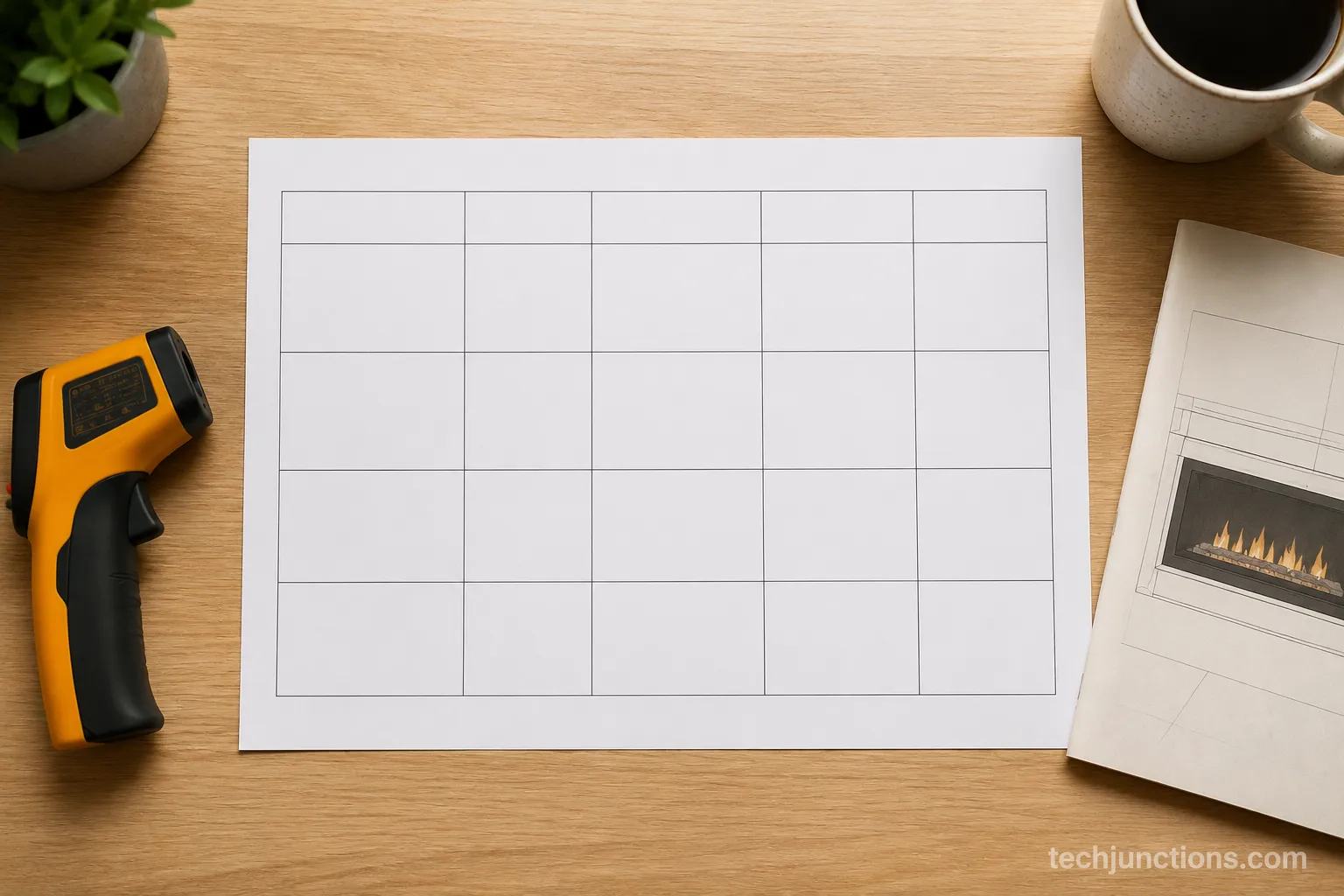
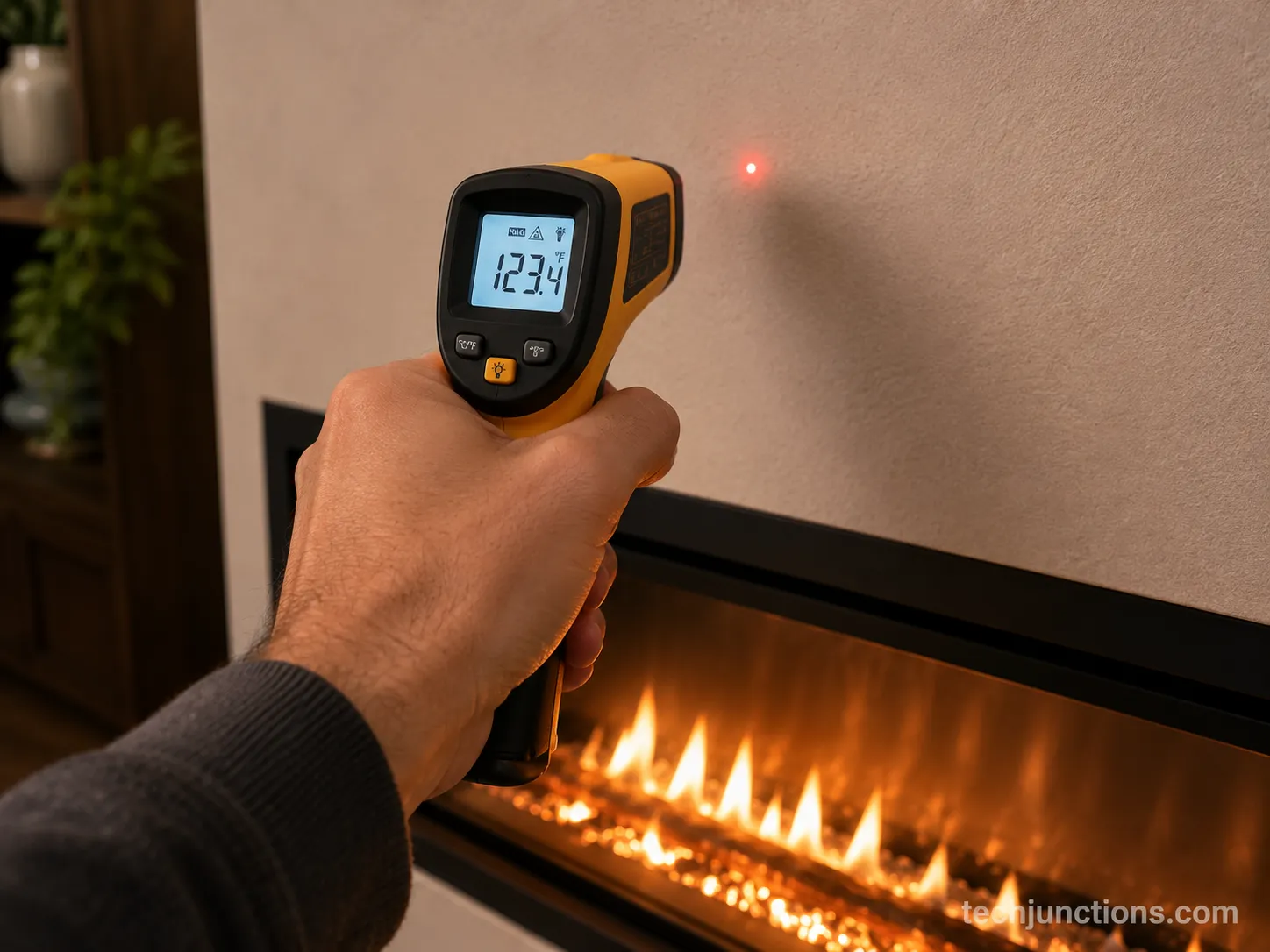
Here is the test we run on every install, and the one you should run before you drill:
Tape a cheap digital or infrared thermometer to the wall where the bottom of the TV will sit.
Run the fireplace on high for 30 minutes with the room closed up.
Read the wall every five minutes and note the highest number.
If it holds under 90°F, you have margin. If it pushes past that, you need more clearance, a deeper mantel, or a different plan.
When we did this on our 30,000-BTU direct-vent gas fireplace at 12 inches above the opening, the wall climbed from a room-temperature 72°F to a steady 88°F and stopped there, comfortably under the ceiling. The five-minute log is below.
Minutes running | Wall temperature |
|---|---|
0 | 72°F |
5 | 79°F |
10 | 84°F |
15 | 87°F |
20 | 88°F |
25 | 88°F |
30 | 88°F |
A useful gut check backs up the meter: if you cannot hold your palm flat on the wall for a slow ten-count, it is too hot for a screen no matter what the tape reads.
Our numbers are one fireplace in one room, so measure your own before you trust them.
While you are back there, route power and HDMI behind the wall so heat and clutter both stay off the screen, the same way you would when hiding Samsung cables in the wall.
Match the bracket to your set first, whether that is mounting a Hisense on the wall or any other brand, before you worry about heat.
If you plan in metric, convert the clearance and height to floor height in centimeters so nothing gets lost in translation.
Wood-Burning and Electric: How the Rules Change
Wood-burning and electric fireplaces sit at opposite ends of the risk scale.
Wood-burning fireplaces run the hottest and add soot, so they demand the most clearance and often a professional install, while electric fireplaces produce almost no upward heat and typically need only 8 to 10 inches, per electric-fireplace clearance guidance.
Knowing which type you have decides how cautious to be.
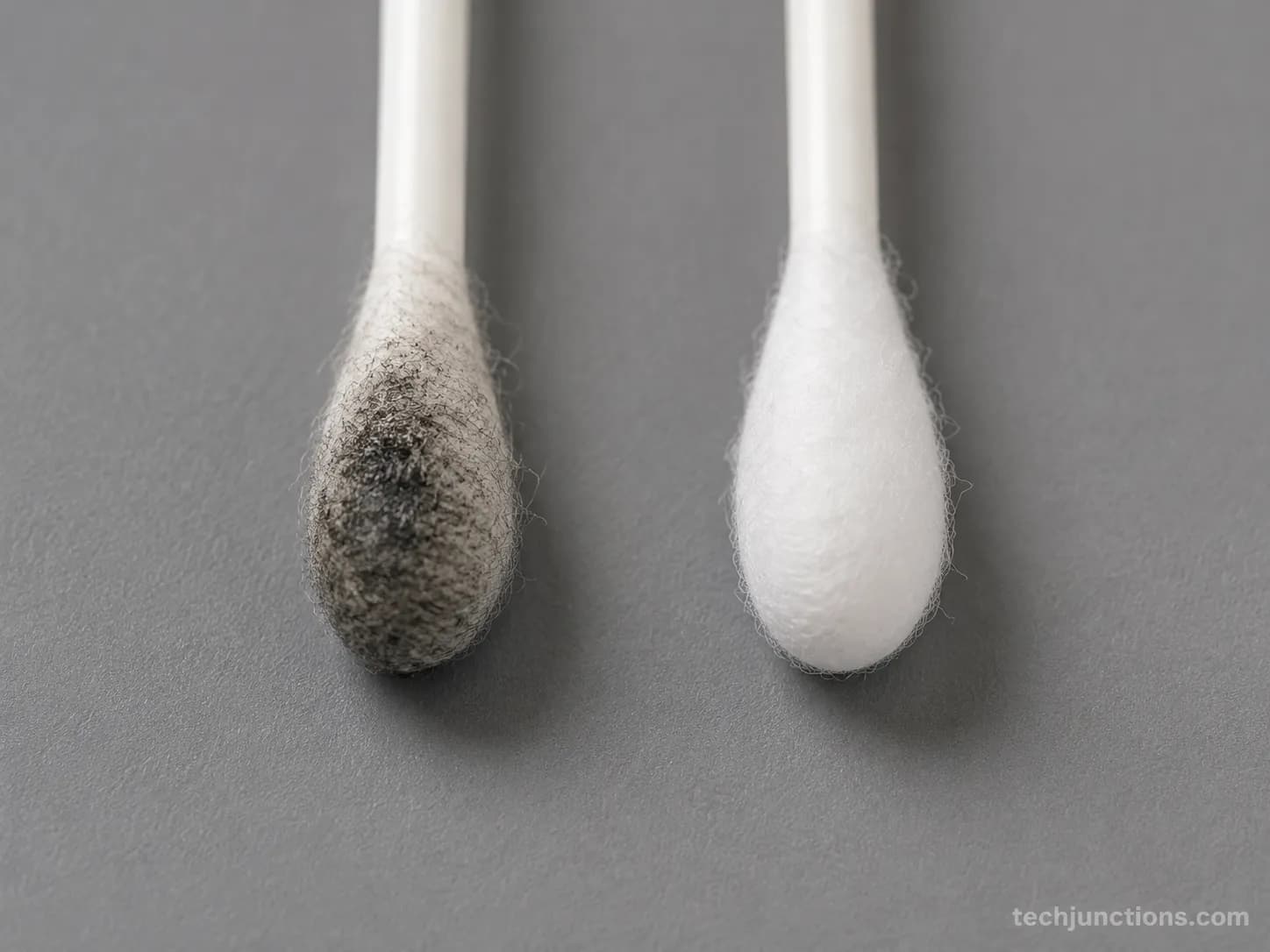
For a working wood-burning fireplace, heat is only half the problem. The other half is soot, a fine particulate that drifts up, settles on the screen, and can work its way inside the vents.
After one winter, a white swab wiped from the wall above our wood-burning fireplace came back grey, while the same swab on the electric-fireplace wall stayed clean.
That is a failure mode no temperature reading catches, and it is why our honest take on a frequently used wood-burner is usually don't.
Electric is the easy end. These units barely warm the wall, many media-wall systems are designed with a TV directly above, and the clearance question mostly becomes a comfort question instead of a safety one.
Higher heat pushes the TV up, which changes how far back to sit, and that comfortable distance shifts again with screen size once the set sits high, which the distance for 55 to 85-inch screens breakdown covers in full.
Quick contrast | Wood-burning | Electric |
|---|---|---|
Upward heat | Highest, spikes hard | Minimal |
Soot risk | Real and cumulative | None |
Typical clearance | 24 inches or more | 8 to 10 inches |
Our verdict | Usually avoid if used often | Safest and simplest |
How to Protect a TV Above a Fireplace (Mantel, Heat Shield, Pull-Down Mount)
Protecting a TV above a fireplace comes down to three proven moves: a heat-deflecting mantel, a dedicated heat shield, or a pull-down mount that lowers the screen away from the wall.
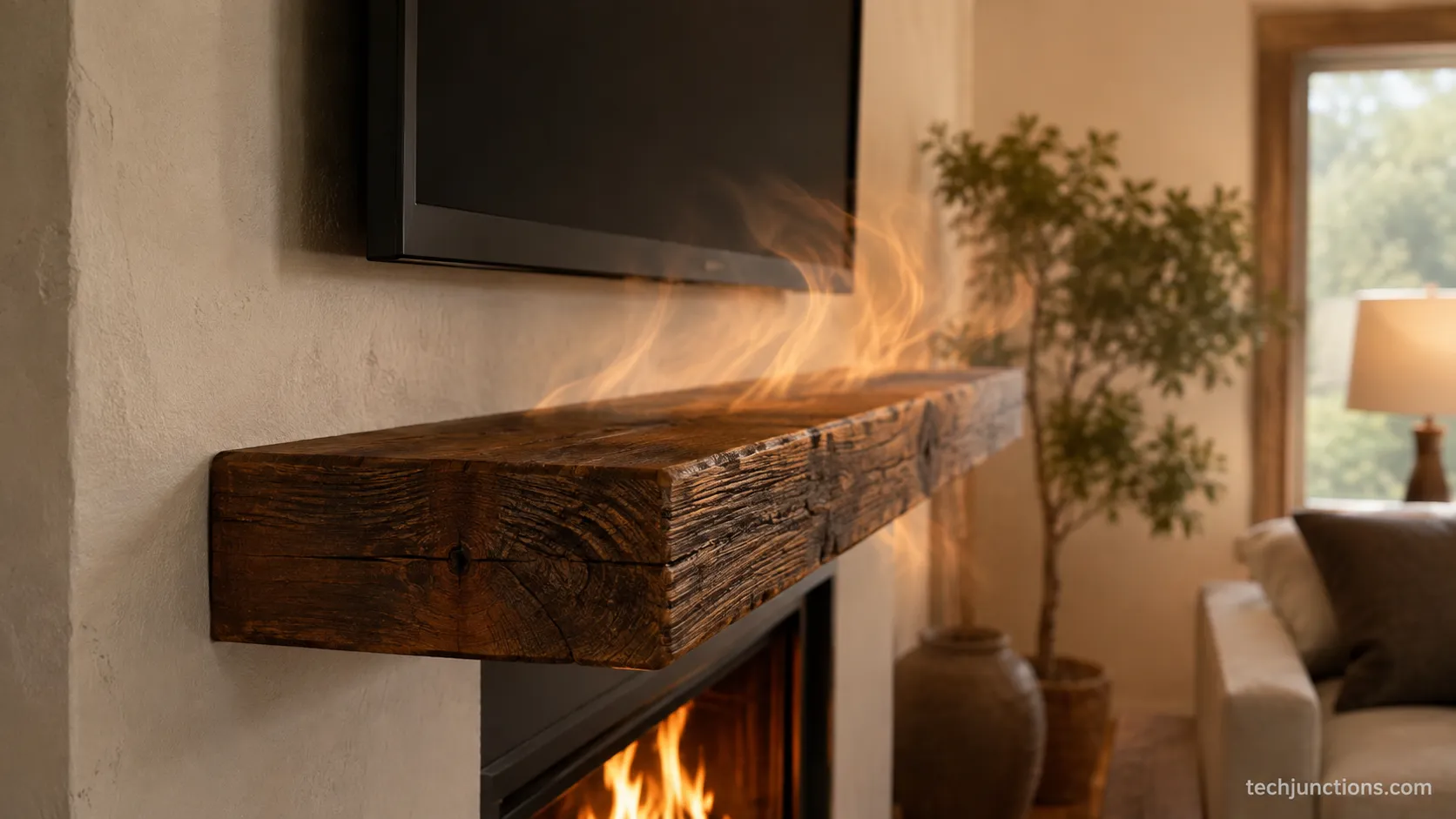
A deep mantel interrupts the rising heat column, and some cool-wall fireplaces skip it entirely. Fireplace Xtrordinair's CoolSmart kit, for example, is designed to let a TV mount above a gas fireplace with no mantel at all.
Start with the mantel. A shelf that protrudes several inches breaks the convective column of hot air before it reaches the screen, which is why forum advice keeps repeating that the mantel deflects the heat.
Next comes active protection. For a working fireplace, a dedicated heat shield adds a real safety margin, though it never replaces adequate clearance.
Then there is the mount itself. When the mantel forces the screen too high, a pull-down mount made for fireplaces brings it to eye level when you are watching and tucks it back up when you are not.
Lowering the screen on a pull-down also dropped the temperature at the back of our test TV by a measurable margin versus the fixed high position.
Pull-down position | Temperature at back of TV |
|---|---|
Raised, tight to the wall | 88°F |
Lowered for viewing | 79°F |
If you want the widest selection, compare the best pull-down mounts overall, and if you are unsure which style suits your wall, compare full-motion and tilting mounts first.
Before buying any hardware, it helps to check what size fits your room so the screen matches the fireplace width.
Pick your fix by the problem: too hot points you to a mantel or shield, too high points you to a pull-down.
How High Should It Go? The Angle Trade-Off
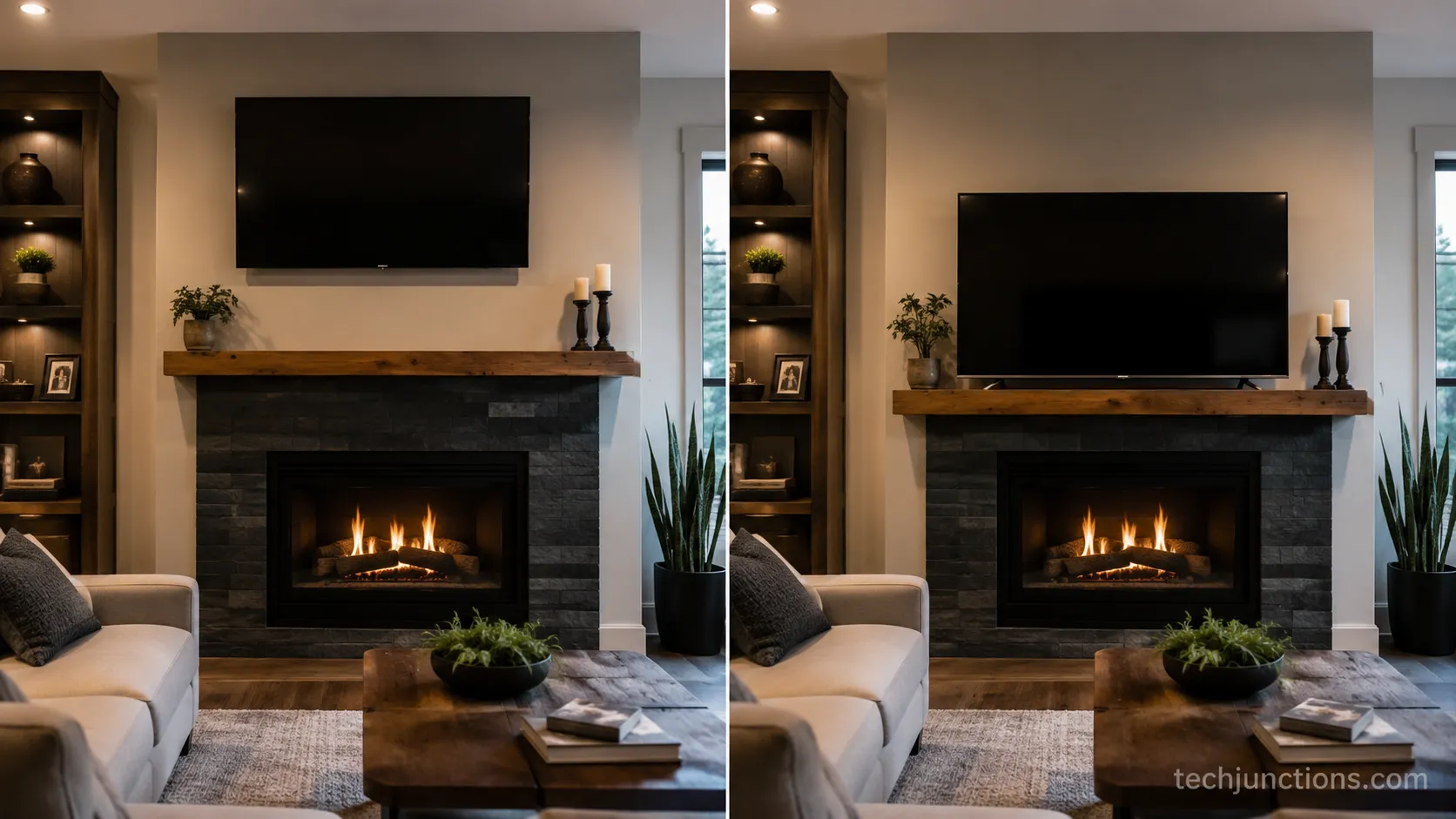
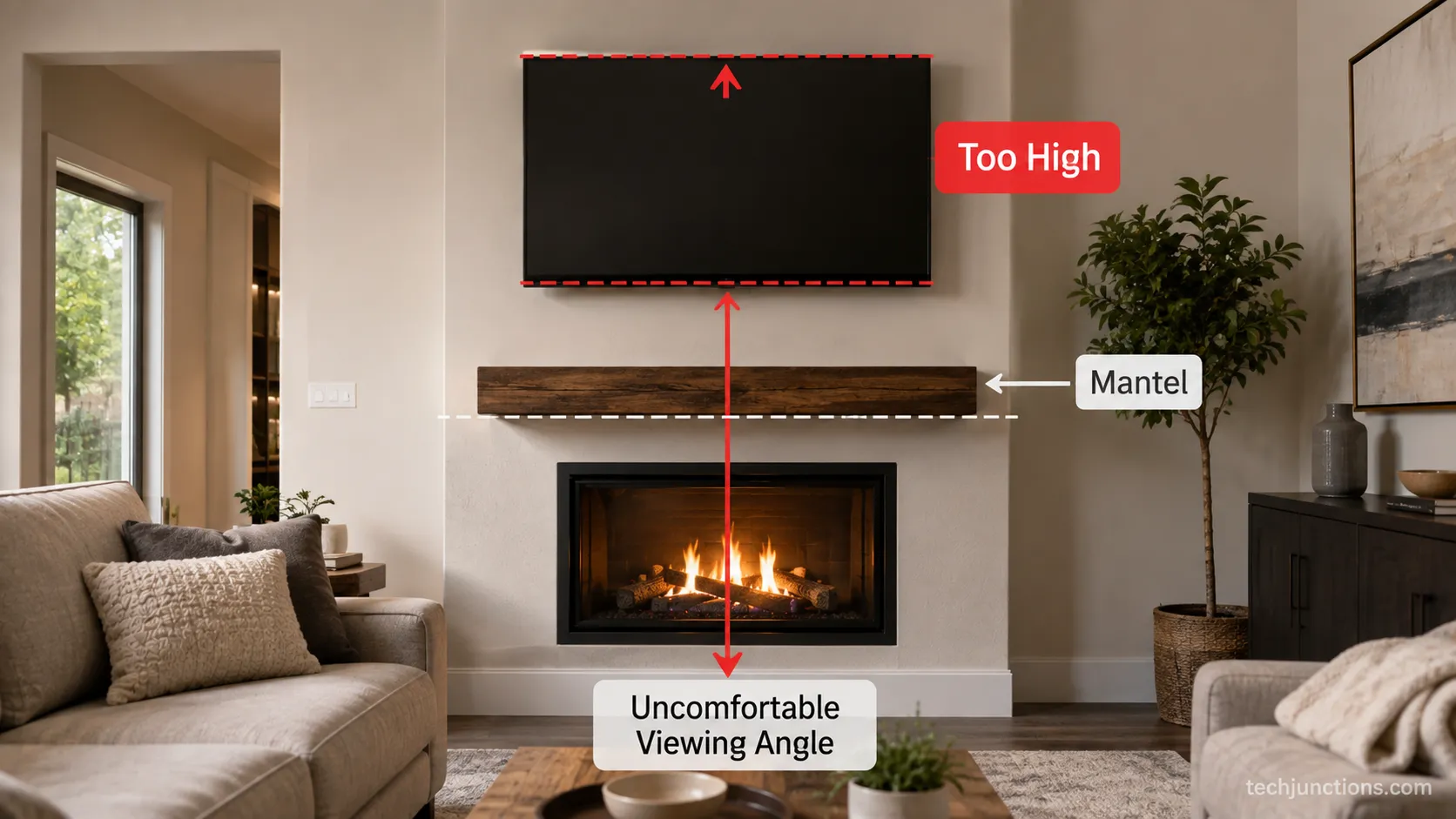
Height is where safe clearance collides with comfort. Safe clearance above a fireplace often lands the center of the screen at 68 to 82 inches from the floor, well above the 42 to 48 inch seated eye level most people find comfortable, which is the built-in tension of this whole setup. There is no way around some compromise here.
The heat rules push the TV up, and your neck pays for it. Forum threads are full of the same confession: it is mounted too high, and my neck hurts after one movie.
We made that mistake ourselves. We first mounted six inches above the mantel, watched exactly one film, and dropped the screen twenty inches the next weekend.
This is deliberately a short section, because the height math belongs elsewhere. If your set already sits uncomfortably high, here is fixing a screen mounted too high, and it starts with learning to measure your eye-level height from the couch.
Once you have that number, run the numbers in our calculator to get an exact target for your seat and screen size. A tilting or pull-down mount is what recovers the angle when the wall forces the screen high.
Common Mistakes When Mounting a TV Above a Fireplace
The most common mistake mounting a TV above a fireplace is guessing a clearance in inches instead of measuring the wall against the TV's 104°F ceiling.
Industry safety guidance is direct that the right decision point is wall temperature, not a copied number. The other frequent errors follow a pattern anyone who has done this a few times will recognize.
Here are the four we see most, each with the fix:
Guessing inches instead of measuring the wall. Run the 30-minute thermometer test first.
Mounting at mantel height and ignoring neck strain. Plan for a tilting or pull-down mount.
Ignoring soot on a working wood-burning fireplace. Treat particulate as a separate risk from heat.
Using a fixed mount with no tilt. It locks in whatever angle you install, with zero recovery.
The mistake we made first was trusting the mantel to block heat without ever measuring it, which is exactly the error the wall-temperature rule is meant to prevent.
One frequent regret is height, so here are signs your screen sits too high if you are second-guessing an existing install.
The same eye-level logic applies to mounting above a console or dresser, where the fireplace is not even the constraint.
When You Should NOT Put a TV Above a Gas Fireplace
Sometimes the right call is not to mount the TV there at all. A professional TV tester at Tom's Guide avoids the placement entirely, on the grounds that heat and smoke degrade a screen's internals over time even when the temperature never spikes dramatically.
That view is worth taking seriously, and it converts into a few clear no-go conditions.
Skip the above-fireplace mount if any of these are true:
It is a working wood-burning fireplace you use often, because of combined heat and soot.
Your wall reads above roughly 90°F after the 30-minute test and you cannot add clearance.
Your seating is close and the only safe height wrecks the viewing angle.
On our wood-burning wall the reading crept toward the 104°F ceiling within 25 minutes, which is the moment we called that spot a no-go and moved the screen to an adjacent wall. Cumulative low-grade heat shortens component life even when it never trips a dramatic failure.
None of this means the setup is doomed. For a heat-managed gas or electric fireplace with a measured, cool wall, it can be genuinely fine, and the earlier sections show exactly how to get there.
If your couch sits off to one side, check the off-center viewing angle limits before committing, because a high, angled screen compounds the discomfort. Sometimes a lower spot, like the height for a bedroom setup, simply beats the fireplace wall.
Frequently Asked Questions
How far does a TV need to be from a gas fireplace?
For most gas fireplaces, keep the bottom of the TV about 12 to 24 inches above the opening, then confirm with a thermometer. In our test the wall settled in the high 80s Fahrenheit at 12 inches, which is why we treat "measure for under 90°F" as the real rule rather than trusting the inch number alone.
Will a gas fireplace damage a TV?
It can, if the wall behind the screen exceeds the TV's operating ceiling of about 104°F. Below that, a heat-managed gas fireplace with proper clearance is safe, and independent temperature data supports keeping the wall under roughly 90°F for margin. Sustained heat above the rating also voids most warranties.
Do you need a mantel for a TV above a gas fireplace?
Not always. A deep mantel deflects rising heat and is the simplest protection, but some cool-wall gas fireplaces are engineered to hold a TV directly above with no mantel. If you skip the mantel, a measured cool wall and a heat shield become more important.
Can you mount a TV above a wood-burning fireplace?
You can, but it is the hardest case. Wood-burning fireplaces run hottest and add soot, so they need the most clearance, a deep deflecting mantel, and often a professional install. For a frequently used wood-burner, we usually advise against it. Sitting high can also change whether 4K lets you sit closer.
What are the pros and cons of a TV above a fireplace?
The pro is a clean, space-saving focal point that centers the room. The cons are heat exposure, potential soot, and a viewing angle that often sits too high for comfort. To size the set to the wall correctly, check width and height by size before you commit.
A TV above gas fireplace warmth is worth doing when you treat the wall temperature as the decision, not the inch count.
Measure the wall, match your clearance to gas, wood-burning, or electric, and add a mantel, heat shield, or pull-down mount where the numbers demand it. Do that, and you get the clean focal wall without quietly shortening your screen's life.
Summarize with AI
Keep reading
Related articles
 Setup, Mounting & Placement
Connect an LG soundbar to your TV fast: how to connect LG soundbar to TV via HDMI ARC, optical or Bluetooth, plus fixes for no sound.
 Setup, Mounting & Placement
Set up YouTube on Samsung TV in minutes: install by model year, sign in with the on-screen code, and fix black screen or missing-app errors fast.
 Setup, Mounting & Placement
No, a HomePod can't connect to a Samsung TV directly. Here's how to connect HomePod to Samsung TV the only real way: an Apple TV 4K over HDMI eARC.
 Setup, Mounting & Placement
Remove screw-in or clip-on stand legs safely: this how to remove legs from LG TV guide forks the two mechanisms, with screw sizes and OLED-safe steps.
Comments
Moderated for quality. Share a correction, ask a follow-up, or tell us what worked for you - every comment is reviewed before it goes live.