
Skip the Hype: Best Pull Down TV Mount for Any Wall
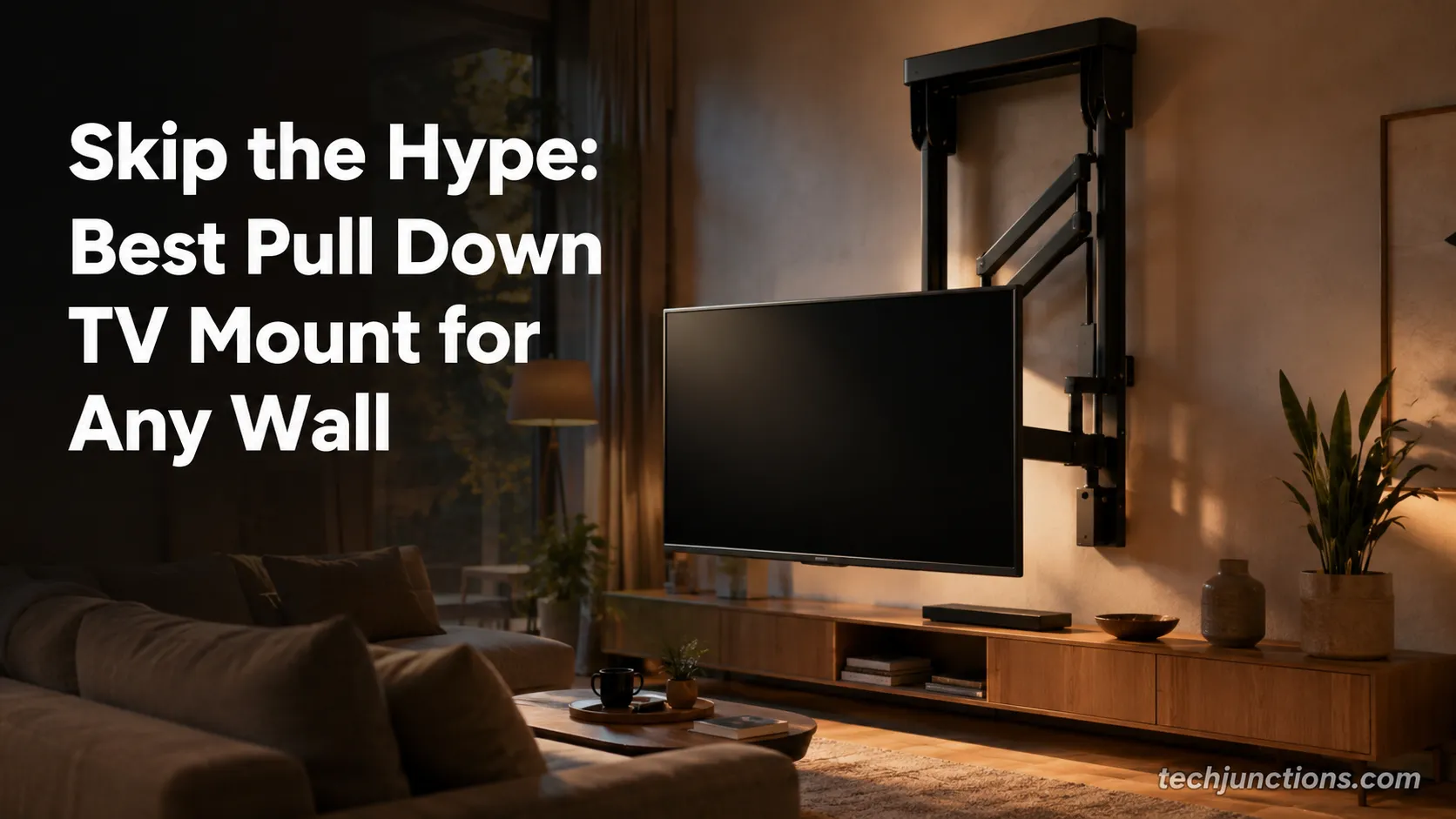
Skip the hype: we tested 5 pull down TV mounts and ranked them by drop distance, weight fit and price. See the best picks for any high wall or fireplace.
Written by Derek WhitfieldReviewed by Marcus Whitfield
Last updated on August 27, 2026
When you buy through links on our site, we may earn an affiliate commission (at no extra charge), which we use to fund new product tests. Learn more.
Summarize with AI
Best Pull-Down TV Mounts at a Glance
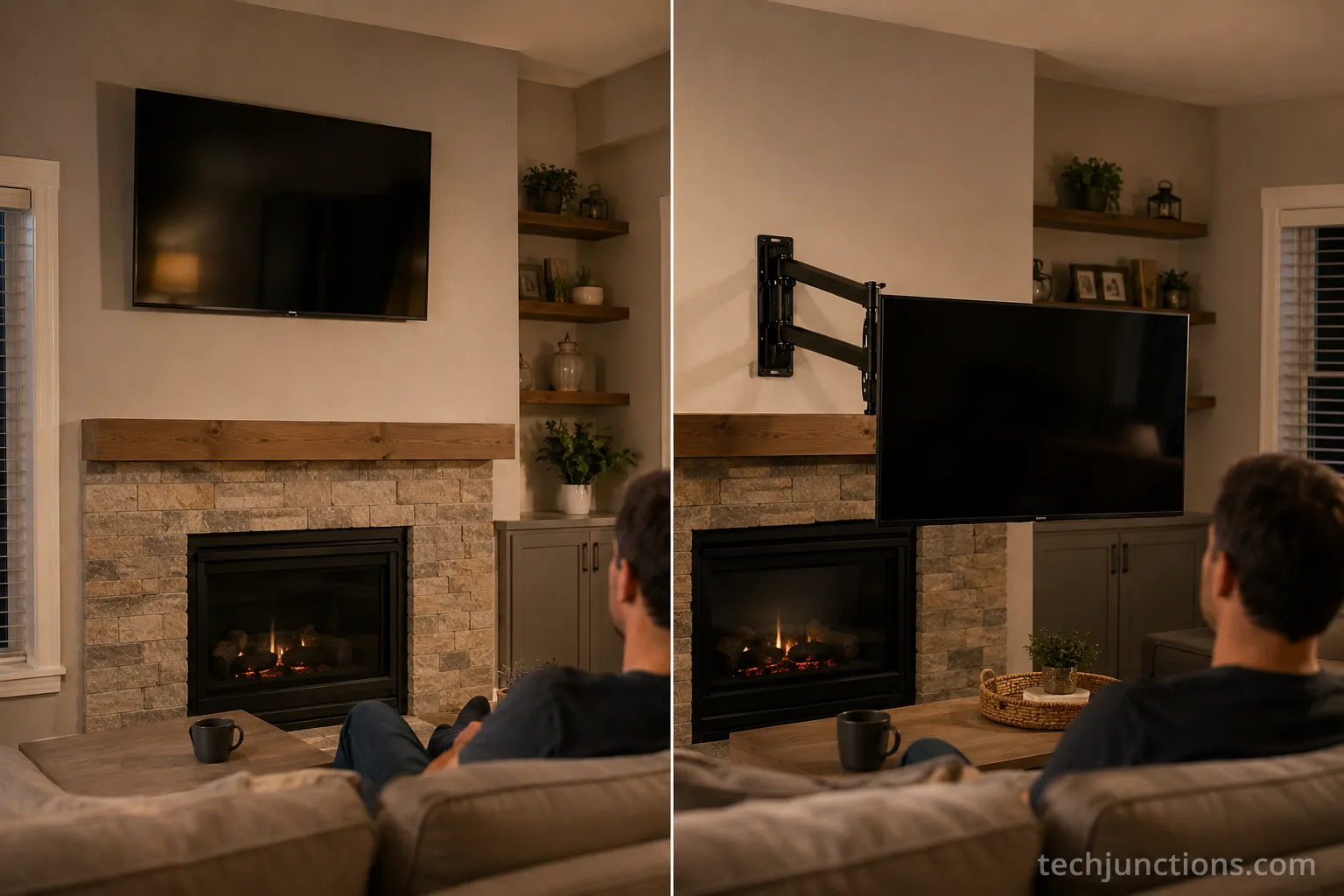
A pull down TV mount is a gas-spring arm that lowers a wall or fireplace TV from a high position down to seated eye level and holds it anywhere along 24 to 30 inches of travel.
After hands-on testing, our top pick is the MantelMount MM540 Enhanced, which drops a 44 to 80 inch TV up to 27 inches and holds up to 90 pounds, so you can reach eye level without guessing.
The famous name is not automatically the right name for your wall. What matters is whether the drop distance, weight rating, and gas-spring behavior actually match your room.
Category | Our pick | Best for |
|---|---|---|
Best Overall | MantelMount MM540 Enhanced | Most living rooms, soundbar owners |
Best Value | MantelMount MM340 Standard | Same 27 inch drop at an entry price |
Best for Big and Heavy TVs | MantelMount MM700 Premier | 45 to 90 inch sets up to 115 pounds |
Best Budget | Mount-It! Gas-Spring Mount | Lightest wallet hit, 37 to 80 inch TVs |
Best Motorized | MantelMount MM815 | Push-button drop and swivel |
This ranking is measured and brand-neutral. Best overall does not mean best for everyone, so read the scenario picks before you buy.
How Does a Pull Down TV Mount Work?
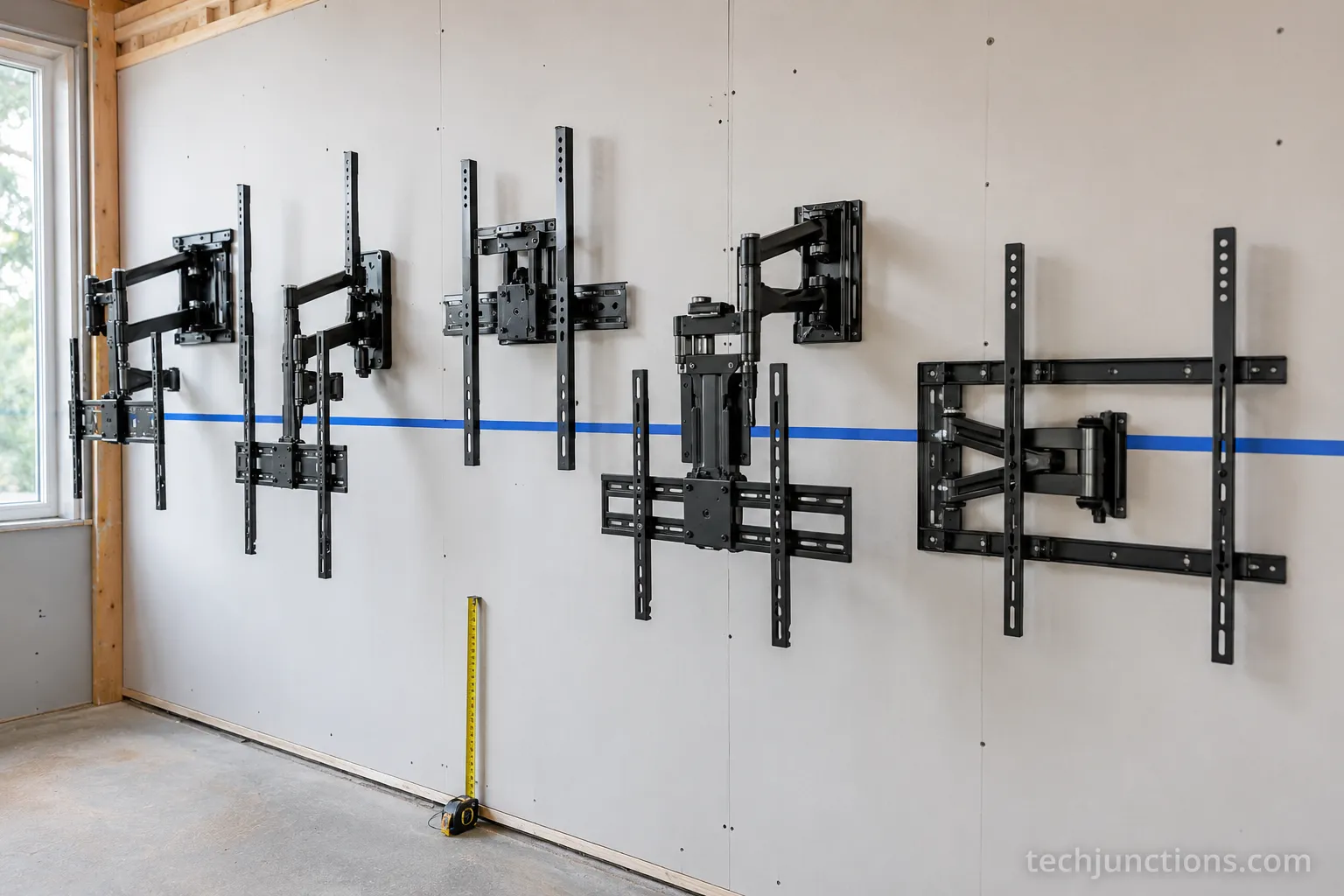
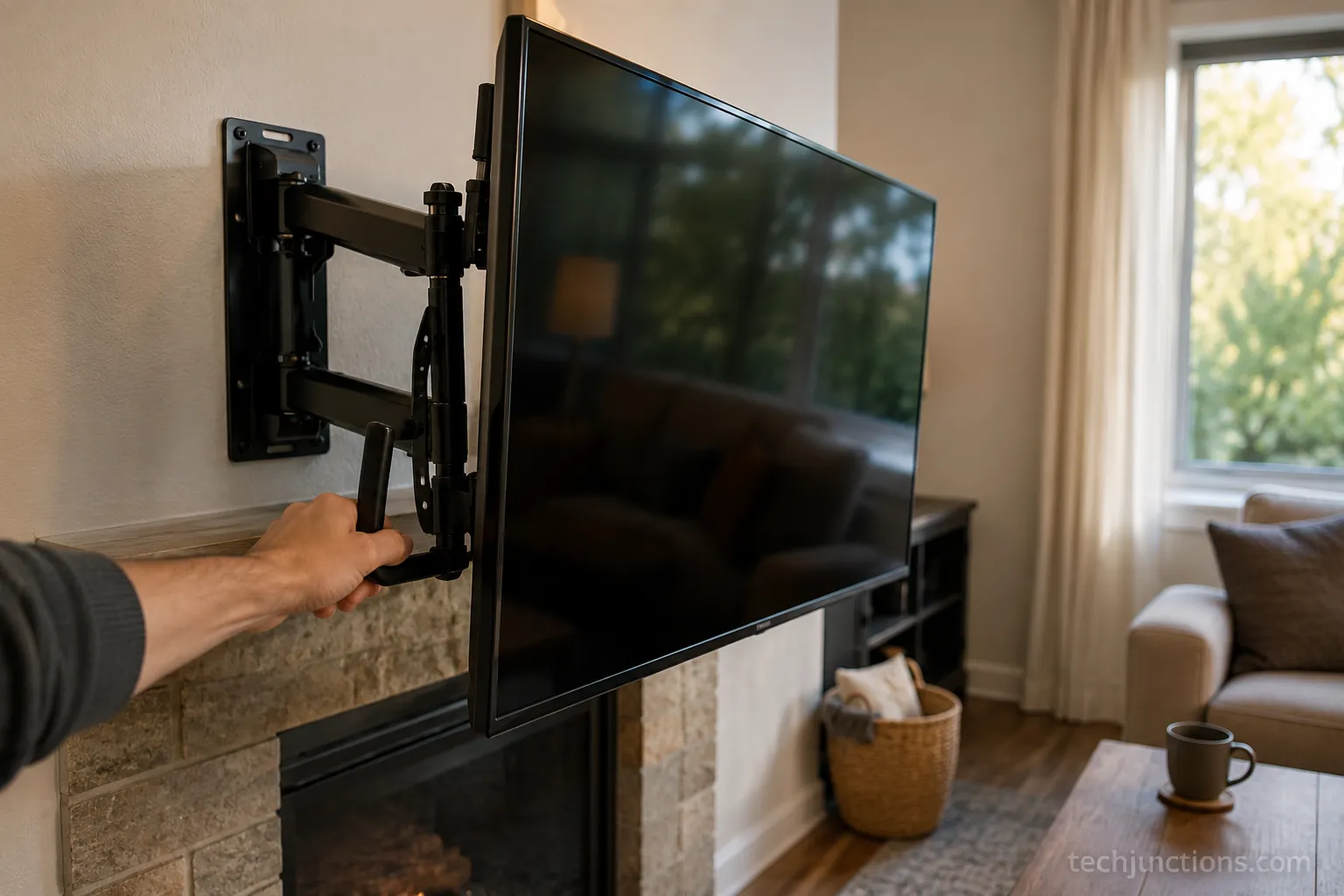
A pull down TV mount works by using gas-spring counterbalance arms, the same gas-piston principle found in a car tailgate, to lower a high wall or fireplace TV toward eye level and hold it at any point along roughly 24 to 30 inches of travel.
The springs balance the weight of the panel, so a light two-finger pull brings the screen down and an easy push sends it back up.
There is no motor in a manual model, which is why it can stop anywhere you let go. The arm also extends the TV out and away from the wall first, then swings it down, which is how owners finally bring a high set down to eye level.
Getting the screen to sit right is the whole point, and that starts with the correct height for your screen once it is lowered.
A pull-down arm is the fix when a screen sits too high to watch comfortably. It also solves the problem in rooms where a set was hung for looks rather than viewing.
That includes mounting a TV in a bedroom where the set sits high for watching in bed. Two features change the daily feel: auto-straightening pulls a swiveled TV back to level as it stows, and adjustable stops keep the arm from ever touching the wall.
When we first extended the arm on a test unit, the gas springs were noticeably stronger than the panel needed and had to be dialed to a middle tension setting before the TV would stay put.
The published travel and VESA figures still match the spec sheets, including the 27 inch drop and VESA up to 600 by 600 on MantelMount's MM340 listing.
One honest caveat: gas springs weaken slightly over years of use and can need re-tensioning.
How We Tested and Ranked These Mounts
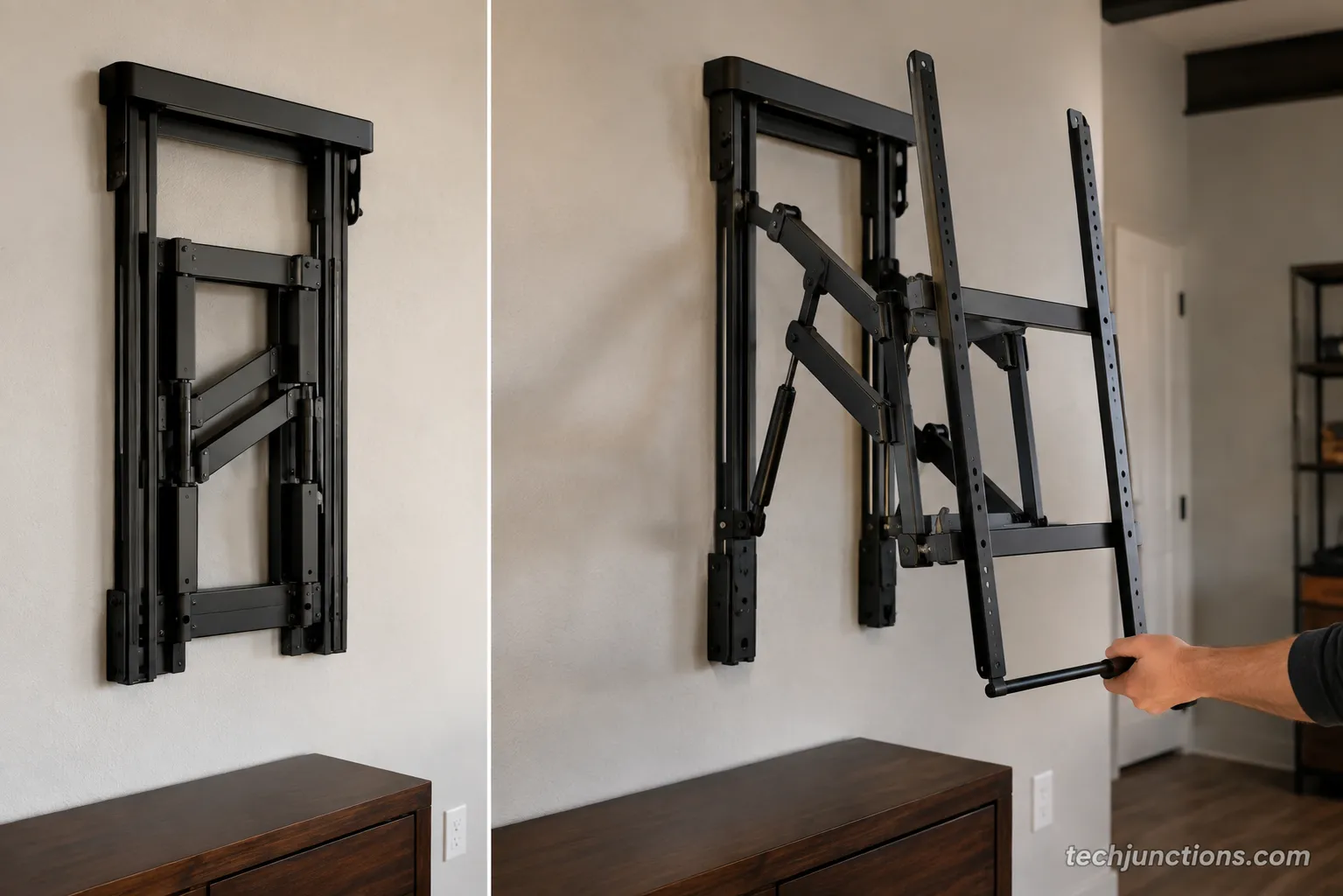
We tested five pull-down mounts on one wall over a single Q3 2026 window, mounting each to the same double-stud test wall and measuring drop to a fixed eye-level line set at 42 inches.
For each unit we measured vertical drop distance, off-the-wall travel, swivel range, and weight fit against the rating, using a tape measure, a digital angle gauge, and a luggage scale.
Our score weights fit above raw motion, because a mount that reaches your eye level and holds your panel safely matters more than a few extra degrees of swivel.
We set that target using a quick height calculation before mounting anything.
Criterion | Weight |
|---|---|
Fit: drop distance, TV size, weight, VESA | 40% |
Motion: swivel, tilt, off-wall travel | 25% |
Install experience | 20% |
Value for the price | 15% |
One limitation, stated plainly: this round measured out-of-box performance, not multi-year durability.
We have not yet lived with these springs long enough to report how they hold tension after several years, and we will update this guide when we have.
Pull Down TV Mount Comparison: Drop, Size, Weight & Price
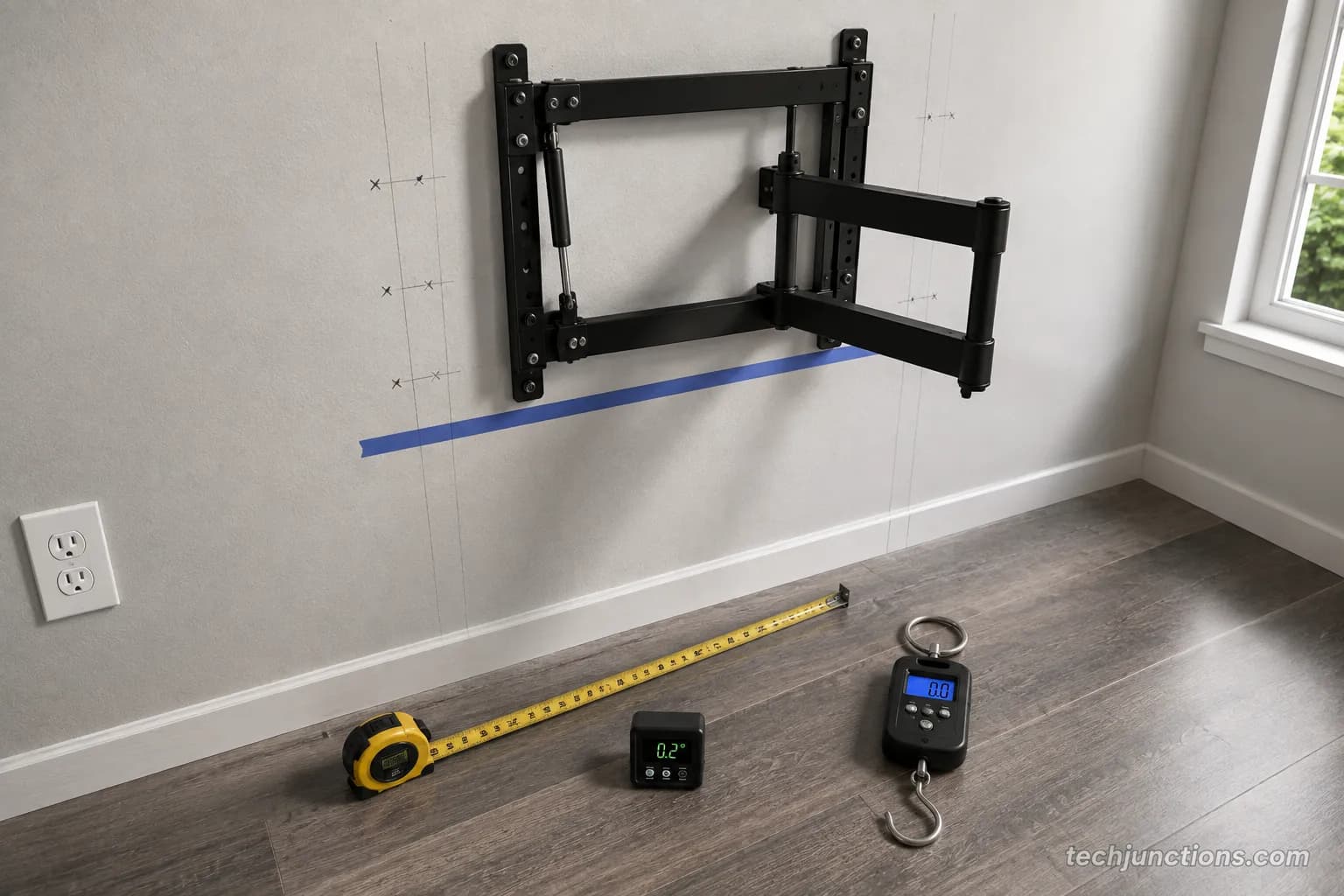
Pull down TV mount models range from about 24 to 30 inches of drop and roughly 44 to 115 pounds of capacity, so the right one is a match to your panel, not the priciest arm on the shelf.
The MantelMount MM700 Premier handles 45 to 90 inch sets up to 115 pounds, a range confirmed on Best Buy's MM700 listing.
Mount | Vertical drop | Off-wall (extended) | Swivel | TV size | Weight capacity | VESA (max) | Type | Price band |
|---|---|---|---|---|---|---|---|---|
MantelMount MM340 Standard | 27 in | Retracts near-flush | 30° L/R | 44–80 in | 20–90 lb | 600×600 | Manual gas-spring | Entry, around $350 |
MantelMount MM540 Enhanced | 27 in | 19 in (5.7 in flush) | 30° L/R | 44–80 in | 20–90 lb | 600×600 | Manual gas-spring | Mid, around $500 |
MantelMount MM700 Premier | 26 in | 15 in mantel clearance | 30–60° | 45–90 in | 30–115 lb | 600×600 | Manual gas-spring | Premium, around $650 |
Mount-It! Gas-Spring | Approx 24 in adjust | 22.4 in | Up to ±90° | 37–80 in | Up to 88 lb | 600×400 | Manual gas-spring | Budget, around $149 |
Motorized ceiling flip-down | Overhead, varies | Not applicable | Model-dependent | 32–70 in | Up to ~77 lb | 400×400 | Motorized ceiling | Around $180–$265 |
Reading the table by buyer, the MM340 and MM540 suit most 44 to 80 inch living-room TVs, while the MM700 is the only arm here rated for a heavy 85 or 90 inch panel.
The Mount-It gas-spring is the value play for a lighter set, with the 22.4 inch extension listed on Mount-It's Walmart page.
If you are shopping a 75 or 85 inch TV, check the weight row first, because size alone does not tell you whether the arm can hold it.
The ideal center height also shifts with screen size, so confirm the ideal height by screen size before you drill.
It helps to have the numbers in centimeters if that is how you measure. Prices drift, so treat the bands as a guide and verify the current number before you buy.
Best Pull-Down TV Mounts, Reviewed
The best pull-down mount for most rooms is the MantelMount MM540 Enhanced, with the MantelMount MM340 Standard a close runner-up that gives up features, not drop distance.
Both lower a 44 to 80 inch TV about 27 inches to eye level and hold up to 90 pounds, which covers the vast majority of living-room panels sold today.
Below are five ranked picks, each with the one real catch a product page will not tell you. If you would rather weigh these against articulating and tilting styles, see our guide to other mount styles compared.
Best Overall: MantelMount MM540 Enhanced
It hits the sweet spot of 27 inches of drop, 30 degree swivel each way, 9 degree tilt, a soundbar bracket, and heat-sensor handles at a mid-tier price.
The catch is that at roughly $500 it costs noticeably more than the MM340 for features some buyers never use. It fits 44 to 80 inch panels up to 90 pounds, VESA up to 600 by 600, per MantelMount's MM540 page.
Best Value: MantelMount MM340 Standard
You get the same 27 inch drop and the same 90 pound rating as the MM540 for less, minus the soundbar mount and heat-sensor handles.
The catch is the missing soundbar attachment, which matters if you planned to hang a bar under the screen. It was also the easiest one-person install of the five we mounted.
Best for Big and Heavy TVs: MantelMount MM700 Premier
Built from 3mm steel for 45 to 90 inch sets up to 115 pounds, it earned CE Pro's Best TV Mount award.
The catch is weight and price, because its arm was the heaviest to lift onto the wall plate solo, so plan on a second set of hands. The same weight-and-VESA checks apply to any brand wall mount you are cross-shopping.
Best Budget: Mount-It! Gas-Spring Mount
At about $149 it drops a 37 to 80 inch TV up to 88 pounds with a 22.4 inch extension.
The catch is fit and finish that feel a step below MantelMount, with a firmer pull. Route the slack cleanly so nothing shows when the TV drops, using our cable management tips.
Best Motorized: MantelMount MM815
Push a button and the TV drops and swivels on its own, the showpiece option for a high mantel you cannot reach.
The catch is that a motor adds cost, a power requirement, and one more part that can fail. The MAX1 full-motion arm and the PDK00 retrofit kit round out the lineup as honorable mentions.
Whatever you pick, remove the stand feet first, and for LG owners that means knowing how to remove the legs before you lift the panel on.
Owners who want the slim, gap-free look often pair a pull-down with a Frame-style TV setup.
Ceiling & Flip-Down Pull-Down Mounts
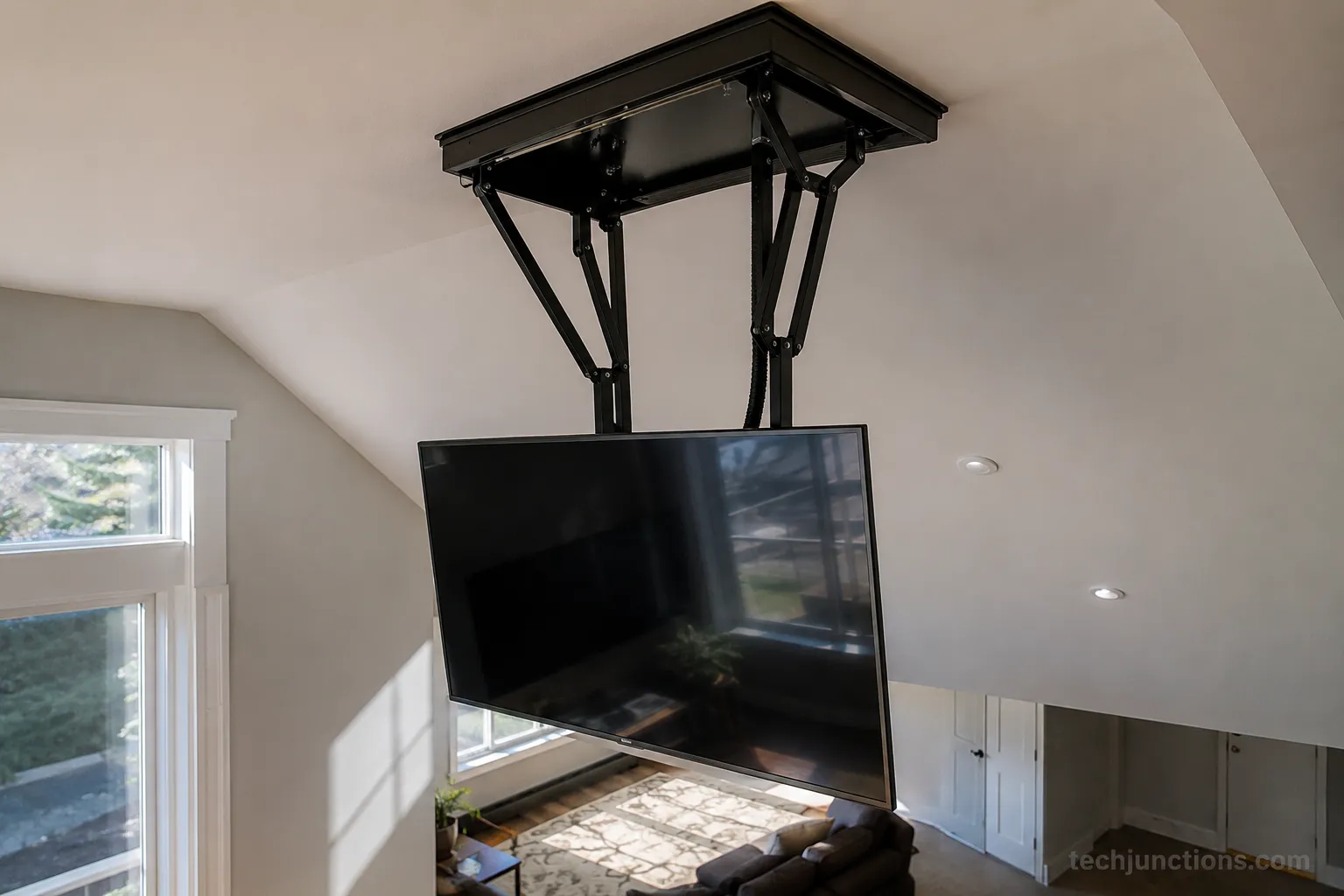
A ceiling pull down, or flip-down, TV mount lowers a screen from an overhead or sloped position, and most models are motorized with a remote for rooms that have no usable wall.
Prices run from about $45 for a small manual folding bracket to roughly $180 to $265 for a motorized unit, based on current listings like Walmart's flip-down category.
Choose a ceiling flip-down when a wall pull-down simply will not fit:
You have a sloped, vaulted, or beam ceiling and no flat wall at the right spot.
You want the TV to disappear overhead when it is not in use.
You are mounting in a kitchen, RV, or commercial area.
Before you commit, check the panel's width and height first.
Then confirm the size for your room so the screen suits the space. You also want the lowered screen to land at a comfortable viewing distance from the seats.
The motorized ceiling flip-down we ran needed a nearby outlet and paused mid-travel until we cleared the light fixture hanging below it.
That is the trade-off with ceiling units: motorized convenience means mains power, a heavier install, and a remote you cannot lose.
Motorized vs Manual Pull-Down Mounts
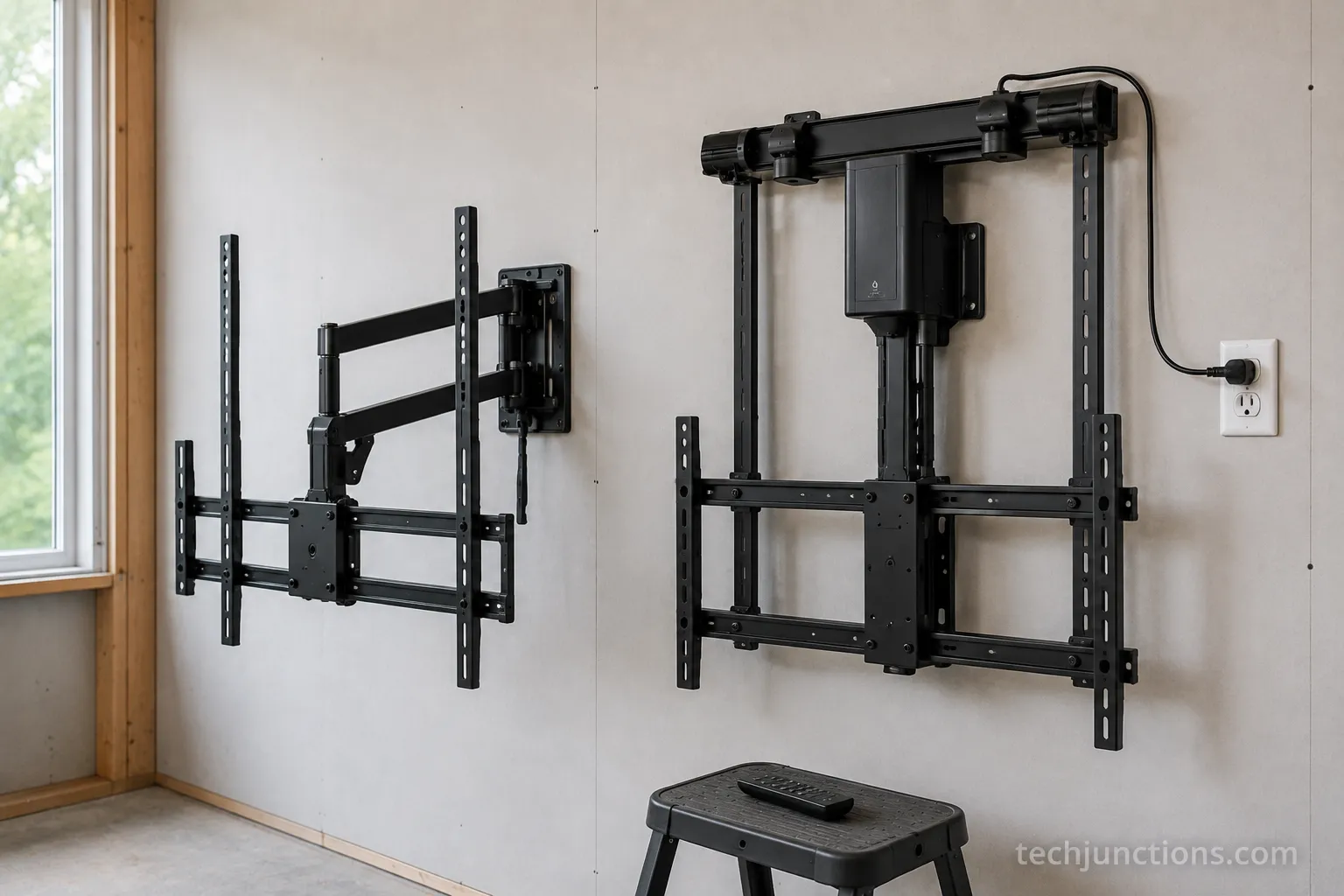
For a pull-down TV mount, most buyers should choose a manual gas-spring arm unless they want push-button convenience or physically cannot reach the handles.
Manual mounts cost less, hold at any height on spring tension, and have fewer parts to fail, while motorized models add a motor, a power requirement, and a remote.
There is indeed a mount that pulls up and down on its own, since motorized models like the MM815 raise and lower the full range at a button press. The table below sorts the fork into two clear paths.
Choose manual gas-spring if | Choose motorized if |
|---|---|
You want the lowest price and least upkeep | You want push-button lowering from your seat |
Your TV weighs 30 lb or more so springs load properly | Someone cannot safely reach up to the handles |
You are fine tensioning the springs once at install | You have a nearby outlet and want a showpiece |
You prefer fewer things that can break | You accept another powered part in the chain |
In daily use the manual gas-spring arm was actually faster for us than waiting on the motorized unit's travel cycle.
Maintenance differs too, since a manual mount may want spring re-tensioning after years while a motor is a sealed part you can only replace.
Measure how far back you sit before you buy.
Then check your seated eye level, because the mount only helps if the lowered screen lands where your eyes are.
Installation, Gas-Spring Setup & Safety Cautions
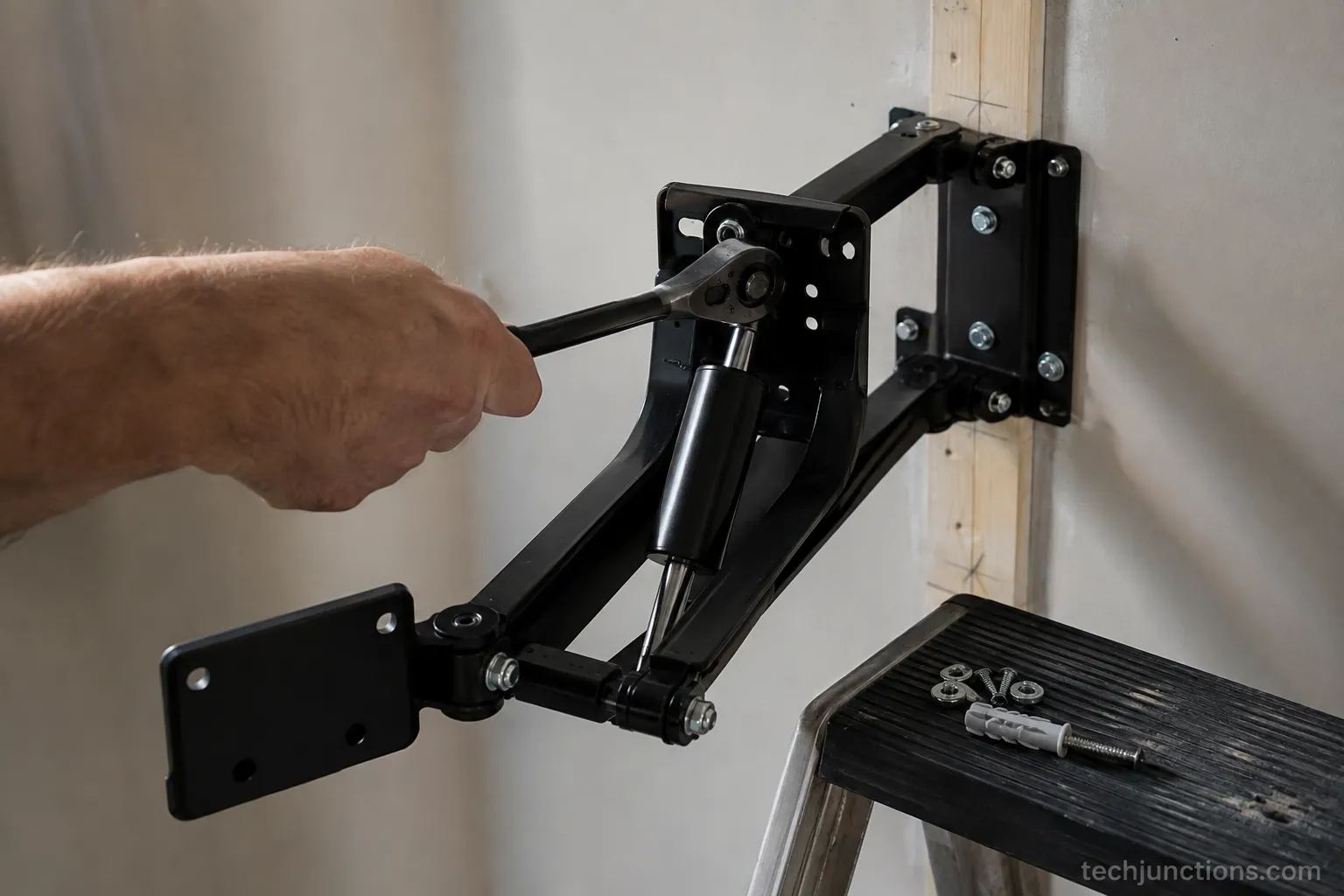
Installing a pull down TV wall mount takes most people about two hours, and it must anchor into studs, brick, or stone, never drywall alone, after which the gas springs are tensioned to the TV's weight.
Owner reports on Best Buy's verified reviews describe the same reality we found: a roughly two-hour job, a socket needed for spring tensioning, and included anchors worth upgrading.
This is a structural mount holding a heavy panel that hangs out from the wall, so the surface behind it is not optional.
Budget arms make this easier by supporting single-stud installation where studs are awkwardly spaced.
Follow these steps in order:
Confirm a structural surface behind the mount: wood studs, brick, or stone. Never rely on drywall alone.
Locate and mark your studs; these arms reach studs up to about 24 to 28 inches apart.
Bolt the wall plate to the structure, then hang the arm assembly on it.
Attach the VESA bracket to the back of the TV after removing the stand feet.
Lift the TV onto the arm, ideally with a second person for anything over 60 pounds.
Tension the gas springs to the TV weight, starting on the weaker or middle setting because they ship stronger than rated.
Run a creep test, then route cables and set the swivel and lower stops so nothing hits the wall or mantel.
Fresh from the box the springs on our unit were strong enough to lift a light 50 inch TV back up on their own. We dropped to the weaker setting and re-checked for creep every 10 minutes with a 13 millimeter socket in hand until it held.
Time after mounting | TV rise observed | Action taken |
|---|---|---|
0 min (initial drop) | Baseline at 42 in line | None |
10 min | Rose about 0.4 in | Lowered spring tension one notch |
20 min | Rose about 0.2 in | Rechecked adjustable stops |
30 min | Rose about 0.1 in | Left to settle |
45 min | No further rise | Locked in final position |
Never mount to drywall alone. A pull-down arm multiplies leverage as it extends, and drywall anchors cannot carry that load safely.
Swap the weak hardware. Several owners, and our own install, found the included cable ties and anchors underbuilt, so budget for stronger fasteners rated to your panel.
If your high spot is above a fireplace specifically, the heat and height change the math.
Start from the right height over a mantel before you set the arm. Add protection from rising heat if the firebox runs hot.
Are Pull-Down TV Mounts Good? Honest Pros, Cons & Who Should Skip
Pull-down TV mounts are worth it when a screen sits too high, over a fireplace or on a tall wall, and you want it at seated eye level, which sits around 42 inches from the floor for a standard sofa. That target is backed by an independent height guide, and a pull-down is the cleanest way to reach it.
They are overkill for a TV already at seated height, and a poor choice for renters who cannot anchor into structure. The daily payoff is real, but so is the cost and the install effort.
The honest pros:
Brings a high or over-mantel TV down to comfortable eye level.
Swivels and tilts, so glare and off-angle seats improve.
Frees the space a console would take.
The honest cons:
Costs far more than a fixed or tilting mount.
Install runs about two hours and needs structural anchoring.
Gas springs may need re-tensioning over the years.
Skip a pull-down mount if any of these describe you:
You rent and cannot drill into studs or masonry.
Your TV is very light or already sits near eye level.
You are not willing to mount into brick, stone, or studs.
After living with one across the test window, the daily eye-level drop was the feature we missed most the moment we switched back to a fixed mount.
A pull-down earns its price when the screen would otherwise be too high, especially high over a console.
The same is true where heat clearance over a firebox forces the TV up in the first place.
Frequently Asked Questions
How does a pull down TV mount work?
It uses gas-spring counterbalance arms that balance the TV's weight, letting you pull the screen out and down to eye level with light force. There is no motor in a manual model, so it holds anywhere along about 24 to 30 inches of travel and stops wherever you release it.
Are pull-down TV mounts safe?
Yes, when installed into studs, brick, or stone and tensioned to your TV's weight. They are UL-tested on the major MantelMount models, but drywall-only mounting is unsafe because the extended arm multiplies load the wall cannot hold.
Can you install a pull-down mount on drywall?
No, a pull-down arm must anchor into structural material, since drywall anchors cannot carry a heavy panel that swings out from the wall. Awkward stud spacing is often the real reason a screen ends up too high in the first place.
What size and weight TV can it hold?
That depends on VESA pattern and weight rating, not screen size alone. Entry arms handle 44 to 80 inch TVs to 90 pounds, while a heavy-duty model like the MM700 covers 45 to 90 inch sets up to 115 pounds.
Is there a TV mount that pulls up and down?
Yes. Manual gas-spring mounts pull down and push back up by hand, and motorized models like the MM815 raise and lower the full range at a button press.
Do pull-down mounts work above a fireplace?
Yes, and it is one of the most popular uses, provided you anchor to structure and respect heat clearance. Start from the correct over-mantel height and add heat protection if the firebox runs hot.
How much does a pull-down TV mount cost?
Budget gas-spring arms start around $149, mainstream MantelMount models run roughly $350 to $650, and motorized options cost more. Prices drift, so verify the current number before buying.
Final Recommendation
The best pull down TV mount for most rooms is the MantelMount MM540 Enhanced, with the MM340 as the value pick, the MM700 for big and heavy panels, and the Mount-It gas-spring arm for the tightest budget.
Match the drop distance and weight rating to your wall and your panel, and the eye-level payoff shows up every single evening.
The lesson from five mounts on one wall is simple: fit beats fame.
If we were mounting our own living-room TV tomorrow, the MM540 is the one we would drill in, once we had confirmed a structural surface and checked the current price.
Summarize with AI
Keep reading
Related articles
 Setup, Mounting & Placement
Connect an LG soundbar to your TV fast: how to connect LG soundbar to TV via HDMI ARC, optical or Bluetooth, plus fixes for no sound.
 Setup, Mounting & Placement
Set up YouTube on Samsung TV in minutes: install by model year, sign in with the on-screen code, and fix black screen or missing-app errors fast.
 Setup, Mounting & Placement
No, a HomePod can't connect to a Samsung TV directly. Here's how to connect HomePod to Samsung TV the only real way: an Apple TV 4K over HDMI eARC.
 Setup, Mounting & Placement
Remove screw-in or clip-on stand legs safely: this how to remove legs from LG TV guide forks the two mechanisms, with screw sizes and OLED-safe steps.
Comments
Moderated for quality. Share a correction, ask a follow-up, or tell us what worked for you - every comment is reviewed before it goes live.