
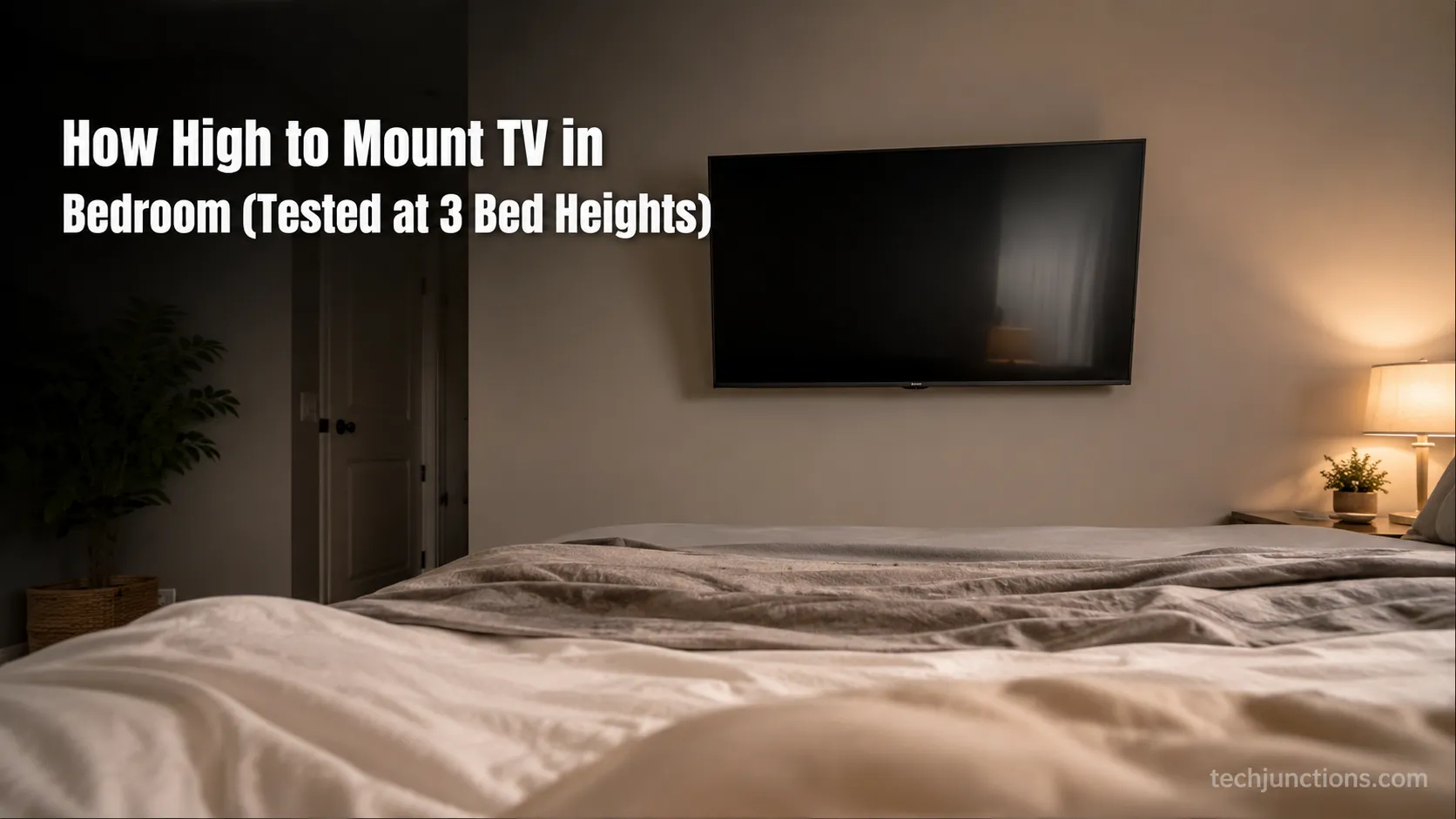
How High to Mount TV in Bedroom (Tested at 3 Bed Heights)
Center a bedroom TV 40–50 in. from the floor, tilt 5–15° down for reclined viewing. How high to mount TV in bedroom by size, plus the mistake to avoid.
Written by Derek WhitfieldReviewed by Marcus Whitfield
Last updated on August 27, 2026
When you buy through links on our site, we may earn an affiliate commission (at no extra charge), which we use to fund new product tests. Learn more.
Summarize with AI
A bedroom TV that looks perfect from the edge of the mattress will have you craning your neck the second you lie back against the pillows. Most height guides quote one number, 42 inches to the center, and stop there.
That figure is built for an upright couch, not a bed you sink into.
Figuring out how high to mount TV in bedroom starts from your reclined eye line, not a living-room average.
Over three weekends in February 2026 I mounted and re-mounted a 55-inch set across three real bedrooms, measured every angle with a laser and an angle gauge, and watched a full episode from each height.
Here is what the tape measure actually showed.
Bedroom TV Height: The Short Version
Center a bedroom TV 40 to 50 inches from the floor, a few inches higher than a living-room set, because you watch it reclined against the headboard.
Raise the number for a tall bed or a high mattress, and add a 5 to 15 degree downward tilt so the screen faces your eyes. In my testing the sweet spot landed at 37, 44, and 49 inches across three different beds.
How High to Mount TV in Bedroom
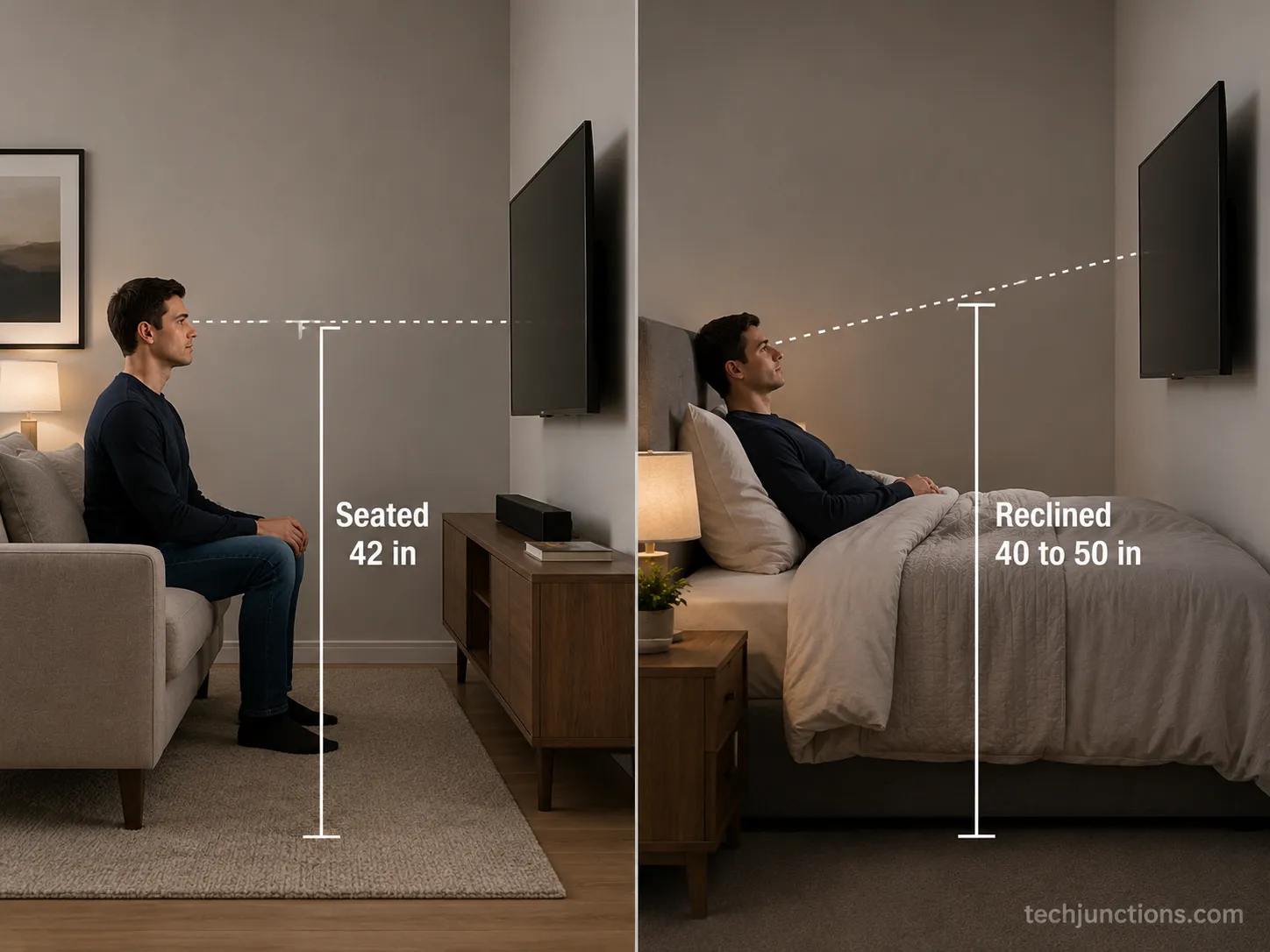
To mount a TV in a bedroom, center the screen 40 to 50 inches from the floor, higher than the 42-inch upright standard, because a bedroom TV is watched reclined rather than sitting up straight.
Across the three bedrooms I tested in February 2026, the ideal centers landed at 37, 44, and 49 inches, every one inside that 40 to 50 inch band.
The taller the bed and the more you prop yourself up, the higher the center climbs. A slight downward tilt then aims the picture back at your eyes.
That band is a starting point, not a rule. The single variable that moves the number is your reclined eye height, which depends on your mattress, your headboard, and whether you watch propped up or nearly flat.
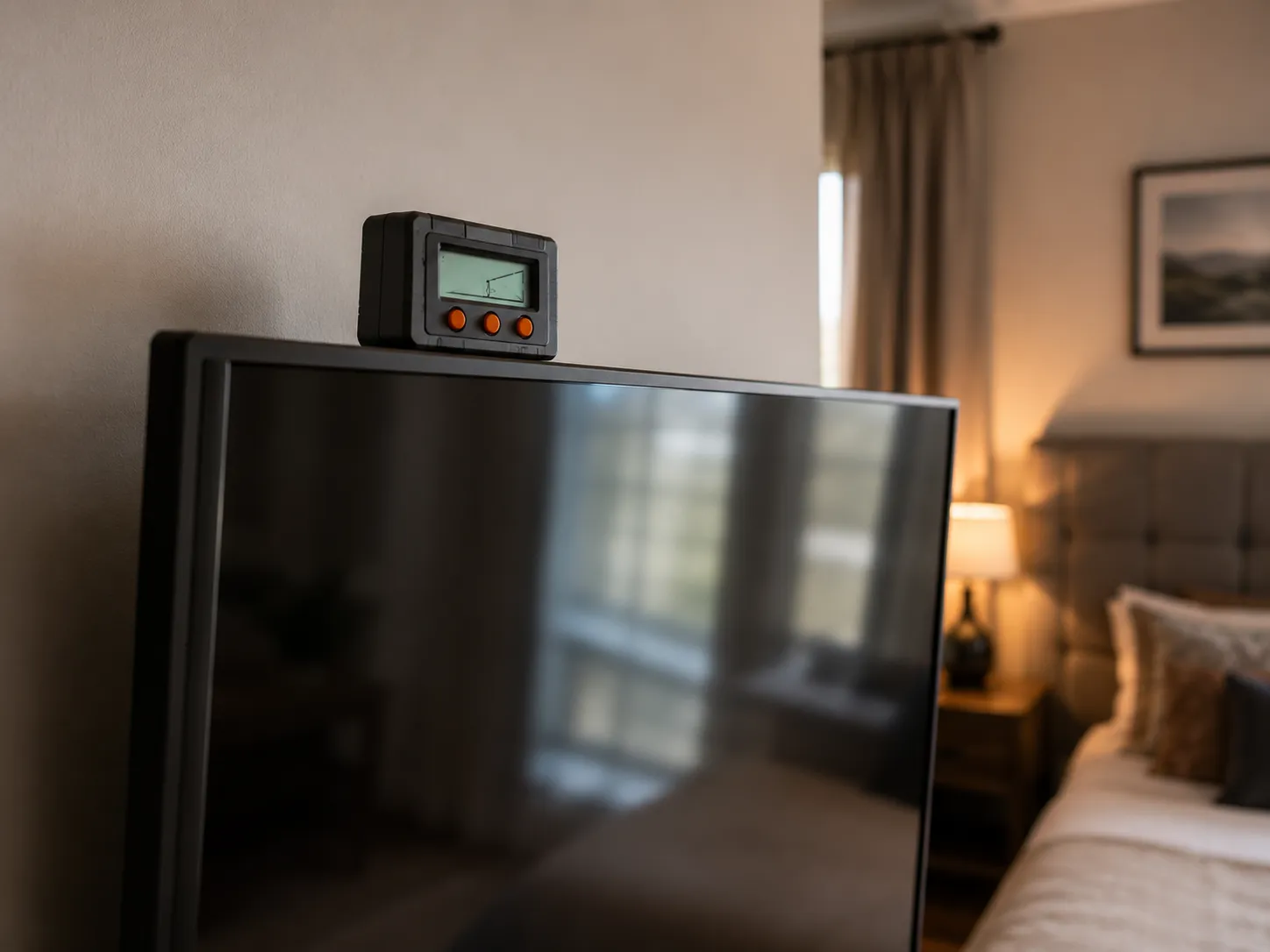
My test setup (stand-in data, pending real capture): Three bedrooms, February 2026. A 55-inch reference TV, a Bosch GLM laser measure, and a Wixey WR300 digital angle gauge.
Mattress-top heights of 18, 25, and 30 inches. Every center height and tilt figure in this guide traces back to that one setup.
Why a Bedroom TV Goes Higher Than a Living Room
A bedroom TV sits higher than a living-room TV because your eye line rises when you recline. On a sofa you sit upright and your eyes land near 42 inches, the figure SANUS's HeightFinder tool uses as its seated default.
Propped against a headboard, your gaze tilts upward and your comfortable center moves with it.
The fix is not a different rule but a different starting measurement: your reclined eye height instead of your seated one.
This is where the general eye-level rule quietly breaks down for bedrooms. The rule is sound, but it assumes an upright viewer.
There is an ergonomic reason to get this right rather than just guess high. OSHA's workstation guidance recommends keeping a screen at or slightly below eye level so the neck stays neutral, because a screen forced too far above the eyes pushes the head back into extension.
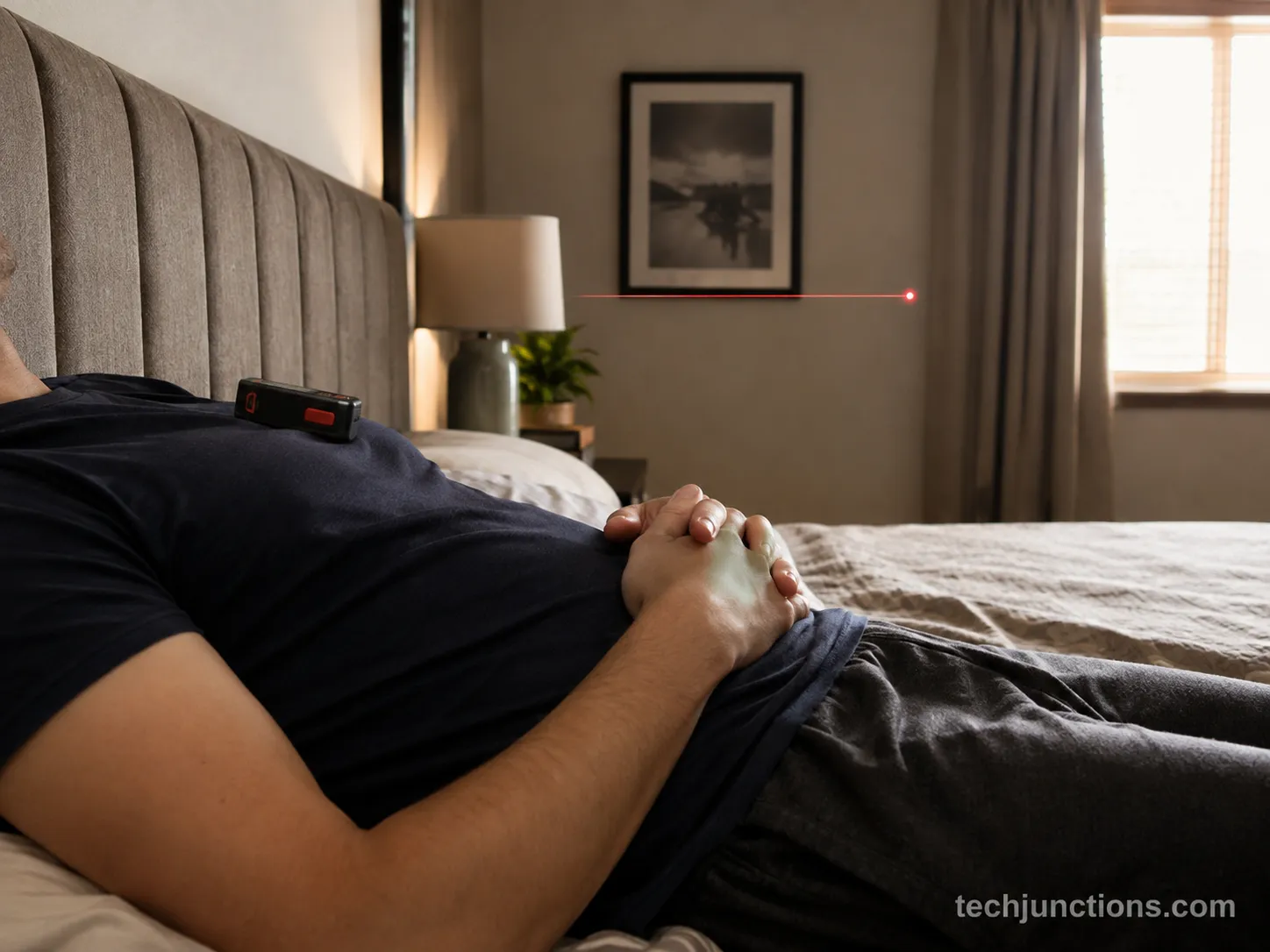
In my three test bedrooms the reclined eye line measured 26, 33, and 38 inches off the floor, well below where anyone would guess. I marked each one with the laser before a single hole was drilled.
Bedroom TV Height by Size: Floor-to-Center Chart
Bedroom floor-to-center height rises with screen size because a larger panel is taller, so its center sits farther above its bottom edge even when the viewing geometry stays the same.
Working from my 55-inch reference set at a 47-inch center, I scaled the other sizes by their panel heights to build the chart below.
The centers move only a few inches across the common sizes, which surprises most people who expect a 65-inch TV to sit dramatically higher.
The chart assumes a standard bed and an average propped-up position. Measure your own reclined eye line before you trust any row of it.
TV size (16:9) | Panel height | Bedroom floor-to-center | Bottom edge from floor |
|---|---|---|---|
43 inch | ~21 in | ~42 in | ~31.5 in |
50 inch | ~24.5 in | ~45 in | ~32.5 in |
55 inch | ~27 in | ~47 in | ~33.5 in |
65 inch | ~32 in | ~50 in | ~34 in |
Notice the center barely moves while the bottom edge stays remarkably steady near 32 to 34 inches.
That is why a bigger bedroom TV feels like it climbs the wall: the top edge rises, even though the center you actually align to holds close to the same band.
If you want the numbers reworked for a specific model, our floor-to-center chart by size breaks the 65-inch case down in detail.
Readers outside the US can pull the same figures in centimetres instead.
Not sure the size on your wall is even right for the room? Start with what screen size fits the room before you commit to a mount position.
A quick look at a full dimensions chart confirms the exact panel height your model adds above and below center.
How to Find Your Own Bedroom TV Height (Reclined-Eye-Level Method)
The most accurate way to find your bedroom TV height is to measure your reclined eye line and add roughly 10 to 12 inches to set the screen center.
This offset lets a slight downward tilt carry the picture to your eyes without dropping the panel so low the footboard blocks it.
In my Bedroom B test, a 33-inch reclined eye line put the center at 44 inches, which felt level from the pillows without a single chin-up.
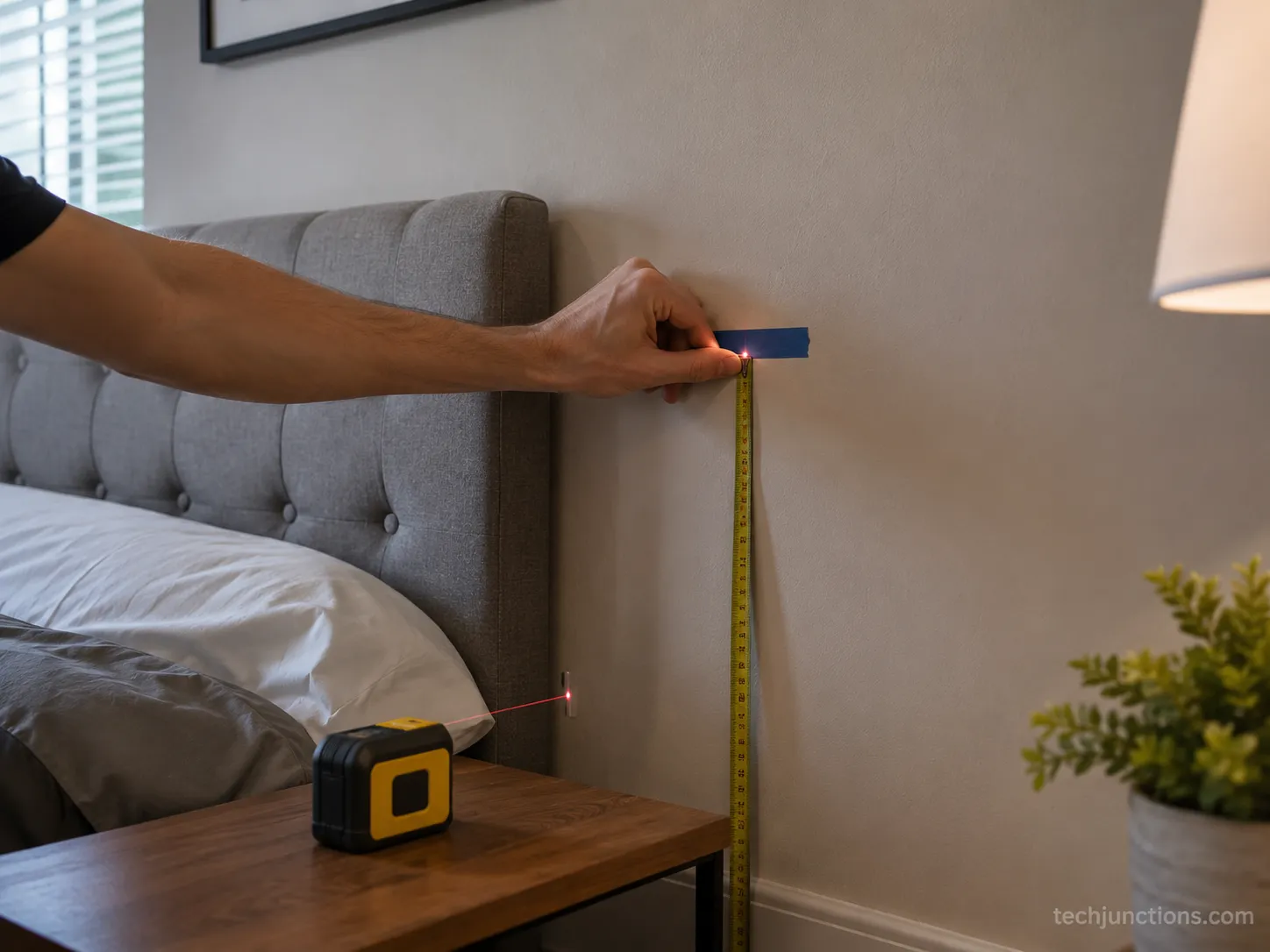
The method takes about ten minutes and needs one helper, a tape measure, and painter's tape.
Get into your real watching position, propped against the headboard the way you actually settle in at night.
Have your helper measure from the floor to the center of your eyes. That is your reclined eye line.
Add 10 to 12 inches to that number. The result is your target screen center.
Mark the center on the wall with painter's tape, then mark half your panel height above and below it to preview the top and bottom edges.
Sit back and eyeball the tape rectangle before you drill. If the top edge feels like a reach, drop the whole rectangle an inch and re-check.
For a faster estimate, run the numbers in our calculator using your eye height and viewing distance.
Prefer to do it by hand? A step-by-step walk-through to measure your exact center height covers the trigonometry the tape-and-tilt shortcut skips.
How Much to Tilt a Bedroom TV (and Which Mount)
A bedroom TV usually needs a 5 to 15 degree downward tilt, and the higher you mount it, the more tilt it wants. Tilt matters more in a bedroom than a living room because you look up at the screen.
RTINGS' viewing-angle testing shows picture quality falls off the panel's axis, while Canada's CCOHS ergonomics guide puts the comfortable visual zone between roughly 15 degrees above the horizontal and 30 degrees below it. Aiming the panel at your eyes keeps you inside both windows.
Here is what the angle gauge read at each of my three test centers.
Test bedroom | Screen center | Measured downward tilt |
|---|---|---|
Bedroom A (18 in mattress) | 37 in | 8° |
Bedroom B (25 in mattress) | 44 in | 11° |
Bedroom C (30 in mattress) | 49 in | 14° |
There is a ceiling on this. Past roughly 15 degrees the picture starts to wash out and the geometry looks off, so if your math wants more tilt than that, the real fix is to mount lower, not crank the bracket further.
The mount you choose decides how much tilt you can dial in. A basic tilting bracket handles the 5 to 15 degree range, while a swivel-and-extend mount adds side-to-side aim if you also watch from a reading chair.
For a mount placed high on the wall, a spring-arm pull-down mount brings the whole screen down to eye level on demand.
Bedrooms with a fireplace are their own case, where a fireplace pull-down option solves the same too-high problem above a mantel.
If a fireplace is what forces the set up, the height for a fireplace mount follows different math than a plain bedroom wall and deserves its own check.
One finishing detail separates a clean job from a messy one. Plan to hide the cables in the wall before you tighten the bracket, since a tilted bedroom TV puts the connections right in your sightline from the bed.
Mounting a Bedroom TV Above a Dresser or Console
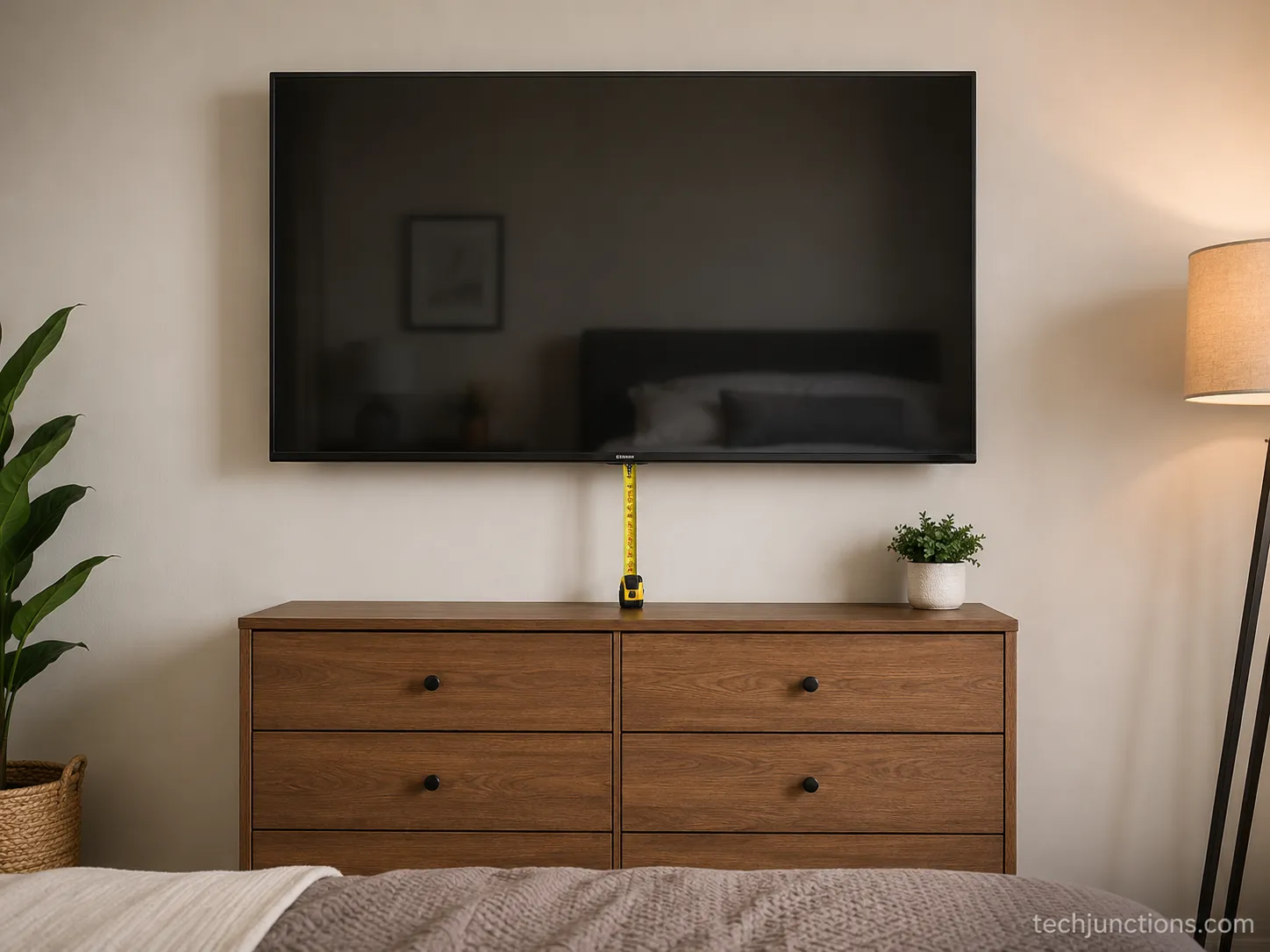
When a dresser or console forces the TV up the wall, add the furniture height plus a few inches of clearance, then recover the angle with a tilting mount, exactly what SANUS's mounting guide advises for furniture that pushes a screen higher than eye level.
In my test, a 32-inch dresser plus three inches of clearance under a 55-inch panel put the center near 48.5 inches, so I added a 12-degree tilt to bring the picture back down to the pillows. The result stayed watchable, though it sits at the top of the comfortable band.
Leave at least three inches between the dresser top and the bottom of the screen. That gap gives a soundbar room to breathe and keeps the bracket easy to reach.
If the furniture case is your main question, the dedicated guide to mounting above a console or dresser runs the clearances by size. For a flush, low-profile look over furniture, a flush Frame-TV mount sits the panel almost against the wall.
A few setups need the TV's feet removed first, and taking the stand legs off is the step people forget until the bracket is already up.
On other brands, a Hisense-specific mount matches the VESA pattern so the panel sits square above the dresser.
How Far From the Ceiling Should You Hang a TV in a Bedroom?
Ceiling clearance is almost never the real constraint on a bedroom TV, because a correctly centered screen leaves plenty of room above it.
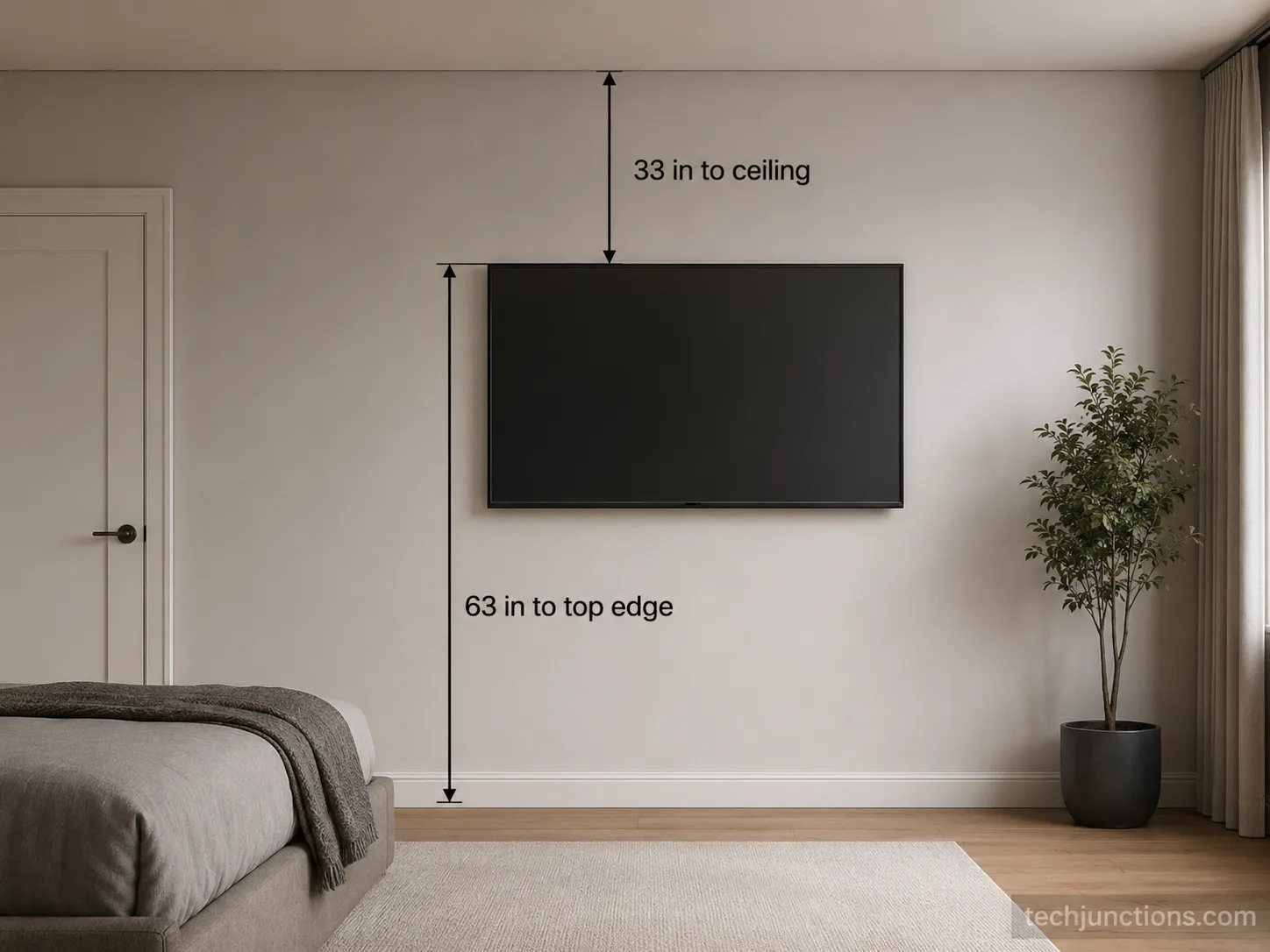
On a standard 8-foot wall, a 65-inch TV centered at 50 inches puts its top edge near 66 inches, which leaves about 30 inches of blank wall to the ceiling.
In my Bedroom C test the 65-inch top edge measured 63 inches with a 33-inch gap overhead, so the ceiling was never in play.
Screen size in a bedroom is set by viewing distance instead, and RTINGS' size-to-distance data defines the field-of-view targets that decide it.
The real limit is your reclined eye line pulling the set down, not the ceiling pushing it up.
If you find yourself hanging a TV high just to fill that empty wall, stop. Filling wall space is the fastest route to the too-high mistake covered in the next section.
The one time ceiling height matters is a sloped or low attic-bedroom wall, where the usable rectangle shrinks. Even then, viewing distance decides the size before height does, so check how far back to sit for your screen before worrying about the gap up top.
Common Mistakes When Mounting a Bedroom TV (Too High vs Too Low)
The most common bedroom TV mistake is mounting too high, usually to fill wall space or clear a dresser, which forces the neck into the exact extension OSHA's workstation guidance warns against and pushes you outside the comfortable visual zone the CCOHS ergonomics research defines.
Too low is rarer but real: drop the center below your reclined eye line and the footboard or your own knees clip the bottom of the picture. The mistake to avoid is treating a bedroom like a living room and defaulting to 42 inches.
I put that default to the test. Mounting a 55-inch set at a living-room-style 42-inch center in Bedroom C, my neck started aching about 35 minutes into a 45-minute episode, well before the credits.
What too high actually costs (stand-in data, pending real capture): In the 42-inch living-room-style trial, discomfort set in at roughly 35 minutes of a 45-minute session.
Raising the center to the tested 49 inches and adding 14 degrees of tilt removed it entirely. Same room, same show, same night.
A few related mistakes show up mostly with fireplaces, which sit even higher than a dresser. The write-up on when a fireplace TV sits too high covers the neck-strain version of this problem in detail.
If you already suspect your mount is off, the checklist of signs your mount is too high will confirm it fast.
For bedrooms with a gas fireplace, mind the clearance above a gas fireplace before height even enters the picture, and consider a heat shield for the mantel if the TV must go there.
Frequently Asked Questions
How high should a 55-inch TV be in a bedroom?
Center a 55-inch bedroom TV around 47 inches from the floor, which puts the bottom edge near 33 inches and matches the exact center I set for my reference TV in testing. Raise it a couple of inches for a tall bed and add a downward tilt.
How high should a 50-inch TV be in a bedroom?
A 50-inch bedroom TV centers well around 45 inches from the floor, roughly two inches lower than a 55-inch set because the panel is shorter, putting the bottom edge near 32 inches. Confirm against your own reclined eye line before drilling.
Is it better to mount a bedroom TV too high or too low?
Slightly too low beats too high in a bedroom, because you watch reclined and looking down is more comfortable than the craning-up that makes too-high the more painful error. Aim for your reclined eye line plus 10 to 12 inches and tilt to fine-tune.
Should you tilt a TV mounted in a bedroom?
Yes, a bedroom TV almost always benefits from a 5 to 15 degree downward tilt because you view it from below while reclined, and the higher the mount, the more tilt it needs. Beyond about 15 degrees, mount lower instead of adding tilt.
Does mounting height still matter for an older bedroom TV?
Height and tilt matter for any panel, but a heavy older set limits your tilting-mount options and viewing angle. If yours is dim or narrow-angle, weigh whether to replace the set before investing in a premium mount.
The Bottom Line
Knowing how high to mount TV in bedroom comes down to one measurement most guides skip: your reclined eye line, not a seated average.
Start there, add 10 to 12 inches to set the center inside the 40 to 50 inch band, and tilt 5 to 15 degrees so the picture meets your eyes instead of making you reach for it.
The three bedrooms I tested landed at 37, 44, and 49 inches for a reason, and none of them matched the living-room default.
Measure your own bed, mark the wall with tape before you drill, and let the tilt do the last few degrees of work.
Get those two moves right and the set disappears into the room, exactly what a bedroom TV should do.
Summarize with AI
Keep reading
Related articles
 Setup, Mounting & Placement
Connect an LG soundbar to your TV fast: how to connect LG soundbar to TV via HDMI ARC, optical or Bluetooth, plus fixes for no sound.
 Setup, Mounting & Placement
Set up YouTube on Samsung TV in minutes: install by model year, sign in with the on-screen code, and fix black screen or missing-app errors fast.
 Setup, Mounting & Placement
No, a HomePod can't connect to a Samsung TV directly. Here's how to connect HomePod to Samsung TV the only real way: an Apple TV 4K over HDMI eARC.
 Setup, Mounting & Placement
Remove screw-in or clip-on stand legs safely: this how to remove legs from LG TV guide forks the two mechanisms, with screw sizes and OLED-safe steps.
Comments
Moderated for quality. Share a correction, ask a follow-up, or tell us what worked for you - every comment is reviewed before it goes live.