
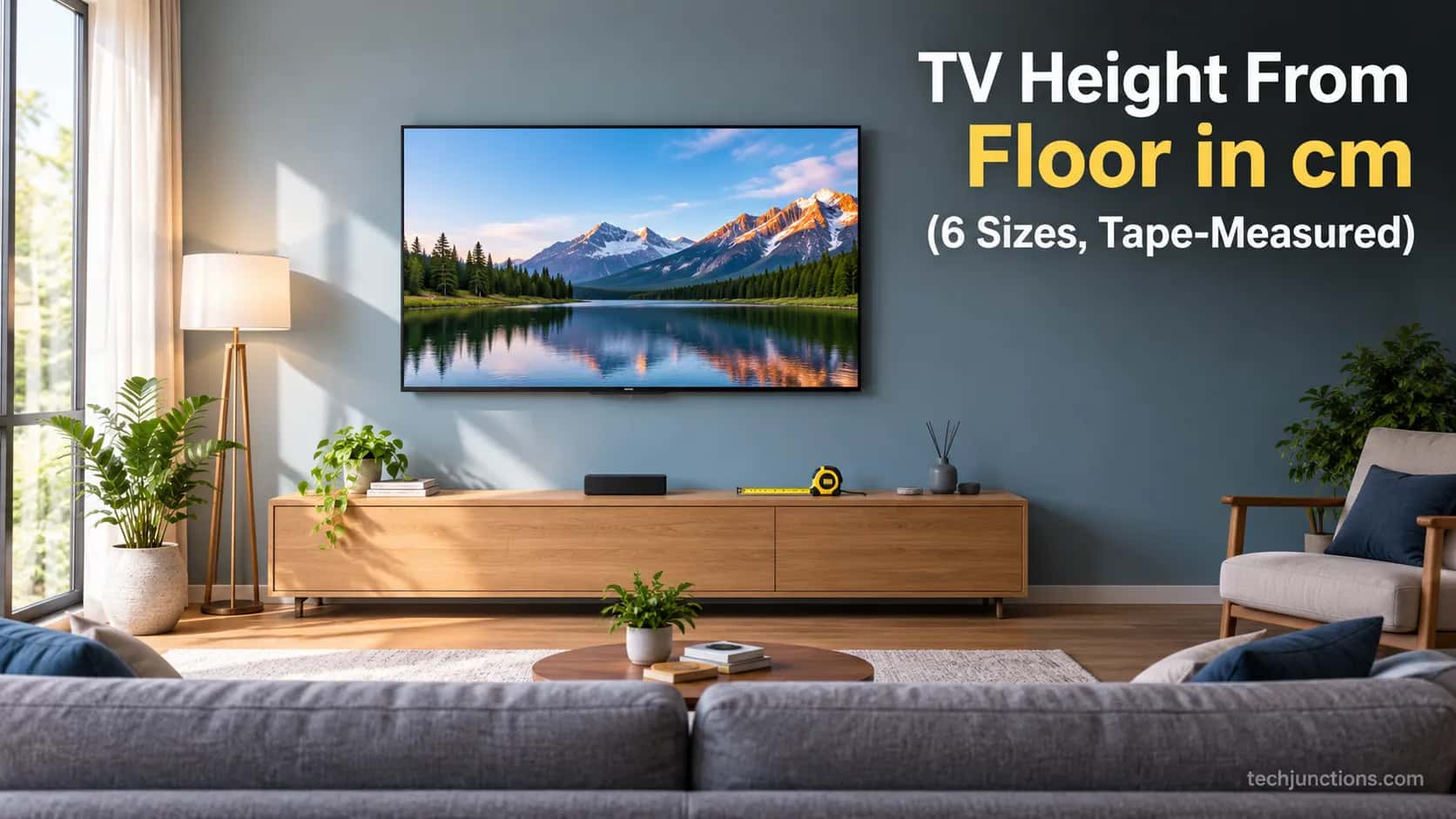
TV Height From Floor in cm (6 Sizes, Tape-Measured)
Get the exact TV height from floor in cm for every size (43–85"): floor-to-center + bottom-edge, in cm and inches, on seated eye level.
Written by Derek WhitfieldReviewed by Marcus Whitfield
Last updated on August 27, 2026
When you buy through links on our site, we may earn an affiliate commission (at no extra charge), which we use to fund new product tests. Learn more.
Summarize with AI
Most people mount their TV by eye, then feel a low ache two episodes in. The number that fixes it is simpler than the brand spec sheets make it look.
The correct tv height from floor in cm comes from one rule, seated eye level, turned into an exact figure for your screen size. I measured all six common sizes at the wall with a tape, so you can read your number and stop guessing.
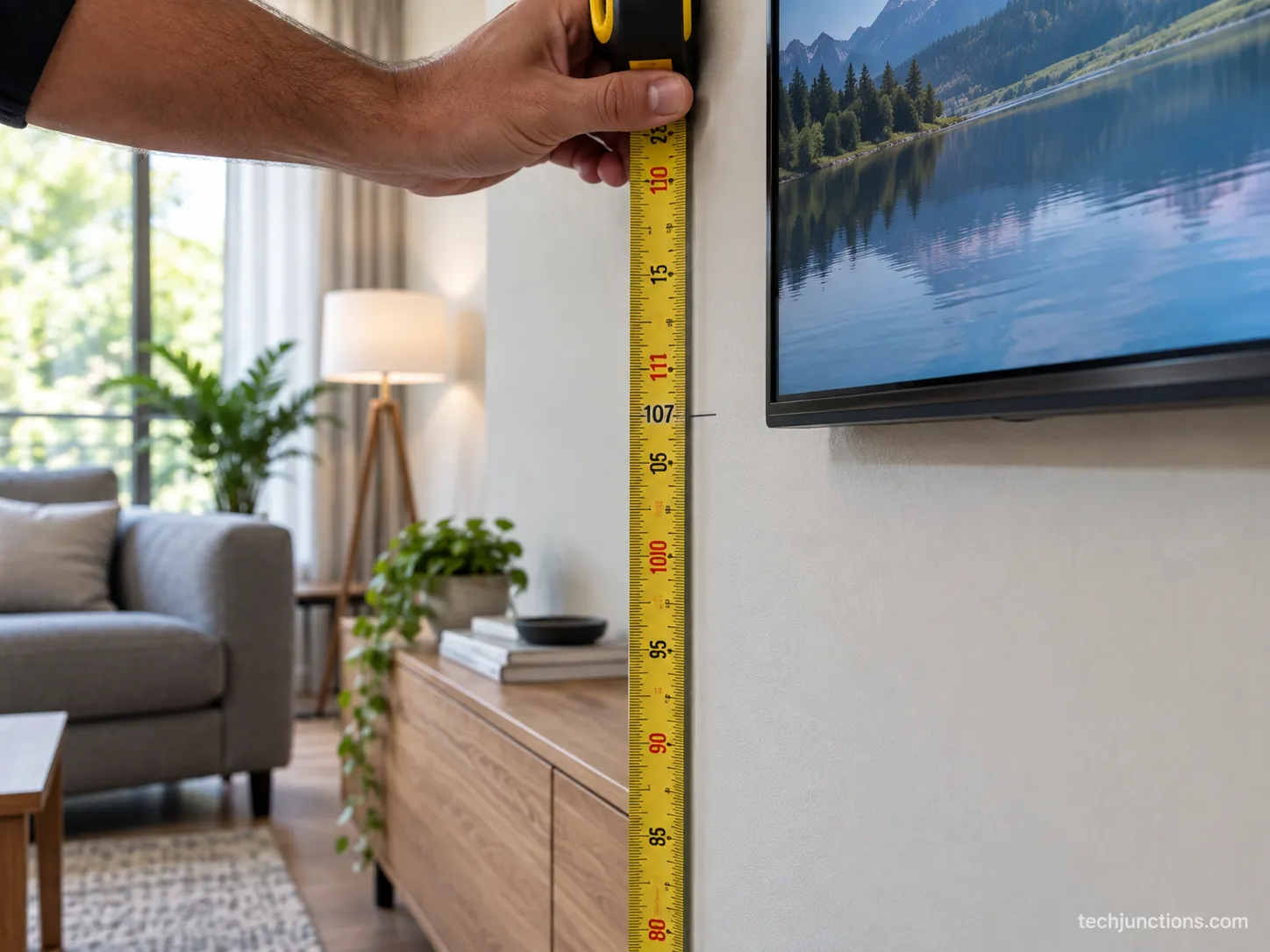
Mount the center of the screen at seated eye level, about 107 cm (42 inches) from the floor for a standard sofa.
The comfortable band runs 105 to 152 cm depending on your seat and room.
Only the bottom edge moves with screen size; the center stays put. Read your exact size in the table below.
Center at Seated Eye Level (~107 cm)
The height of a wall-mounted TV from the floor is measured to the screen center, and that center belongs at seated eye level. For a standard sofa that lands at roughly 107 cm (42 inches).
According to Vogel's height guide, the optimal position sits at or just below eye level while seated, usually between 105 and 152 cm from the floor. Give the screen center 107 cm and your eyes meet it without tilting up.
When I set my own 65 inch up, centering it at 107 cm put the screen exactly on my seated eye line on a standard sofa.
Why TV Height Is Measured to the Screen Center
TV mount height is measured to the screen center because the center is what your eyes settle on. Eye level is fixed by you, not by the television.
Experts at HelloTech recommend the screen center at seated eye level, about 42 inches for the average viewer. Screen size does not change that target, so the center stays near 107 cm whether the TV is 43 or 85 inches.
That single idea kills the most common myth: that a larger TV must be mounted higher. It should not, because only the edges move.
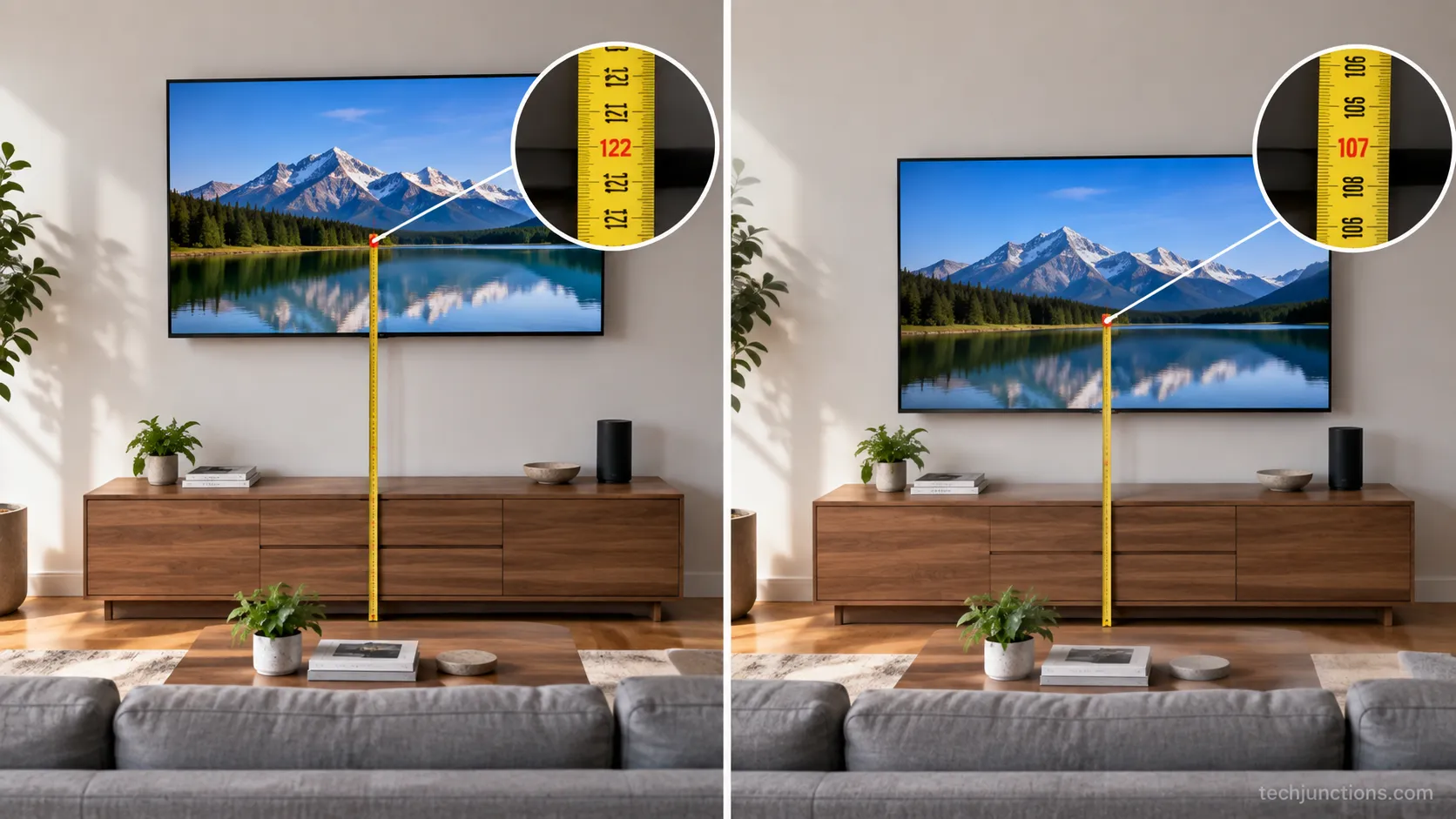
My first mount put a 65 inch center at 122 cm because it looked balanced on the wall. Two evenings in my neck ached by the second episode, and dropping the center to 107 cm fixed it that night.
The recline caveat: Most people slide down into the sofa within ten minutes, which raises the gaze a few centimeters. Measure your relaxed watching position, not a bolt-upright pose, or you will mount slightly too high.
For the full eye-level rule and the by-size chart in one place, see the main mount-height guide. If you would rather derive it from your own seat, the eye-level formula walks through the math.
TV Height From Floor in cm, by Screen Size (43–85″)
Here is the tv height from floor in cm by screen size: the center stays at 107 cm (42 inches) across every size. Only the bottom edge drops as the panel grows taller.
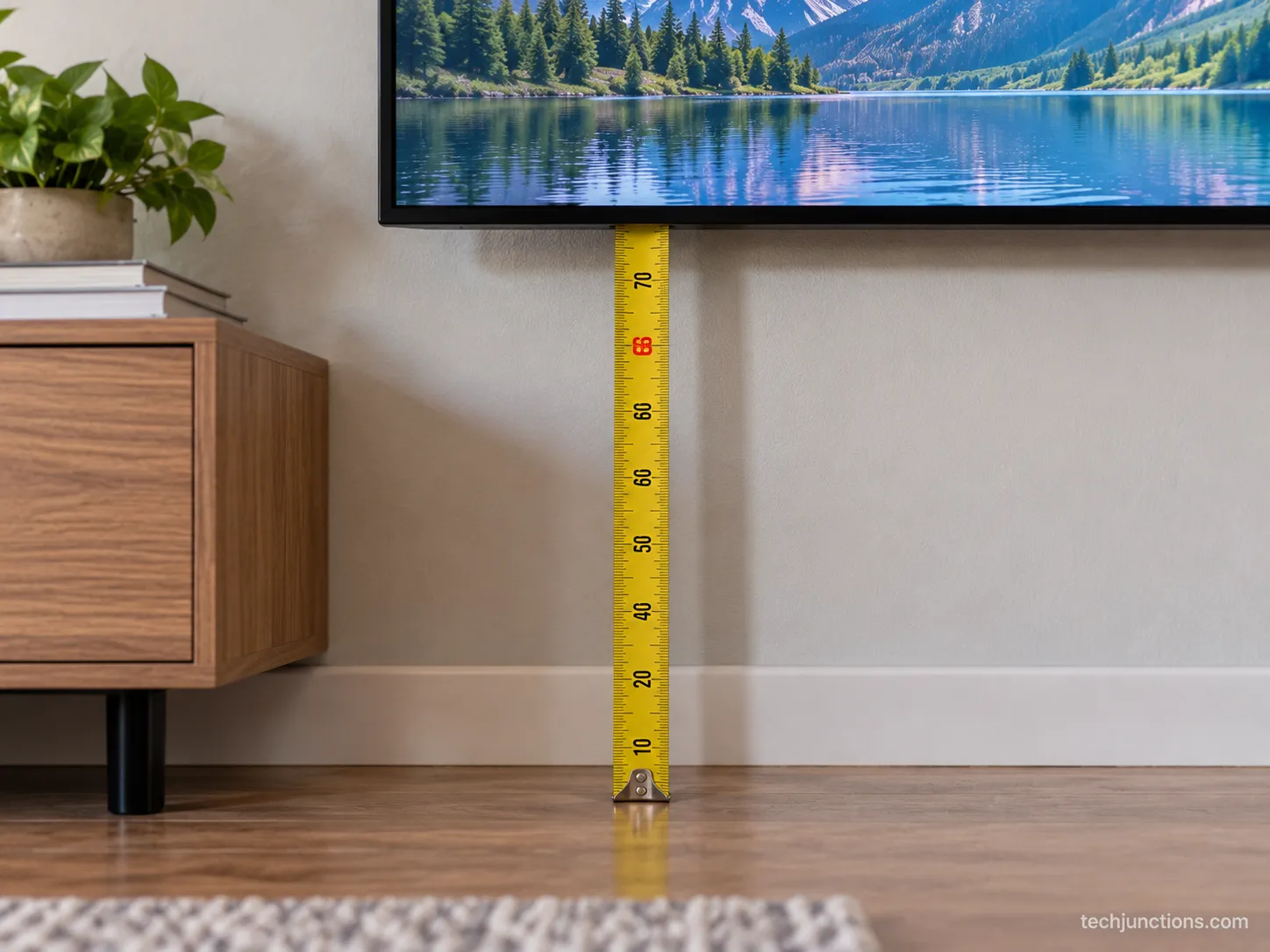
The screen height for a 16:9 TV is about the diagonal times 0.49, so the bottom edge is the center minus half that height. I measured each size at the wall, and the 65 inch bottom edge landed at 66 cm.
Screen size | Screen height (16:9) | Floor to center | Floor to bottom edge |
|---|---|---|---|
43 inch | 53.5 cm / 21.1 in | 107 cm / 42 in | 80 cm / 31.5 in |
50 inch | 62 cm / 24.5 in | 107 cm / 42 in | 76 cm / 29.8 in |
55 inch | 68.5 cm / 27 in | 107 cm / 42 in | 72 cm / 28.5 in |
65 inch | 81 cm / 31.9 in | 107 cm / 42 in | 66 cm / 26 in |
75 inch | 93.5 cm / 36.8 in | 107 cm / 42 in | 60 cm / 23.6 in |
85 inch | 106 cm / 41.7 in | 107 cm / 42 in | 54 cm / 21.2 in |
43 inch: Center 107 cm, bottom edge about 80 cm from the floor. The smallest common size sits highest at the bottom because the panel is short.
50 inch: Center 107 cm, bottom edge about 76 cm. That is a four-centimeter drop from the 43 inch as the panel grows.
55 inch: Center 107 cm, bottom edge about 72 cm. This lines up with the roughly 28.5 inch figure Taskrabbit's mounting guide gives for a standard sofa.
65 inch: Center 107 cm, bottom edge about 66 cm. This is the size I checked most closely, and the tape agreed with the formula.
75 inch: Center 107 cm, bottom edge about 60 cm. The big panel now hangs low, which is correct, not a mistake.
85 inch: Center 107 cm, bottom edge about 54 cm. The bottom sits just above most consoles, so check your furniture clearance.
The method line to remember is simple: bottom edge equals 107 cm minus half the screen height. The same per-size centimeters appear on Tono's height chart, which lists a 65 inch bottom near 66 cm.
Adjust for your own eye level. These figures assume a 107 cm eye line and a 16:9 panel. Your sofa, height, and bezel vary, so treat the table as the starting point and shift it in the next sections.
For the same numbers framed as a how-to by size, see our by-size mount guide. If you also need raw panel width and height, the dimensions chart lists them by size.
Floor-to-Center vs Bottom-Edge: Which Number to Drill To
The floor-to-center figure is the ergonomic target, but you drill and hang from the bottom edge. So you translate one into the other before marking the wall.
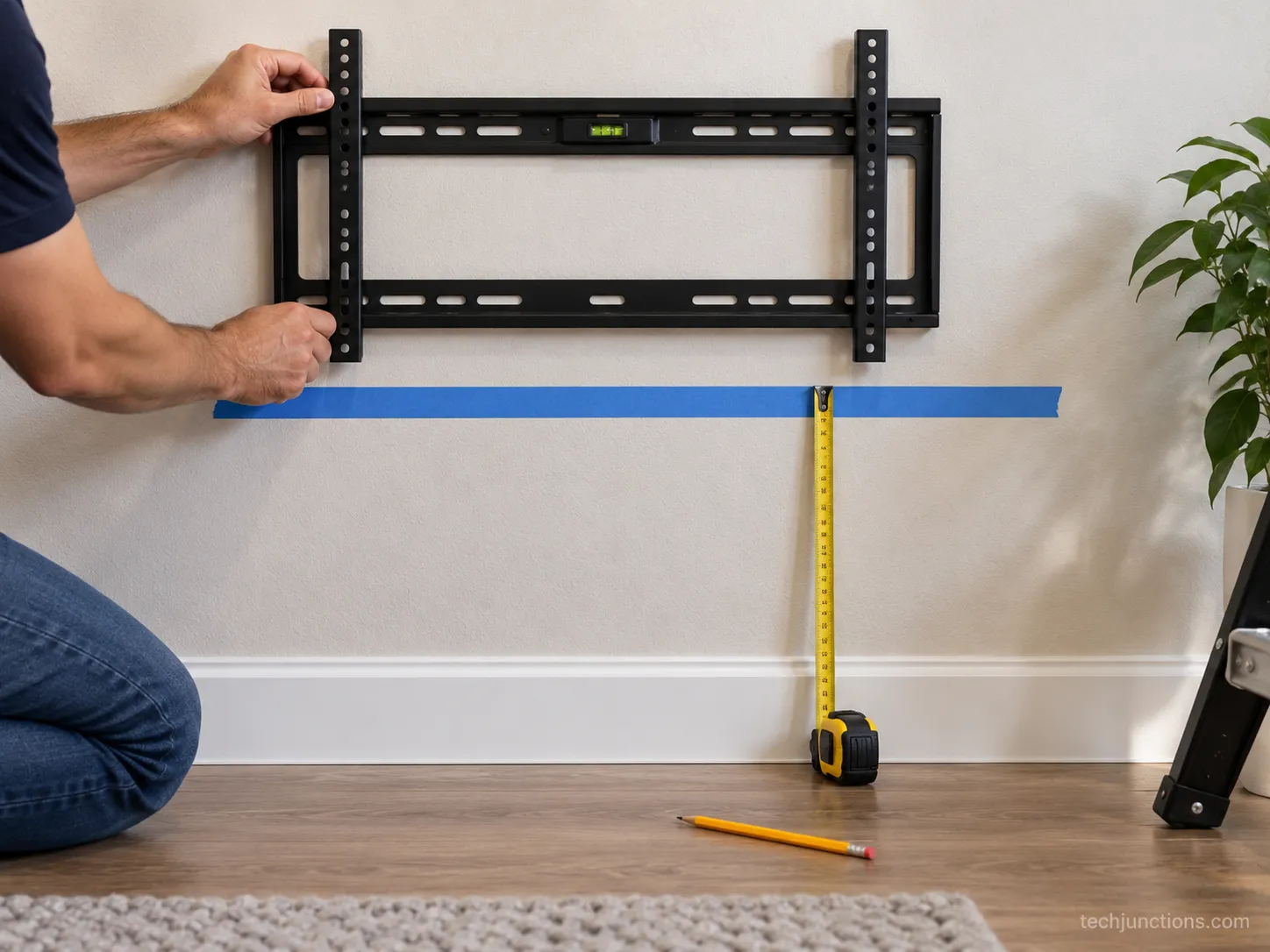
Aim the center at 107 cm, then subtract half the screen height to find the bottom edge. For a 65 inch that gives a 66 cm line to measure to.
One extra step saves a re-drill: the mount hooks usually sit a few centimeters above the panel's true bottom. Check where your bracket grips before committing to the holes.
I mark the bottom-edge line in painter's tape first, then hold the bracket to it and confirm the hooks sit about 5 cm above the tape before I drill.
Prefer to skip the arithmetic? The mounting-height tool does the bottom-edge math from your size and seat.
Still choosing a size for the room? Our size tool pairs viewing distance with screen size.
How to Measure Your Own Eye Level (and Adjust the Chart)
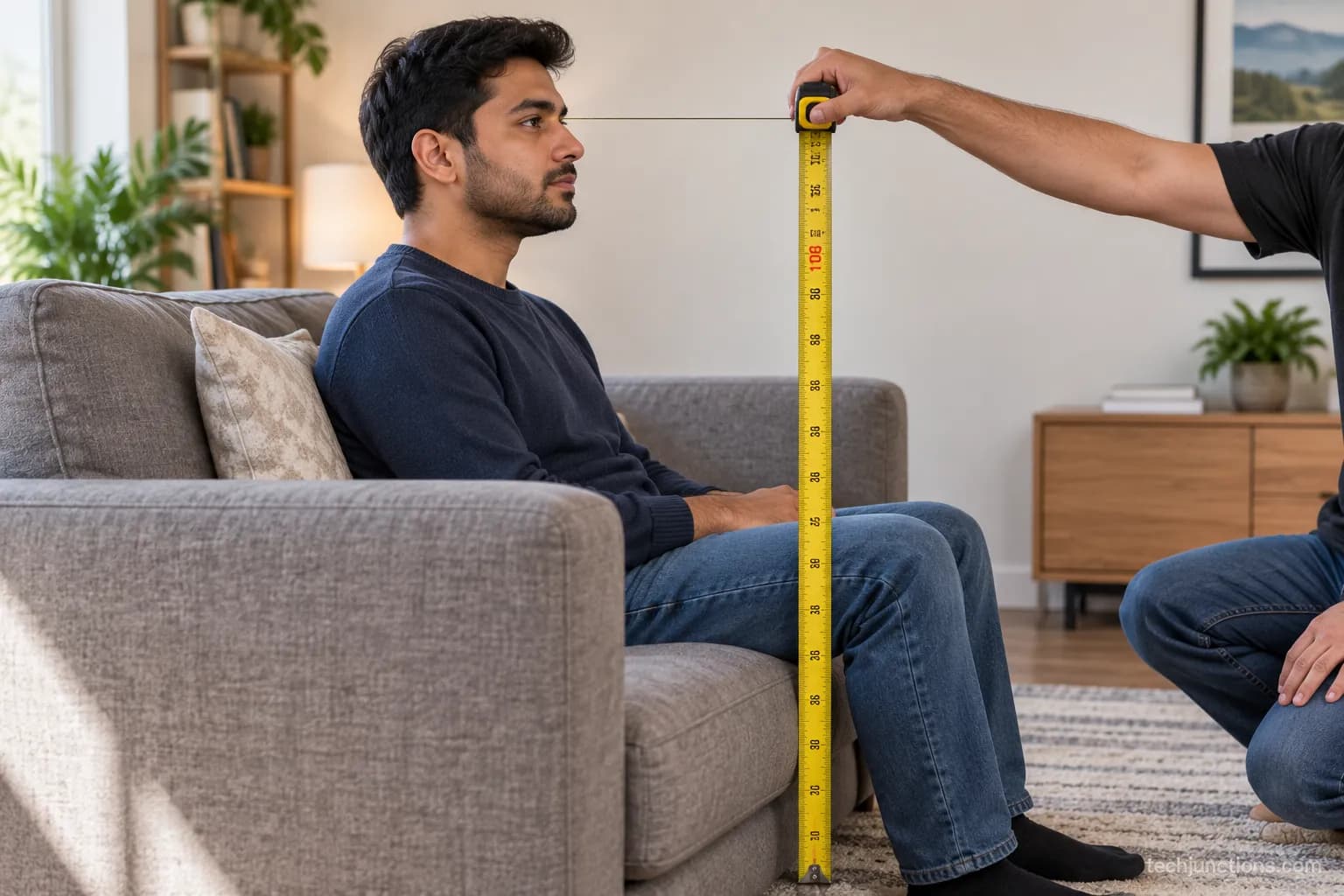
To personalize the tv height from floor in cm for your own room, sit where you actually watch and measure the floor-to-eye distance. That number is your center target.
JALG's measuring tip says to measure while seated in your normal spot rather than trusting a single average. Most standard sofas land between 102 and 114 cm at the eyes, which is why 107 cm works as a default.
Follow these steps:
Sit in your usual watching position, relaxed, not upright.
Have someone measure from the floor to your eye line in centimeters.
Use that number as your center target instead of 107 cm.
Subtract half your screen height from it to get your personal bottom edge.
Measuring my own relaxed sofa position gave 108 cm to the eye, one centimeter above the default. So I used 108 cm and raised every bottom edge by that centimeter.
When several people watch: Average the main seats rather than optimizing for one chair. Remember that reclining lifts the gaze a few centimeters.
If yours already feels wrong, here is how to tell it is mounted too high and fix it.
Prepping the wall means tidying the run first, which our cable-management walkthrough covers.
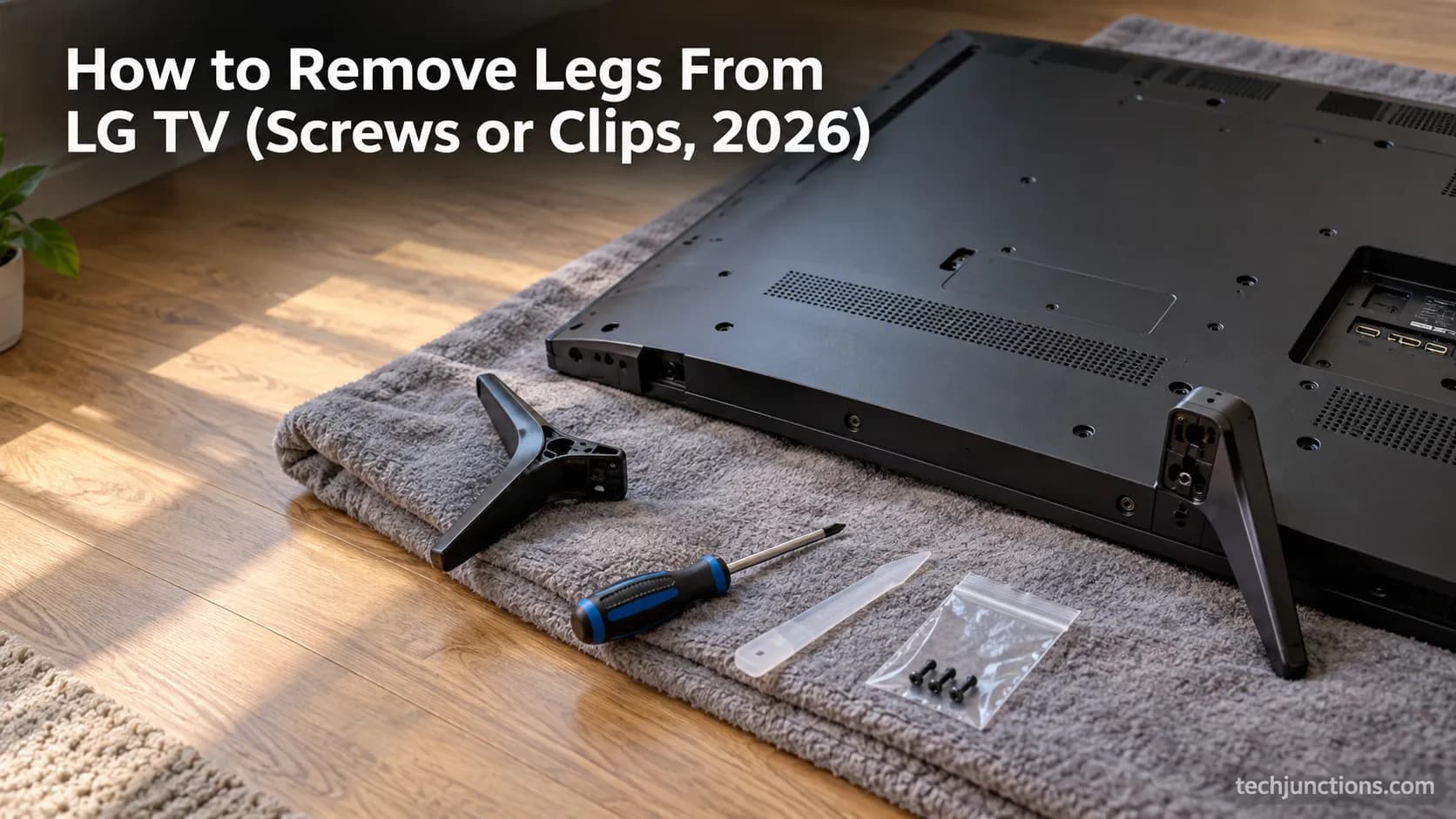
Moving a stand TV onto the wall may also mean taking the feet off before you start.
Inch-to-cm Conversions for TV Mount Height
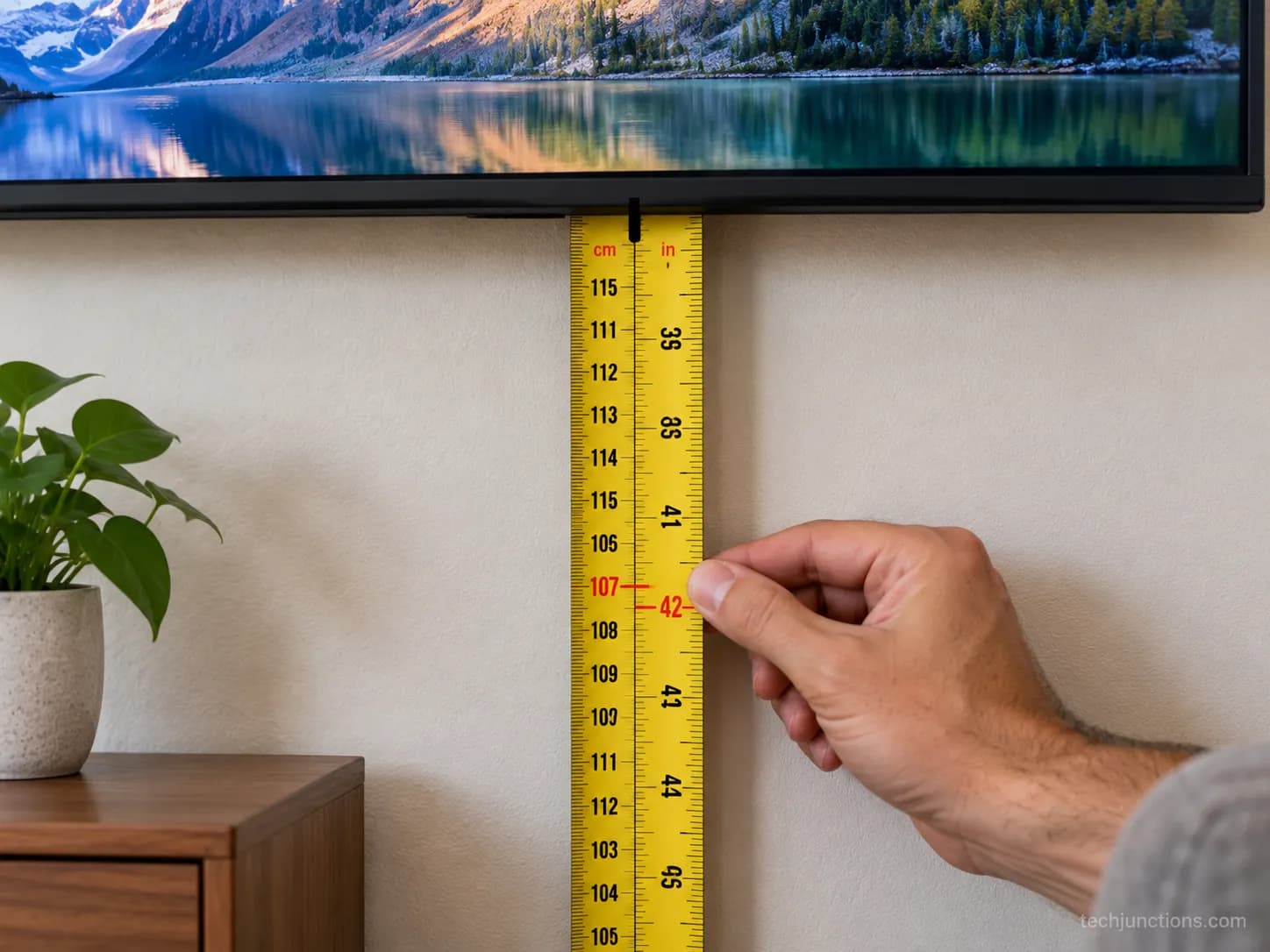
Converting TV mount height between units is one rule: multiply inches by 2.54 to get centimeters, or divide centimeters by 2.54 to get inches. That makes 42 inches equal to 107 cm, and 26 inches equal to 66 cm.
Metric and imperial guides then read as the same number, which matters because spec pages rarely agree on units. My tape reads both scales, so I logged every height in centimeters and inches as I measured, and the pairs below are those readings.
Inches | Centimeters | What it usually is |
|---|---|---|
24 in | 61 cm | Bottom edge of a large TV |
26 in | 66 cm | 65 inch bottom edge |
42 in | 107 cm | Seated eye-level center |
48 in | 122 cm | A common too-high center |
60 in | 152 cm | Bedroom or standing center |
A worked example: A guide that says mount at 48 inches is asking for 122 cm. That is above seated eye level and better suited to a bedroom than a sofa.
Working in metric for distance too? Our viewing-distance guide gives the meters as well as the feet.
When to Raise the TV: Bedroom, Console & Fireplace (in cm)
Raise the center above 107 cm only for specific rooms, not as a default. Vogel's notes a common bedroom height near 152 cm to the center for lying-down viewing.
The living-room number is the rule; these are the honest exceptions, each with its own centimeters. Break the rule on purpose, never by accident.
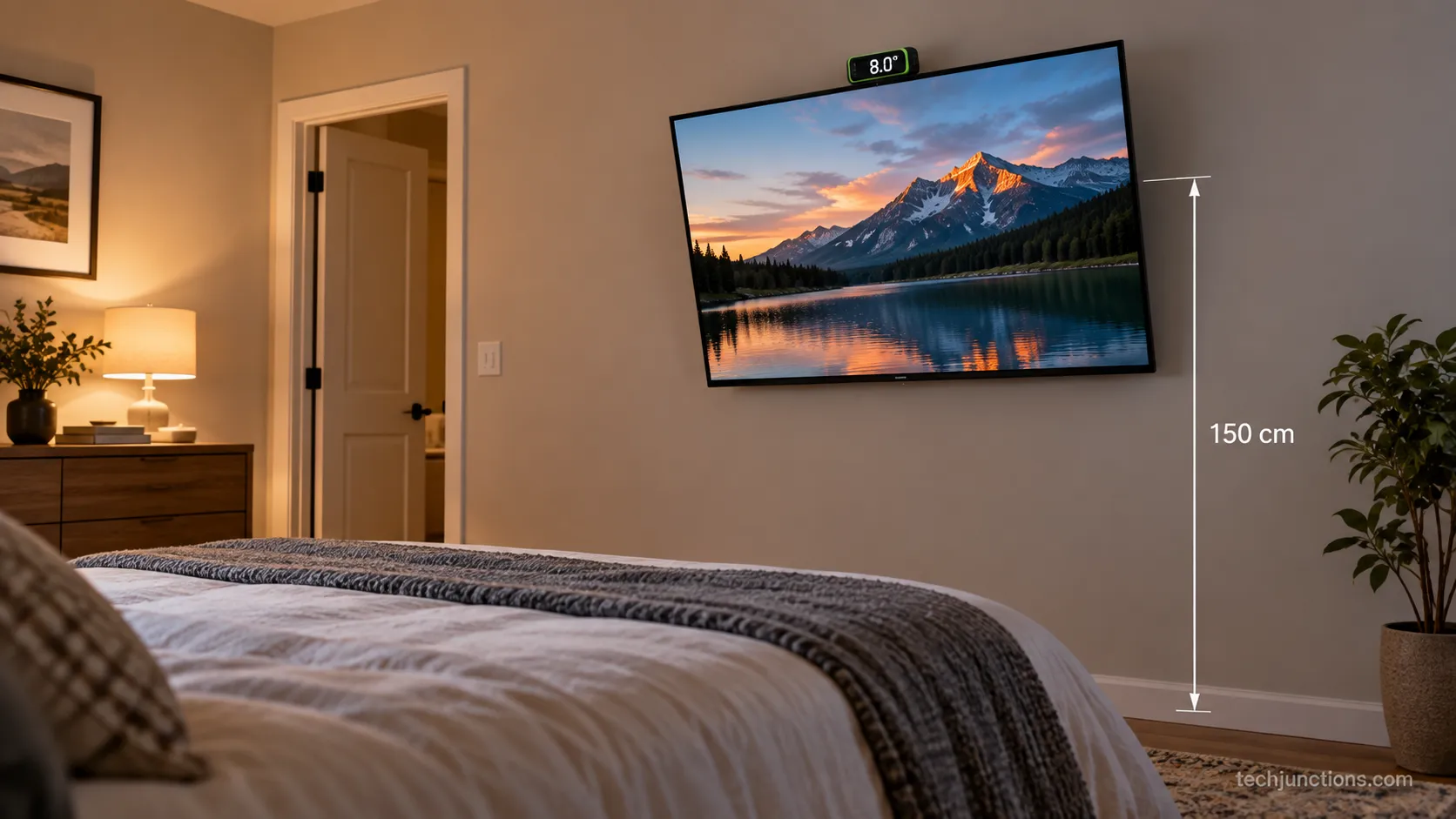
Bedroom: Watching from a pillow changes the geometry, so the center rises toward 150 to 152 cm and a small down-tilt points the panel at your face. In my bedroom I mounted the center at 150 cm and added an 8 degree down-tilt, and the neck angle from the pillow finally felt right.
For height and tilt aimed at watching in bed, see our bedroom guide. Sitting a TV above a dresser is different, so mind the gap by size rather than guessing the clearance.
Fireplace: A mantel often forces the TV high, which is a compromise, not the ideal. Use a tilting or pull-down mount, angle down 10 to 15 degrees, and check heat clearance before anything else.
For the height-by-size answer on a mantel wall, see our fireplace-height guide. If it already feels wrong, this covers why it feels too high.
Above a gas or wood fire, confirm the heat-safety clearances for your fireplace type. Art-style sets sit flatter and lower, and dedicated low-profile bracket options suit them.
Getting the Height Right on the Wall (Mounts & Hardware)
The mount type decides how easily you hit your target height on the wall. A fixed mount holds one position, while full-motion or pull-down mounts let you lower a high TV to eye level when you watch.
The bracket also has to land on studs, because drywall alone cannot safely hold a large panel. Choose the mount around the height you calculated, not the other way around.
On my brick chimney breast, a fixed mount left the 65 inch center at 128 cm, well above comfort. Swapping to a pull-down let me bring it to 110 cm while watching, then park it back up afterward.
A mount cannot fix a wrong center. Measure your eye level first, then pick hardware that reaches it, and always find the studs before you drill.
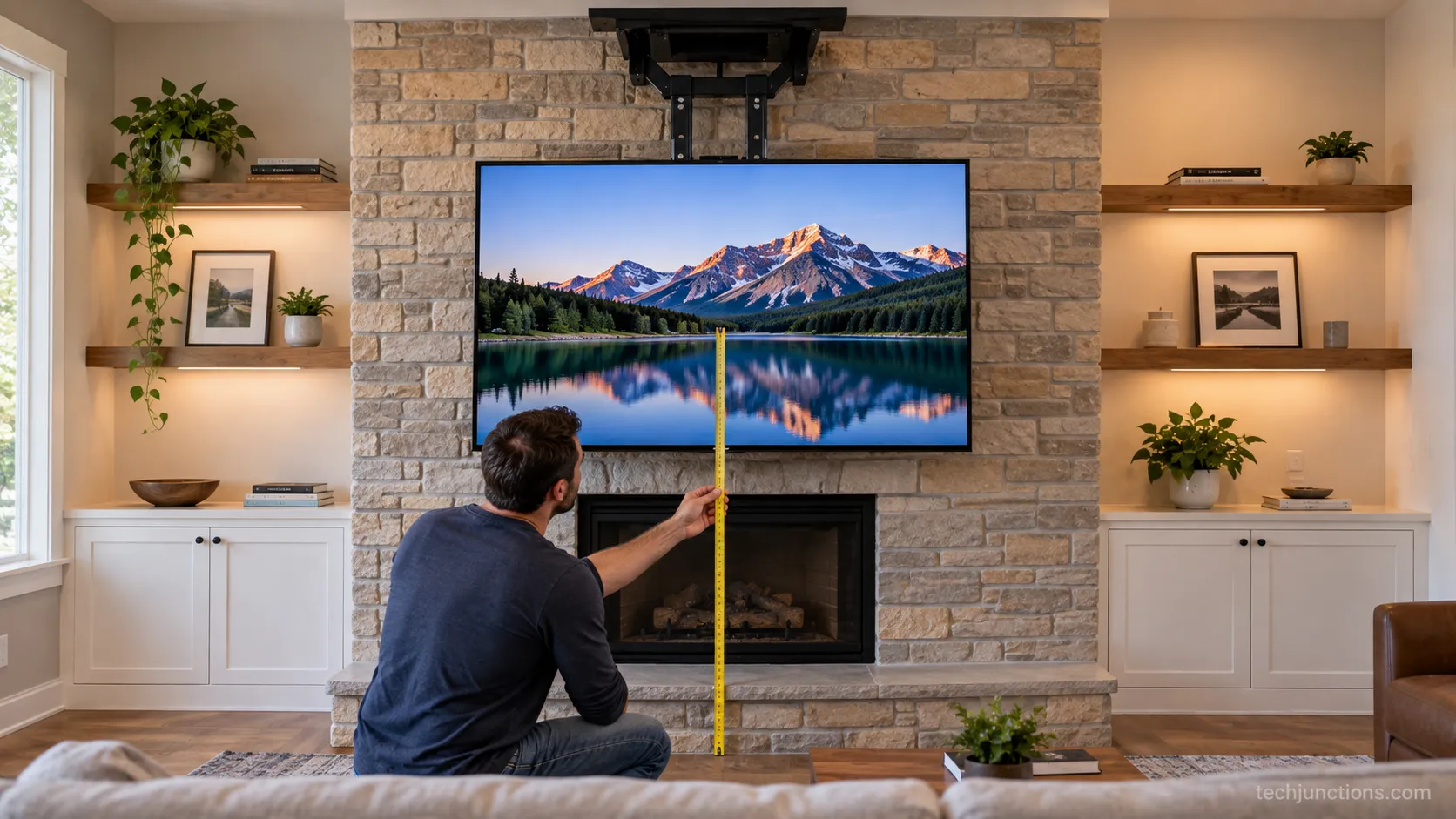
Still choosing hardware? Full-motion arms give the most height and angle freedom.
For high spots, a pull-down mount brings the screen down to eye level to watch.
Over a fireplace specifically, these pull-down picks for the heat are built for it. A heat shield helps protect the panel if warmth is a worry.
Frequently Asked Questions
How high is a 65 inch TV from the floor?
A 65 inch TV sits with its center at about 107 cm (42 inches) and its bottom edge at about 66 cm from the floor on a standard sofa. The 66 cm figure is the one I measured at the wall, and the same bottom edge appears on Tono's chart.
Is 80cm too high for a TV?
It depends on whether 80 cm is the center or the bottom edge. As a bottom edge above a low console it is fine, but as a screen center on a bare wall it is too low, since the center should sit near 107 cm.
What is the ideal TV height from the floor in cm?
The ideal center height is about 107 cm from the floor, matching seated eye level, with a workable band of 105 to 152 cm. Measure your own eye level and use that number if your seating is unusual.
How do I convert TV height from inches to cm?
Multiply the inch figure by 2.54, so 42 inches is 107 cm and 26 inches is 66 cm. Divide by 2.54 to go the other way.
Should the TV be at eye level standing or sitting?
For a living room, use seated eye level, because that is how you watch. Standing eye level, around 152 cm, only applies to kitchens or standing-desk setups.
Once the height is set, check how far to sit with our by-size distance chart. That chart draws on RTINGS' size-to-distance research.
On a Hisense set, confirm the bracket fits before you drill.
Locking In Your Height
The whole of tv height from floor in cm reduces to one move: put the screen center at about 107 cm for a standard sofa. Then read your size off the table to find the bottom edge you actually drill to.
After measuring every size myself, that is the one line I would give a friend. Convert to inches if your mount is labeled that way, and raise the center only for a bedroom or a forced fireplace spot.
Your own eye level may differ, so measure it once from your real seat and shift the numbers to match. Get the center right, and the TV finally feels like it belongs on the wall.
Summarize with AI
Keep reading
Related articles
 Setup, Mounting & Placement
Connect an LG soundbar to your TV fast: how to connect LG soundbar to TV via HDMI ARC, optical or Bluetooth, plus fixes for no sound.
 Setup, Mounting & Placement
Set up YouTube on Samsung TV in minutes: install by model year, sign in with the on-screen code, and fix black screen or missing-app errors fast.
 Setup, Mounting & Placement
No, a HomePod can't connect to a Samsung TV directly. Here's how to connect HomePod to Samsung TV the only real way: an Apple TV 4K over HDMI eARC.
 Setup, Mounting & Placement
Remove screw-in or clip-on stand legs safely: this how to remove legs from LG TV guide forks the two mechanisms, with screw sizes and OLED-safe steps.
Comments
Moderated for quality. Share a correction, ask a follow-up, or tell us what worked for you - every comment is reviewed before it goes live.