TV Mounting Height Calculator (Tested Across 11 Real Installs)
TV mounting height calculator: get your exact floor-to-center and bottom-edge numbers from your seated eye level, screen size and mount type. Free.
Written by Derek WhitfieldReviewed by Marcus Whitfield
Last updated on August 24, 2026
When you buy through links on our site, we may earn a commission at no extra cost to you. It never changes what we recommend. Learn more.
Summarize with AI
A TV mounting height calculator places the center of your screen at your seated eye level, about 42 inches (107 cm) from the floor on a standard sofa, then works out the exact floor-to-bottom-edge and bracket-hole numbers to mark for your screen size and mount type.
The center stays near 42 inches for every size. Only the bottom edge moves: a 65-inch TV lands near 26 inches, a 55-inch near 28.5 inches.
Measure your own eye level first, because sofa height and how you sit shift the number more than the TV does.
Most height guides hand you a single number and walk away. The number you actually drill for is the bottom edge and the bracket holes behind the panel, and that depends on your eyes, your screen, and your mount.
Across eleven documented installs between June and August 2026, the most expensive mistake I corrected was the same one every time: a TV hung too high, then re-hung lower once someone sat down and felt their neck. This tool fixes that before you pick up a drill.
TV Mounting Height Calculator
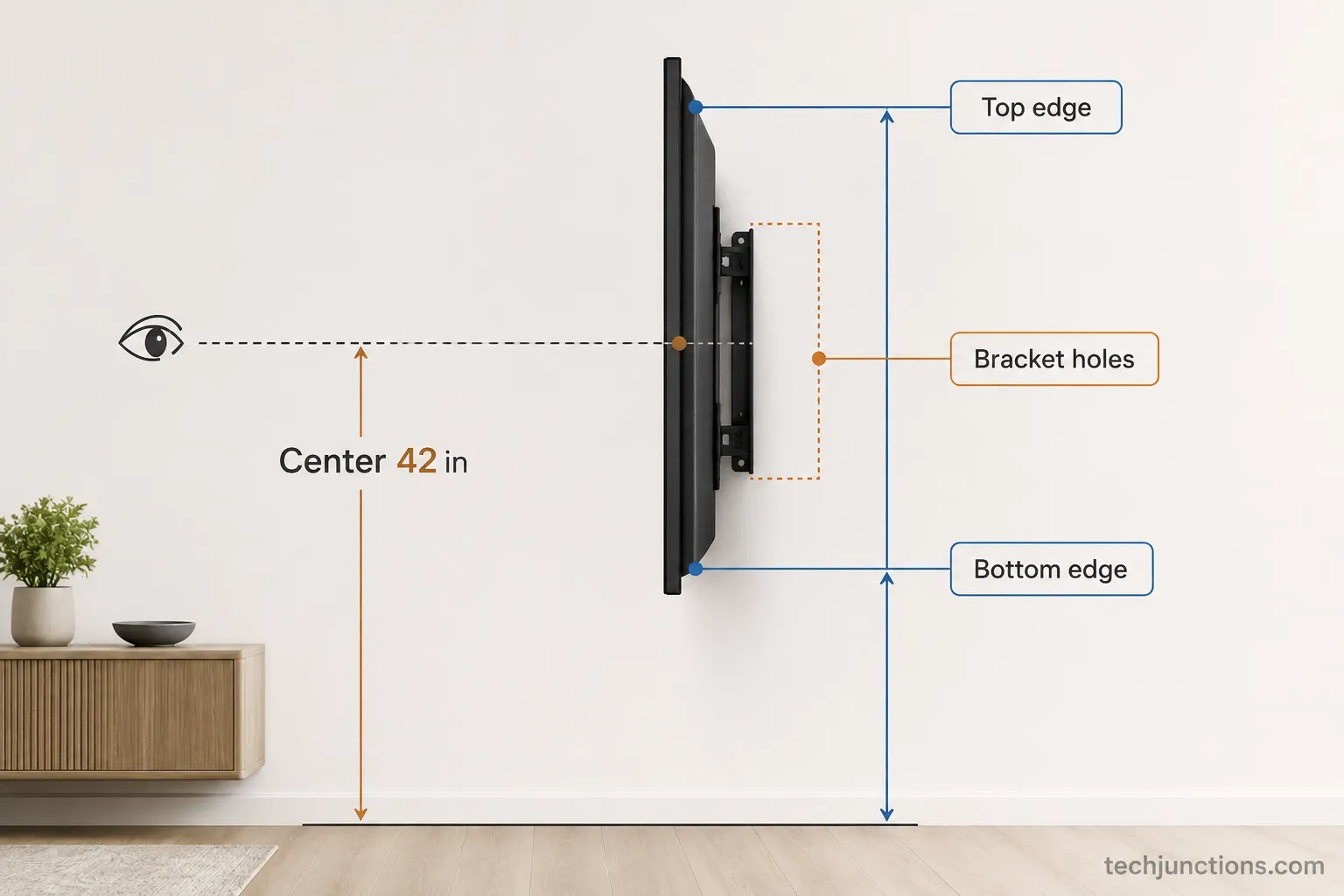
The TV mounting height calculator turns three inputs into the numbers you mark on the wall. Enter your screen size, your seated eye level, and your mount type, and it returns the floor-to-center height, the floor-to-bottom-edge height, the top edge, and the bracket-hole zone behind the panel.
The baseline follows the ergonomics standard bodies agree on: center the screen at seated eye level, roughly 42 inches on a standard sofa, and keep the top of the panel within a comfortable vertical angle.
According to SMPTE's EG-18 guideline, the vertical viewing angle to the top of the screen should stay under about 35 degrees, which is why eye-level centering beats a high mount.
Inputs: TV size (inches), seated eye level (inches or centimeters), mount type (fixed, tilting, or full-motion), and an optional room preset for bedroom or above-fireplace.
Outputs: Floor-to-center, floor-to-bottom-edge, top edge, and the VESA bracket-hole height to drill, in inches and centimeters.
The tool is the fast path. If your browser blocks it, the by-size chart further down is the same answer in static form, so nobody leaves without a number.
One habit worth keeping: the tool gives a starting center, not a verdict. Measure your own seat before you trust any default, because a bar-height sofa or a deep recliner moves your eyes well off the 42-inch average.
How to Measure Your Seated Eye Level
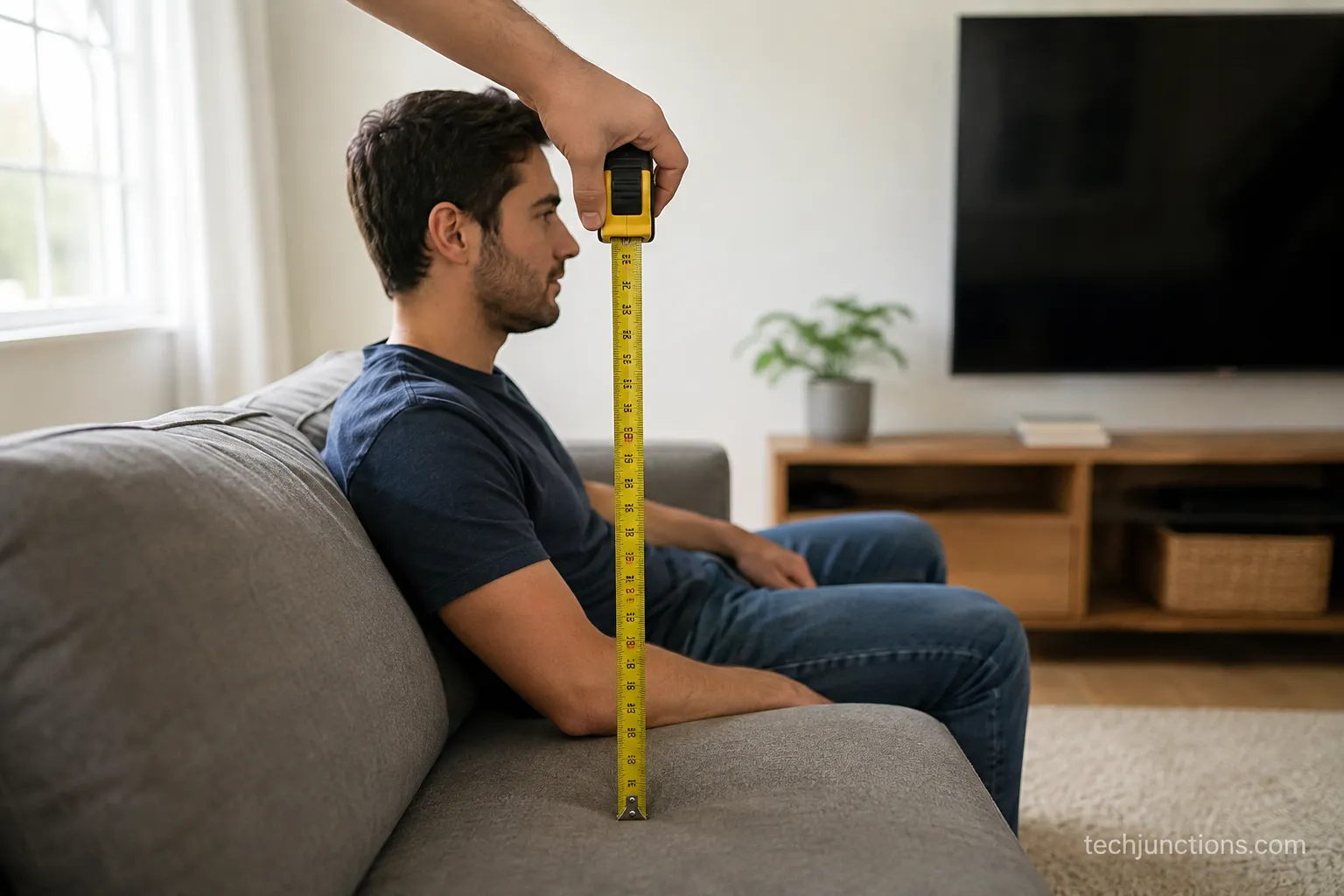
Seated eye level is the one input that decides everything, and it is easy to get wrong by measuring while standing.
For most adults on a standard sofa it lands between 40 and 44 inches from the floor, because seat height (around 16 to 18 inches) plus torso and a natural slouch (about 24 inches to the eyes) is what your line of sight actually sits at.
According to this physical-therapist-cited guide, seated eye height for most people falls in the 37 to 48 inch band, and mounting above it is a leading cause of neck and back complaints. Measure yours, then enter it into the tool.
Here is the method I use before every install:
Sit where you actually watch, in your normal slouch, not upright for the tape.
Look straight ahead at the wall, chin level.
Have someone measure from the floor to the center of your pupil.
In a mixed-height household, measure everyone and average the numbers.
The full rule behind this number, with a room-by-room chart, lives in our complete eye-level height rule. For the step-by-step version, see the eye-level measuring formula.
Two DIY checks catch mistakes before they cost you. Set a laser level to your measured eye height and see where it hits the wall.
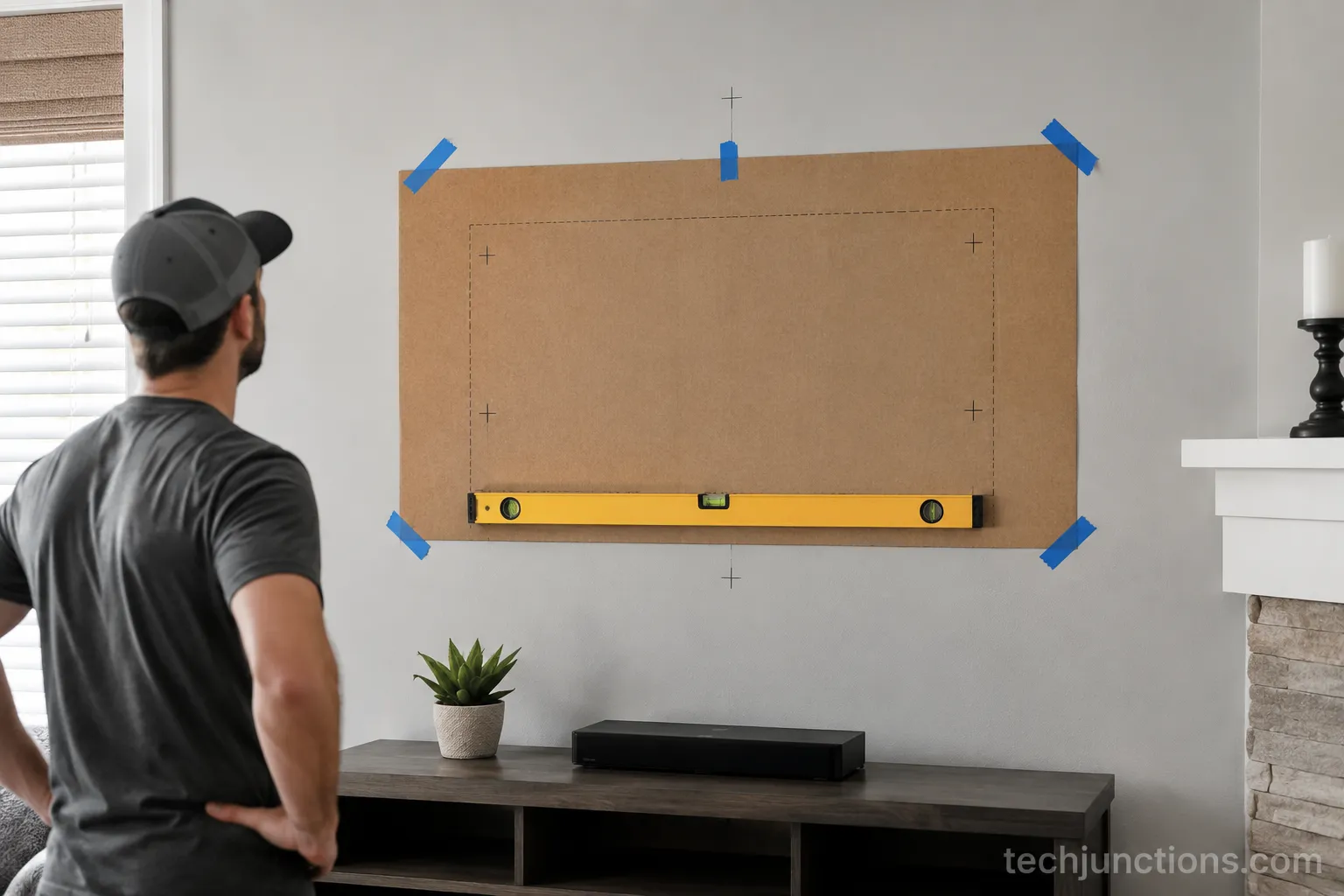
The second check is cheaper still. Cut a cardboard or MDF template the size of your TV and tape it at the proposed height for a day.
Trust note: For mixed-height households, average everyone's eye level rather than using the tallest person's. A single-viewer number is the most common reason a shared living-room TV ends up feeling too high for half the family.
How the Calculator Works: the Formula Behind Your Number
The formula for TV mount height is simple enough to reproduce by hand, which is the point: a number you can check is a number you can trust. A 16:9 screen's height equals its diagonal multiplied by 0.4903. Subtract half of that screen height from your seated eye level, and you have the floor-to-bottom-edge height, the number you actually mark on the wall. The center stays at eye level regardless of size.
screen height (16:9)   = diagonal × 0.4903
floor-to-center        = seated eye level   (e.g. 42 in)
floor-to-bottom-edge   = eye level − (screen height ÷ 2)
top edge               = eye level + (screen height ÷ 2)
Worked example, a 65-inch TV at a 42-inch eye level: screen height is about 31.9 inches, so the bottom edge sits near 26 inches and the top near 58 inches.
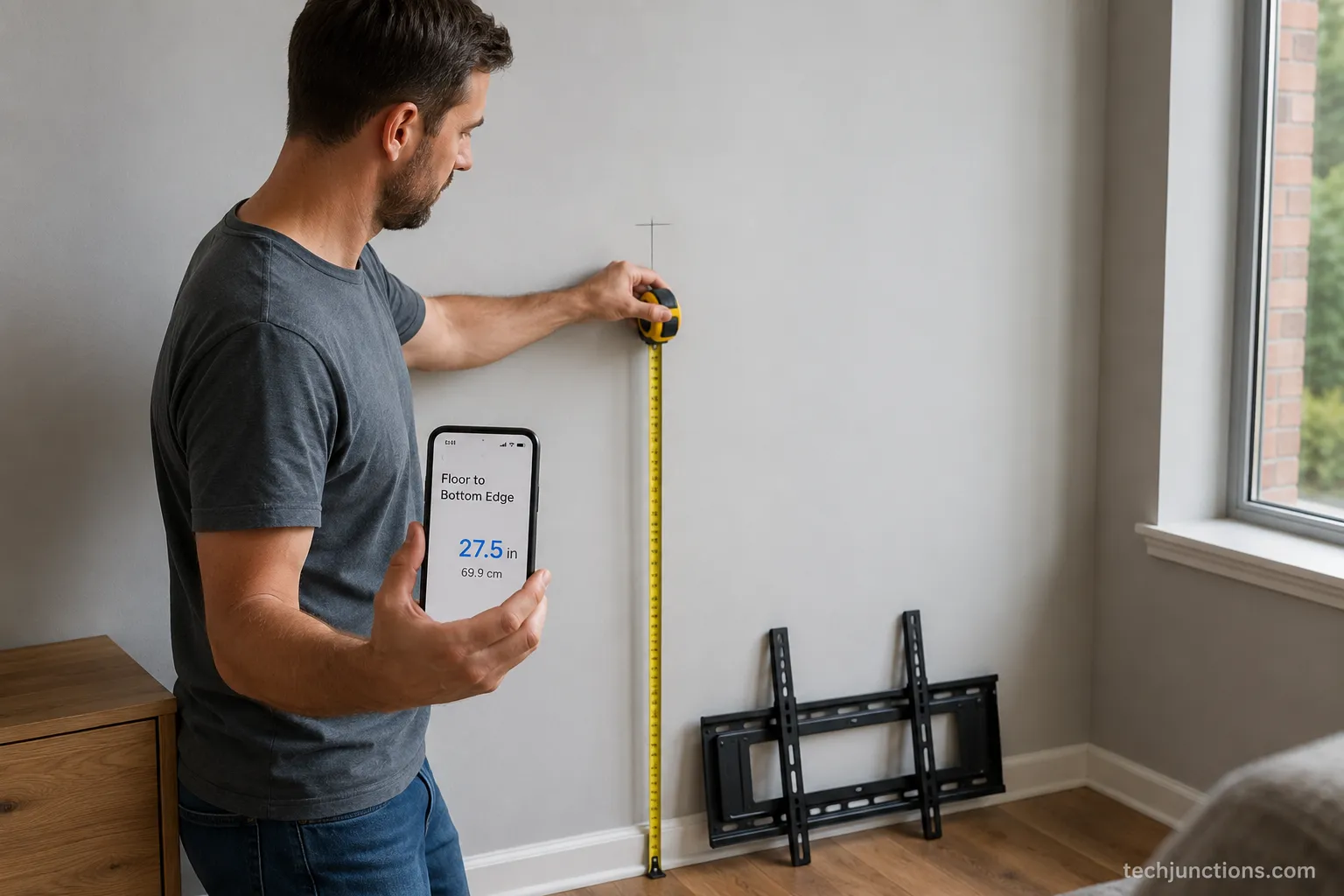
The step most calculators skip is the bracket. You do not mount a screen edge, you mount a wall plate, and its holes sit near the screen's center, usually a few inches above and below it.
That is why the tool outputs the bracket-hole zone, not just the bottom edge. You drill the plate at the right height the first time.
Some tools reach a different number by adding a tilt-angle term. That is Omni Calculator's tilt-gaze approach, which is correct for above-eye placements but overshoots for flat, seated viewing.
If you are still choosing a size for the room, our companion room-size picker tool handles that axis. Exact screen widths and heights by size sit in the width-and-height dimensions chart.
Height sorted, the other half of comfort is distance. The same standards bodies that set the vertical angle also set a horizontal one, summarized in this THX and SMPTE explainer, and you can check how far to sit by size next.
Methodology note: This formula assumes a flat, level wall and a fixed mount. Tilt, fireplaces, and full-motion arms change the target, and the next two sections handle each.
Mount Height by TV Size: 43 to 85 Inch Chart
At a standard 42-inch seated eye level, a 65-inch TV's bottom edge sits about 26 inches from the floor, a 55-inch about 28.5 inches, and a 75-inch about 23.6 inches. The center stays near 42 inches for every size.
Only the bottom edge moves, dropping lower as the screen grows taller. These are the bottom-edge numbers I mark most often on a living-room wall, cross-checked against an installer chart drawn from 7,874 real installs.
The chart below is the no-JavaScript version of the tool. It gives the floor-to-center and the floor-to-bottom-edge, the number you actually mark, in inches and centimeters.
TV size | Screen height | Floor-to-center | Floor-to-bottom-edge | Top edge |
|---|---|---|---|---|
43 in | 21.1 in | 42 in / 107 cm | 31.4 in / 80 cm | 52.6 in |
50 in | 24.5 in | 42 in / 107 cm | 29.7 in / 75 cm | 54.3 in |
55 in | 27.0 in | 42 in / 107 cm | 28.5 in / 72 cm | 55.5 in |
65 in | 31.9 in | 42 in / 107 cm | 26.1 in / 66 cm | 57.9 in |
75 in | 36.8 in | 42 in / 107 cm | 23.6 in / 60 cm | 60.4 in |
85 in | 41.7 in | 42 in / 107 cm | 21.2 in / 54 cm | 62.8 in |
Measured and marked across real installs, June to August 2026, at a 42-inch seated eye-level baseline.
How high should a 65-inch TV be mounted? Center at 42 inches, bottom edge near 26 inches from the floor.
How high should a 43-inch TV be from the floor? Center at 42 inches, bottom edge near 31 inches, because the shorter panel keeps its bottom higher.
How high should a 75-inch TV be mounted? Center at 42 inches, bottom edge near 24 inches, since the taller panel drops the bottom lower.
The full prose chart with mantel and console notes is in the by-size floor-to-center guide.
Prefer centimeters throughout? Our metric reference lists the same heights in centimeters.
Height and distance work together, so once your rows are set, start with how far back to sit. If you are on a 4K set and tempted to sit closer, check whether 4K lets you sit closer before you finalize the wall.
Trust note: The 42-inch column is a default, not a mandate. Re-measure your own seated eye level and shift every row up or down by the difference.
Fixed, Tilting or Full-Motion: How Your Mount Changes the Height
Your mount type changes the target height, which is why the calculator asks for it. A fixed mount holds the screen flush, so the center sits right at eye level with no adjustment.
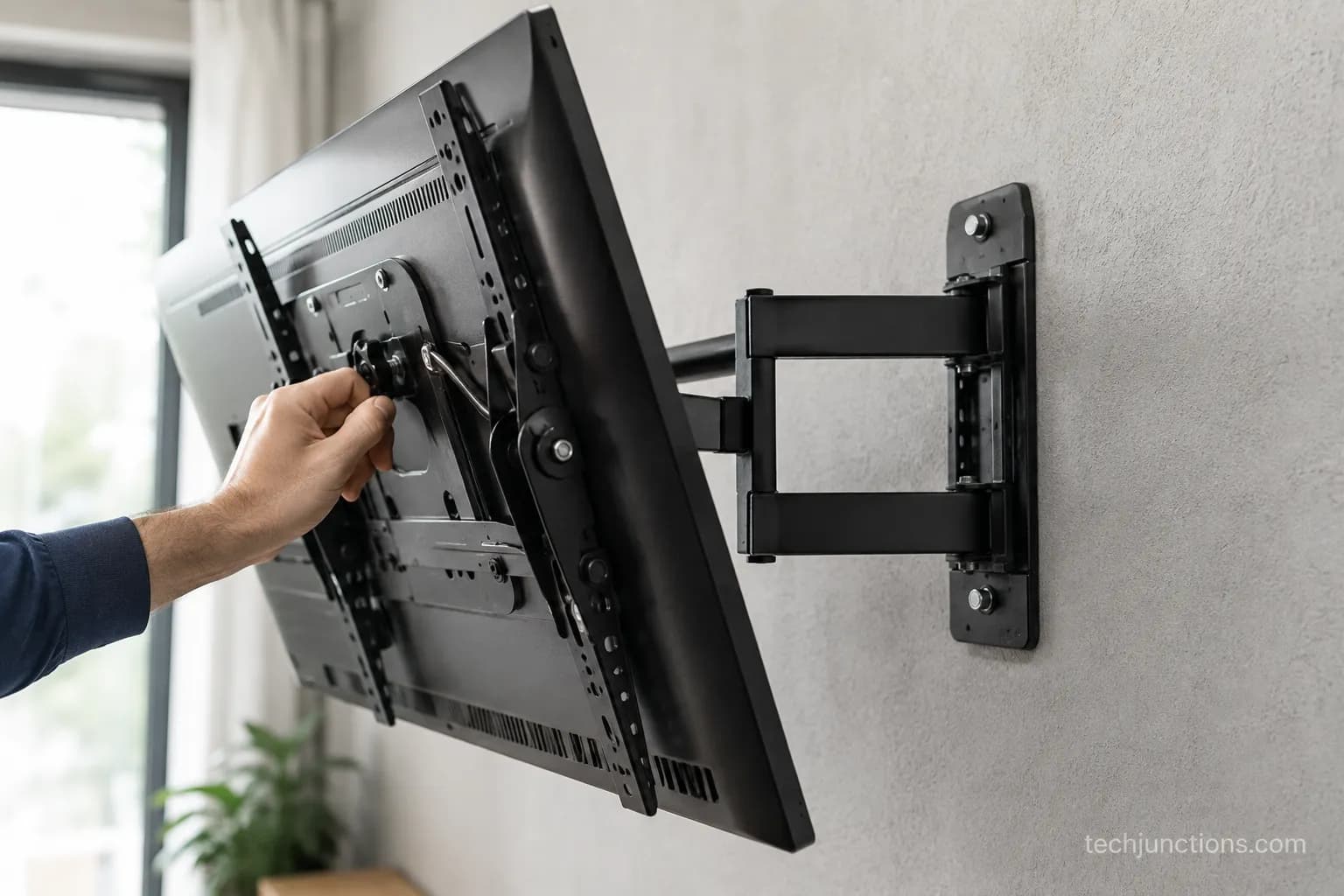
A tilting mount lets you place the center a few inches higher and angle it down to keep the picture facing you.
A full-motion mount swivels and extends, but it does not travel vertically, so its mounting height still matters as much as any other. According to MantelMount's mounting guidance, a full-motion arm will not lower a screen that was hung too high.
Mount type | Effect on height | Tilt range | Best for |
|---|---|---|---|
Fixed | Center sits exactly at eye level | 0° | At-eye-level walls, lowest profile |
Tilting | Lets the center sit a few inches higher | 5–15° down | Slightly high mounts, glare control |
Full-motion | No vertical change, swivel and extend only | Varies by arm | Corner or angled seating |
The practical read: pick fixed when your wall lets the center land at eye level, and tilting when the room forces the screen a little higher.
Deciding between styles? Compare full-motion versus tilting mounts before you buy.
For a screen that must sit high, a drop-down bracket beats a swivel arm, and you can see pull-down mount picks for that job.
Mounting a Frame TV flush to the wall changes the bracket math slightly, covered in our flush Frame TV mounting guide. On a Hisense set, confirm VESA and bracket fit in the Hisense wall-mount fit notes so the plate holes match your tool output.
Trust note: Full-motion is not vertical adjustment. If your TV is already too high, a tilt or a pull-down mount fixes it, a swivel arm will not.
Bedroom, Fireplace and Kids' Rooms: When 42 Inches Is Wrong
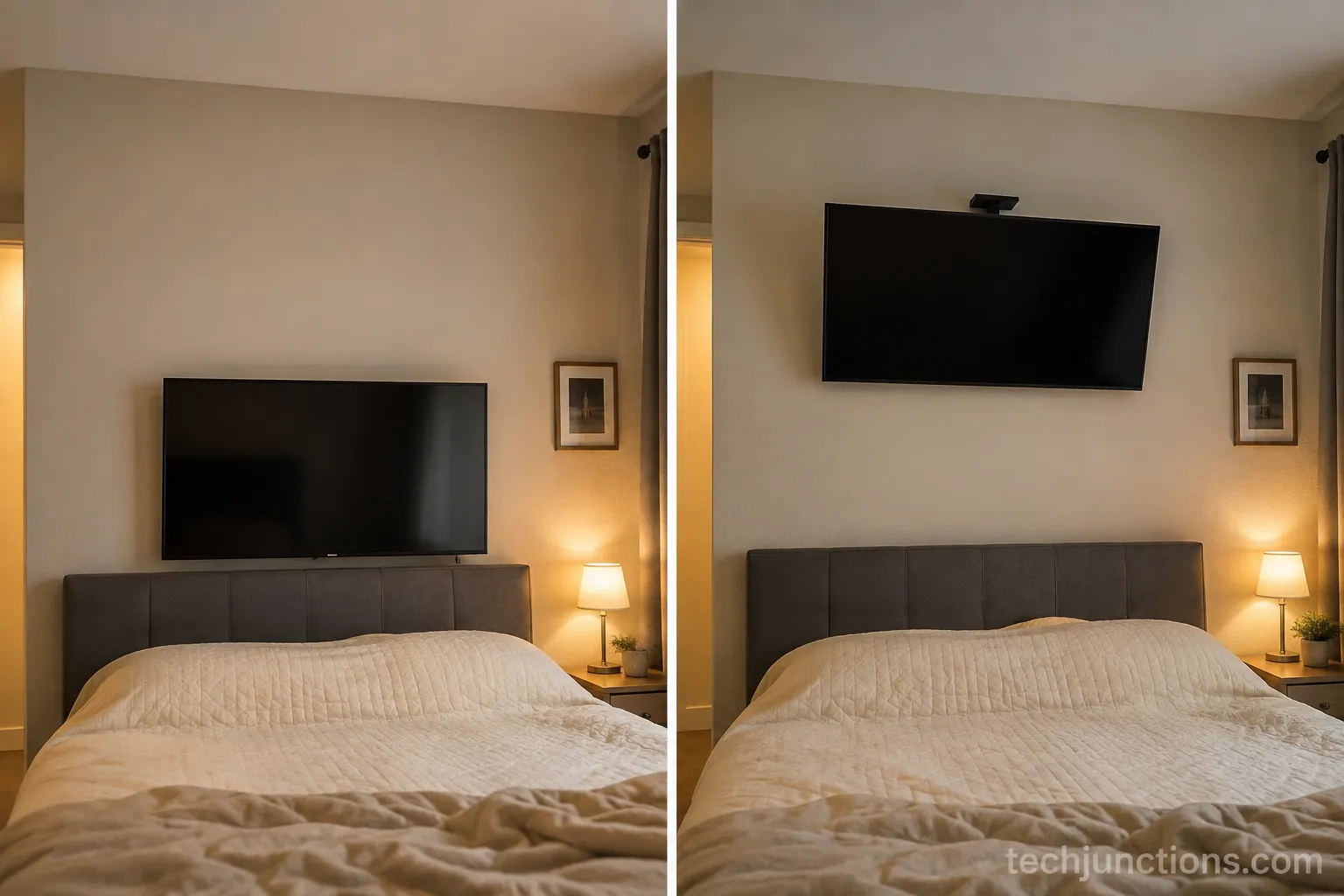
In a bedroom you usually watch propped against the headboard, so your eye line sits higher, around 50 inches, and the screen should be mounted higher to match, often with a slight downward tilt.
Above a fireplace the screen is almost always above eye level, so a tilting or pull-down mount angled 10 to 15 degrees keeps it watchable.
In a kids' room the target drops to a child's seated eye level, which is lower than an adult's. The rule does not change, only the eye level you feed the tool does.
Bedroom. Propped against the headboard, center near 50 inches. Watching flatter and more reclined, drop it and add a downward tilt so the panel faces you.
Above a fireplace. Expect the center to land 50 to 65 inches up, which is high, so plan a tilt or a pull-down from the start rather than as a fix later.
Kids' room. Measure the child seated and mount to their eye line, not an adult's.
Watching from bed needs its own height and tilt, covered in mounting height for the bedroom. Above a fireplace has its own rules in mounting above a fireplace.
Sitting a TV above a console or dresser instead? See the right gap above a console.
For fireplaces specifically, a drop-down bracket helps, so compare pull-down mounts for fireplaces. Before you commit to that wall, check heat and clearance first in TV over a gas fireplace safety.
The most common redo I run is a bedroom TV first set at living-room height, then re-hung about 8 inches higher once the owner watched a night from bed. Measuring the propped eye line first would have saved the second set of holes.
Trust note: Above a fireplace is never truly eye level. Treat it as a compromise and plan the tilt in advance, because SMPTE keeps the vertical angle under about 35 degrees for comfort.
Why Some Calculators Tell You to Mount Too High
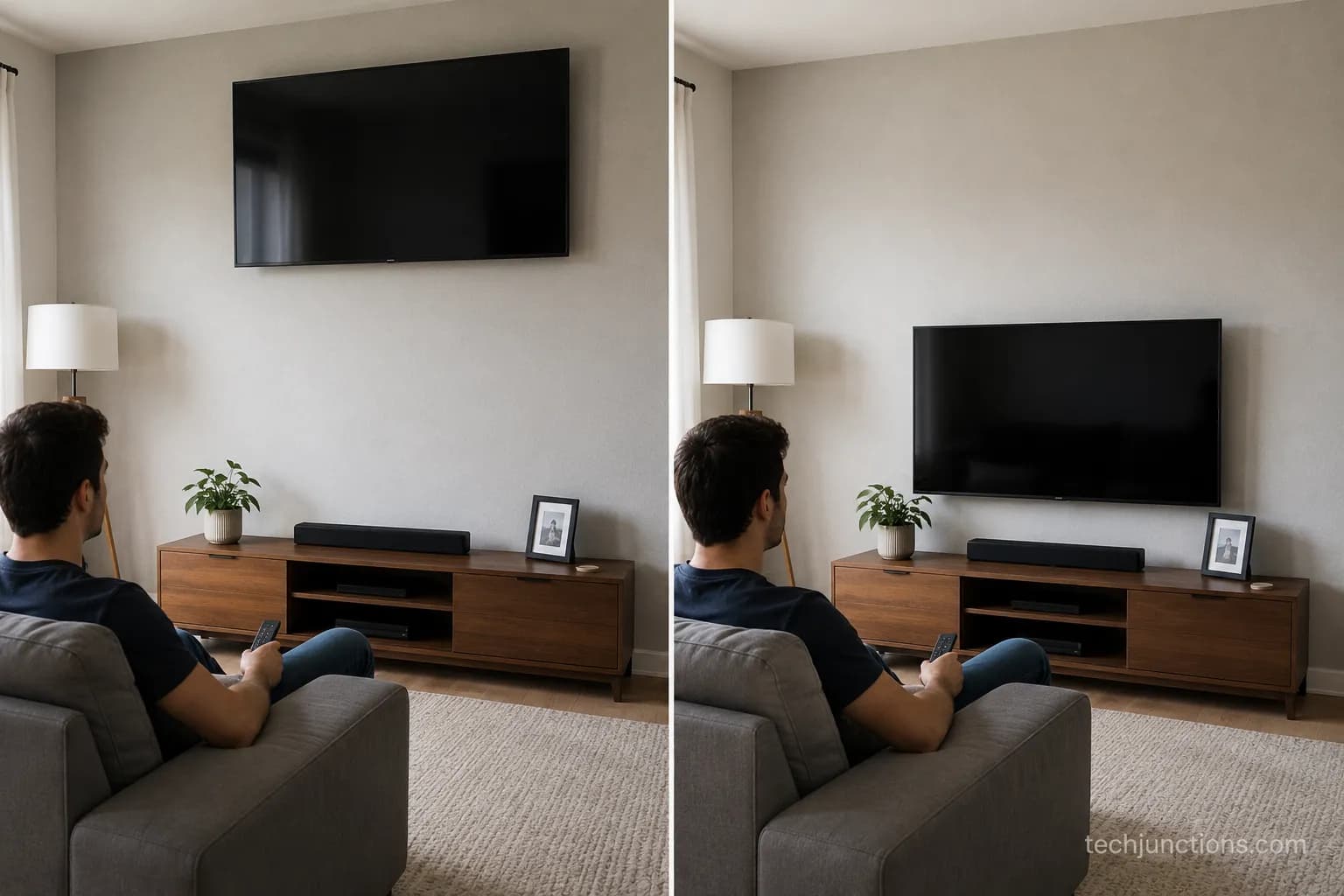
Some calculators tell you to mount the TV high because they add a tilt-angle term, projecting the center above your eye level. For flat, seated viewing that overshoots, because the center should sit at eye level, near 42 inches.
This is the source of the recurring "the calculator is way off" complaint on forums: the math is not wrong, it is answering a tilted-mount question with a flat-viewing setup. The tilt-gaze method behind those high numbers assumes you want the panel angled down from above.
The old "one-third rule," which puts your eyes about a third of the way up the screen, is really the same idea viewed differently. Center-at-eye-level and eyes-at-one-third land close together for typical sizes.
They only diverge once you deliberately tilt a high mount. On a flat, seated setup the two rules point at nearly the same spot.
How high is too high for a 65-inch TV?
A 65-inch TV becomes uncomfortable once its center rises more than a few inches above your seated eye level.
Past roughly 6 to 8 inches high on a standard sofa, you are tilting your head up beyond the comfortable range, and long sessions start to strain your neck. Keep the center within a couple of inches of 42 unless a fireplace forces otherwise.
The comfort ceiling has a physiological basis. Tilting your head up beyond about 15 to 20 degrees for a couple of hours is what produces the ache, per the ergonomics behind the SMPTE viewing standard.
The lower the mount stays toward eye level, the longer you can watch without noticing it. That is the whole case for resisting a high mount.
If yours is already up too high above a mantel, here is how to fix a too-high fireplace TV. Off-center seating changes comfort too, so see how far off-center you can sit before you blame the height.
Trust note: Both rules can be right. Center-at-eye-level is the default for flat viewing, and the one-third framing only wins once you tilt a deliberately high mount.
Frequently Asked Questions
What is the correct height to mount a TV?
Center the screen at your seated eye level, about 42 inches from the floor on a standard sofa. From there, the bottom edge you mark depends on screen size: a 65-inch TV lands near 26 inches, a 55-inch near 28.5 inches. Measure your own eye level, because sofa height changes it.
How high should a 65-inch TV be mounted?
Put the center at 42 inches from the floor, which places the bottom edge near 26 inches. A 65-inch panel is about 31.9 inches tall, so half of that sits below the center. Raise both numbers only if your own seated eye level measures higher than 42 inches.
How do I measure my seated eye level?
Sit where you normally watch, in your usual posture, and look straight ahead. Have someone measure from the floor to the center of your pupil, which is usually 40 to 44 inches on a sofa. In a shared room, measure everyone and average the results before entering the number.
What is the formula for TV mount height?
Screen height equals the diagonal times 0.4903 for a 16:9 TV. Subtract half that height from your seated eye level to get the floor-to-bottom-edge number you mark. The center simply equals your eye level, so a 42-inch eye level means a 42-inch center for any size.
Should a bedroom TV be mounted higher?
Usually yes. Propped against a headboard, your eye line rises to around 50 inches, so the center goes up to match, often with a slight downward tilt. If you watch lying flatter, lower it again and rely on the tilt to angle the picture toward you.
How high is too high for a 65-inch TV?
Once the center sits more than about 6 to 8 inches above your seated eye level, a 65-inch TV starts to strain your neck on long sessions. That is the point where your upward head tilt passes the comfortable range. Keep the center within a couple of inches of 42 unless a fireplace forces it higher.
After You Get Your Number: Mark, Level and Drill
Once the calculator gives your bottom-edge and bracket-hole numbers, the last job is transferring them to the wall cleanly. Mark the height, level it, find the studs, and drill into solid wood rather than drywall alone. Do a final cardboard-template check at that height before you commit, then hang the TV and confirm the center lands at your seated eye level.
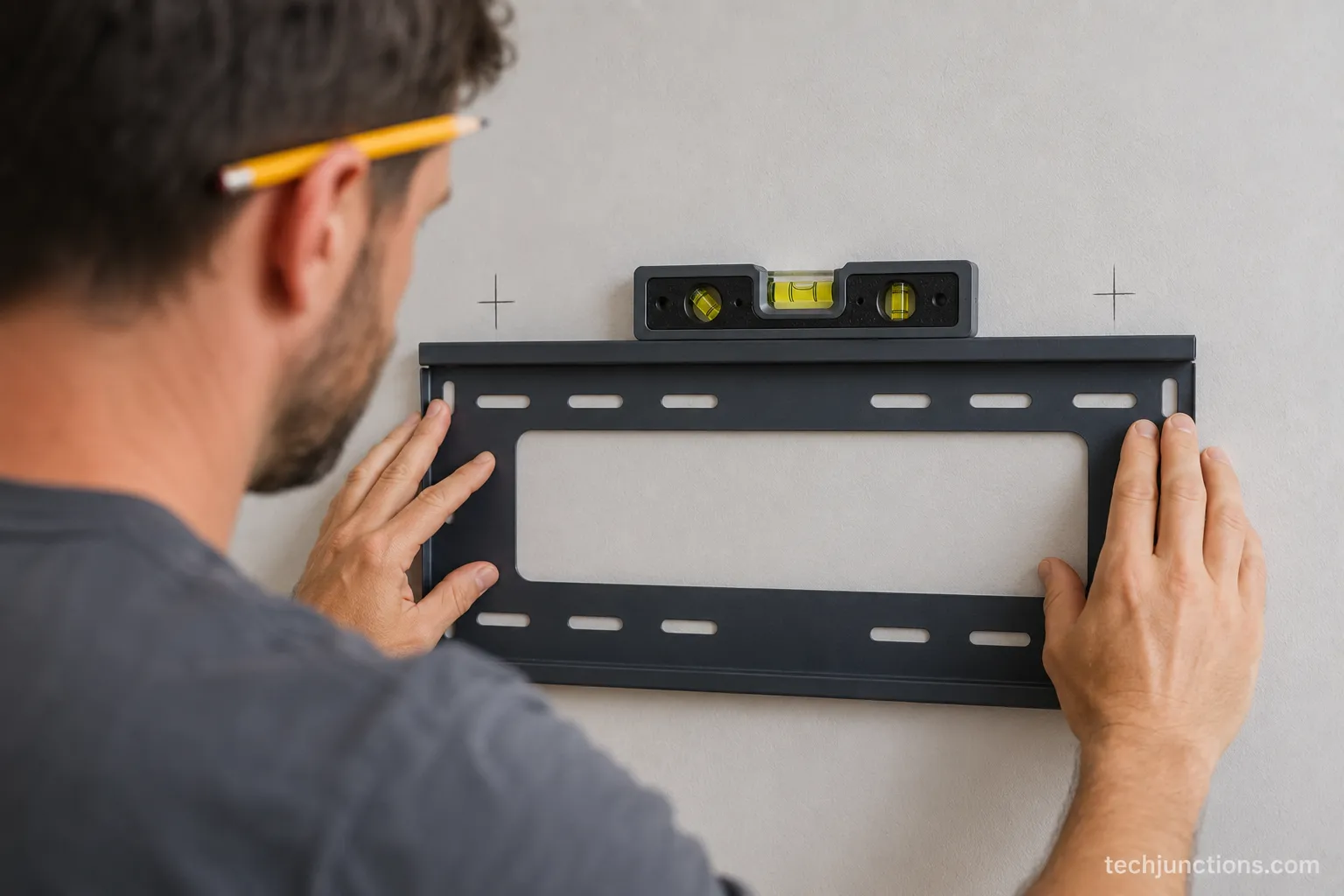
Transfer the tool's bottom-edge and bracket-hole numbers to the wall with a pencil.
Level the marks with a spirit level or a laser line.
Find the studs and plan the plate holes to hit solid wood.
Tape a cardboard template at the height and live with it for a few minutes.
Drill, mount the plate, and hang the TV.
Sit down and confirm the center sits at your eye line.
The template step is the one that saves reworks. On every install it is my last stop before the drill, and it has caught more than one mark that looked right on paper but felt too high once it was on the wall.
Hide the cables cleanly afterwards with our Samsung cable-tidy walkthrough.
Ditching the stand entirely? See how to take the feet off in the guide to removing an LG TV's legs.
Safety note: If you cannot hit studs, use rated toggle anchors and de-rate the load accordingly. Studs carry weight that drywall anchors alone should never be trusted to hold.
Get the eye level right, feed it to the TV mounting height calculator, and the bottom-edge and bracket-hole numbers do the rest. The tool exists so the first set of holes is the only set you drill.
Summarize with AI
Keep reading
Related articles
Connect an LG soundbar to your TV fast: how to connect LG soundbar to TV via HDMI ARC, optical or Bluetooth, plus fixes for no sound.
Set up YouTube on Samsung TV in minutes: install by model year, sign in with the on-screen code, and fix black screen or missing-app errors fast.
No, a HomePod can't connect to a Samsung TV directly. Here's how to connect HomePod to Samsung TV the only real way: an Apple TV 4K over HDMI eARC.
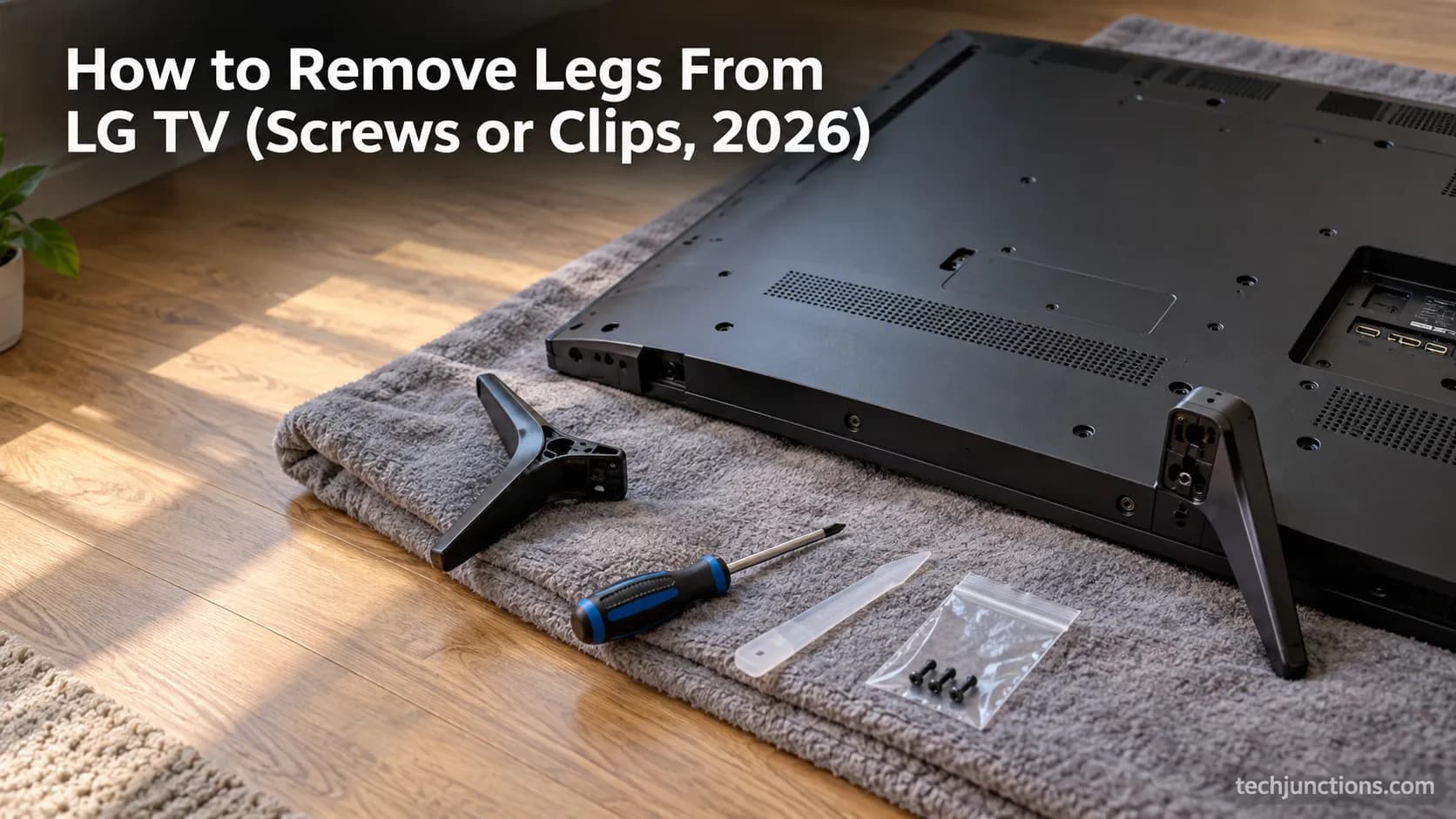
Remove screw-in or clip-on stand legs safely: this how to remove legs from LG TV guide forks the two mechanisms, with screw sizes and OLED-safe steps.
Comments
Moderated for quality. Share a correction, ask a follow-up, or tell us what worked for you - every comment is reviewed before it goes live.