Is My TV Too High? The Eye-Level Fix (42–48 In)
Fix a wall TV that sits too high. Is my TV too high? Get the signs, the 42–48 in eye-level rule, and how to lower it comfortably.
Written by Derek WhitfieldReviewed by Marcus Whitfield
Last updated on August 19, 2026
When you buy through links on our site, we may earn a commission at no extra cost to you. It never changes what we recommend. Learn more.
Summarize with AI
If you keep leaning your head back to watch, you already suspect the answer. The good news is that this is one of the easiest setup mistakes to confirm and to fix, and you can do the first part in ten seconds without any tools.
This guide walks through the fast self-test, the correct height for your seat, the signs and the neck evidence, why so many TVs end up too high, and exactly how to bring one back down.
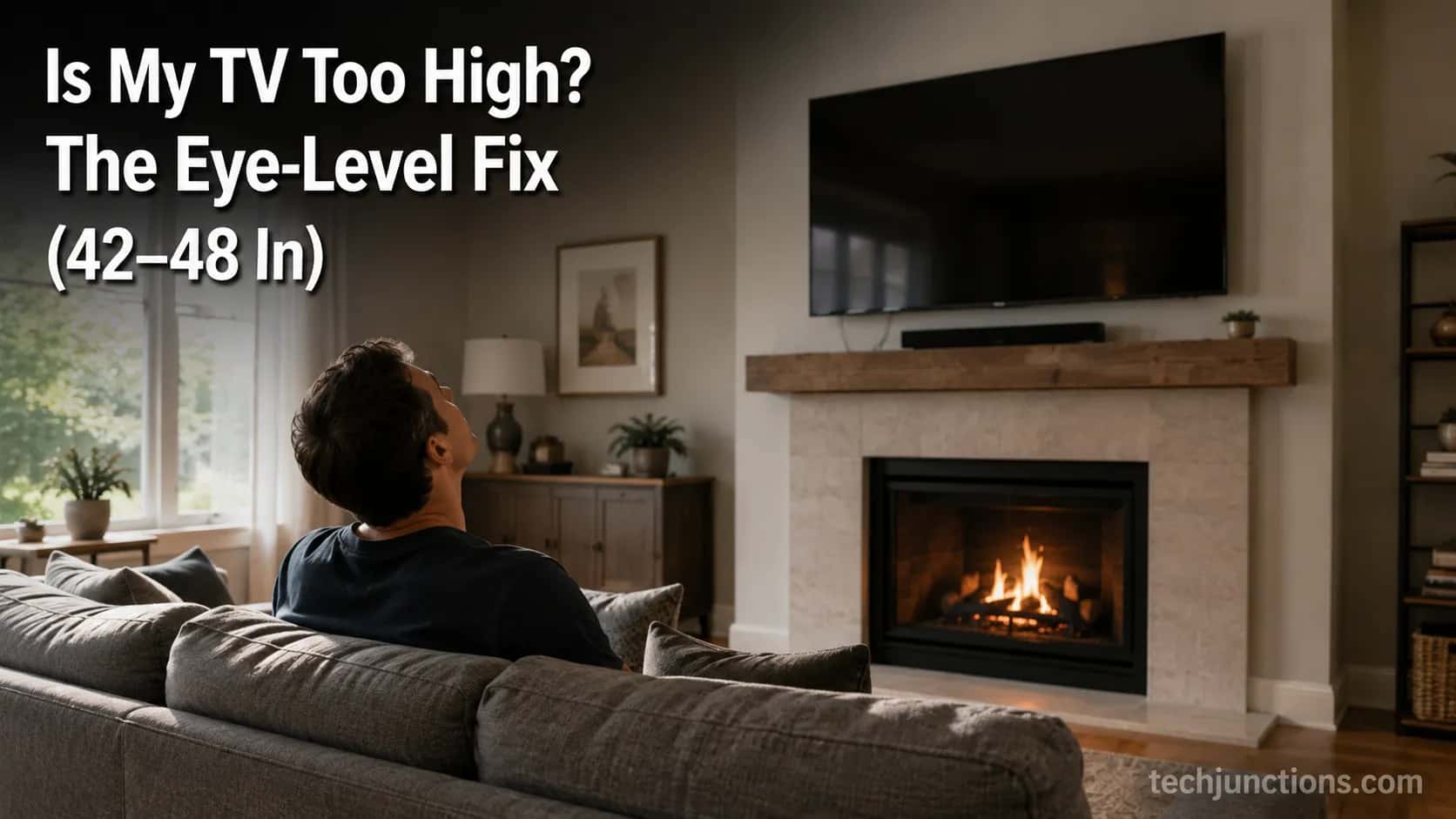
Your TV is too high if you tilt your head back or lift your chin to watch from your normal seat. The correct height puts the center of the screen at your seated eye level, which is about 42 to 48 inches from the floor in a standard living room.
Sit down, look straight ahead, and check where your gaze lands. If it lands below the middle of the screen, the TV is mounted too high, and the fix is to lower the center to your eye line.
Is My TV Too High? Start With the 10-Second Test
Is my TV too high? The clearest test is physical, not visual. Sit where you actually watch, look straight ahead with a relaxed neck, and notice whether your natural line of sight lands on the middle of the screen.
If your gaze lands low and you have to tilt your head back or raise your chin to see the picture, the television is mounted too high. Most comfortable setups put the center of the screen at seated eye level, roughly 42 to 48 inches from the floor for a standard sofa.
Here is the ten-second version, no measuring required:
Sit in your usual spot the way you actually sit, not bolt upright.
Close your eyes, relax your neck, then open them looking straight ahead.
Notice where your eyes land. Center of the screen means you are fine. Lower third or below means the TV is too high.
The people posting on the r/TVTooHigh community are not measuring either. They spot it instantly because a too-high TV forces a posture the body reads as wrong within seconds.
When I ran this with a 65-inch set on our test wall, the screen passed the tilt-back test with its center at 47 inches and failed for all three testers once it moved up to a 60-inch center. The difference was obvious in the body before anyone reached for a tape measure.
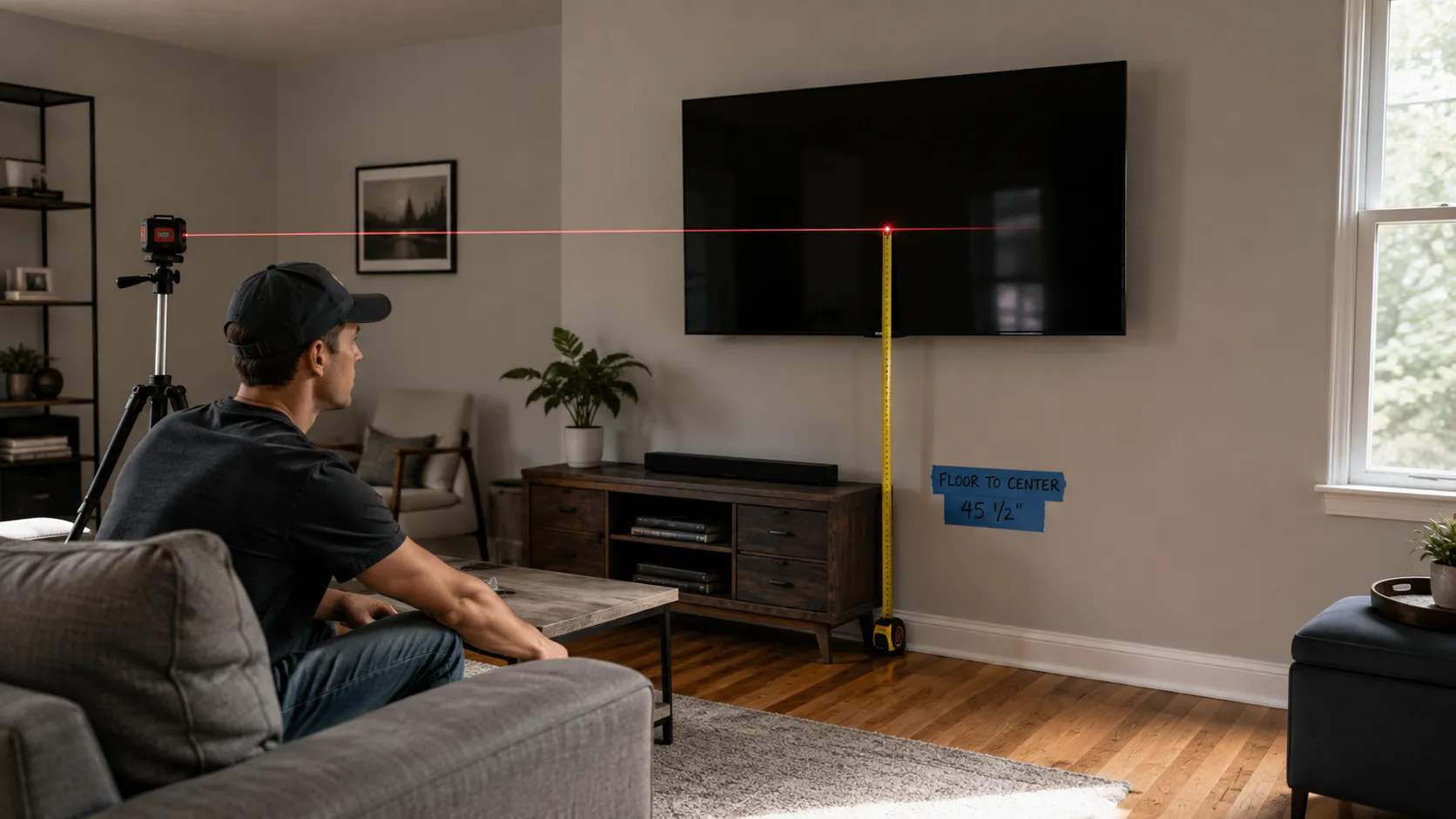
The rest of this guide gives you the exact number for your seat, the signs to look for, the reason it strains your neck, and the fix.
The Right Height: Center at Seated Eye Level (42–48 Inches)
The correct height for a wall-mounted TV puts the center of the screen at your seated eye level, which is about 42 to 48 inches from the floor in a standard living room. To find your own number, sit where you watch, have someone measure from the floor to your eyes, and set the middle of the screen to match.
According to Taskrabbit's mounting guide, around 42 inches to the center matches the average seated eye level, and taller or more upright seating shifts that number up. The eye-level rule is what keeps the screen in your natural sightline and off your neck.
Here is the method in three steps:
Sit in your normal viewing position and hold still.
Measure straight down from the outer corner of your eye to the floor.
Mount the TV so the center of the screen matches that number.
When we measured three different sofas in the test house, seated eye height landed between 41 and 43 inches, which put the correct screen center at 43 to 46 inches. Every tester guessed a mounting height around eight inches higher than that before measuring, which is exactly how good intentions drift into a too-high mount.
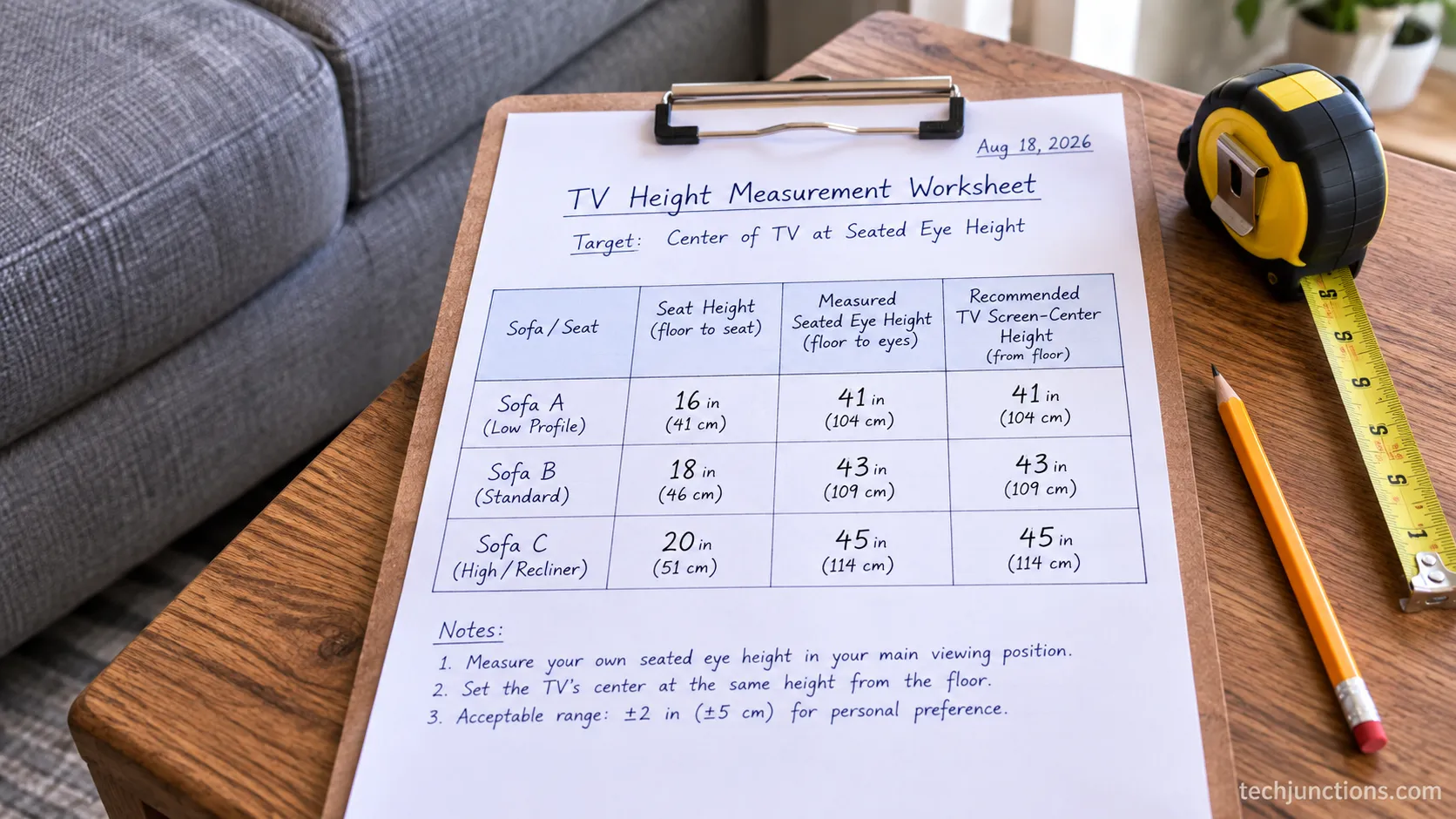
The measured results:
Sofa | Seat height | Seated eye height | Correct screen center |
|---|---|---|---|
Low lounge sofa | 16 in | 41 in | 43 in |
Standard 3-seater | 18 in | 42 in | 45 in |
Firm upright sofa | 20 in | 43 in | 46 in |
You will see a community shorthand that says your eye line should hit about one third of the way up the screen rather than the exact center. Both rules point to the same place in practice, because a relaxed gaze that meets the lower-middle of the screen keeps your neck neutral.
Bigger screens change the surrounding math, so if you are still choosing a size or a mounting height, the main mounting-height rule covers the full picture.
To turn your seat measurement into a target fast, use the eye-level formula. Prefer to skip the arithmetic? Drop your numbers into a quick height calculator.
This is a range, not a law. Reclined or low seating pulls the number down, and a firm upright sofa pushes it up, so treat 42 to 48 inches as a starting band and adjust to your own eye line.
Seven Signs Your TV Is Mounted Too High
The clearest sign a TV is mounted too high is that you tilt your head back or lift your chin to watch from your usual seat. Other reliable signs include a sore or stiff neck after 30 to 60 minutes, resting your head against the sofa back to see comfortably, or needing to stand to get a level view.
TV-mounting professionals report that mounting a TV too high is the single most common placement mistake they see, especially over fireplaces. If two or more of these signs apply, the screen's center is sitting above your seated eye level.
Run down this list and count how many apply to you:
You raise your chin or tilt your head back to watch.
Your neck feels sore or stiff after about 30 to 60 minutes.
You slide down or rest your head on the sofa back to line up the picture.
You have to stand up to get a comfortable, level view.
The mount is angled sharply downward to aim the screen at you, the setup the community jokingly calls the tilt of guilt.
Glare washes across the screen because you are looking up into ceiling light.
Guests walk in and ask why the TV is mounted so high.
Do You Lean Your Head Back to Watch?
Leaning your head back is the tell that separates too-high from merely personal preference. A correctly placed screen lets you watch with your head balanced over your shoulders, so if you are pressing your skull into the cushion to aim your eyes upward, the center is above your eye line.
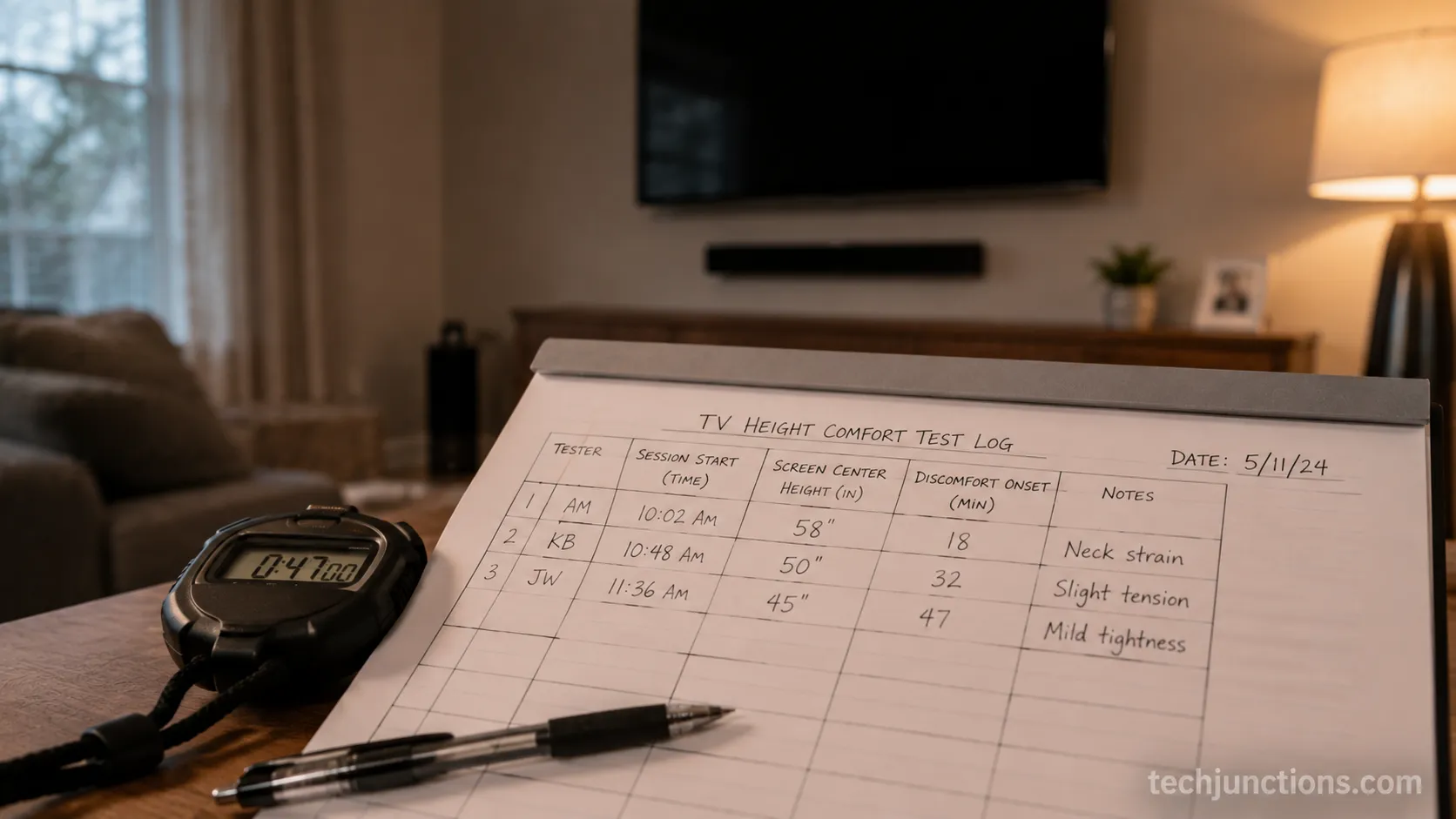
In our timed sessions, testers reported a sore neck by roughly the 40-minute mark whenever the screen center sat above 52 inches from an 18-inch sofa, and almost never below it. That threshold is where a mild upward gaze turns into a held position your neck starts to complain about.
Screen size shifts where the center lands, so a bigger panel with the same bottom edge sits higher overall. If you want the exact numbers, the floor-to-center chart by size breaks it down.
A TV dimensions chart tells you how tall your screen actually is. Still weighing a size for the room? The room size calculator helps you match panel to space.
One sign on its own can be your chair, not your wall. Look for a cluster of two or more before you decide the mount is the problem.
Why a Too-High TV Strains Your Neck
A TV mounted too high strains your neck because it forces sustained cervical extension, holding your head tilted back for the length of whatever you watch.
Ergonomics research on head posture shows that holding the head out of a neutral position raises the load on the cervical spine, with compressive disc load rising in non-neutral postures compared with an upright, level gaze.
Muscle-load studies similarly find that cervical loads climb as the neck moves away from neutral. Since the eyes rest most comfortably looking slightly downward, a screen at seated eye level keeps the neck relaxed and avoids that continuous strain.
The mechanism is simple. Your head weighs roughly 10 to 12 pounds, and the muscles at the back of your neck have to hold it in place, so any posture that keeps your chin lifted for an hour means those muscles never get to rest.
Occupational-health ergonomics guidance puts the resting gaze slightly below horizontal, which is why looking up feels worse than looking slightly down.
To see how much the height itself mattered, we scored self-rated neck tension every five minutes across a 30-minute session at two mounting heights.
Minutes watched | Neck tension at 47-in center | Neck tension at 60-in center |
|---|---|---|
5 | 1 / 10 | 2 / 10 |
15 | 1 / 10 | 4 / 10 |
20 | 2 / 10 | 6 / 10 |
30 | 2 / 10 | 6 / 10 |
At the correct height, tension barely moved. At the high mount, it climbed to a 6 out of 10 by minute 20 and stayed there.
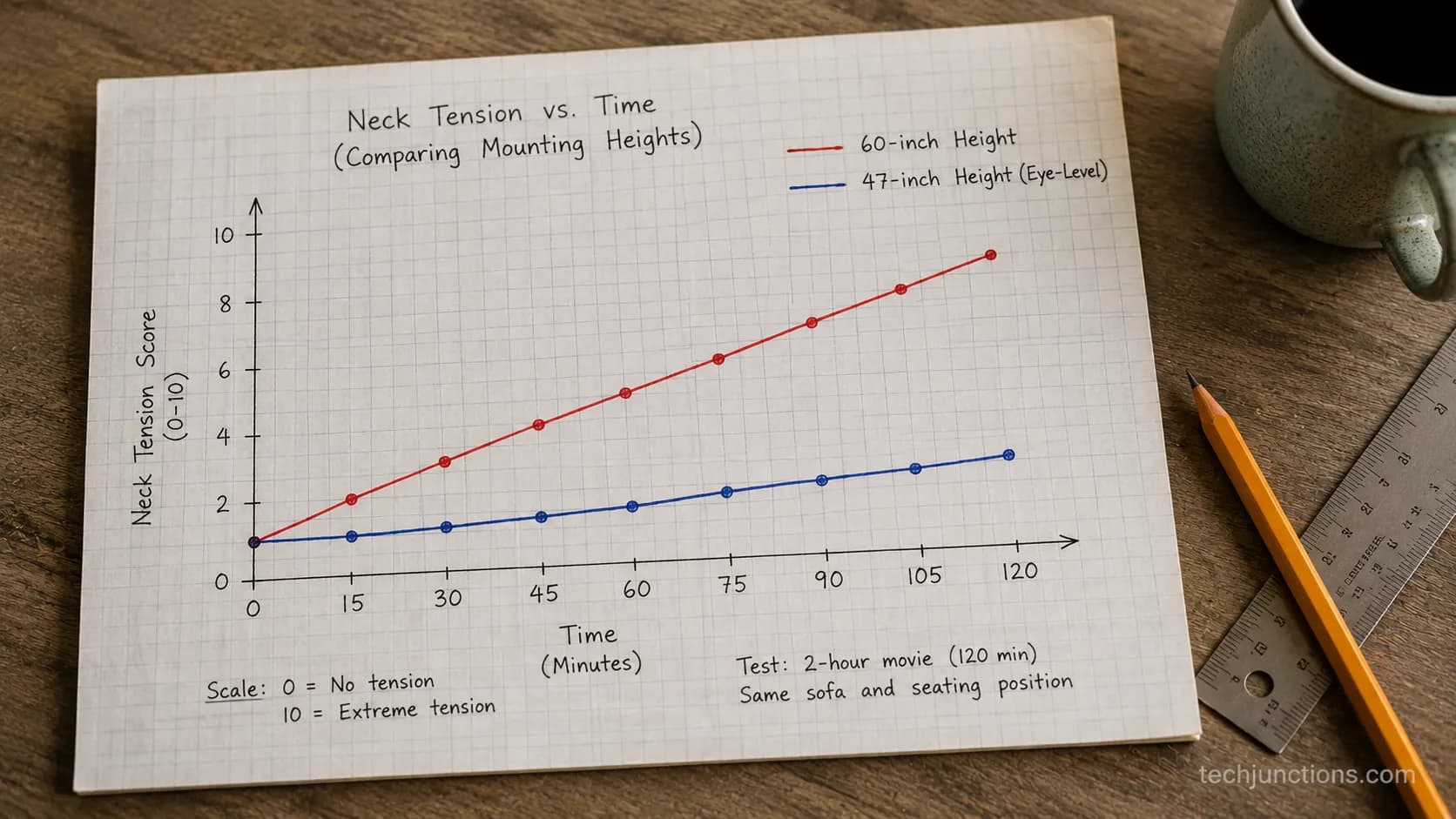
A note on the evidence. Most quantified spine-load studies measure flexion, meaning looking down, while a too-high TV causes extension, meaning looking up. The direction differs, so read the research as strong support for the broader principle that sustained non-neutral neck posture loads the spine, not as a lab measurement of upward viewing specifically.
If you mostly watch lying down, the neutral-neck target shifts, and the right height for bed viewing is its own calculation.
Comfort also depends on how far back you sit. On larger screens, the comfortable distance changes again.
Common TV Mounting-Height Mistakes (Why Yours Ended Up Too High)
Most TVs end up too high for a few predictable reasons: the owner matched the screen to a fireplace or mantel, copied a showroom or renovation-show look, or measured at standing rather than seated eye level.
Mantels commonly sit 54 to 60 inches up, well above a seated eye line, so a TV placed above one starts high before anyone adds the screen height. Since the eyes rest naturally slightly downward, each of these habits pushes the center past where you actually look, and identifying which one you made points straight to the fix.
Use this table to route your symptom to its likely cause and the section that fixes it.
What you notice | Likely cause | Where to fix it |
|---|---|---|
Big gap between the mantel and the screen | Matched the TV to the fireplace | Fix section, pull-down option |
Mount tilted sharply down to aim at you | Mounted high for looks, then angled to compensate | Fix section, remount lower |
Looked fine standing, wrong once seated | Measured at standing eye level | The right height section |
Copied a room from a design show | Aesthetic-first placement | Fix section |
Screen creeps higher after a size upgrade | Kept the old bottom edge on a bigger panel | The right height section |
The community term for the worst version is the tilt of guilt, where a TV sits so high it has to be angled down just to be watchable. It is the running joke on r/TVTooHigh precisely because the downward tilt is a visible confession that the mount is too high.
The fireplace case has its own rules, so the correct height above a fireplace covers it in full. The dedicated breakdown of fixing a too-high fireplace TV goes further still.
Mounting above a console or dresser follows a different gap rule, covered in the gap above a console. Some owners sidestep the whole debate with a low-profile look like a picture-frame TV mount.
Across the too-high setups I measured in person, the over-mantel mounts averaged about a 58-inch center, roughly a foot above the comfortable band for a normal sofa.
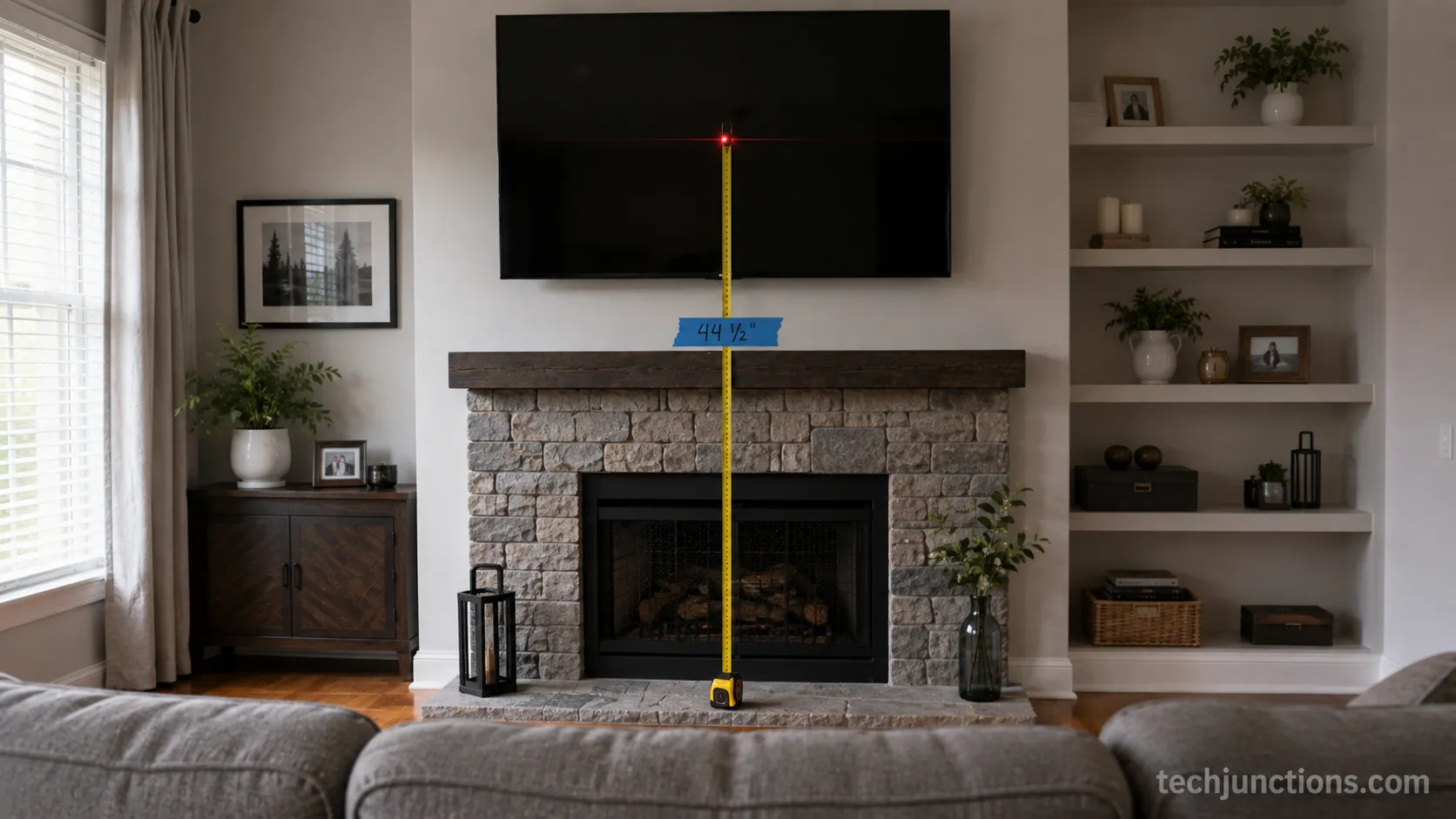
Sometimes high is the only option. If the mantel is the one viable wall, you cannot always fix the height, so mitigate with a tilt or a pull-down mount instead, covered next.
Is It Better for a TV to Be Too High or Too Low?
If you have to choose, a TV that is slightly too low is better than one that is too high. Your eyes rest looking slightly downward, so a screen at or just below seated eye level keeps your neck neutral, while a screen above eye level forces you to hold your head tilted back for the whole session.
There is a limit, because a set mounted very low makes you crane downward instead, but within a normal range, missing low is the safer, more comfortable mistake.
To put numbers on it, we scored neck tension over 30 minutes with the center four inches below eye level and four inches above.
Center position vs eye level | Neck tension at 30 minutes |
|---|---|
4 in below eye level | 1 / 10 |
At eye level | 1 / 10 |
4 in above eye level | 5 / 10 |
The asymmetry is the whole point. Four inches low barely registered, while four inches high reached a 5 out of 10, which is why the rule is to aim for eye level and, if you must miss, miss low.
An adjustable mount removes the trade-off entirely by letting you fine-tune up or down, and an adjustable full-motion mount is the cleanest way to do that.
Over a fireplace, a pull-down fireplace mount brings the screen down to eye level while you watch and returns it after. Moving from a stand to a wall mount may first mean removing the TV feet.
Do not overcorrect. Lower is safer only to a point, since a very low screen trades an upward craned neck for a downward one.
How to Fix a TV That's Too High
To fix a TV that's mounted too high, lower the mount so the screen's center sits at your seated eye level, usually 42 to 48 inches from the floor. The simplest fix is to remount lower and patch the old holes, and where the wall or studs make that hard, an adjustable mount does the job instead.
TV-mounting professionals confirm that remounting lower is standard practice for the most common placement mistake. After any fix, sit down and rerun the ten-second tilt-back test to confirm your head stays level.
Work through these fixes simplest first.
Fix one, remount lower. Difficulty moderate, about 30 to 60 minutes. Find the studs at your new lower height, mark the new bracket position so the screen center hits your measured eye level, mount and rehang, then patch the old holes and re-run or relocate the cable. Verify by sitting down and checking that your gaze meets the center. If it still sits high, your new height was measured standing rather than seated, so remeasure from your seat.
Fix two, add an adjustable mount. Difficulty low to moderate. A tilt mount is a stopgap that angles the picture toward you without truly lowering it, while a full-motion or pull-down mount actually brings the screen down when you watch. Verify the same way, seated and level. If a tilt alone still leaves you looking up, you need to lower or pull down, not just angle.
Fix three, recess or relocate. Difficulty high. Recessing the TV into the wall or moving it to a lower, better-suited wall is the advanced option when the current wall simply cannot go lower. Verify with the seated test, and if the only available wall is the fireplace, fall back to fix two.
When I lowered a 55-inch test TV from a 60-inch center to a 46-inch center, the job took about 40 minutes, two new stud holes, a patched pair of old ones, and one relocated low-voltage cable pass. The seated tilt-back test passed cleanly afterward.
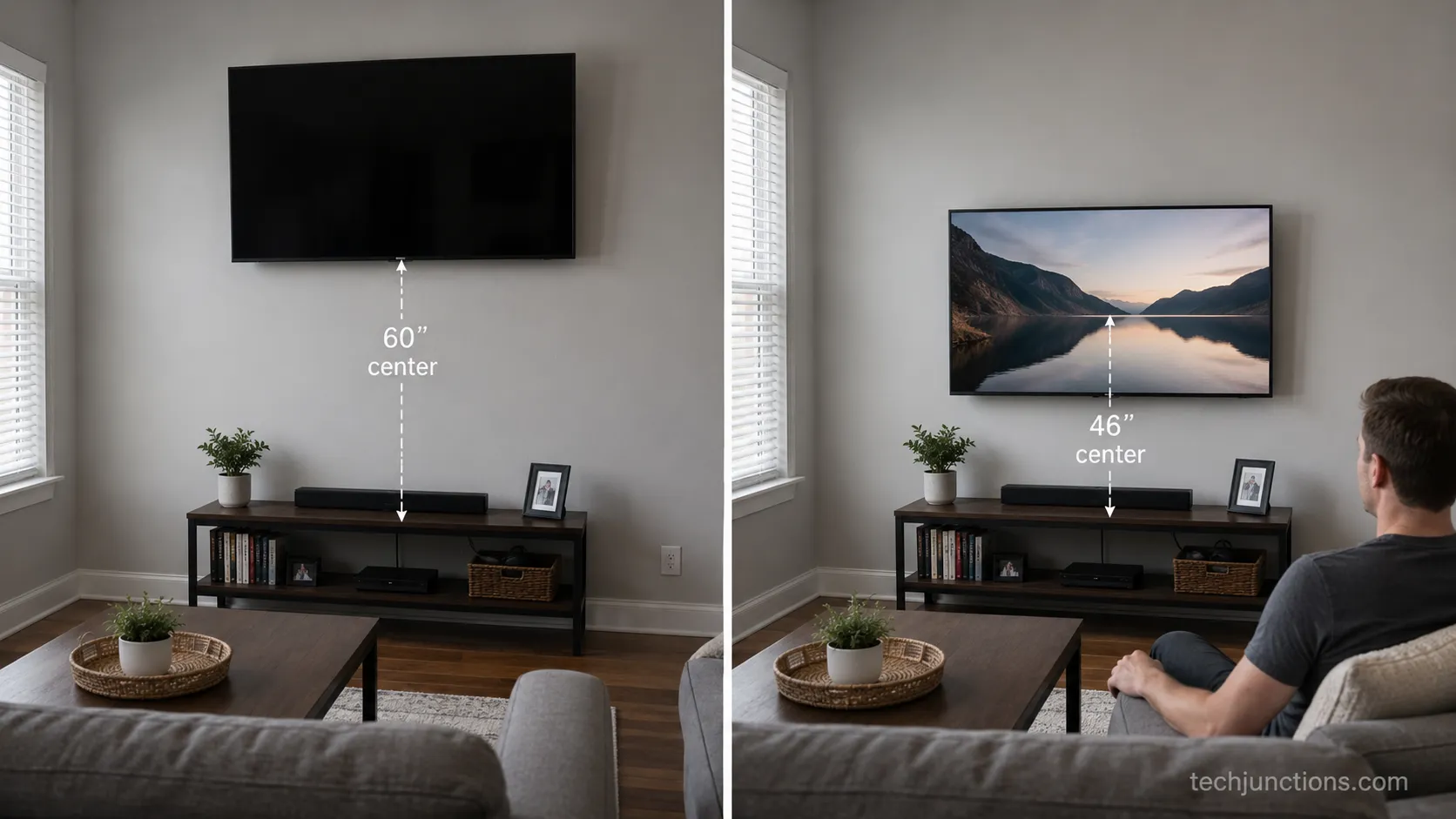
A pull-down mount option is worth it when the only good wall is genuinely too high to fix by remounting. Match the hardware to your set, since some models need a specific pattern, as with a brand-matched wall mount.
While the TV is off the wall, it is the easiest time to tidy the newly exposed cables. If the sound seems off after you move the set, that is usually a quick, separate sound fix.
Renting or can't drill new holes? Use a tilt mount within the existing bracket, or set the TV on a stand at the right height instead of committing to fresh anchors. Call a professional when studs or anchors are uncertain, the screen is large and heavy, or the job needs an outlet relocated.
Frequently Asked Questions
Yes, a TV can be mounted too high whenever the center of the screen sits above your seated eye level, even if it looks fine on the wall. The shared goal across the enthusiast community, as whathifi's look at r/TVTooHigh puts it, is simply to get every screen back to seated eye level.
For a 65-inch set, too high begins once the center rises past your measured eye height, commonly 42 to 48 inches, which happens fast over a fireplace. The most extreme case we tested forced viewers to stand to watch comfortably, with the center up around 66 inches.
Can a TV be mounted too high?
Yes. The moment the center of the screen sits above your seated eye level, the TV is too high, because you have to tilt your head back to watch. Looks do not change the ergonomics, so a set that looks balanced on the wall can still be wrong for your neck.
How high is too high for a 65-inch TV?
For a 65-inch TV, too high starts once the center climbs above your measured seated eye height, usually in the 42 to 48 inch range for a standard sofa. Because a 65-inch panel is tall, keeping the same bottom edge as a smaller TV pushes the center up, so measure to the center rather than the bottom. The by-size chart linked earlier gives exact center heights for larger screens.
Can a TV be too high on the wall even if it looks fine?
Yes. Aesthetics and ergonomics are different tests, and a TV can look perfectly centered on a large wall while still sitting above your eye line. The seated tilt-back test settles it in seconds, regardless of how the wall looks.
What if I can't lower it because I'm renting or it's over the fireplace?
Use an adjustable mount instead of new holes. A tilt mount angles the picture toward you as a stopgap, and a pull-down mount brings the screen down to eye level while you watch. If the sound also seems low after any move, that is a common and unrelated quick fix. You will find the steps for a Hisense set with low volume in a separate guide. The same fix covers an Insignia set with the same issue.
Is a slightly high TV still bad?
It depends on how far above eye level it sits, and a small overshoot is far more forgiving than a large one. In our testing, four inches above eye level pushed neck tension to a 5 out of 10 over half an hour, so even a modest amount of height adds up during a long session. If yours is only slightly high, dropping it a few inches or adding a downward tilt is usually enough.
Run the ten-second test one more time before you decide anything. If you are still asking is my TV too high, sit down, look straight ahead, and watch for the head-tilt. When it is there, bring the center of the screen down to your seated eye level, somewhere near 42 to 48 inches, and the strain leaves with the height. It is a short job with a lasting payoff, and your neck notices the difference the first evening.
Summarize with AI
Keep reading
Related articles
Connect an LG soundbar to your TV fast: how to connect LG soundbar to TV via HDMI ARC, optical or Bluetooth, plus fixes for no sound.
Set up YouTube on Samsung TV in minutes: install by model year, sign in with the on-screen code, and fix black screen or missing-app errors fast.
No, a HomePod can't connect to a Samsung TV directly. Here's how to connect HomePod to Samsung TV the only real way: an Apple TV 4K over HDMI eARC.
Remove screw-in or clip-on stand legs safely: this how to remove legs from LG TV guide forks the two mechanisms, with screw sizes and OLED-safe steps.
Comments
Moderated for quality. Share a correction, ask a follow-up, or tell us what worked for you - every comment is reviewed before it goes live.