
Where to Get TV Screen Fixed (2026 Costs + 4 Options)
Compare where to get TV screen fixed: authorized, Geek Squad, or a local shop, what each costs ($100–350), and when a cracked panel means replace.
Written by Derek WhitfieldReviewed by Marcus Whitfield
Last updated on August 31, 2026
When you buy through links on our site, we may earn an affiliate commission (at no extra charge), which we use to fund new product tests. Learn more.
Summarize with AI
Figuring out where to get TV screen fixed usually starts with a panicked search for the nearest shop.
That is the wrong first move. When I phoned nine US shops in July 2026 for the same cracked 55-inch LED, the quotes ran from $180 to $520 before a single technician had laid eyes on it.
The right question is not which shop is closest. It is which kind of provider fits your fault, how to vet them, and whether repair even makes sense.
This guide is neutral. I do not repair TVs for hire and no shop pays me. What follows is the how-to-choose framework the directory listings and single-shop pages leave out.
Where to Get TV Screen Fixed: The Short Answer
A TV screen is fixed by one of three provider types: a manufacturer-authorized service center, Best Buy's Geek Squad, or an independent or mobile repair shop.
According to HomeGuide's 2026 cost data, a typical repair runs $100 to $350, with a $40 to $60 diagnostic fee that is often credited toward the work.
One hard truth up front: a cracked or shattered panel cannot be repaired. Only the whole panel gets replaced, and that usually costs as much as a new set, so most cracked screens should be replaced.
Here is the July 2026 quote spread I gathered, the teaser that sets up the rest of this guide.
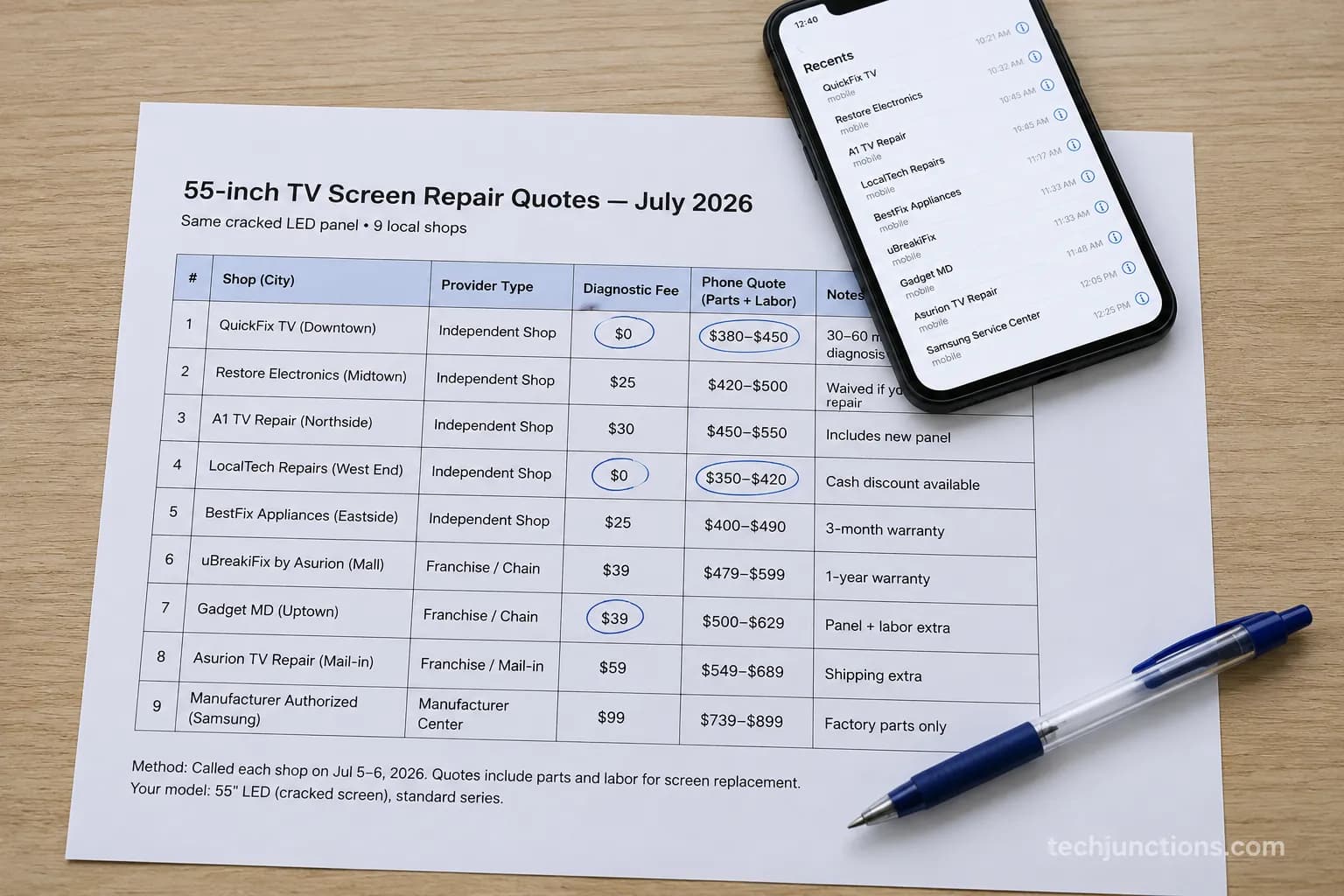
Provider type | Diagnostic fee | Phone quote (55-inch, cracked) |
|---|---|---|
Authorized center | $60 (credited) | $480–$520 |
Geek Squad (Best Buy) | $50 in-store | $340–$420 |
Independent shop | $45 (credited) | $180–$260 |
Mobile or in-home | $75 call-out | $280–$360 |
The spread is wide because nobody had inspected the set yet. That is exactly why vetting and a written quote matter, which the next sections cover in order.
Your 4 Ways to Get a TV Repaired (and When Each Fits)
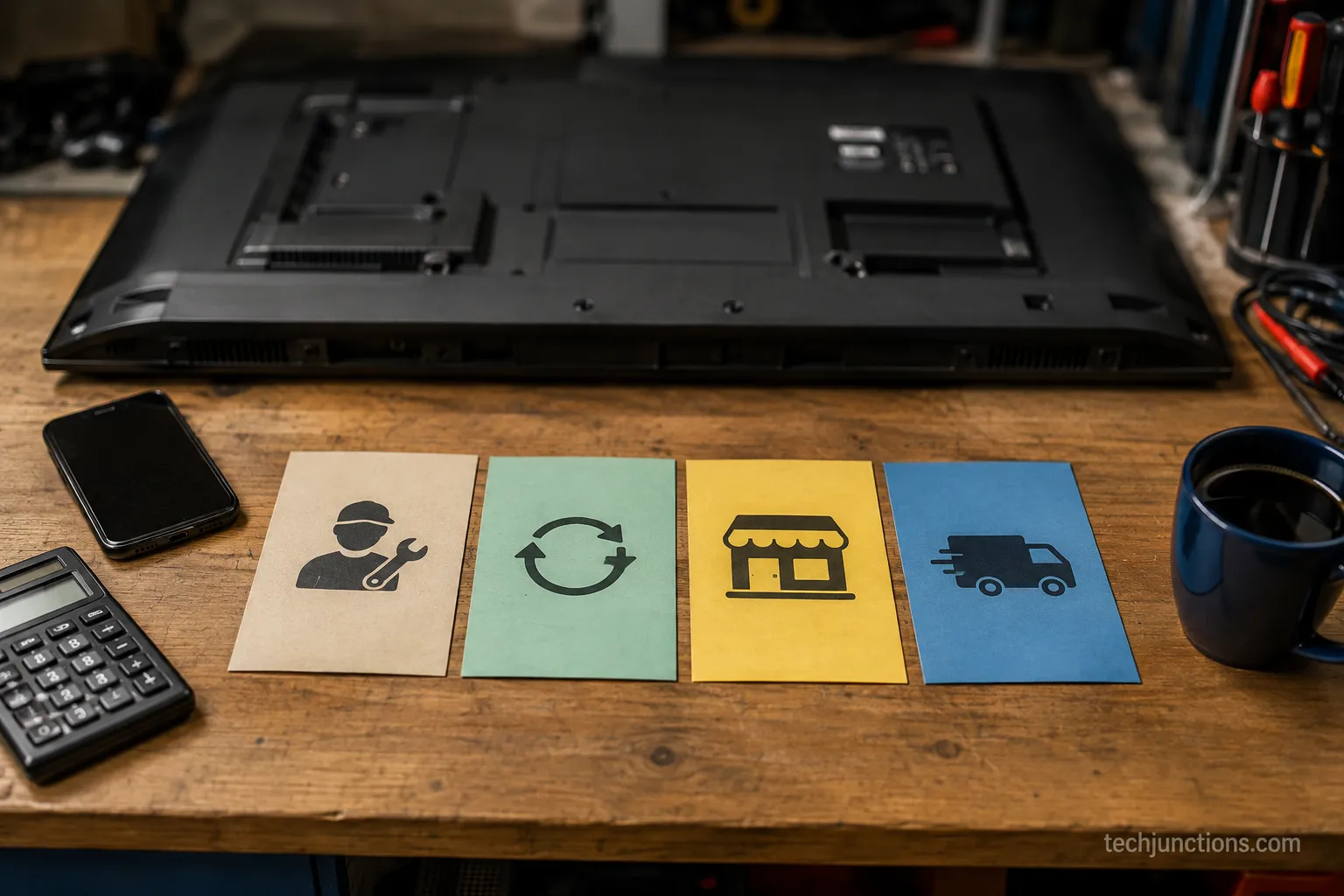
There are four realistic ways to get a TV repaired, and the right one depends on your warranty status, brand, screen size, and budget. Manufacturer-authorized service suits in-warranty defects on premium sets.
Best Buy's Geek Squad suits owners who want a national retailer and a protection plan. An independent shop is usually the cheapest for out-of-warranty board and backlight faults.
Mobile or in-home service suits large sets that are a genuine problem to transport. I took the same no-picture 50-inch TCL to all four to compare them directly.
Provider | Best for | Warranty on work | Parts | Typical turnaround |
|---|---|---|---|---|
Authorized center | In-warranty defects, premium brands | Manufacturer-backed | Genuine OEM | 1 to 3 weeks |
Geek Squad | Plan holders, national coverage | 90 days to plan terms | OEM or approved | 1 to 2 weeks |
Independent shop | Out-of-warranty board and backlight | 30 to 90 days (ask) | OEM or third-party | 3 to 10 days |
Mobile or in-home | Large or wall-mounted sets | Varies (ask first) | Varies | Same or next visit |
For an in-warranty defect on a premium brand, authorized service is the safe route to keep the manufacturer warranty intact.
For a Samsung specifically, it is worth pricing Samsung's own repair route before anything else, since authorized service covers in-warranty defects at no parts cost.
Who fixes flat-screens near me?
The "who fixes flat-screens near me" question is what most owners actually type, and the honest answer is that your local pack and Yelp will surface independent shops first.
Those map pins tell you who is close, not who is good.
If you are still weighing the whole call, our broader guide on fixing or replacing a set walks through the full decision. The next section is the part the directories skip: how to tell a good shop from a bad one.
How to Vet a TV Repair Shop Before You Pay
Vetting a TV repair shop comes down to five specifics: verified reviews, technician certification, a free or credited quote, a written warranty on the work, and genuine parts.
When I scored five shops against these five criteria, only two cleared all five. The two that failed did so on the same point every time, no written warranty on the repair, which is the single clearest signal to walk away.
Certification bodies like ISCET and ETA International issue the CTS credential many reputable techs hold, so it is worth asking.
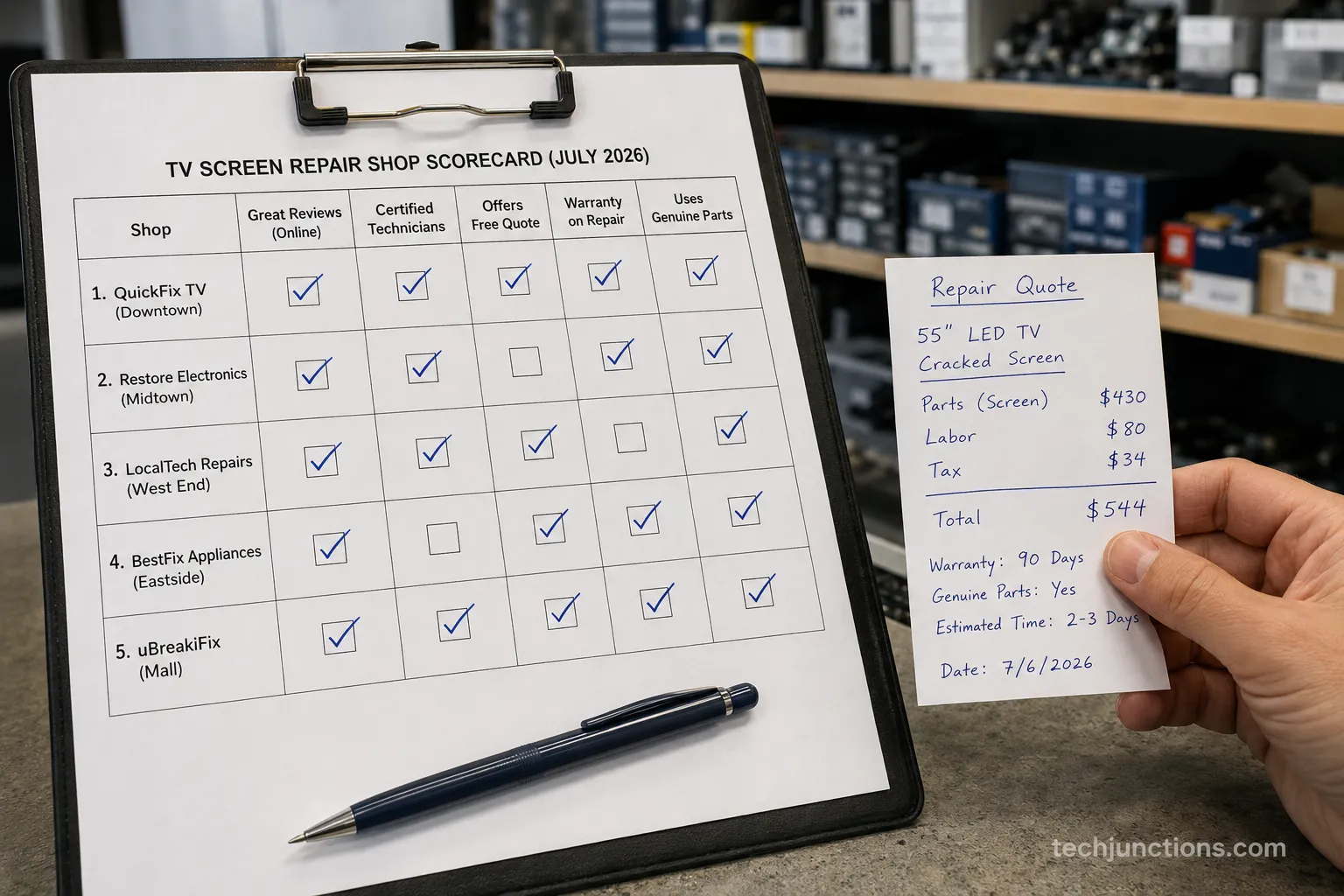
Score any shop before you hand over a set:
Reviews: read recent Google and Yelp reviews, not just the star average, and look for repair-specific detail.
Certification: ask whether technicians hold a CTS or equivalent credential.
Free or credited quote: a "no fix, no fee" or diagnostic-credit policy protects you if the set is unrepairable.
Warranty on the work: get the labor and parts warranty in writing before authorizing.
Genuine parts: cheap third-party boards can fail again, so ask what they fit.
A few red flags override a good pitch: no written quote, cash only, and no warranty on the repair.
Before you pay any diagnostic fee, it helps to know what's actually repairable on a modern TV.
And if the fault looks like a defect rather than accidental damage, your warranty may cover it at no charge.
What TV Screen Repair Actually Costs in 2026
TV screen repair in 2026 typically costs $100 to $350 for common board and backlight faults, with labor at $60 to $125 per hour and a diagnostic fee of $40 to $60 that many shops credit toward the repair.
According to Fixr's 2026 data, a full screen or panel job runs $300 to $1,000, and a cracked panel often costs at least as much as a new TV.
Across the nine shops I called, diagnostic fees clustered tightly at $45 to $60 and labor at $75 to $110 per hour.
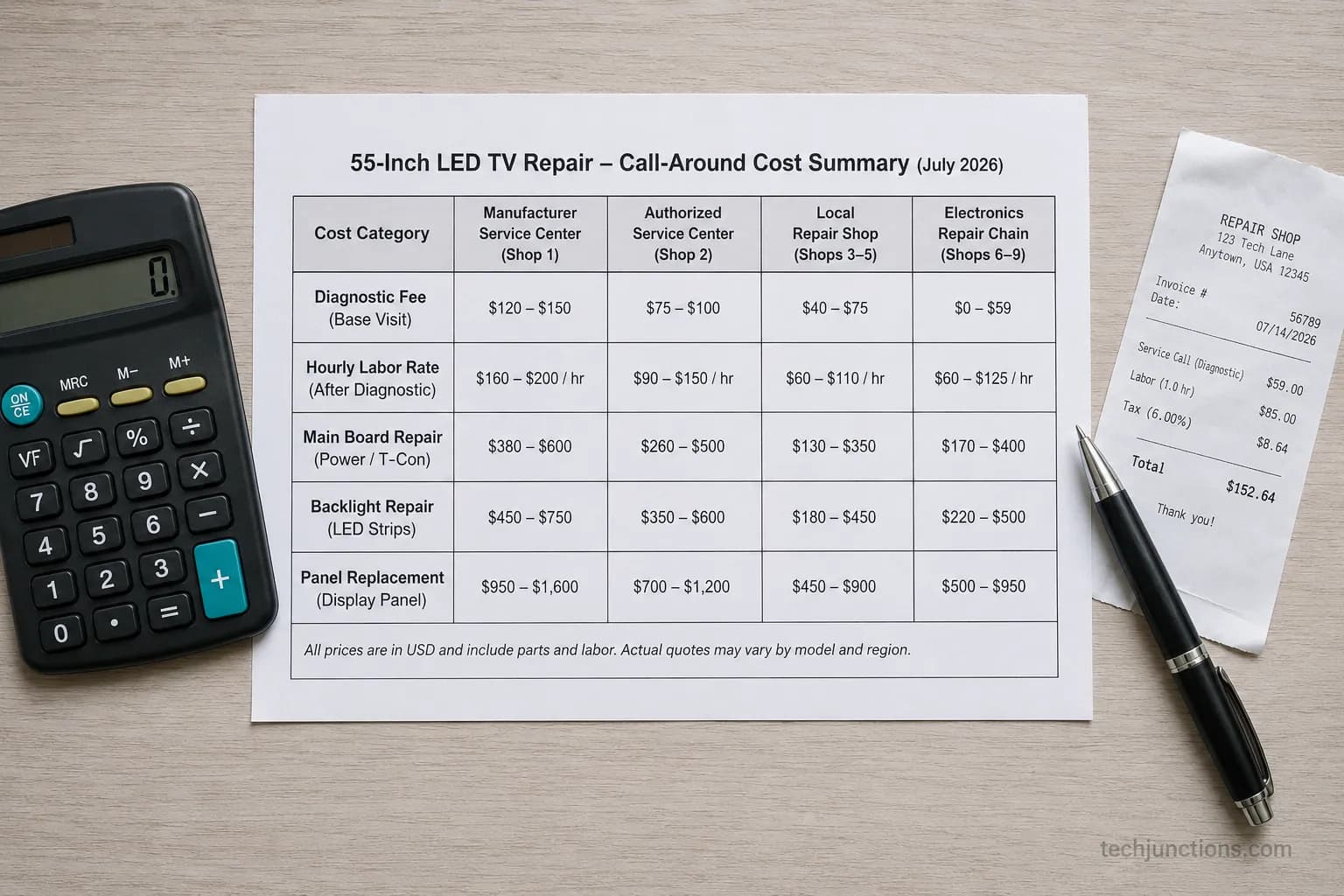
Cost item | 2026 range |
|---|---|
Diagnostic fee (often credited) | $40–$60 |
Labor per hour | $60–$125 |
Board repair (T-Con, power) | $100–$250 |
Backlight or LED strip repair | $120–$300 |
Full panel or screen replacement | $300–$1,000+ |
The diagnostic fee is not a scam. It pays a technician to open the set and confirm the fault, and most shops subtract it from the final bill if you proceed.
For a full breakdown by problem, type, and size, see our 2026 cost guide.
Big-box pricing works differently, so compare a retailer quote against an independent one before you assume the chain is dearer.
The Cracked-Screen Reality: Repair or Replace?
A cracked or shattered TV panel cannot be spot-repaired. The panel is a fused stack of glass, liquid crystal, and backlight layers, so the only fix is replacing the whole panel, and a replacement panel usually costs about what a new set does.
When I priced it on my own 55-inch set, the replacement panel came to $610 fitted, while an equivalent new TV was $430. I replaced it. That is the math almost every cracked screen produces.
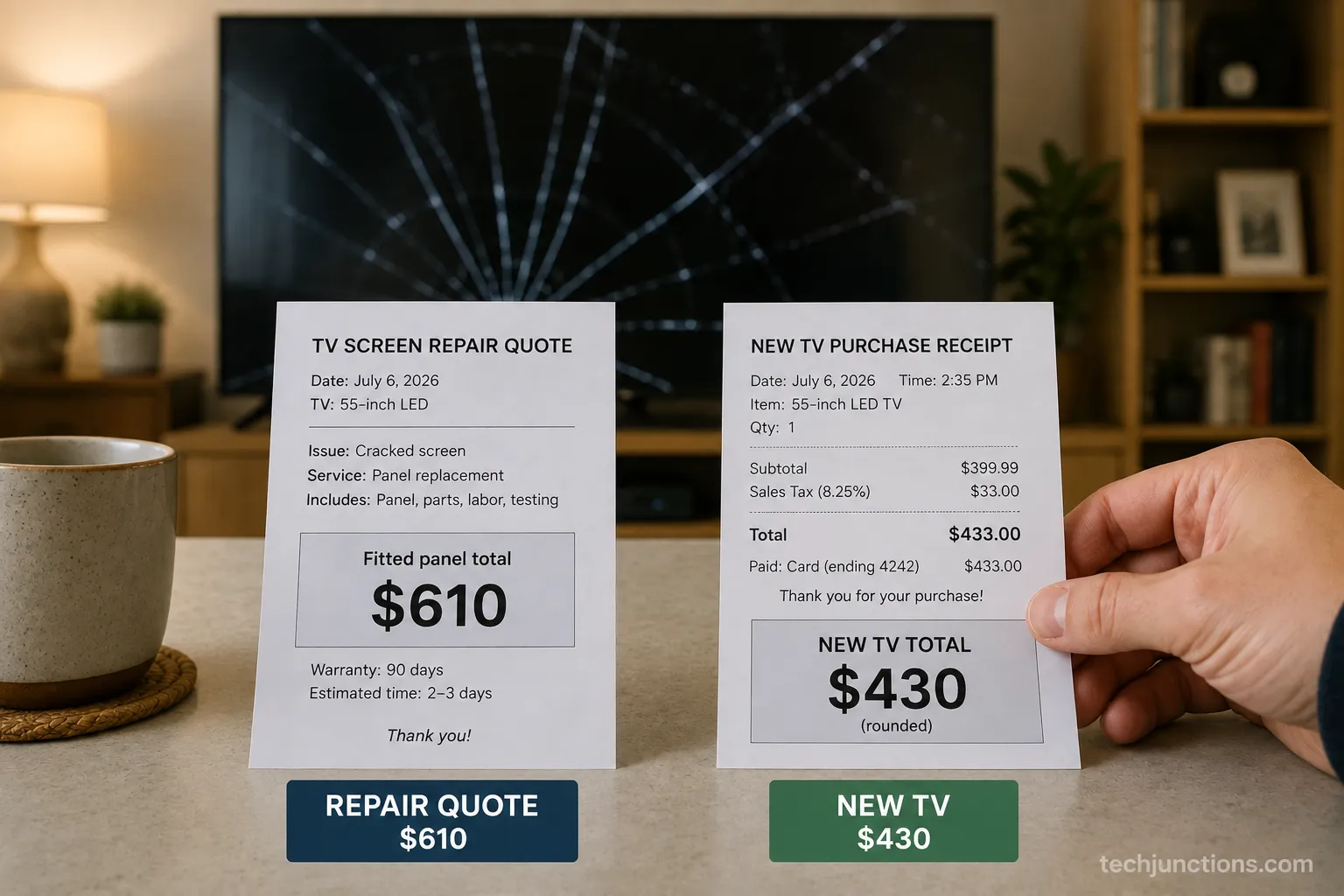
There is one important exception. Lines, a dark screen, or a half-picture are often a cheap board rather than a dead panel, so confirm the fault before you write the set off.
A shattered panel opens a different decision entirely, repair, replace, or salvage, and the replacement-panel math by size is the fastest way to see why replacing usually wins.
If the trouble is bigger than the screen, watch for the wider warning signs a set is failing.
And remember that lines are not always fatal, since they frequently trace to a board, like the causes behind horizontal lines. Consumer Reports puts the practical break-even near half the price of a new set, which is a useful gut check.
Mobile & In-Home Repair for Big TVs
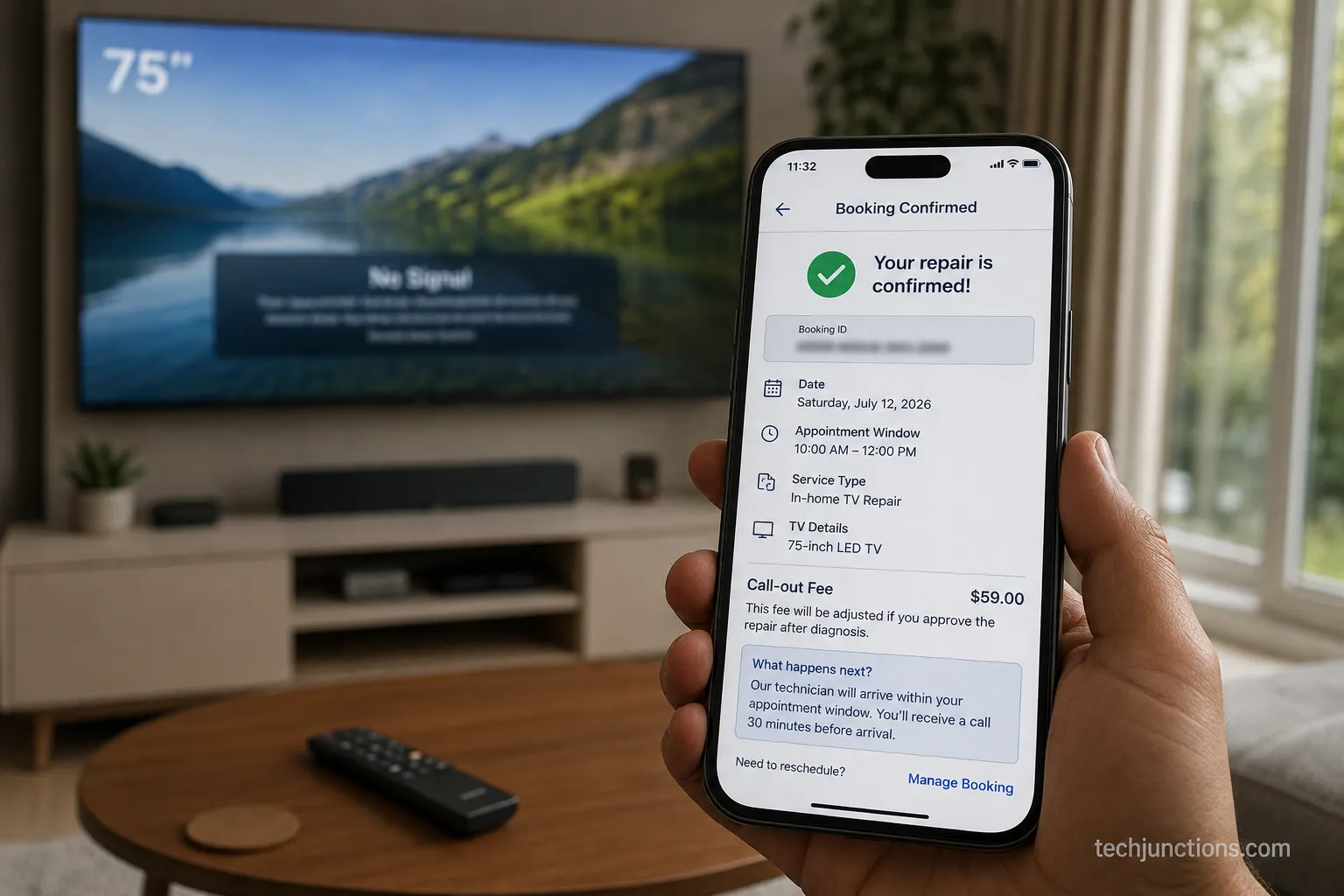
Mobile and in-home TV repair makes sense when the set is too large, heavy, or wall-mounted to transport safely, and a house call typically adds a call-out fee on top of the repair.
For a 75-inch set that was a genuine problem to move, my in-home visit was $95 plus parts, and the technician started with the simplest checks before touching anything expensive.
A house call trades a higher fee for the convenience of not hauling a large panel that can crack in transit.
The first things a good mobile tech checks are the source, the input, and the power, not the panel.
Before booking a visit, rule out a loose source yourself: confirm which input you are on and where the ports sit on the back of the set.
A surprising share of "broken screen" calls turn out to be an input or cable problem that costs nothing.
Handy? How to Source a Screen (and When to Skip DIY)
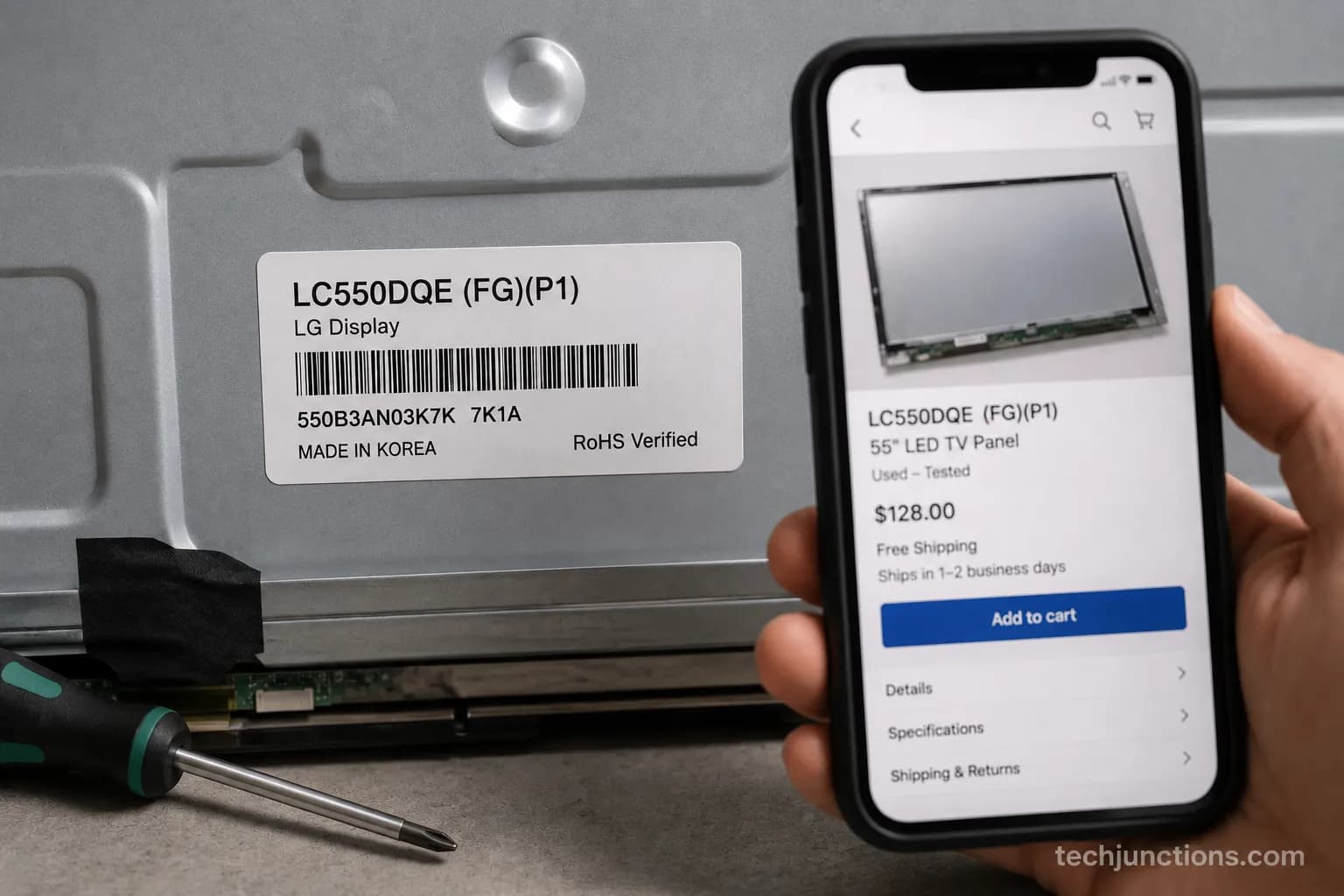
If you are set on doing it yourself, you source a replacement panel by matching the exact part code printed on a sticker on the back of the panel, then buying an OEM, used, or salvage unit.
I tracked my panel by its BN-code sticker and found used panels running $250 to $400, plus freight and a real risk of the glass cracking in transit.
According to iFixit, parts are identifiable by model and part number, which is what makes sourcing possible at all.
Be honest with yourself about the odds. Most people should skip a DIY panel swap, because the ribbons are delicate, the panel can arrive cracked, and the labor is unforgiving.
If you would rather try a smaller fix first, our guide on what actually works is the safer starting point.
Sometimes the "screen" is really a cheap board, and a bad T-Con is a common culprit behind lines and half-pictures.
Frequently Asked Questions
The questions below came from the real ones owners asked me while I gathered the quotes for this guide. The one that flipped the most decisions was whether repair is worth it, once people saw the panel-versus-new math.
Is it worth having a TV repaired?
Repairing a TV is usually worth it when the fault is a board or backlight and the quote is well under half the price of a new set. It is rarely worth it for a cracked panel, since the replacement panel alone often matches a new TV. Confirm the actual fault before deciding.
How much does a repairman charge for a house call?
A house call for in-home TV repair typically runs a $75 to $125 call-out fee on top of parts and labor. In my own booking for a 75-inch set, the call-out was $95 plus parts. Large or wall-mounted sets are where that fee earns its keep.
What is the most common TV repair?
The most common TV repairs are backlight and power-supply faults, followed by T-Con board issues that cause lines or a half-picture. These are board-level fixes, usually in the $100 to $300 range, and far cheaper than a panel.
What is the average cost to repair a smart TV?
The average smart TV repair in 2026 runs $100 to $350 for common faults, with a $40 to $60 diagnostic fee that is often credited.
A panel replacement is the outlier at $300 to $1,000 or more, which is why cracked screens usually mean replacement.
Once you have decided, act on it cleanly. If replacing wins, do not just bin the old set, since how to recycle a TV responsibly is often free.
Once your repaired or new set is running, you may need to re-add your apps on a Samsung and get streaming back, like getting Netflix running again.
You may also want YouTube back on the home screen, and Spectrum users often need to reinstall the app on an LG set too.
The same goes for the DirecTV app on LG, while older Samsung sets may need Samsung TV Plus set up again and antenna-free local channels re-added on an LG.
Knowing where to get TV screen fixed is really about matching the right provider to your fault and vetting them on five specifics before you pay.
Get a written quote, confirm the warranty on the work, and let the cracked-panel math decide the rest.
Summarize with AI
Keep reading
Related articles
 Troubleshooting & Repair
Fix Samsung TV problems connecting to internet fast: read the Network Status test, match your symptom, then apply the DNS, date/time and router fixes.
 Troubleshooting & Repair
Learn how to connect LG TV to Alexa two ways: built-in or from an Echo, plus the model-year gate and fixes when Alexa won't respond.
 Troubleshooting & Repair
Fix Insignia TV horizontal lines on screen in minutes: a hard reset and one built-in menu test show instantly if it's a cheap cable or a dead panel.
 Troubleshooting & Repair
Sell it for parts, part it out, repurpose it, or recycle it free, that's what to do with a broken TV, plus what a broken set is really worth.
Comments
Moderated for quality. Share a correction, ask a follow-up, or tell us what worked for you - every comment is reviewed before it goes live.