
Free? Best Buy TV Recycle Costs, State by State (2026)
Skip the $29.99 myth: Best Buy TV recycle is free in most states (fee only in PA/WI/MI, and refunded). See fees, size limits, haul-away & free options.
Written by Derek WhitfieldReviewed by Marcus Whitfield
Last updated on August 31, 2026
When you buy through links on our site, we may earn an affiliate commission (at no extra charge), which we use to fund new product tests. Learn more.
Summarize with AI
If you searched "best buy tv recycle" bracing for a $29.99 charge, here is the 2026 update that most pages still get wrong: for the majority of Americans, dropping a TV at Best Buy now costs nothing.
The old flat fee survives in only three states, and even there a gift card cancels it out.
I walked a cracked 43-inch set into a store this month and paid zero, then checked the fee line for three different states to be sure.
This guide gives you the current cost by state, what Best Buy will and will not take, the haul-away price for a set too big to carry, and the free alternatives worth considering first.
Best Buy recycles most televisions up to 50 inches at its stores, and in 2026 drop-off is free in most U.S. states.
A $29.99 per-TV fee applies only in Pennsylvania, Wisconsin, and Michigan, and those states hand you a $30 Best Buy gift card that offsets it.
Best-Buy-branded Insignia and Dynex sets up to 50 inches are free everywhere, the limit is two TVs per household per day, and a home haul-away runs $199.99 for up to two large items.
Does Best Buy Recycle TVs? The 30-Second Answer
Best Buy does recycle TVs, and for most people in 2026 it is free.
According to Best Buy's recycling program, stores accept most televisions up to 50 inches, working or broken, with a limit of two TVs per household per day.
The only standing per-TV charge is a $29.99 fee in Pennsylvania, Wisconsin, and Michigan, and each of those states reimburses it with a $30 gift card.
California, Connecticut, and Hawaii have no drop-off fee at all. So the honest answer to "does Best Buy take my old TV" is yes, almost certainly, and almost certainly at no cost.
The reason this trips people up is that the fee used to be the default. Older guides still quote a flat $29.99 for any TV, which was accurate years ago but is now the exception rather than the rule. Below is exactly what you will pay where you live.
Best Buy TV Recycle Fees: What You Actually Pay in 2026
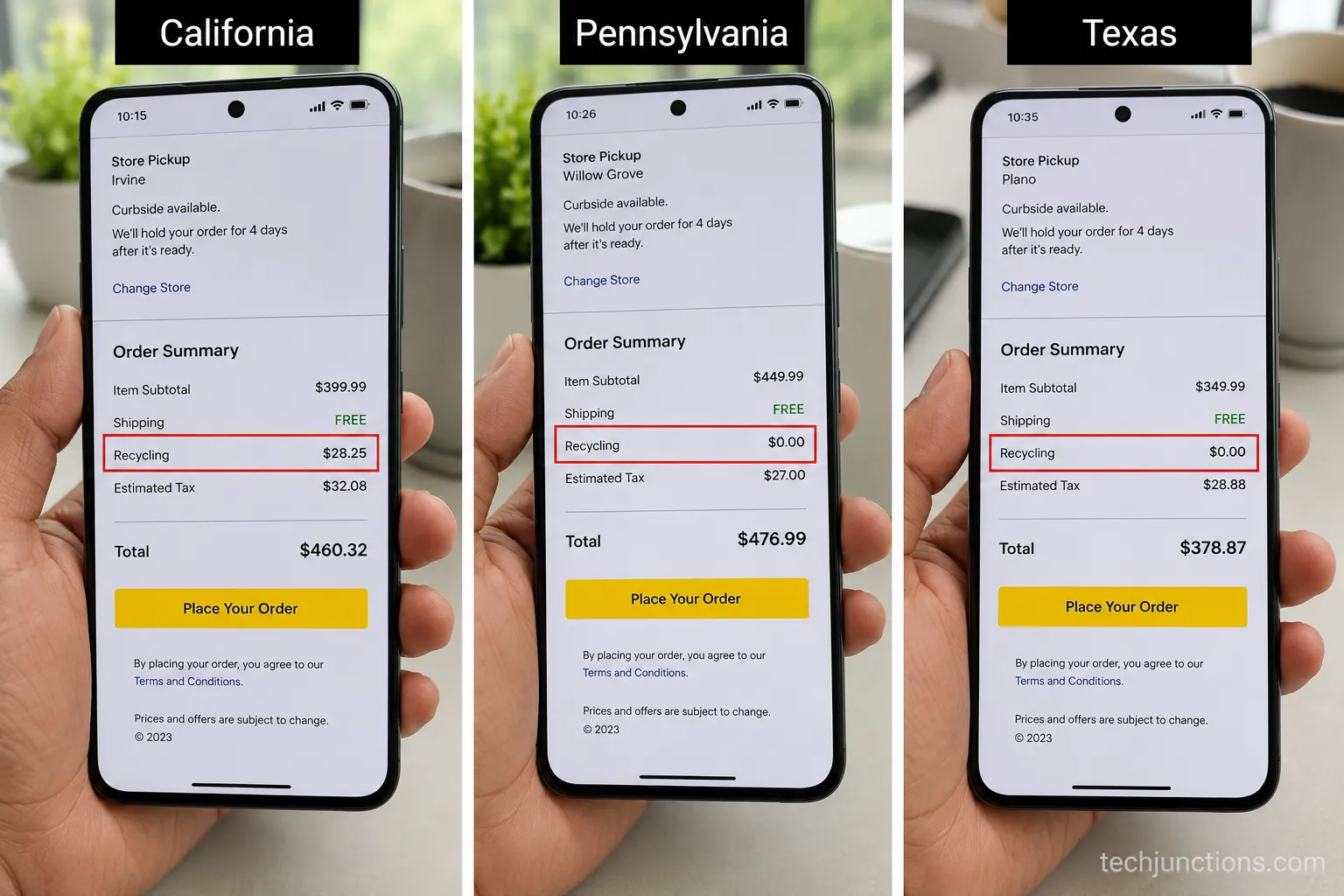
Best Buy TV recycle fees now depend almost entirely on your state, not your TV. Drop-off is free across most of the country for accepted sizes, and the surviving $29.99 charge is limited to Pennsylvania, Wisconsin, and Michigan, where it is offset by a $30 Best Buy gift card.
The Pennsylvania Department of Environmental Protection notes that state e-waste rules govern how retailers can charge, which is why the map looks the way it does.
When I checked the checkout fee line this month, a Pennsylvania store showed the $29.99 charge alongside the matching $30 credit, while a Texas store showed nothing at all.
Here is the current picture. Treat the gift-card offset as an honest catch: it only helps if you actually shop at Best Buy.
Where you live | Drop-off fee (non-branded TV up to 50") | The catch |
|---|---|---|
Most states (TX, NY, IL, WA, and more) | $0, free | Up to 50 inches, two TVs per day |
California, Hawaii | $0, free | State e-waste programs fund it |
Pennsylvania, Wisconsin, Michigan | $29.99 per TV | You get a $30 gift card back, so it nets out free if you shop there |
Connecticut | Non-branded TVs not accepted | CT stores take Insignia and Dynex only |
Insignia or Dynex (any state) | $0, free | Best-Buy-branded sets up to 50 inches |
Heads up: Individual stores set their own prices and policies change without much notice, so call your local store before you load the car.
If your set is only a few years old and the picture problem is minor, it is worth a quick look at what a Geek Squad diagnosis runs before you write it off entirely.
What Best Buy Accepts (and What It Won't Take)
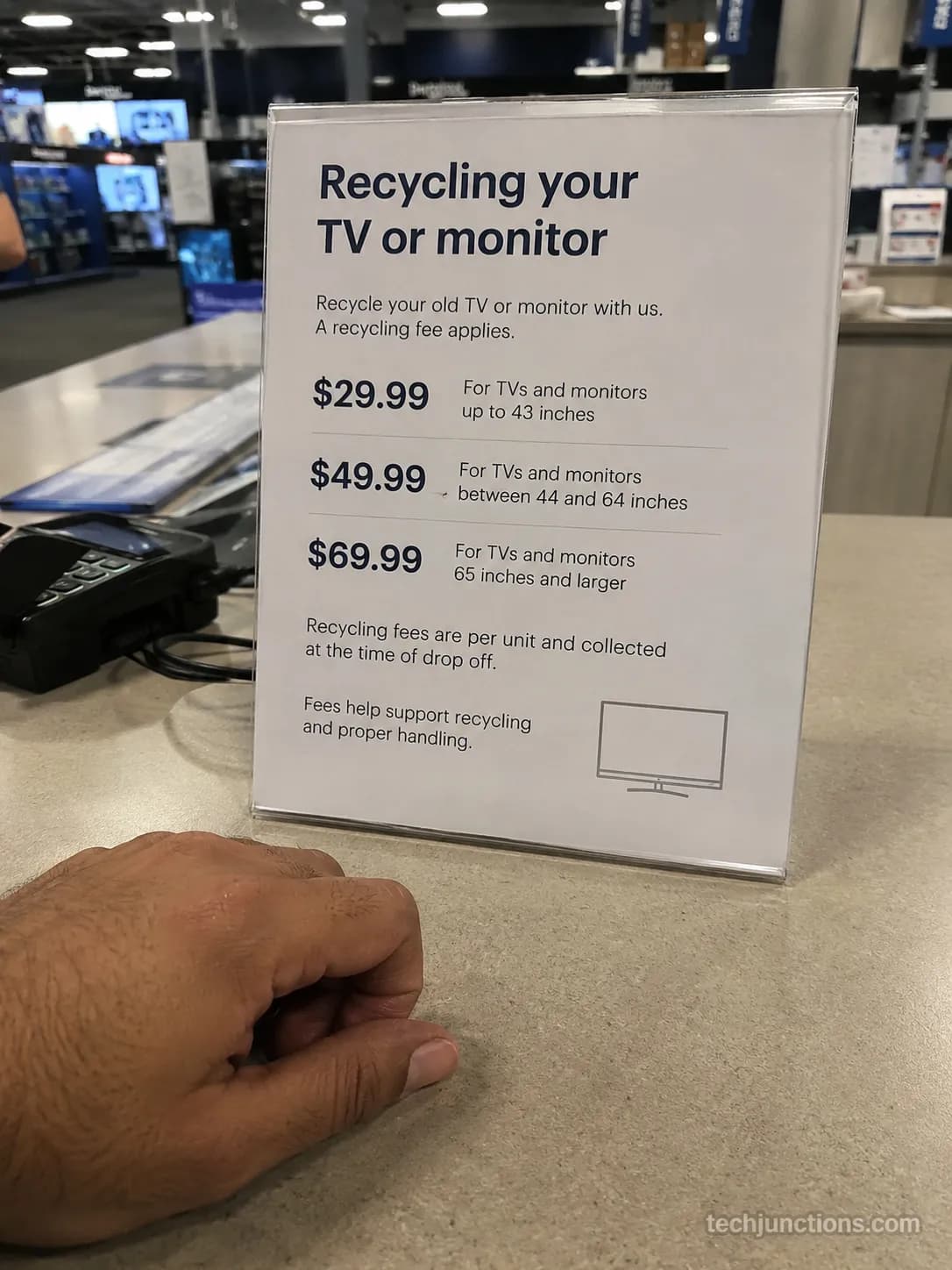
Best Buy accepts most flat-panel televisions up to 50 inches, including LCD, LED, OLED, and plasma, along with older tube TVs within size caps, and it takes them whether they power on or not.
The Best Buy recycling FAQ sets the daily limit at two TVs plus up to three total items per household.
Best-Buy-branded Insignia and Dynex sets are accepted up to 50 inches for free. Anything larger than the size cap has to go through the paid haul-away service instead.
On my August drop-off, the counter took a cracked, non-working 43-inch LED without a second glance but turned away a 55-inch set as over the limit.
Broken is fine because these units are dismantled for materials, not resold, so a dead panel is no barrier.
Category | Accepted at drop-off? | Notes |
|---|---|---|
Flat-panel up to 50" (LCD/LED/OLED/plasma) | Yes | Working or broken |
Tube (CRT) TVs | Yes, within size caps | Heavy, carry upright |
Insignia or Dynex up to 50" | Yes, free everywhere | Best-Buy-branded |
TVs over 50" | No, drop-off | Use haul-away instead |
Commercial or business units | No | Residential program only |
Recalled units | No | Handled through recall channels |
If your set still powers on but the glass is fractured, it is worth a moment on what to do with a cracked screen before you hand it over, since salvage value occasionally beats disposal.
And if it simply looks tired rather than broken, the telltale signs a set is failing can tell you whether recycling is really the right call yet.
Best Buy TV Haul-Away: When It's Worth $199.99
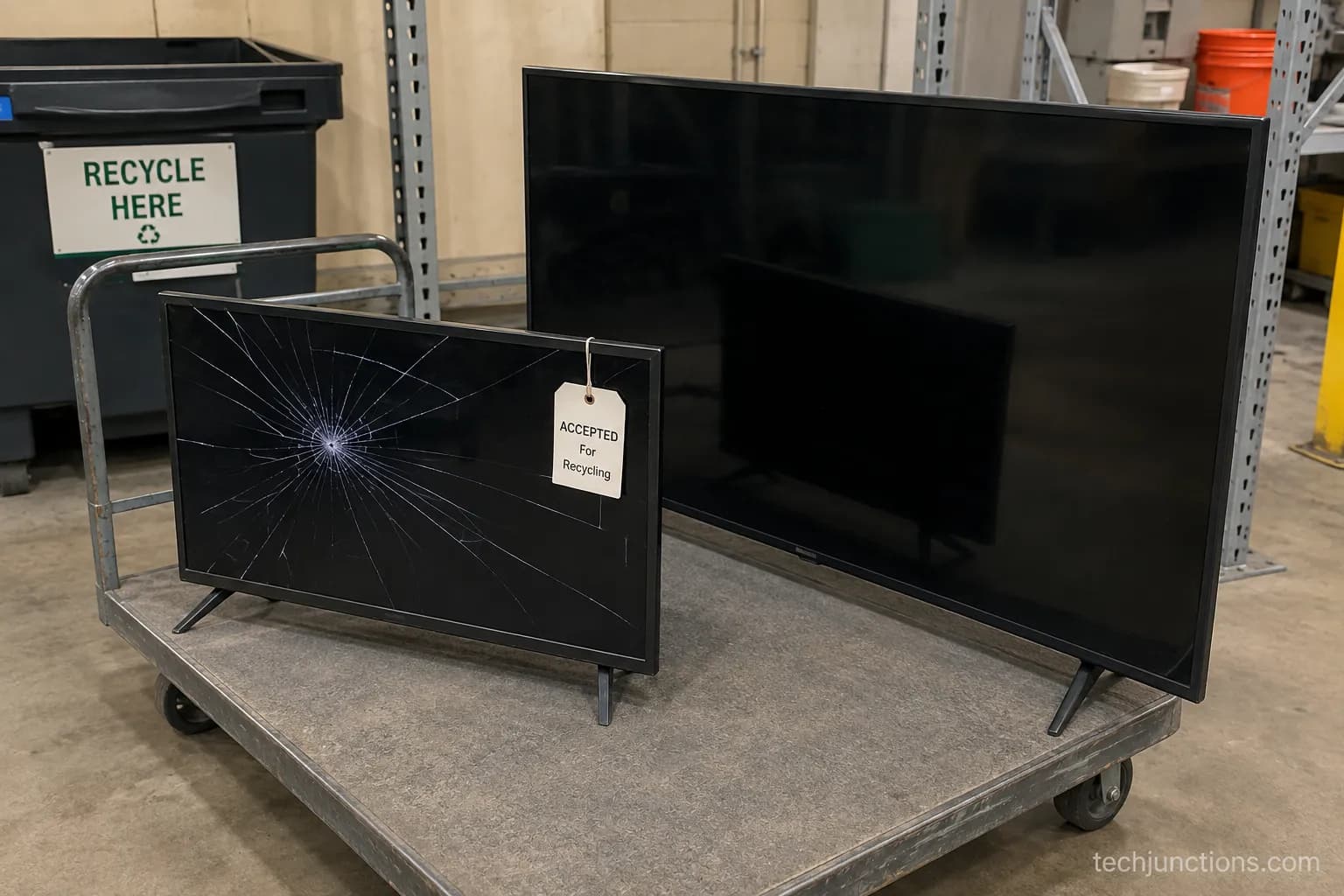
For a television too big or heavy to carry, Best Buy offers haul-away that picks the set up from your home.
The standalone service, with no purchase required, runs $199.99 for up to two large items plus a number of smaller ones.
If you are buying a new TV and having it delivered, the old-set pickup is far cheaper, roughly $49.99 to $59.99 depending on your order, so confirm the exact figure at checkout.
Best Buy's own program lists these prices, and they change without notice, so verify before you book.
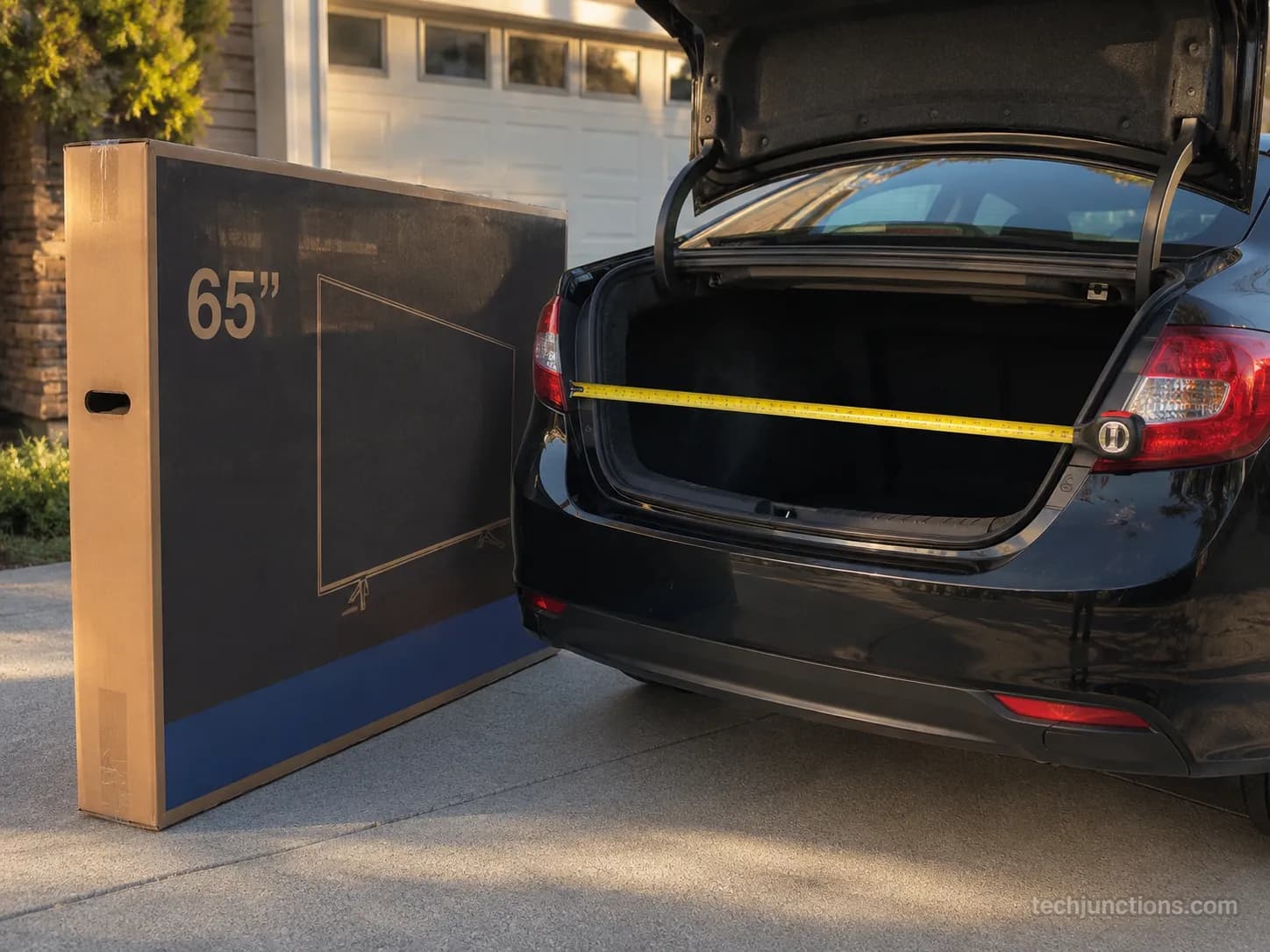
Here is the honest test for whether haul-away earns its price. I measured a boxed 65-inch set against a mid-size sedan trunk this month: it does not fit, and it is a genuine two-person lift.
That is exactly the situation the $199.99 pickup is built for. If you can carry the set yourself, a free drop-off saves you the whole fee.
Service | Price | What it covers |
|---|---|---|
Standalone home haul-away | $199.99 | Up to two large items plus select small items |
Haul-away with a new-TV delivery | About $49.99 to $59.99 | Old set taken when the new one arrives, verify at checkout |
Before you pay to haul a set away, run a quick sanity check on whether the set is worth fixing at all.
For a newer Samsung still inside its coverage window, booking service can beat disposal, and how Samsung's repair service works lays out that path.
How to Recycle Your TV at Best Buy, Step by Step
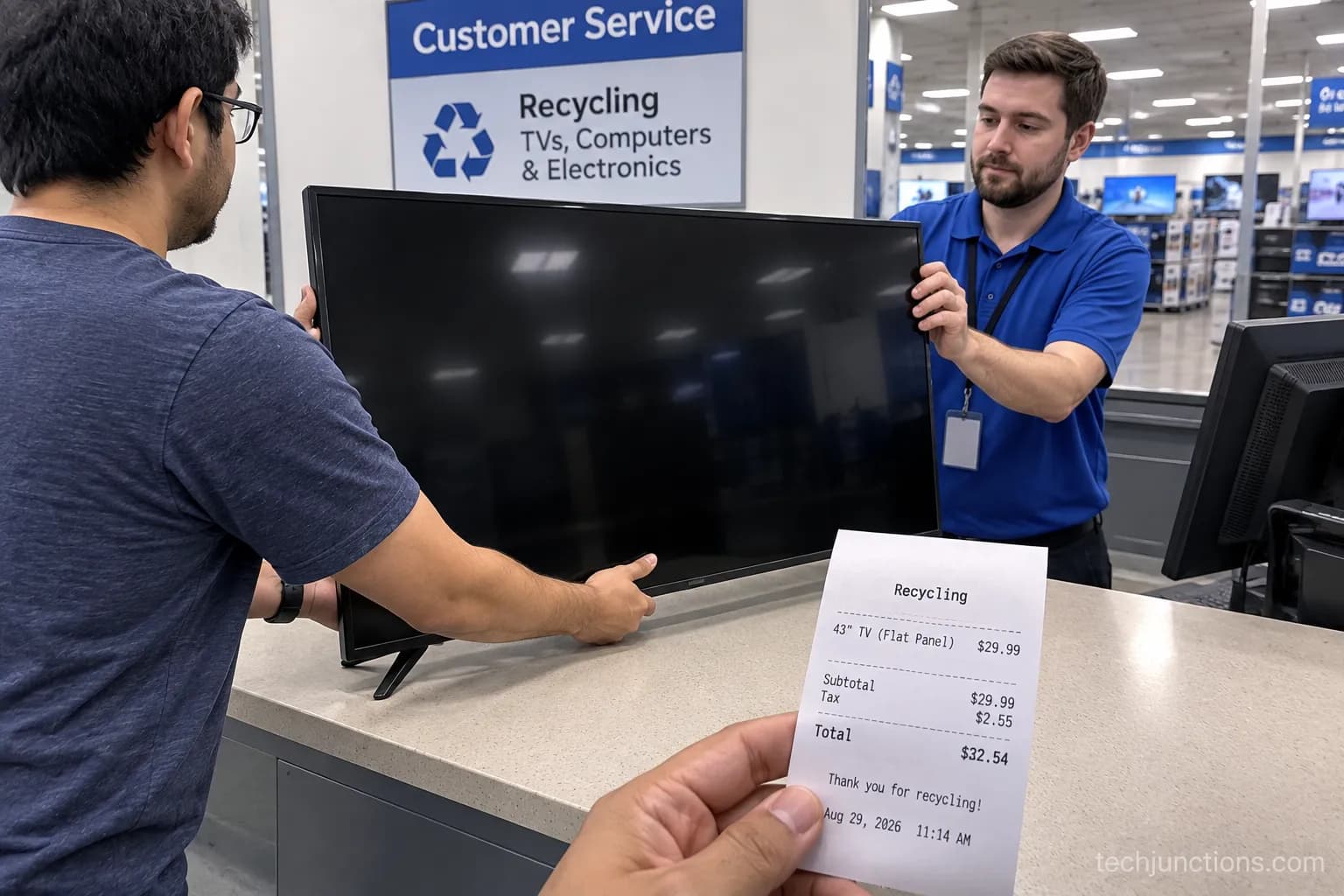
Recycling a TV at Best Buy takes about five minutes once you know the sequence.
According to the EPA's guidance on certified recyclers, Best Buy routes what it collects to processors certified under the R2 or e-Stewards standards, so the how-to matters less than the where-it-goes.
On my August run, I carried a 43-inch LED straight to the customer-service desk, handed it over with no appointment, and was back in the car in under five minutes.
Follow the steps below and you will not need to search again.
Confirm your state rule first. Check whether your ZIP falls in a fee state (PA, WI, MI) or a free one, so there are no surprises at the desk.
Check the size and daily limit. Non-branded sets up to 50 inches qualify, with a cap of two TVs per household per day.
Wipe your data and strip accessories. Sign out of your accounts, factory reset the set, and remove the stand, wall bracket, and cables.
Bring it to the recycling area or customer-service desk. Most stores need no appointment for a drop-off.
Or schedule haul-away if it is oversize. Book the pickup online and keep the confirmation.
If the only real problem is a minor picture glitch, some picture fixes you can try first are simpler than a trip to the recycler.
Faint bands across an LG panel, for example, sometimes trace to what causes lines on an LG screen rather than a dead set.
Where does my TV actually end up?
This is the question I see most in recycling threads, usually phrased as a worry that the set just gets shipped overseas.
Certified recyclers exist precisely to prevent that. The EPA recognizes two certification standards, R2 and e-Stewards, that require responsible material handling and bar improper export, and Best Buy's licensed partners work under them.
Your TV is dismantled so metals, plastics, and glass are recovered and sent to legitimate end markets, not dumped.
Cheaper and Free Alternatives to Best Buy
Best Buy is convenient, but it is rarely your only free option, and sometimes not the best one.
The EPA's electronics donation and recycling hub points you toward responsible options first.
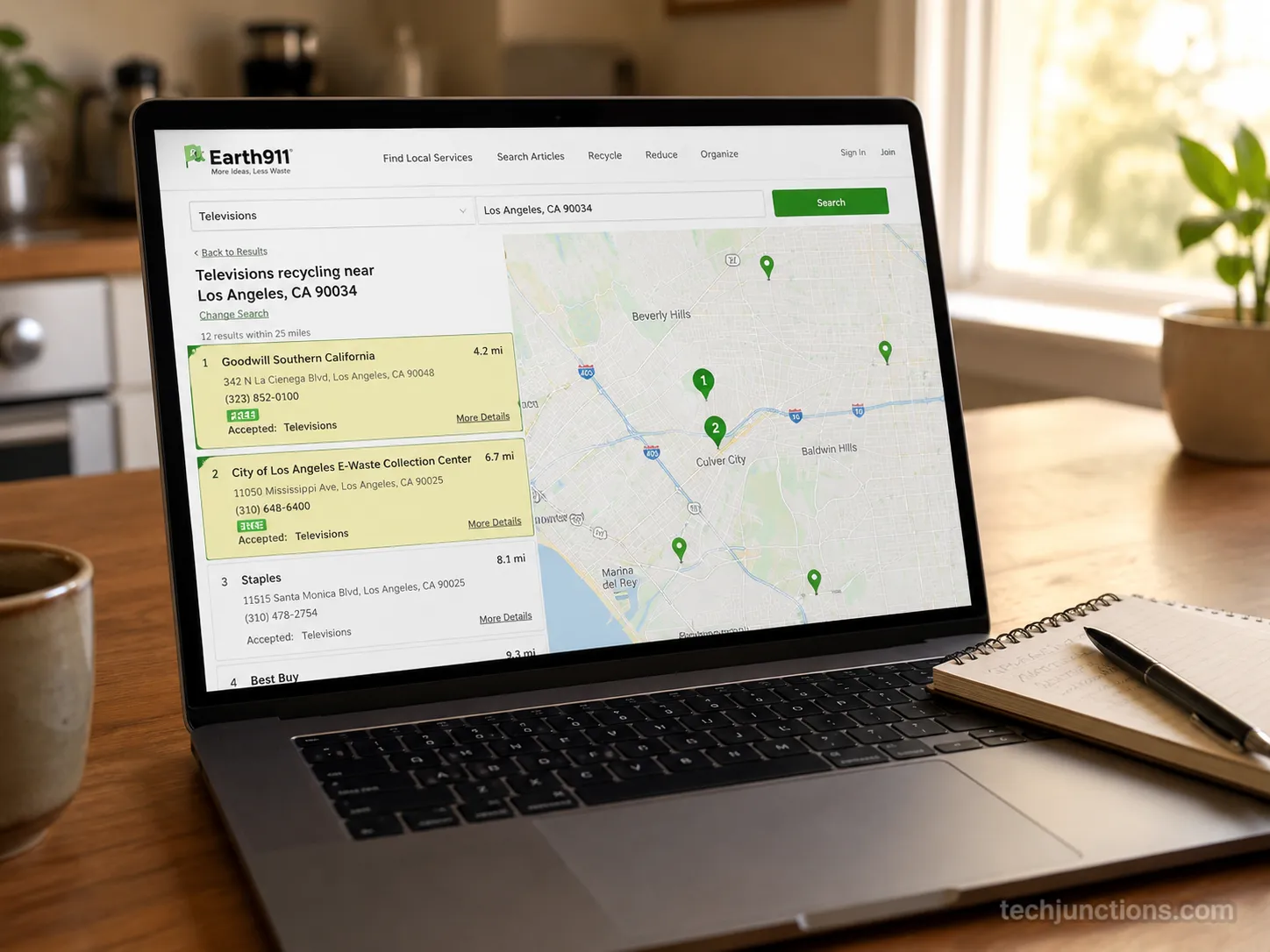
A locator like Earth911's recycling search then surfaces certified drop-off sites near you, many run by your county or state at no charge.
When I ran one sample ZIP through both tools this month, two free drop-off sites turned up within twelve miles, no fee and no purchase required.
The trade-off is convenience: municipal events are free but infrequent, and locations rotate.
Here is how the main routes compare, and our full recycling playbook covers each in depth.
Route | Typical cost | Best when |
|---|---|---|
Best Buy drop-off | Free in most states | You want it gone today |
County or city e-waste event | Free | You can wait for the next scheduled date |
State e-waste program site | Free | You live in one of the 25-plus states with a law |
Certified R2 or e-Stewards recycler | Free to low | You want documented, responsible handling |
Manufacturer take-back (LG, Samsung, Sony, Vizio) | Free for their brands | Your set matches the brand program |
One honest note for the "just wait for the free recycling event" crowd: that is genuinely the cheapest path, but you are trading weeks of storage for the savings.
Staples and Office Depot, worth ruling out early, do not take televisions at all.
If you are only recycling because the set is beyond saving, it helps to weigh disposal against what a repair typically costs.
For a dead panel specifically, what a replacement panel costs usually settles the decision fast.
When a new set is already on the way, that delivery is also the moment to have the old one hauled off, and a good time to get the replacement looking right.
It is worth a few minutes on dialing in a new Samsung's picture. If you are still shopping instead, it pays to see which LG QNED sets lead the current lineup.
On a new LG in particular, the LG mode worth knowing about is one setting most owners never touch.
Before You Recycle: Wipe Your Data and Prep the TV
A modern smart TV is an account-linked device, so wiping it before recycling matters as much as it does for a phone.
The EPA's recycling guidance advises erasing personal data and removing accounts before you hand off any electronics.
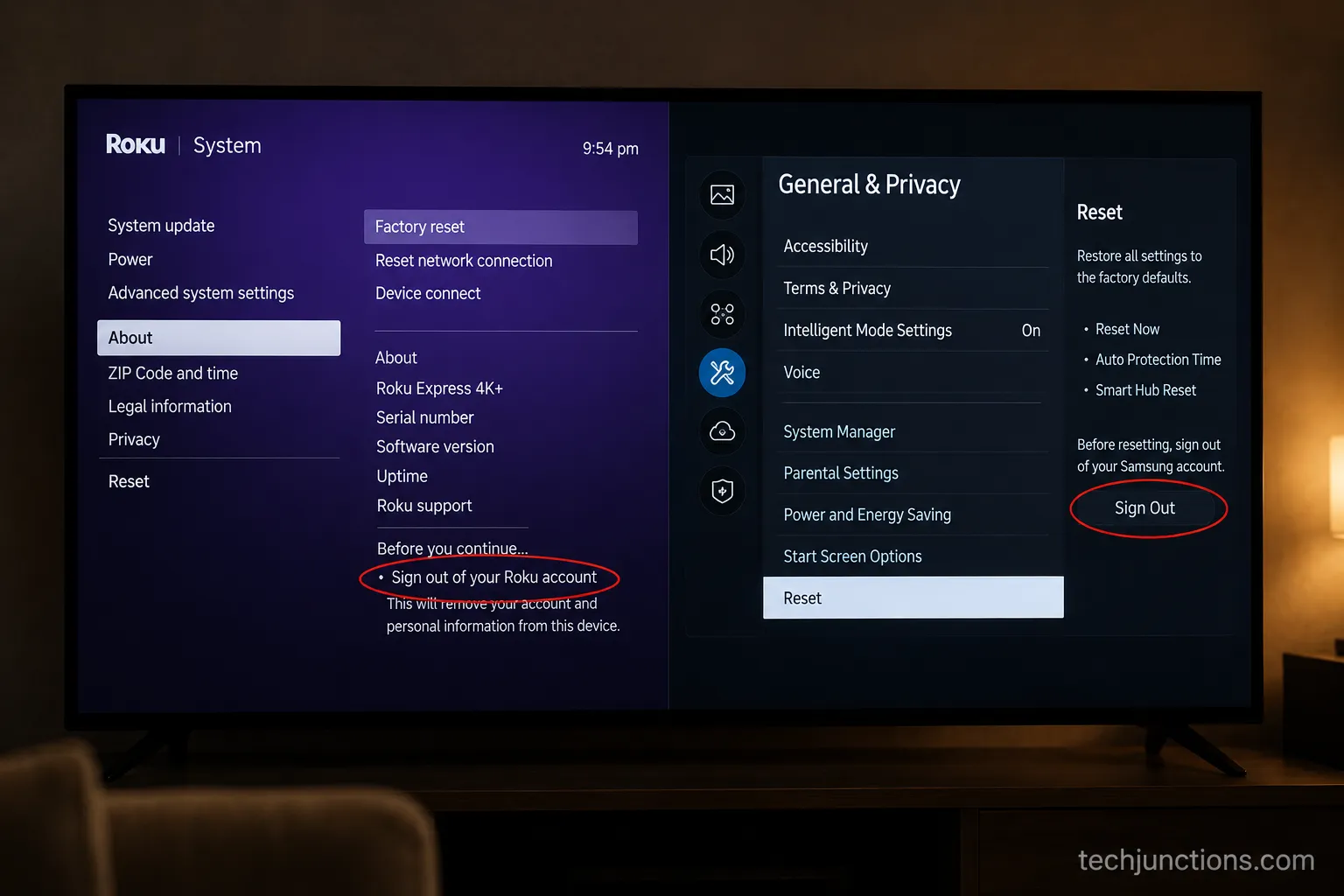
When I reset a Roku TV and a Samsung Tizen set this month, the Samsung held onto a linked account until I signed out first, a step the factory reset alone did not clear.
Do these five things before drop-off.
Sign out of streaming and smart-home accounts on the set.
Run a factory reset (usually Settings, then General, then Reset).
Remove the wall bracket, stand, and cables, and recycle cables separately.
For a tube TV, carry it upright so the leaded glass tube stays intact.
Optionally, photograph the set before drop-off for your own records.
Heads up: Reset menus differ by brand and model year, so check your manual if the path does not match.
And if the set shows sound but no picture, do not wipe and recycle yet, because that symptom is often a common board that mimics death rather than a dead TV.
Frequently Asked Questions
Best Buy TV recycling raises the same handful of questions again and again, and the answers below reflect the program as it stands in August 2026.
Policies vary by store and change over time, so treat these as your starting point and confirm locally.
Does Best Buy recycle TVs for free?
In most states, yes. Drop-off is free for accepted sizes across the majority of the country, including California and Hawaii. The exceptions are Pennsylvania, Wisconsin, and Michigan, where a $29.99 per-TV fee applies but is offset by a $30 Best Buy gift card. Best-Buy-branded Insignia and Dynex sets up to 50 inches are free everywhere.
Does Best Buy take my old TV if it's broken?
Yes. Best Buy accepts televisions whether they power on or not, because recycling recovers materials rather than reselling the set. A cracked screen, a dead backlight, or a set that will not turn on are all fine, as long as the size falls within the drop-off limits.
How many TVs can I recycle per day?
Two. The program caps drop-off at two televisions per household per day, within a broader limit of three total items per household per day. If you have more, plan a second trip or book a haul-away for the overflow.
Is there Best Buy TV recycling near me?
Almost certainly, since the program runs at stores nationwide. Use the store locator on Best Buy's site to confirm your nearest location and its current rules, and if a free county e-waste event is coming up, that is often the cheaper route.
What's the difference between trade-in and recycling?
They are two separate programs, which is where the gift-card confusion starts. Trade-in gives you value for a working, in-demand device, while recycling is for end-of-life gear and generally does not pay you. A broken TV goes to recycling, not trade-in.
Does Best Buy recycle TVs over 50 inches?
Not at the drop-off counter. Sets larger than 50 inches exceed the in-store size limit and must go through the home haul-away service instead, which runs $199.99 standalone or less when bundled with a new-TV delivery. If your set is still young and might be worth a warranty claim, check that before you pay to dispose of it.
The Bottom Line
The short version is the one worth remembering: for most people in 2026, a best buy tv recycle trip costs nothing, and the old $29.99 fee now survives in just three states where a gift card cancels it anyway.
Confirm your state, keep the set under 50 inches and to two per day, and you can hand off a working or broken TV in about five minutes.
If it is too big to carry, weigh the $199.99 haul-away against a free municipal e-waste day, and if the set might still be fixable, price that out before you let it go.
Do that, and disposing of an old television becomes a quick, free, and genuinely responsible errand rather than a surprise charge.
Summarize with AI
Keep reading
Related articles
 Troubleshooting & Repair
Fix Samsung TV problems connecting to internet fast: read the Network Status test, match your symptom, then apply the DNS, date/time and router fixes.
 Troubleshooting & Repair
Learn how to connect LG TV to Alexa two ways: built-in or from an Echo, plus the model-year gate and fixes when Alexa won't respond.
 Troubleshooting & Repair
Fix Insignia TV horizontal lines on screen in minutes: a hard reset and one built-in menu test show instantly if it's a cheap cable or a dead panel.
 Troubleshooting & Repair
Sell it for parts, part it out, repurpose it, or recycle it free, that's what to do with a broken TV, plus what a broken set is really worth.
Comments
Moderated for quality. Share a correction, ask a follow-up, or tell us what worked for you - every comment is reviewed before it goes live.